
Remote SIM Provisioning Market Report Scope & Overview:
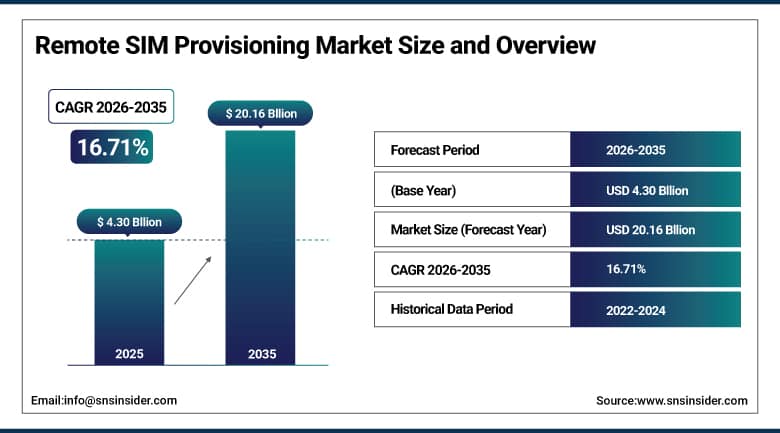
The Remote SIM Provisioning Market size was valued at USD 4.30 Billion in 2025 and is projected to reach USD 20.16 Billion by 2035, expanding at a CAGR of 16.71% during the forecast period 2026–2035.
The RSP market has experienced significant growth due to increased adoption of eSIM technology, proliferation of connected devices, and the need for secured and remote connectivity management within telecom, automotive, consumer electronics, and IoT ecosystems. With RSP, mobile network operators, enterprises, and OEMs have the ability to activate, update, swap, and manage the identities of subscribers without needing to replace their SIM cards. This technology helps in lowering the cost of operation, improving the customer experience, making device lifecycle management simpler and fasten the deployment of connected devices in many industries. The evolution of GSMA standardization of eSIM, cloud-native subscription management, cyber security, and 5G connectivity is further boosting the market growth worldwide.
From 2025-2026, several leading connectivity solution providers broadened their RSP offerings with the addition of cloud-native subscription management, artificial intelligence-driven lifecycle management, security, and multi-operator eSIM orchestration platforms enabling large-scale IoT deployment.
To Get More Information On Remote SIM Provisioning Market - Request Free Sample Report
Remote SIM Provisioning Market Trends:
-
Increasing global adoption of eSIM technology across smartphones, wearables, connected vehicles, industrial IoT devices, and enterprise mobility solutions.
-
Rising deployment of 5G-enabled connected devices requiring secure remote SIM lifecycle management and over-the-air subscription provisioning.
-
Growing investments in cloud-native subscription management platforms supporting scalable, automated, and multi-operator eSIM provisioning.
-
Expanding implementation of IoT connectivity management platforms across automotive, manufacturing, logistics, healthcare, and smart city applications.
-
Increasing focus on cyber security, digital identity management, GSMA compliance, and secure remote authentication for connected device ecosystems.
U.S. Remote SIM Provisioning Market Size Outlook:
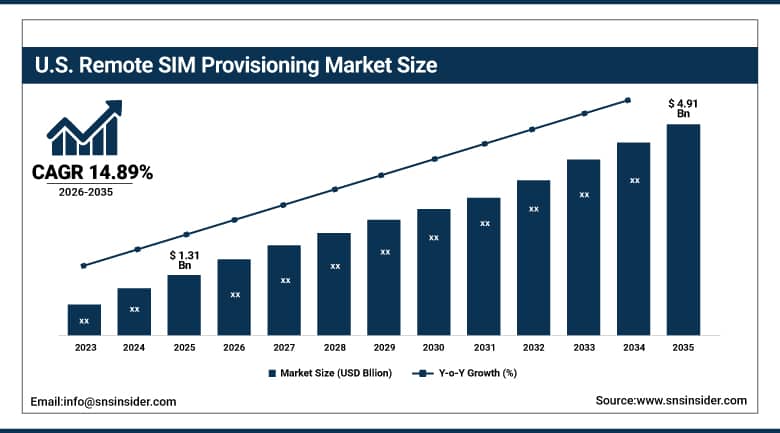
The U.S. Remote SIM Provisioning Market was valued at USD 1.31 billion in 2025 and is expected to reach approximately USD 4.91 billion by 2035, expanding at a CAGR of 14.89% during 2026–2035.
The U.S. continues to be one of the largest markets for remote SIM provisioning due to the use of connected consumer devices, the development of 5G infrastructure, digital transformation of enterprises, and rapid adoption of IoT solutions. The increasing adoption of remote SIM provisioning solutions by mobile network providers, car manufacturers, consumer electronics providers, and industrial organizations is attributed to easier management of subscribers, flexibility, and reduction in logistics associated with physical SIM cards. The rapid growth in the number of connected cars, smart manufacturing, enterprise mobility, and cloud connectivity solutions has contributed to this trend.
In the year 2026, several telecom and connectivity technology firms based in the United States broadened their eSIM management offerings through advanced subscription management platforms that enable AI-powered provisioning, cyber security, cloud orchestration, and multi-network connectivity.
Remote SIM Provisioning Market Segment Analysis:
-
By Component, subscription management platforms dominated the market with 34.00% share in 2025 and are projected to witness the fastest growth with a CAGR of 17.70% during the forecast period.
-
By Deployment, cloud dominated the market with 56.00% share in 2025, while hybrid is projected to witness the fastest growth with a CAGR of 18.54% during the forecast period.
-
By Application, consumer electronics dominated the market with 36.00% share in 2025, whereas industrial IoT is expected to register the fastest CAGR of 18.81% during the forecast period.
-
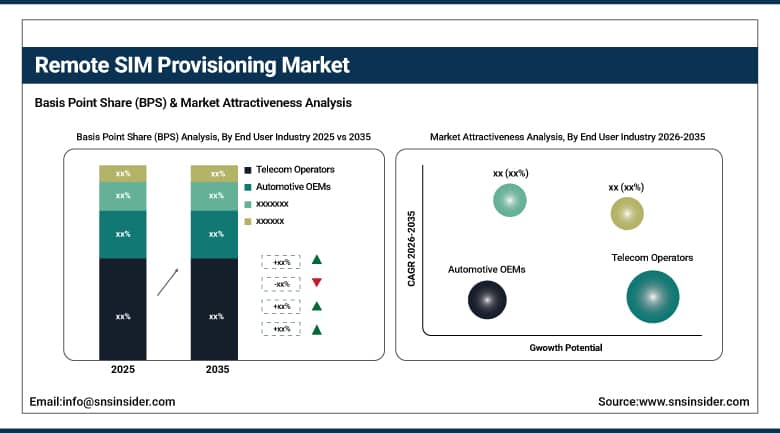
By End User Industry, telecom operators dominated the market with 36.4% share in 2025, while consumer electronics manufacturers are projected to witness the fastest growth with a CAGR of 18.24% during the forecast period.
By End User Industry, telecom operators dominated the market, consumer electronics manufacturers the fastest growth.
Telecom operators dominated the Remote SIM Provisioning Market with approximately 36.4% of the global market share in 2025. The segment's leadership is driven by increasing deployment of eSIM-enabled smartphones, IoT devices, connected vehicles, and wearable technologies. Telecom operators are extensively adopting remote SIM provisioning to enable seamless over-the-air (OTA) SIM activation, improve subscriber management, reduce physical SIM distribution costs, and accelerate digital onboarding. Growing 5G deployments, expanding IoT connectivity, and rising demand for flexible mobile subscription management continue to strengthen the dominance of telecom operators in the global Remote SIM Provisioning Market.
By Component, subscription management platforms dominated and are also the fastest-growing segment.
Subscription Management Platforms segment occupied the maximum market share of 34.00% in 2025 and will also exhibit the highest CAGR of 17.70% throughout the forecasted period. The increasing use of eSIM technology in various categories of phones, vehicles, IoT devices, wearables, and enterprise mobility solutions has driven the demand for subscription lifecycle management platforms that can be operated centrally. Such platforms help the mobile network operators, enterprises, and original equipment manufacturers (OEMs) activate, manage, update, and switch the operator profiles remotely through OTA provisioning without increasing their operational expenses.
With an increase in the number of connected devices deployed worldwide, it has become imperative to use scalable cloud-native subscription management platforms for securing and managing millions of connected endpoints efficiently. Standardization of the GSMA-compliant eSIM ecosystem provides another boost to the long-term demand for subscription management solutions. In 2025-2026, several connectivity platform providers launched advanced cloud-native subscription management platforms offering AI-based automation, multi-network orchestration, advanced security features, and massive IoT device provisioning capabilities within the telecom ecosystem.
By Deployment, cloud dominated the market, while hybrid is projected to witness the fastest growth.
Cloud accounted for the highest market share of 56.00% in 2025 as more organizations preferred scalable, centralized, and remotely managed connectivity infrastructure. The Cloud deployment allows telecom operators and enterprises to quickly create subscriber profiles, track device connectivity, manage lifecycles, and update software without having to build significant on-site infrastructure. Furthermore, Cloud-based platforms offer better scalability, reduced cost of maintenance, easy integration, and better disaster recovery options which make them the ideal deployment choice for remote SIM provisioning services globally.
Hybrid deployment segment is projected to experience the fastest growth rate- CAGR of 18.52%, during the forecast period. The large enterprises and highly regulated industries demand an architecture that combines cloud scalability with localized management of sensitive subscriber data and security activities. Moreover, the Hybrid platforms offer additional flexibility, regulatory compliance, and business continuity along with support for complex multi-country connectivity deployments. During the year 2025 to 2026, many providers have launched hybrid remote SIM provisioning solutions that integrate secure cloud management along with enterprise grade on-site infrastructure for telecommunications, automotive and IoT applications.
By Application, consumer electronics dominated the market, while industrial IoT is projected to witness the fastest growth.
The market share held by the consumer electronics category was 36.00%, the largest of all, in 2025, owing to high prevalence of the use of eSIM-supported smartphones, tablets, smart watches, laptops, wearables, and other consumer goods that offer connectivity. Device makers incorporate remote SIM provisioning technology in order to enable easier activation of the device, increase the convenience of the user, enable global roaming, and make it independent of physical SIM card. Growth in the premium category of connected devices, along with next-gen mobile eco-systems is fueling high adoption rates in consumer electronics sector. In the years 2025–2026, several device makers launched an enhanced portfolio of eSIM enabled consumer electronics devices offering improved remote provisioning.
The fastest growing category will be industrial IoT that is expected to show a CAGR of 18.81% during the forecast period. Increased deployments of connected sensors, industrial automation systems, and asset tracking devices, smart utilities, logistics, and smart city infrastructures have led to high demand for scalable remote connectivity management solutions. Remote SIM provisioning allows centralized lifecycle management of millions of industrial devices with cost-effective maintenance.
Regional Analysis:
|
Region |
Major Country |
Share within Region, 2025 (%) |
|---|---|---|
|
North America |
United States |
92.00% |
|
Europe |
Germany |
29.00% |
|
Asia Pacific |
China |
31.00% |
|
Middle East & Africa |
UAE |
4.00% |
|
Latin America |
Brazil |
3.00% |
North America Remote SIM Provisioning Market Insights
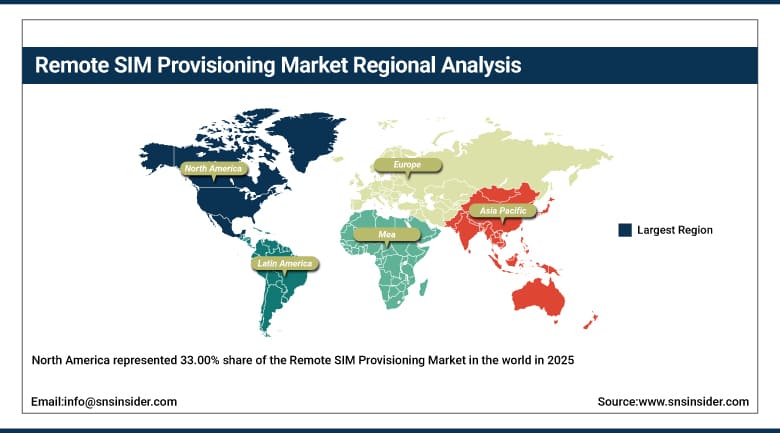
North America represented 33.00% share of the Remote SIM Provisioning Market in the world in 2025 and is expected to remain one of the major regions because of the presence of a wide base of eSIM-enabled devices, fast commercialization of 5G services, and increased investments into IoT connectivity platforms. Remote SIM provisioning is gaining popularity in consumer electronics, connected cars, IoT, enterprise mobility solutions, and smart city applications in both the United States and Canada. Telcos in the region have been increasingly implementing cloud-based subscription management systems for better onboarding, profile switching, and user experience. Increased deployments of edge computing, private 5G networks, AI-driven connectivity management, and digital enterprise transformations also support the regional market growth.
During 2025-2026, a number of North American telecom operators and connectivity platforms vendors have significantly extended their eSIM ecosystems with advanced remote SIM provisioning platforms equipped with AI-based subscription lifecycle management capabilities, cloud orchestration, improved cyber security, and multi-network connectivity for enterprises and IoT use cases.
Get Customized Report as Per Your Business Requirement - Enquiry Now
Europe Remote SIM Provisioning Market Insights
The Europe region emerged as the leader in the world Remote SIM Provisioning Market with an estimated 29.00% share of the total revenue generation in 2025 due to high GSMA eSIM adoption rate, robust telecommunication networks, favorable regulatory environment, and extensive usage of connected mobility services. Germany, the UK, France, Italy, and the Netherlands countries have been making huge investments in connected automobiles, industrial automation, and smart manufacturing facilities, healthcare connect ability, and digital transformation of enterprises. Mobile network operators are rapidly developing remote SIM provisioning systems to increase operational efficiency and cut down cost associated with physical SIM card distribution and subscriber profile management.
In 2025-2026 period, some leading European connectivity solution vendors diversified their cloud-based eSIM management portfolio through launching new GSMA subscription management platforms for over-the-air SIM provisioning and enterprise mobility management solutions.
Asia Pacific Remote SIM Provisioning Market Insights
The fastest CAGR of 19.27% is anticipated in Asia Pacific due to the rapid growth in the manufacture of smartphones and consumer electronic products, deployment of connected vehicles, digitalization of industry, and 5G infrastructure development in China, Japan, South Korea, India, and Southeast Asia. There are substantial investments being made in IoT systems, smart manufacturing, logistics, and enterprise mobility applications that require scalable remote connectivity management. Growing use of eSIM-enabled smartphones, wearables, connected industry devices, and automotive telematics solutions is adding impetus to the demand for remote SIM provisioning solutions. Cloud-based telecom infrastructure and digitalization initiatives by the government of these countries are driving the growth in the region.
From 2025 to 2026, there have been innovations in remote SIM provisioning systems by leading technology firms in Asia Pacific that included AI-based connectivity management, cloud-based subscription management, IoT connectivity for industries, and lifecycle management solutions.
Middle East & Africa and Latin America Remote SIM Provisioning Market Insights
The Middle East & Africa market is gradually developing owing to the growth of investment in digital telecommunication infrastructure, Smart Cities programs, connected transport, enterprise mobility, and IoT-driven public services in the UAE, Saudi Arabia, South Africa, and adjacent nations. The telecom companies in the region are increasingly implementing cloud-based remote SIM provisioning solutions due to the increased demand for the connected devices and improved efficiencies in subscribers' management and operations.
The Latin America market is experiencing steady growth, driven by the growing penetration of smartphones, 5G service provision, the development of digital enterprises, and increasing adoption of connected consumer electronics in Brazil, Mexico, Argentina, and Chile. There is an ongoing implementation of eSIM-enabled connectivity management systems in order to facilitate subscriber activation, deploy IoT and increase operational flexibility. Between 2025 and 2026, several firms operating in Latin America and Middle East markets launched advanced remote SIM provisioning solutions with cloud-based connectivity management, enterprise IoT solutions, secure digital identities management, and subscription management solutions.
Market Dynamics:
Growth Drivers: Rapid uptake of the eSIM solution and extensive use of connected IoT devices.
One of the key drivers for the growth of the Remote SIM Provisioning Market is the increased worldwide adoption of eSIM technology in smartphones, tablets, wearable devices, connected cars, industrial IoT devices, and enterprise mobility solutions. By enabling MNOs and enterprises to manage the activation, administration, updating, and swapping of subscriber profiles remotely, without any need for swapping physical SIM cards, remote SIM provisioning aims at improving efficiency and saving costs related to logistics and distribution. The growing implementation of 5G network technology, proliferation of connected devices, and the increasing use of connectivity management systems based on cloud computing technologies contribute to a high demand for remote SIM provisioning capabilities.
In 2025-2026, many major providers of telecommunications technology have added AI-powered subscription lifecycle management, GSMA-compatible eSIM orchestration, improved cyber security, and massive IoT connectivity management to their cloud-based remote SIM provisioning platforms.
Restraints: Issues regarding cyber security, interoperability, and regulation.
Even with high rates of market growth, remote SIM provisioning experiences many challenges related to cyber security risks, regulatory issues, and interoperability among other factors. The remote SIM platform manages subscribers' data which makes it highly vulnerable to attacks from malicious hackers and unauthorized individuals. In order to ensure that the platform operates securely through the provision of encrypted communication, over-the-air profiles and secure identity verifications, constant investments must be done on security infrastructures. Other factors that affect the adoption of remote SIM provisioning include lack of interoperability due to disparities in eSIM implementation standards and network compatibility in different regions.
In 2026, various solution providers released advanced solutions such as enhanced encryption technologies, zero trust security infrastructure, AI-based threat prevention, and GSMA certified remote SIM management platforms aimed at enhancing interoperability and security within the connected ecosystem.
Opportunities: 5G, Connected Vehicles, and Industrial IoT Ecosystems.
There are many opportunities that would arise due to the rapid growth of the 5G ecosystem, the connected mobility market, and Industrial Internet of Things (IoT) segment for the Remote SIM Provisioning Market. There are millions of devices including sensors, connected cars, smart meters, industrial equipment, health care devices, and logistics solutions that need remote SIM provisioning services for secure connectivity solutions. Remote SIM provisioning will help companies to centrally manage identities of subscribers, remotely change network operator, save connectivity cost, and simplify deployment globally. The adoption of private 5G networks, AI-based connectivity management, cloud-native IoT platforms, edge computing, and digital enterprise transformation will also boost the future market potential.
In the year 2025 and 2026, there were many connectivity platform vendors which launched the next generation remote SIM provisioning solutions which include artificial intelligence-based network optimization, automated subscription management, multi-operator orchestration, cloud-native architecture, and IoT connectivity management solutions.
Recent Developments:
-
2026: Thales expanded its eSIM management portfolio by introducing advanced remote SIM provisioning solutions featuring AI-driven subscription lifecycle management, enhanced cybersecurity, and cloud-native orchestration for telecom operators and enterprise IoT deployments.
-
2026: IDEMIA Secure Transactions launched upgraded GSMA-compliant remote SIM provisioning platforms supporting secure over-the-air profile downloads, multi-network management, and large-scale enterprise connectivity services.
-
2025: Giesecke+Devrient (G+D) introduced next-generation eSIM orchestration solutions integrating cloud-native subscription management, automated provisioning workflows, and enhanced digital identity protection for connected consumer and industrial devices.
-
2025: Kigen expanded its remote SIM provisioning platform by introducing scalable eSIM lifecycle management capabilities supporting IoT devices, connected vehicles, smart manufacturing infrastructure, and global enterprise connectivity solutions.
Remote SIM Provisioning Companies are:
-
Thales Group
-
Giesecke+Devrient GmbH
-
Kigen Ltd.
-
Valid S.A.
-
Tata Communications Limited
-
Deutsche Telekom AG
-
Orange S.A.
-
Vodafone Group Plc
-
STMicroelectronics N.V.
-
NXP Semiconductors N.V.
-
Infineon Technologies AG
-
Sierra Wireless (Semtech Corporation)
-
Cisco Systems, Inc.
-
Apple Inc.
-
Samsung Electronics Co., Ltd.
-
Qualcomm Technologies, Inc.
-
1GLOBAL(Truphone Limited)
-
Workz Group
Remote SIM Provisioning Market Report Scope:
| Report Attributes | Details |
|---|---|
| Market Size in 2025 | USD 4.30 Billion |
| Market Size by 2035 | USD 20.16 Billion |
| CAGR | CAGR of 16.71% From 2026 to 2035 |
| Base Year | 2025 |
| Forecast Period | 2026-2035 |
| Historical Data | 2022-2024 |
| Report Scope & Coverage | Market Size, Segments Analysis, Competitive Landscape, Regional Analysis, DROC & SWOT Analysis, Forecast Outlook |
| Key Segments | • By Component (Subscription Management Platforms, Provisioning Software, Managed Services, Security Solutions, Others) • By Deployment (Cloud, On-Premise, Hybrid) • By Application (Consumer Electronics, Automotive, Industrial IoT, Smartphones & Tablets, Others) • By End User Industry (Telecom Operators, Automotive OEMs, Consumer Electronics Manufacturers, Industrial Enterprises, Others) |
| Regional Analysis/Coverage | North America (US, Canada), Europe (Germany, UK, France, Italy, Spain, Russia, Poland, Rest of Europe), Asia Pacific (China, India, Japan, South Korea, Australia, ASEAN Countries, Rest of Asia Pacific), Middle East & Africa (UAE, Saudi Arabia, Qatar, South Africa, Rest of Middle East & Africa), Latin America (Brazil, Argentina, Mexico, Colombia, Rest of Latin America). |
| Company Profiles | Thales Group, IDEMIA Secure Transactions, Giesecke+Devrient GmbH, Kigen Ltd., Valid S.A., Tata Communications Limited, Deutsche Telekom AG, Telefónica S.A., Orange S.A., Vodafone Group Plc, STMicroelectronics N.V., NXP Semiconductors N.V., Infineon Technologies AG, Sierra Wireless (Semtech Corporation), Cisco Systems, Inc., Apple Inc., Samsung Electronics Co., Ltd., Qualcomm Technologies, Inc., 1GLOBAL(Truphone Limited), Workz Group |

Frequently Asked Questions
Asia Pacific is projected to register the fastest CAGR of 19.27% during 2026–2035.
North America dominated the global market in 2025 with approximately 33.00% revenue share.
The market is expected to expand at a CAGR of 16.71% during the forecast period.
The market is projected to reach USD 20.16 Billion by 2035.
The Remote SIM Provisioning Market was valued at USD 4.30 Billion in 2025.
