
Remote Cardiac Monitoring Market Report Scope & Overview:
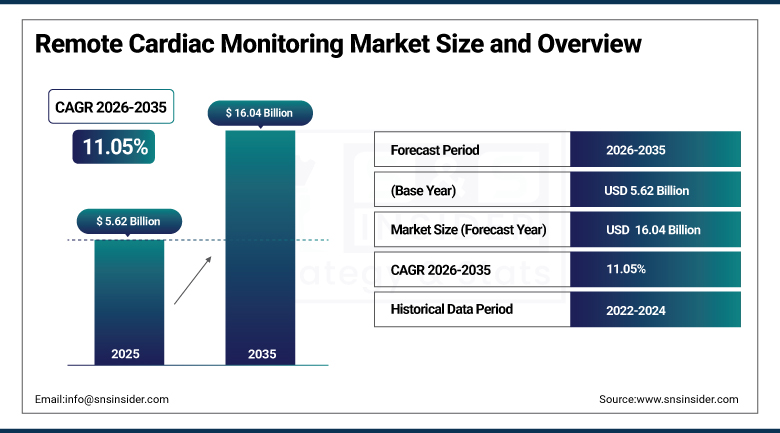
The Remote Cardiac Monitoring Market was valued at USD 5.62 Billion in 2025 and is expected to reach USD 16.04 Billion by 2035, growing at a CAGR of 11.05% from 2026 to 2035.
The Remote Cardiac Monitoring Market is witnessing constant growth, or accelerated growth in some cases, due to increased prevalence of cardiovascular diseases in the world, increasing favoritism of cardiologists toward the use of remote data monitoring as compared to traditional in-clinic cardiac data collection and the increasing reimbursement for remote physiologic monitoring in large hospitals around the globe. Remote cardiac monitoring solutions such as ambulatory ECG patches, implantable loop recorders, mobile cardiac telemetry and connected wearables help cardiologists to monitor the occurrence of arrhythmias, heart failure symptoms and post procedure complications.
⮞In 2025, Medtronic and iRhythm Technologies added more features to their respective app-based and mobile telemetry monitoring devices to cater the needs of increasing number of cardiologists using continuous and AI-enabled arrhythmia monitoring.
To Get more information On Remote Cardiac Monitoring Market - Request Free Sample Report
Remote Cardiac Monitoring Market Trends:
-
Rising adoption of AI-powered arrhythmia detection algorithms is enhancing diagnostic accuracy across wearable and implantable cardiac monitoring devices.
-
Expanding reimbursement coverage for remote physiologic monitoring under CPT codes 93228 and 93229 is accelerating adoption among U.S. cardiology practices.
-
Growing preference for hospital-to-home cardiac telemetry transitions is reducing readmission rates and driving demand for post-discharge monitoring solutions.
-
Increasing integration of cloud-based ECG analytics platforms is streamlining physician workflow and enabling faster arrhythmia intervention.
-
Rising deployment of smartwatch-based ECG and photoplethysmography sensors is broadening consumer-level cardiac screening beyond clinical settings.
U.S. Remote Cardiac Monitoring Market Outlook:
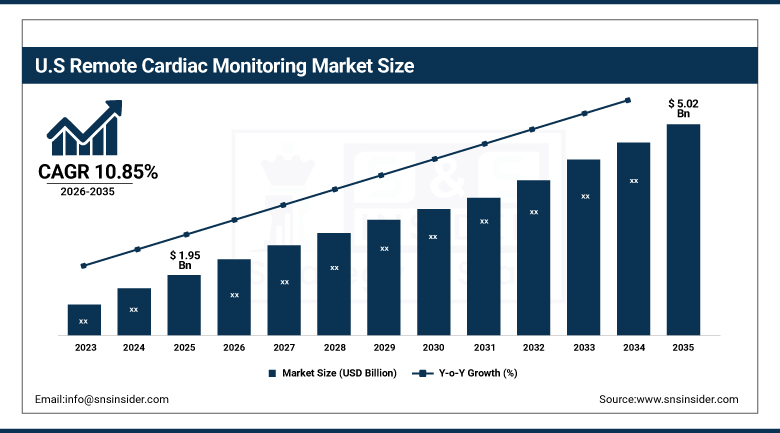
The U.S. Remote Cardiac Monitoring Market was valued at USD 1.95 Billion in 2025 and is projected to reach USD 5.02 Billion by 2035, growing at a CAGR of 10.85% during 2026–2035.
In U.S., leading health organizations and cardiology groups continue to expand the utilization of their remote cardiac monitoring solutions. The expansion is encouraged by the favorable reimbursement for remote physiologic monitoring CPT codes, increased frequency of atrial fibrillation and heart failure cases among elderly people, and the development of hospital-at-home and telecardiology solutions. America's powerful medical devices manufacturing industry, the availability of leading ambulatory ECG and mobile telemetry vendors, and the active participation of payers in the provision of post-discharge monitoring contribute to the stable demand for remote cardiac monitoring solutions within the domestic market.
⮞In 2025, iRhythm Technologies expanded its American clinical operations through the addition of more ECG data processing capacity, enhancing its capabilities to satisfy the increasing demand of physicians for Zio-branded ambulatory cardiac monitoring solution.
Remote Cardiac Monitoring Market Segment Analysis:
-
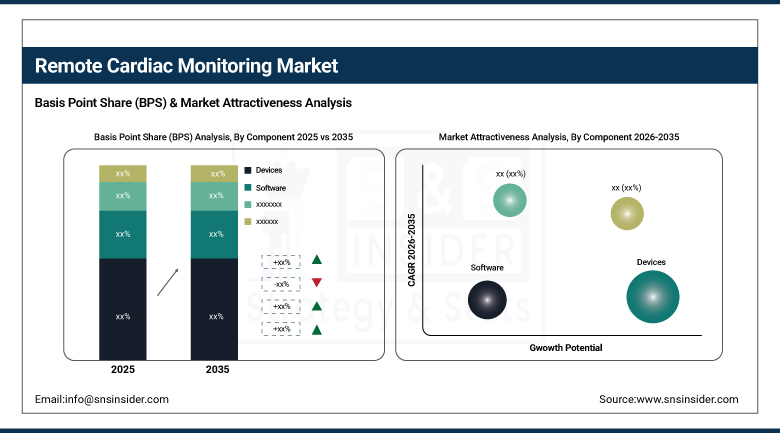
By Component, Devices dominated the Remote Cardiac Monitoring Market with a 47.80% share in 2025, while Software is the fastest-growing component segment with a CAGR of 14.20% from 2026–2035.
-
By Device Type, Holter Monitors dominated the Remote Cardiac Monitoring Market with a 27.60% share in 2025, while Mobile Cardiac Telemetry is the fastest-growing device type segment with a CAGR of 12.90% from 2026–2035.
-
By Application, Arrhythmia Monitoring dominated the Remote Cardiac Monitoring Market with a 41.80% share in 2025, while Heart Failure Monitoring is the fastest-growing application segment with a CAGR of 13.40% from 2026–2035.
-
By End User, Hospitals & Clinics dominated the Remote Cardiac Monitoring Market with a 45.00% share in 2025, while Home Care Settings is the fastest-growing end user segment with a CAGR of 14.80% from 2026–2035.
By Component, Devices led the market, while Software is the fastest-growing segment.
The Devices segment was the leading contributor with in the Remote Cardiac Monitoring Market in 2025. Devices remain the largest component category because ambulatory ECG patches, implantable loop recorders, and mobile telemetry hardware form the physical foundation on which every remote monitoring workflow is built, and cardiology practices continue to prioritize proven, clinically validated hardware platforms over standalone software when initiating remote monitoring programs. Established manufacturing relationships between device makers and hospital procurement systems, broad reimbursement recognition for device-based monitoring episodes, and continuous incremental hardware improvements in battery life, signal fidelity, and patient comfort have collectively reinforced the devices category's dominant position across both established and emerging healthcare markets, sustaining its lead even as software-driven analytics layers grow in parallel importance.
The Software segment is expected to witness the highest CAGR during the forecast period 2026-2035. Rapid growth is being driven by rising deployment of cloud-based ECG analytics platforms, AI-powered arrhythmia detection engines, and physician dashboards that convert raw device data into actionable clinical alerts, all of which are increasingly bundled or sold as recurring subscription services rather than one-time hardware purchases. Growing hospital investment in interoperable, EHR-integrated monitoring software, coupled with payer interest in software-enabled risk stratification tools that reduce unnecessary readmissions, is adding further impetus to this segment's above-average growth relative to the broader remote cardiac monitoring category.
⮞In January 2025, Boston Scientific announced the U.S. FDA approval of its LUX-Dx II+ insertable cardiac monitor, expanding its portfolio of long-term cardiac rhythm monitoring devices with remote connectivity and arrhythmia detection capabilities.
By Device Type, Holter Monitors led the market, while Mobile Cardiac Telemetry is the fastest-growing segment.
In 2025, Holter monitors continue being the most common devices for primary ambulatory ECG assessment of short duration arrhythmias due to extensive clinical experience, well-established insurance coverage, and easy integration into standard cardiological practice at large hospital systems and independent laboratories. Affordable price compared to implants or telemetry along with good diagnostics yield in many cases of routine arrhythmia diagnosis contribute to constant purchase of Holter monitors in well-developed and budget-conscious health care markets.
Mobile Cardiac Telemetry is the fastest growing segment among other Remote Cardiac Monitoring categories between 2026 and 2035. Modern doctors prefer instant arrhythmia alerts sent by mobile telemetry patches or systems to the retrospective analysis of Holter monitor results and are willing to apply mobile telemetry more rapidly to assess high risk arrhythmia patterns. Expanding reimbursement recognition for extended-wear mobile telemetry services and growing integration of these systems with cloud-based physician alerting platforms are further reinforcing this segment's above-average growth trajectory.
⮞In January 2026, the U.S. FDA cleared Boston Scientific Cardiac Diagnostic Technologies’ BodyGuardian Remote Monitoring System (BGRMS v3.0), supporting the continued development of connected ambulatory cardiac monitoring technologies for remote patient surveillance.
By Application, Arrhythmia Monitoring led the market, while Heart Failure Monitoring is the fastest-growing segment.
The Arrhythmia Monitoring segment dominated the Remote Cardiac Monitoring Market in 2025. Arrhythmia monitoring remains the largest application category owing to the sheer global prevalence of atrial fibrillation, bradycardia, and ventricular arrhythmias, conditions that require intermittent or continuous ECG capture for accurate diagnosis and that account for the majority of ambulatory and implantable cardiac monitoring prescriptions written by cardiologists and electrophysiologists worldwide. The established clinical pathway connecting arrhythmia symptoms to remote ECG monitoring referral, combined with strong reimbursement recognition across major markets, continues to sustain this application's dominant share across both developed and emerging healthcare systems.
The Heart Failure Monitoring segment will grow with the fastest CAGR. The quick adoption of these platforms is primarily driven by increased clinical validation of how heart failure decompensation can be determined from early changes in heart sounds, thoracic fluid retention, and activity levels, thus decreasing readmission rates. As health care organizations are penalized for readmissions, they have adopted remote heart failure monitoring platforms at a faster rate. Besides, multi-parameter sensors that monitor rhythm and hemodynamics continue to find their way into more applications, further contributing to faster growth in this segment relative to other monitoring platforms.
⮞In July 2026, King Abdullah Medical City in Saudi Arabia implemented Abbott’s CardioMEMS HF System, enabling remote pulmonary artery pressure monitoring to identify early signs of heart failure deterioration and support timely treatment adjustments.
By End User, Hospitals & Clinics led the market, while Home Care Settings is the fastest-growing segment.
The Hospitals & Clinics segment dominated the Remote Cardiac Monitoring Market in 2025. Hospitals and cardiology clinics remain the largest end-user category because they serve as the primary point of prescription, device fitting, and initial data review for the overwhelming majority of remote cardiac monitoring episodes, and because large health systems possess the reimbursement infrastructure, clinical staffing, and EHR integration capacity required to operate remote monitoring programs at scale across broad patient populations. Continued expansion of hospital-based cardiology service lines and growing investment in dedicated remote monitoring command centers are reinforcing this segment's leading position.
Home Care Settings is expected to exhibit the fastest growth during the period of 2026-2035. This trend will be driven by the preference of patients to receive recovery services in their homes instead of hospitals, along with payers’ motivation to shift less acute cardiac monitoring from hospitals to home settings, making the adoption of remote cardiac monitoring solutions faster. Moreover, advancements in wearable devices for cardiac monitoring, which are easy to operate and minimally invasive, will aid the growth of this segment.
⮞In August 2025, the American Heart Association partnered with Cadence to introduce American Heart Association Connected Care, a virtual program providing home-based monitoring, clinical support, and post-discharge management for patients living with heart failure.
Regional Analysis:
|
Region |
Major Country |
Share within Region, 2025 (%) |
|---|---|---|
|
North America |
United States |
83.50% |
|
Europe |
Germany |
24.60% |
|
Asia Pacific |
China |
38.90% |
|
Middle East & Africa |
Saudi Arabia |
28.40% |
|
Latin America |
Brazil |
35.70% |
North America Remote Cardiac Monitoring Market Insights
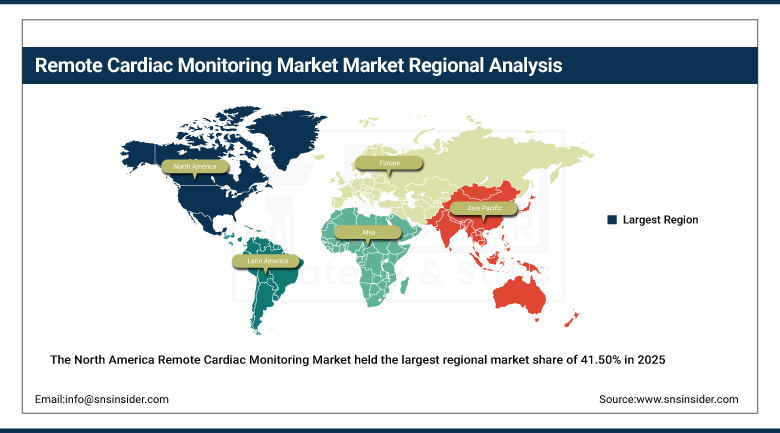
The North America Remote Cardiac Monitoring Market held the largest regional market share of 41.50% in 2025, owing to the region's well-established cardiology infrastructure, high prevalence of atrial fibrillation and heart failure among an aging population, and strong payer support for remote physiologic monitoring reimbursement across both government and commercial insurance programs. The region's advanced hospital-at-home and virtual cardiac care initiatives, combined with early and sustained adoption of AI-enabled monitoring platforms by leading academic medical centers and integrated health systems, continue to reinforce North America's leadership position, while ongoing expansion of remote monitoring CPT code coverage further lowers adoption barriers for smaller cardiology practices and independent clinics across the region.
The US was the leading country within the North America Remote Cardiac Monitoring Market in 2025 of the regional market, driven by extensive domestic device manufacturing and clinical data-processing infrastructure, strong presence of leading ambulatory ECG and mobile telemetry providers, and growing health system investment in post-discharge cardiac surveillance programs designed to reduce readmission penalties. Canada is contributing to regional growth through its own expanding virtual cardiac care initiatives and growing provincial health authority interest in remote monitoring as a tool to manage rural and geographically dispersed cardiology patient populations.
⮞In May 2025, Octagos Health launched OctaLink, an AI-optimized cardiac monitoring mobile application providing clinicians with secure access to real-time alerts, monitoring tasks, and patient information, supporting faster remote cardiac care decisions.
Get Customized Report as per Your Business Requirement - Enquiry Now
Europe Remote Cardiac Monitoring Market Insights
The Europe region was a significant contributor to the Remote Cardiac Monitoring Market in 2025, expected to register comparatively steady growth for hospital-integrated telemetry and cloud-based ECG analytics solutions during the forecast period. This is attributed to the region's strong national health system emphasis on reducing inpatient cardiac observation costs, well-established cardiology referral networks, and growing consumer familiarity with wearable ECG technology across member states pursuing broader digital health modernization objectives, even as reimbursement caps on monitoring duration in several countries continue to moderate the overall pace of adoption relative to North America.
Germany is one of the major markets in Europe owing to its strong medical device manufacturing base, along with the presence of leading cardiac monitoring technology providers serving both domestic and international hospital customers. Other countries such as the United Kingdom, France, and the Netherlands, home to expanding virtual ward and hospital-at-home programs, are also contributing to market growth through growing national health service investment in remote cardiac telemetry and post-discharge monitoring infrastructure.
⮞In November 2025, Hannover Medical School implemented an integration of GE HealthCare’s MUSE Cardiology Information System with AliveCor’s KardiaMobile 6L, enabling patients to record ECGs remotely and transmit results directly into hospital clinical workflows.
Asia Pacific Remote Cardiac Monitoring Market Insights
The Asia Pacific Remote Cardiac Monitoring Market is expected to witness the fastest growth rate during the forecast period 2026-2035, registering a CAGR of 13.20%. The market growth is driven by rapidly expanding hospital modernization programs, growing private healthcare investment, and increasing government focus on reducing the region's substantial cardiovascular disease burden through earlier, more accessible diagnostic and monitoring pathways across both major and emerging economies pursuing broader healthcare digitization strategies.
China is one of the main growth drivers in the Asia Pacific Remote Cardiac Monitoring Market, owing to its large hospital network expansion and rapidly growing domestic medical device manufacturing capability supporting both local and export-oriented cardiology customers. India and Japan, the former a fast-growing private healthcare market and the latter a country with an aging population increasingly reliant on telehealth, are also contributing to regional growth through expanding remote monitoring adoption and rising government reimbursement support for connected cardiac care technologies.
⮞In July 2025, OMRON Healthcare and Tricog Health launched KeeboHealth in India, combining AI-driven cardiac analytics, real-time health data, and home-based monitoring to identify early warning signs and support proactive cardiovascular care.
Middle East & Africa and Latin America Remote Cardiac Monitoring Market Insights
Middle East & Africa and Latin American regions are gradually expanding remote cardiac monitoring adoption as healthcare infrastructure investment grows across both regions, supported by increasing government focus on reducing cardiovascular mortality and growing private hospital network expansion in key urban centers.
Brazil is set to be a prominent Latin American market fueled by its expanding private cardiology network and growing domestic demand for post-procedural and heart failure monitoring solutions. The Middle East & Africa region has Saudi Arabia and the UAE investing heavily in modern hospital infrastructure and medical tourism initiatives that are gradually increasing demand for remote cardiac monitoring across their expanding cardiology and critical care service lines.
⮞In July 2026, Cleveland Clinic Abu Dhabi introduced an implantable wireless pulmonary artery pressure monitoring system for heart failure patients, enabling remote transmission of cardiovascular measurements to clinical teams for earlier identification of deterioration.
⮞In May 2026, Dong-A ST signed a distribution agreement with Brazilian cardiac monitoring specialist CARDIOS for its HiCardi+ wearable remote monitoring system, expanding access to connected ECG and physiological monitoring through established Brazilian hospital networks.
Market Dynamics:
Growth Drivers: Rising cardiovascular disease burden and expanding telehealth reimbursement driving market growth
The rising global prevalence of cardiovascular disease, combined with growing physician and payer preference for continuous, real-time cardiac surveillance over intermittent in-clinic assessment, is among the primary drivers of the Remote Cardiac Monitoring Market. Remote monitoring technologies provide an early-detection, cost-effective alternative to extended inpatient cardiac observation, improving diagnostic yield and enabling faster clinical intervention across virtually every major arrhythmia and heart failure care pathway, from initial diagnostic work-up through long-term post-procedural surveillance and chronic disease management. Expanding reimbursement recognition for remote physiologic monitoring under dedicated billing codes across the United States and select European markets is further lowering adoption barriers for smaller cardiology practices.
Technological advancements in sensor miniaturization and battery efficiency have significantly increased device wearability and patient compliance, with recent innovations improving signal fidelity and reducing false-positive alert rates across commercial monitoring platforms. Rising hospital investment in hospital-at-home and virtual ward programs seeking to reduce readmission penalty exposure, growing integration of AI-based arrhythmia detection into physician alerting workflows, and continued strategic investment by device manufacturers in cloud-based analytics infrastructure are further supporting demand across the forecast period, as remote cardiac monitoring continues displacing conventional intermittent in-clinic ECG assessment across an increasingly broad range of cardiology care settings.
⮞In March 2025, Peerbridge Health introduced its Cor MDx connected ECG wearable at the HIMSS Global Health Conference, incorporating real-time multi-lead ECG streaming and Bluetooth and LTE connectivity to support expanded remote cardiovascular monitoring.
Restraints: Reimbursement inconsistencies and data security concerns limiting broader adoption
One of the most critical obstacles to market growth comes in the form of inconsistent reimbursement policy across international markets for the Remote Cardiac Monitoring Market. This comes down to the fact that several European public payer systems impose duration caps on reimbursed monitoring episodes, typically limiting continuous telemetry coverage to 48 to 72 hours, which constrains the clinical and commercial case for longer-duration monitoring adoption relative to the United States, where remote physiologic monitoring billing codes support more extended, recurring reimbursement structures.
Moreover, growing concerns around the privacy and cybersecurity of continuously transmitted patient cardiac data directly impact hospital and patient willingness to adopt connected monitoring platforms, particularly as wireless medical devices become increasingly attractive targets for cyberattack. Besides, the high technical requirements involved in integrating remote monitoring data streams with legacy hospital electronic health record systems, combined with a persistent shortage of clinical staff trained to triage and interpret continuous monitoring alerts, require considerable ongoing IT and workforce investment that many smaller healthcare providers, particularly in emerging markets, are not yet positioned to absorb.
Opportunities: AI-driven diagnostics and emerging market infrastructure expansion creating new growth avenues
The increasing need for predictive, AI-based analytics capable of detecting early heart failure decompensation signals before clinical symptoms emerge, the rise of miniaturized leadless implantable monitors, and greater emphasis on multi-parameter wearable platforms combining ECG, oxygen saturation, and blood pressure sensing into a single device will provide ample growth opportunities in the Remote Cardiac Monitoring Market. A definite pathway exists towards achieving scalable and affordable discharge surveillance technologies that decrease penalties arising out of the possibility of being penalized in case of a readmission.
The possibilities are enormous when it comes to developing cloud-based platforms for physician alerts, which would decrease the burden of work for clinicians, increase the rate of detection of arrhythmias, and at the same time, decrease costs for hospitals as well as improve results for patients. Since investments in hospital infrastructures are increasing, private healthcare networks are extending their reach in Asia Pacific and Latin American countries due to the increasing attention paid by governments to the reduction of deaths from cardiovascular disease in the region.
⮞In January 2025, Biotricity partnered with B-Secur to develop a device-neutral ambulatory cardiac monitoring platform integrating HeartKey FDA-cleared algorithms with Biotricity’s diagnostic solutions, targeting improved ECG analytics and broader interoperability across healthcare monitoring systems.
Recent Developments:
-
2025: Medtronic received U.S. FDA clearance for its MyCareLink Smart Monitor, an app-based remote monitoring system enabling pacemaker and ICD patients to transmit cardiac data directly to physicians via smartphone connectivity, eliminating the need for a dedicated bedside receiver.
-
2025: iRhythm Technologies expanded availability of its Zio MCT mobile cardiac telemetry patch, adding real-time arrhythmia alerting capability alongside its existing Zio XT and Zio AT ambulatory ECG monitoring service lines for extended-wear patients.
-
2026: Abbott introduced its Confirm Rx 2.0 insertable cardiac monitor, integrating enhanced AI-based arrhythmia detection algorithms and extended battery longevity for long-term atrial fibrillation surveillance in remote patient populations.
-
2026: Philips launched a next-generation cloud-based cardiac telemetry analytics platform building on its BioTelemetry monitoring technology, targeting hospital-to-home transition programs for post-discharge cardiac patients requiring extended remote surveillance.
Remote Cardiac Monitoring Market Key Players are:
-
Medtronic plc
-
Abbott Laboratories
-
Boston Scientific Corporation
-
Koninklijke Philips N.V.
-
GE HealthCare Technologies Inc.
-
BIOTRONIK SE & Co. KG
-
iRhythm Technologies, Inc.
-
Nihon Kohden Corporation
-
Baxter International Inc.
-
VitalConnect, Inc.
-
AliveCor, Inc.
-
Biotricity Inc.
-
Cardiac Insight, Inc.
-
Schiller AG
-
InfoBionic, Inc.
-
Spacelabs Healthcare
-
Cardinal Health, Inc.
-
Zoll Medical Corporation
-
OMRON Healthcare, Inc.
-
Preventice Solutions, Inc.
Remote Cardiac Monitoring Market Report Scope:
| Report Attributes | Details |
|---|---|
| Market Size in 2025 | USD 5.62 Billion |
| Market Size by 2035 | USD 16.04 Billion |
| CAGR | CAGR of 11.05% From 2026 to 2035 |
| Base Year | 2025 |
| Forecast Period | 2026-2035 |
| Historical Data | 2022-2024 |
| Report Scope & Coverage | Market Size, Segments Analysis, Competitive Landscape, Regional Analysis, DROC & SWOT Analysis, Forecast Outlook |
| Key Segments | • By Component (Devices, Software, Services) • By Device Type (Holter Monitors, Event Monitors, Implantable Loop Recorders, Mobile Cardiac Telemetry, Smart Wearable Cardiac Monitors) • By Application (Arrhythmia Monitoring, Heart Failure Monitoring, Post-Surgical Monitoring, Others) • By End User (Hospitals & Clinics, Ambulatory Surgical Centers, Home Care Settings, Diagnostic Centers) |
| Regional Analysis/Coverage | North America (US, Canada), Europe (Germany, France, UK, Italy, Spain, Russia, Poland, Rest of Europe), Asia Pacific (China, India, Japan, South Korea, Australia, ASEAN Countries, Rest of Asia Pacific), Middle East & Africa (UAE, Saudi Arabia, Qatar, South Africa, Rest of Middle East & Africa), Latin America (Brazil, Argentina, Mexico, Colombia, Rest of Latin America) |
| Company Profiles | Medtronic plc, Abbott Laboratories, Boston Scientific Corporation, Koninklijke Philips N.V., GE HealthCare Technologies Inc., BIOTRONIK SE & Co. KG, iRhythm Technologies Inc., Nihon Kohden Corporation, Baxter International Inc., VitalConnect Inc., AliveCor Inc., Biotricity Inc., Cardiac Insight Inc., Schiller AG, InfoBionic Inc., Spacelabs Healthcare, Cardinal Health Inc., Zoll Medical Corporation, OMRON Healthcare Inc., Preventice Solutions Inc. |

Frequently Asked Questions
The market is driven by the rising global burden of cardiovascular disease, expanding remote physiologic monitoring reimbursement, and continued advancement in AI-based arrhythmia detection technology.
The North America region dominated the Remote Cardiac Monitoring Market in 2025 with a 41.50% market share, driven by strong reimbursement support and advanced cardiology infrastructure.
