
ADHD Remote Patient Monitoring & Digital Coaching Market Report Scope & Overview:
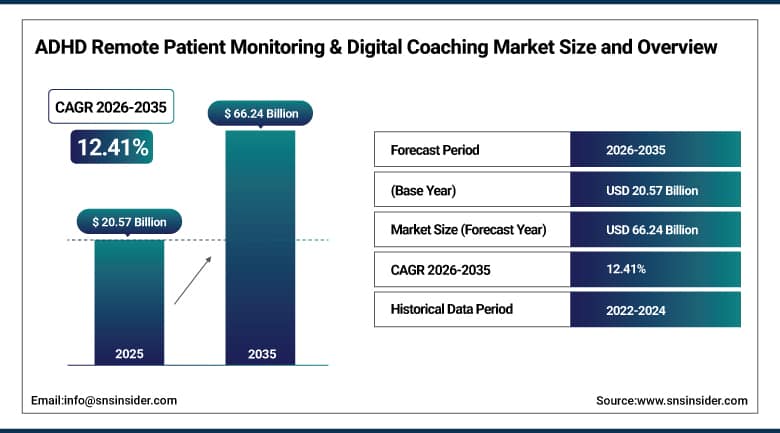
The ADHD Remote Patient Monitoring & Digital Coaching Market was valued at USD 20.57 Billion in 2025 and is projected to reach USD 66.24 Billion by 2035, expanding at a CAGR of 12.41% during the forecast period 2026–2035.
The ADHD Remote Patient Monitoring and Digital Coaching market is experiencing tremendous growth on account of the increasing prevalence of attention deficit hyperactivity disorder among children and adults, growing demand for digital mental health applications, and ongoing innovation in the field of remote behavioral monitoring technology. Healthcare companies, digital therapeutics companies, and behavioral health organizations have been increasingly adopting AI-enabled coaching platforms, remote symptom monitoring solutions, behavioral analytics with wearables, and personalized digital interventions for ADHD management.
With these technologies, continuous patient engagement, medication compliance monitoring, collaboration with caregivers, and personalized behavioral coaching can be provided without being confined within conventional healthcare delivery environment. Digital health organizations have witnessed rapid commercialization of AI-powered ADHD coaching platforms with remote patient monitoring, predictive behavioral analytics, and personalized cognitive interventions. The healthcare organizations have also started using digital therapeutic ecosystems for improved ADHD management at home care environment.
To Get More Information On This Market - Request Free Sample Report
ADHD Remote Patient Monitoring & Digital Coaching Market Trends
-
Increasing adoption of AI-enabled ADHD digital coaching platforms for continuous behavioral management.
-
Rising deployment of remote patient monitoring technologies for real-time symptom tracking and medication adherence.
-
Growing commercialization of prescription digital therapeutics integrated with cognitive behavioral interventions.
-
Expansion of wearable-enabled behavioral analytics supporting personalized ADHD management.
-
Increasing use of cloud-connected caregiver engagement platforms for pediatric ADHD care coordination.
The U.S. ADHD Remote Patient Monitoring & Digital Coaching Market Size Outlook
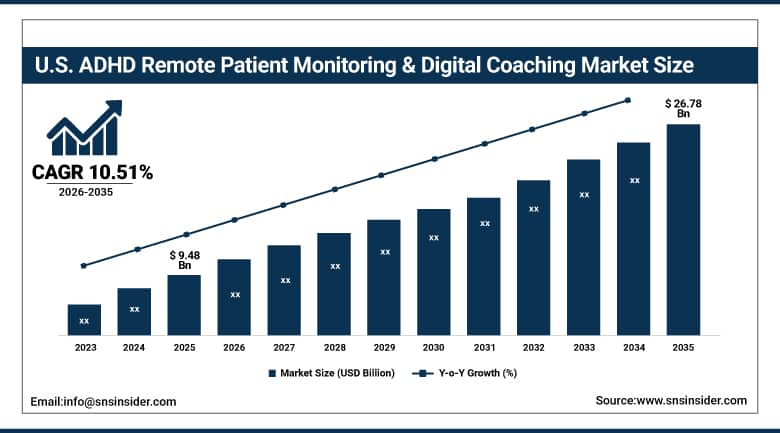
The U.S. ADHD Remote Patient Monitoring & Digital Coaching Market was valued at USD 9.48 billion in 2025 and is expected to reach approximately USD 26.78 billion by 2035, expanding at a CAGR of 10.51% during 2026–2035.
The USA remains at the forefront in terms of dominating the adhd remote patient monitoring & digital coaching market globally due to its highly evolved digital healthcare ecosystem, rising ADHD diagnosis rates, increasing adoption of telehealth services, and commercialization of digital therapeutics. The adoption of artificial intelligence-driven remote monitoring tools, digital coaching applications, behavioral tracking solutions using wearables, and patient engagement solutions using cloud is already in progress within healthcare organizations, behavioral experts, educational institutions, and employers to achieve high treatment compliance and symptom management.
Focus on digital innovation in mental health care, insurance coverage of virtual behavioral health services, and growing demand for personalized home-based management of ADHD in the country will probably help it stay at the forefront of the market. It is further evidenced by CDC statistics showing increasing cases of ADHD among U.S. adults.
ADHD Remote Patient Monitoring & Digital Coaching Market Segment Analysis
-
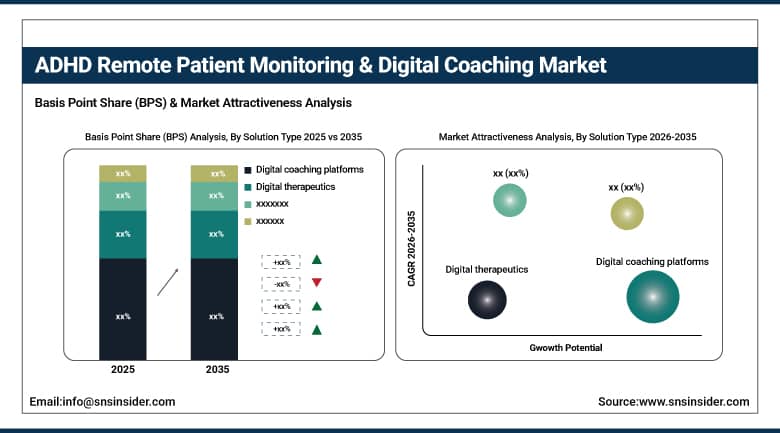
By Solution Type, digital coaching platforms dominated the market with 34.00% share in 2025, while digital therapeutics are projected to witness the fastest growth with a CAGR of 15.69% during the forecast period.
-
By Age Group, children 6–12 years dominated the market with 39.00% share in 2025, while adults 18–35 Years are projected to witness the fastest growth with a CAGR of 15.07% during the forecast period.
-
By End User, parents & families dominated the market with 30.00% share in 2025, while schools & educational institutions are projected to witness the fastest growth with a CAGR of 15.86% during the forecast period.
By Solution Type, digital coaching platforms dominated, while digital therapeutics fastest-growing.
The segment of digital coaching platforms will register a revenue market share of 34.00% in 2025 owing to the growing requirement for continuous behavioral coaching, personalized cognitive intervention solutions, and artificial intelligence-based patient engagement solutions. The implementation of digital coaching platforms helps to carry out behavioral therapy sessions, drug reminders, progress monitoring, caregiver collaborations, and communication with clinicians through cloud-based ecosystems. It can be observed that there is an increasing trend among digital health and healthcare providers for utilizing such digital coaching platforms to ensure treatment compliance and behavioral changes. There are various digital mental health services providers who are developing digital coaching platforms for ADHD that include personalized cognitive and behavioral interventions and remote patient monitoring functionalities.
The digital therapeutics market segment is expected to register the fastest growth with a CAGR of 15.69% from 2026 to 2035 because of the growing clinical adoption of prescription digital therapeutics, favorable regulatory climate, and rising demand for evidence-based, non-pharmacological ADHD interventions. Digital therapeutics offer a structured cognitive behavioral therapy, executive function training, and attention improvement exercises via validated software platforms. Software-based ADHD treatment developers continued building their clinical evidence base related to the use of digital therapeutics to improve attention performance.
By Age Group, children 6–12 years dominated, while adults 18–35 years fastest-growing.
The segment comprising children 6-12 years held the highest market share of 39.00% in 2025 owing to the high prevalence of ADHD cases among children of school age coupled with heightened awareness on the part of parents, teachers and health care practitioners specializing in pediatrics. Adoption in this segment was facilitated by early behavior modification therapy programs, monitoring programs in schools and digital coaching applications. Remote monitoring technology in conjunction with pediatric behavioral healthcare is still ongoing to facilitate symptom assessment, medication compliance and collaboration between health care providers, parents and schools. Organizations in the field of pediatric behavioral health have come up with digital solutions for ADHD management involving caregiver portals and remote behavioral monitoring.
The adults 18-35 years segment is estimated to be the fastest-growing, at a CAGR of 15.07%, during the forecast period, attributed to increasing adult ADHD cases, increased mental healthcare awareness, and use of virtual behavioral healthcare services. Increasing preference of young adults for mobile coaching applications, telepsychiatry services, wearable-based behavioral monitoring, and AI productivity platforms is seen among young adults. Digital coaching applications and remote symptom monitoring applications are increasingly used by healthcare providers in the adult ADHD care process.
By End User, parents & families dominated, while schools & educational institutions fastest-growing.
The Parents & Families vertical generated the highest revenue share of 30.00% in 2025 due to their pivotal role in the management of pediatric ADHD, monitoring behavioral improvement, adherence to medications, and communicating with doctors and schools. Today, modern ADHD solutions offer real-time behavioral dashboards, personalized coaching tips, appointments reminders, and even the capability of remote monitoring of the patients. Companies developing digital health products continued designing ADHD management software for caregivers including the integration of AI-driven behavioral analysis, personalized coaching, and family engagement.
In turn, the schools & educational institutions segment is expected to be the fastest-growing with a CAGR of 15.86% over the forecast period due to a growing number of implementations of digital behavioral monitoring, personalized learning solutions, and mental health programs at the schools. The collaboration between healthcare providers, technology companies, and educational facilities leads to the integration of symptom and cognitive performance monitoring and behavioral management platforms in student support services. Investments in digital educational infrastructure and ADHD intervention knowledge will further boost the adoption in such environments. Schools continued implementing digital student wellness platforms incorporating behavioral monitoring technologies and collaborative care solutions for children diagnosed with ADHD and other neurological disorders.
Regional Analysis
|
Region |
Major Country |
Share within Region, 2025 (%) |
|---|---|---|
|
North America |
United States |
94.50% |
|
Europe |
Germany |
24.00% |
|
Asia Pacific |
China |
17.00% |
|
Middle East & Africa |
UAE |
4.00% |
|
Latin America |
Brazil |
4.00% |
North America ADHD Remote Patient Monitoring & Digital Coaching Market Insights
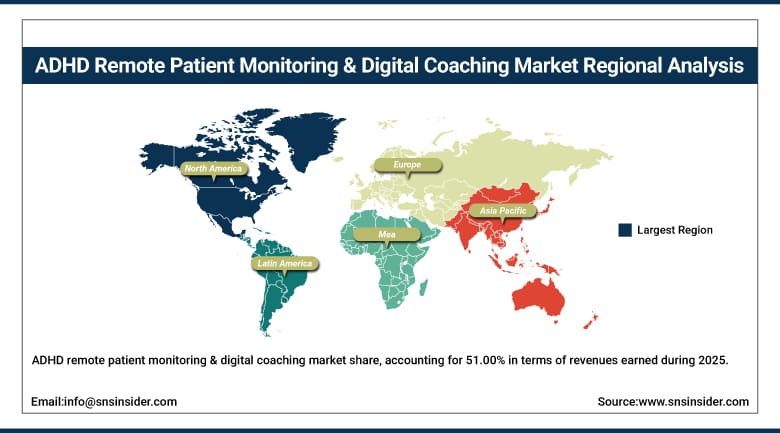
Regionally, North America has been dominating the global ADHD remote patient monitoring & digital coaching market share, accounting for 51.00% in terms of revenues earned during 2025. The dominant position of this region can be contributed to the presence of advanced digital health care infrastructure, high prevalence rate of ADHD disorders, availability of telemedicine services, and fast adoption of digital therapeutics and remote behavioral monitoring solutions. Artificial intelligence-driven digital coaching solutions, behavioral analytics solution using wearables, and patient engagement solutions using cloud technologies are increasingly being adopted to treat ADHD.
Moreover, consistent growth in reimbursements, investments in behavioral health technologies, and favorable regulatory environment for digital health technologies is expected to aid in the growth of the market. Collaborations between tech vendors, healthcare providers, academic institutions, and employers are expected to drive the adoption of personalized ADHD treatment solutions in the United States and Canada. Many leading healthcare providers in the United States have implemented various digital behavioral health programs using AI-driven remote monitoring solutions and personalized ADHD coaching solutions.
Get Customized Report as Per Your Business Requirement - Enquiry Now
Europe ADHD Remote Patient Monitoring & Digital Coaching Market Insights
Europe showed signs of drive in the form of greater investments in mental health care digitization such as telepsychiatry services and increased attention towards ADHD diagnosis among both children and adults. Countries such as Germany, the United Kingdom, France, Italy, and the Netherlands have been incorporating digital therapeutics and remote symptom monitoring tools into their regular mental healthcare offerings.
Government-led digital healthcare projects, growing healthcare digitization, and partnership between healthcare companies and educational institutions will continue to drive the commercialization of ADHD treatment tools. Increased focus on early diagnosis and personalized treatment plans for long-term behavioral management will further support market growth in the region over the forecast period. Digital healthcare offerings by European healthcare providers expanded in the form of remote behavioral assessments, telepsychiatry services, and artificial intelligence-enabled patient engagements in case of neurodevelopmental disorders such as ADHD.
Asia Pacific ADHD Remote Patient Monitoring & Digital Coaching Market Insights
The region of Asia Pacific is expected to have the highest CAGR of 17.73%, driven by the development of advanced digital healthcare ecosystem, rising usage of smartphones, increased awareness of ADHD, and investments made in behavioral health technologies. The nations in the region like China, Japan, India, South Korea, Singapore, and Australia are experiencing rapid adoption of digital coaching applications, cloud-based patient monitoring systems, and AI-based behavioral analytics for ADHD management in children and adults. Digital health startup involvement along with government-led digital health initiatives and telemedicine expansion are providing many business opportunities.
Higher healthcare spending and digital therapeutics adoption are anticipated to drive future market growth in the region. The firms operating in the digital health industry in Asia Pacific have developed AI-powered behavioral coaching platforms with remote patient monitoring and cognitive assistance technologies for better ADHD management.
Middle East & Africa and Latin America ADHD Remote Patient Monitoring & Digital Coaching Market Insights
Middle East & Africa due to rising investments in healthcare infrastructure, rising awareness about mental disorders, and adoption of telemedicine services in the UAE, Saudi Arabia, and South Africa. Digital mental health service providers are gradually deploying remote behavioral monitoring solutions and AI-assisted coaching technologies to provide better access to specialist ADHD treatment services. Public healthcare system modernization efforts and rising smartphone usage are further fueling the market growth opportunities in the region.
Latin America is also witnessing increasing adoption of telehealth services, behavioral healthcare access improvements, and raising awareness about neurodevelopmental disorders in Brazil, Mexico, Argentina, and Chile. The adoption of cloud-based patient engagement platforms, digital therapeutics, and remote monitoring systems is helping to maintain treatment continuity and remove access barriers in the region. Rising investments in digital healthcare infrastructure and healthcare collaborations between private-public sector entities are going to help to drive future market growth in the region. In the Middle East, Africa, and Latin America regions, digital mental health players continued expanding their footprint by leveraging remote patient monitoring, telepsychiatry, and AI-powered mental health solutions to provide access to ADHD management services.
Market Dynamics
Growth Drivers: Increasing usage of digital therapeutics for managing ADHD in the long run.
Increasing adoption of digital therapeutics and remote patient monitoring technologies is rapidly propelling the adhd remote patient monitoring & digital coaching market. Various AI-driven behavioral coaching platforms, cloud-based symptom monitoring applications, wearable-based cognitive assessment techniques, and personalized digital therapies have been incorporated into ADHD management plans to ensure better adherence to treatment and patient engagement. These technologies facilitate continuous behavioral analysis, medication adherence tracking, involvement of caregivers, and clinical intervention in ADHD management outside the traditional care settings.
The increasing prevalence of ADHD among children as well as adults, rising demand for at-home behavioral healthcare, and growing reimbursement for digital health solutions keep fueling the market expansion globally. In light of the shifting focus of healthcare organizations from volume-based to value-based and patient-centric care models, digital solutions for managing ADHD have become an important element of delivering behavioral healthcare. The CDC kept highlighting the importance of early diagnosis, continuous monitoring, and long-term management of ADHD.
Restraints: Privacy issues regarding the use of health data in digital behavioral health platforms.
While there have been fast technological developments, some obstacles such as those related to healthcare data privacy issues, cyber security compliances, varying reimbursement and the lack of standardization in digital ADHD management solutions persist. AI-based behavioral monitoring tools collect highly sensitive patient health data which should be protected in line with healthcare data privacy regulations as well as in a secure cloud environment. Besides, the reimbursement rules for digital therapeutics and behavioral monitoring differ from country to country, making digital therapies less scalable in terms of business.
Healthcare institutions also struggle with integrating digital platforms into their electronic medical record systems and processes in behavioral healthcare. All these obstacles persist despite the rising acceptance of remote ADHD management technologies. Regulatory agencies continuously improved digital health regulation, cyber security framework and software-as-a-medical-device management to protect patients and their data in digital behavioral healthcare platforms.
Opportunities: AI-enabled personalized behavioral coaching and cloud-connected mental health ecosystems.
There are numerous commercialization opportunities associated with rapid advances in artificial intelligence, predictive behavioral analytics, cloud-enabled health platforms, and personalized digital therapeutics. Health organizations are more and more implementing AI-powered coaching tools designed to provide personalized behavioral intervention solutions using patients' data, their cognitive performance results, and compliance information. The implementation of wearables, digital biomarkers, natural language processing, and machine learning is facilitating early symptoms detection and personalized therapeutic approaches.
Telepsychiatry services, employer-based mental health programs, school-based behavioral healthcare, and digital health services based on value propositions are expected to help facilitate commercialization in this sphere. More collaborations among health organizations, technology companies, insurers, and educational institutions are expected to result in the development of innovations and remote care ecosystems for the benefit of ADHD patients worldwide. Some companies that specialize in digital mental health have developed artificial intelligence-based platforms for ADHD personal coaching solutions.
Recent Developments
-
2026: Akili, Inc. continued expanding commercialization initiatives for its prescription digital therapeutic technologies supporting cognitive assessment and behavioral management through AI-enabled digital platforms.
-
2026: Teladoc Health, Inc. expanded its virtual behavioral health services by strengthening digital mental healthcare programs integrating remote patient monitoring, telepsychiatry, and AI-supported patient engagement capabilities.
-
2025: Amwell enhanced its digital behavioral health ecosystem by expanding virtual mental healthcare services and remote patient monitoring capabilities supporting long-term neurobehavioral disorder management.
-
2025: UpScriptHealth expanded partnerships with behavioral healthcare providers to improve virtual ADHD assessment, remote follow-up care, and personalized digital treatment support through telehealth platforms.
ADHD Remote Patient Monitoring & Digital Coaching Market Key Players are:
-
Teladoc Health, Inc.
-
Amwell
-
Akili, Inc.
-
Cognoa, Inc.
-
Omada Health, Inc.
-
NeuroFlow, Inc.
-
Brightline
-
Headspace Health
-
Talkspace, Inc.
-
Happify Health
-
Medtronic plc
-
Koninklijke Philips N.V.
-
GE HealthCare Technologies Inc.
-
Biofourmis
-
Validic, Inc.
-
Oracle Health
-
MEDITE Cancer Diagnostics
-
Click Therapeutics, Inc.
-
eIQ Mental Health
-
Datavant
ADHD Remote Patient Monitoring & Digital Coaching Market Report Scope:
| Report Attributes | Details |
|---|---|
| Market Size in 2025 | USD 20.57 Billion |
| Market Size by 2035 | USD 66.24 Billion |
| CAGR | CAGR of 12.41% From 2026 to 2035 |
| Base Year | 2025 |
| Forecast Period | 2026-2035 |
| Historical Data | 2022-2024 |
| Report Scope & Coverage | Market Size, Segments Analysis, Competitive Landscape, Regional Analysis, DROC & SWOT Analysis, Forecast Outlook |
| Key Segments | • By Solution Type (Digital Coaching Platforms, Remote Symptom Monitoring Tools, Digital Therapeutics, Parent & Caregiver Support Platforms, Others) • By Age Group (Children 6–12 Years, Adolescents 13–17 Years, Adults 18–35 Years, Adults Above 35 Years, Others) • By End User (Parents & Families, Hospitals & Clinics, Schools & Educational Institutions, Payers & Employers, Digital Health Platforms, Others) |
| Regional Analysis/Coverage | North America (US, Canada), Europe (Germany, UK, France, Italy, Spain, Russia, Poland, Rest of Europe), Asia Pacific (China, India, Japan, South Korea, Australia, ASEAN Countries, Rest of Asia Pacific), Middle East & Africa (UAE, Saudi Arabia, Qatar, South Africa, Rest of Middle East & Africa), Latin America (Brazil, Argentina, Mexico, Colombia, Rest of Latin America). |
| Company Profiles | Teladoc Health, Inc., Amwell, Akili, Inc., Cognoa, Inc., Omada Health, Inc., NeuroFlow, Inc., Brightline, Headspace Health, Talkspace, Inc., Happify Health, Medtronic plc, Koninklijke Philips N.V., GE HealthCare Technologies Inc., Biofourmis, Validic, Inc., Oracle Health, MEDITE Cancer Diagnostics, Click Therapeutics, Inc., eIQ Mental Health, Datavant |

Frequently Asked Questions
The ADHD Remote Patient Monitoring & Digital Coaching Market was valued at USD 20.57 Billion in 2025.
North America dominated the global market in 2025 with a 51.00% revenue share.
The market is expected to expand at a CAGR of 12.41% during the forecast period.
The market is projected to reach USD 66.24 Billion by 2035.
