
Rice Bran Oil Market Report Scope & Overview:
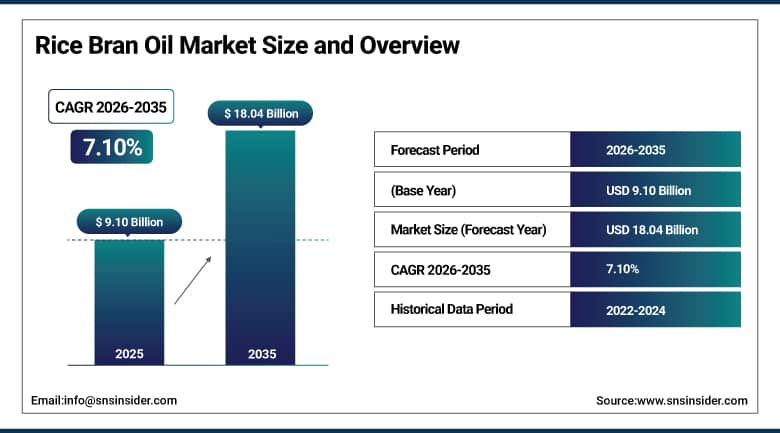
The Rice Bran Oil Market was valued at USD 9.10 Billion in 2025 and is expected to reach USD 18.04 Billion by 2035, growing at a CAGR of 7.10% from 2026 to 2035.
Rice bran oil market is experiencing high growth due to increased consumer inclination towards healthy oils that are rich in balanced fat content and are cholesterol-reducing agents. The growing awareness regarding heart ailments and other diseases caused by lifestyle changes are driving demand for rice bran oil in various culinary applications both within homes and in processed foods. Growing food processing and food services sectors are further fueling market growth. Availability of products in retail as well as online segments and rising rice production across the globe are key factors driving global market growth during the forecast period.
According to the European Food Safety Authority, dietary guidelines across Europe recommend reducing saturated fat intake to below 10% of total daily energy, supporting a shift toward healthier edible oils such as rice bran oil. The European Commission (Eurostat) reports the EU imports around 12–14 million tonnes of vegetable oils annually, reflecting strong dependence on imports and increasing diversification toward specialty and value-added edible oils.
Market Size and Forecast
-
Market Size in 2026E: USD 9.73 Billion
-
Market Size by 2035: USD 18.04 Billion
-
CAGR: 7.10% from 2026 to 2035
-
Fastest Growing Region: North America
-
Largest Region: Asia Pacific
To Get More Information On Rice Bran Oil Market - Request Free Sample Report
Rice Bran Oil Market Trends
-
Rising consumer preference for healthy edible oils with heart-friendly properties is driving the rice bran oil market.
-
Growing awareness of cholesterol management and lifestyle-related diseases is boosting market growth.
-
Expansion of food processing, retail distribution, and packaged food industries is fueling product demand.
-
Increasing adoption in household cooking, restaurants, and foodservice sectors is shaping consumption trends.
-
Advancements in refining technologies and extraction processes are improving oil quality, stability, and shelf life.
The U.S. Rice Bran Oil Market Outlook
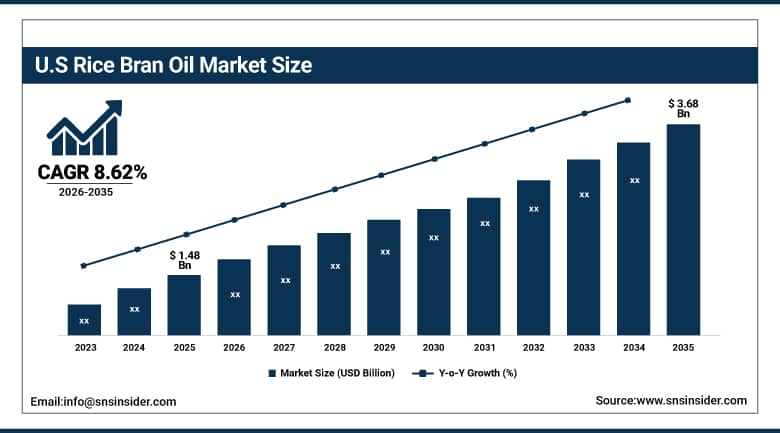
The U.S. Rice Bran Oil Market was valued at approximately USD 1.48 Billion in 2025 and is expected to reach approximately USD 3.68 Billion by 2035, growing at a CAGR of approximately 8.62%.
The United States is the most commercially advanced Western market for rice bran oil, supported by growing consumer health literacy regarding its cardiovascular benefits, its established presence in natural and specialty food retail channels, and growing adoption by domestic food manufacturers whose product reformulation programmes increasingly specify rice bran oil for its functional and nutritional positioning advantages. California, Texas, and Arkansas each host domestic rice processing operations whose bran by-product supply supports the U.S. rice bran oil extraction industry.
The U.S. foodservice sector generates over USD 900 billion annually, driving strong demand for stable, high-smoke-point oils used in frying, processing, and large-scale commercial cooking operations across restaurants and institutional kitchens.
Rice Bran Oil Market Segment Analysis
-
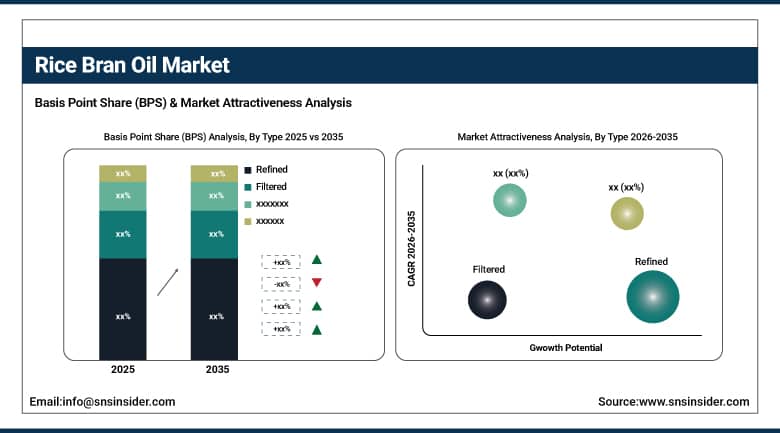
By Type, Refined oil held the largest market share of 64.27% in 2025, while the Filtered segment is expected to grow at the fastest CAGR of 9.68% during 2026–2033.
-
By Category, the Conventional segment dominated with a 71.54% share in 2025, while Organic rice bran oil is projected to expand at the fastest CAGR of 10.12% during the forecast period.
-
By Application, Food & Beverages accounted for the highest market share of 59.83% in 2025, while the Cosmetics segment is anticipated to record the fastest CAGR of 9.91% through 2026–2033.
-
By Distribution Channel, Supermarkets & Hypermarkets held the largest share of 46.78% in 2025, while Online Retail is expected to grow at the fastest CAGR of 10.27% during 2026–2033.
By Type, refined oil segment held the largest market share, filtered segment is the fastest growing
The Refined oil segment held the largest market share in 2025 owing to higher preference among consumers because of longer shelf life, absence of taste, and stability during cooking. This can be attributed to its wider availability through retail channels and significant use in households, food service establishments, and processing facilities for preparing food items. Moreover, factors such as consistent quality, cost-effectiveness, and capability to produce on a larger scale contribute to the wide popularity of refined oil around the globe.
The Filtered segment is the fastest growing owing to rising awareness among consumers about minimally processed and healthier edible oil. Filtered oils contain higher levels of natural compounds than refined oils. Growing consumer demand for clean label products along with the preference for traditionally processed oils will drive the demand for filtered oils. The increasing trend towards wellness along with changing eating habits of consumers has propelled growth in the market.
By Category, conventional segment dominated the market, organic rice bran oil segment is the fastest growing
The Conventional segment dominated the market in 2025 owing to high availability, lower prices, and developed distribution channels. Conventional rice bran oil is commonly used by both individual consumers and food manufacturing companies owing to the product's affordable nature and easy mass production techniques. Moreover, the widespread presence of agricultural sources along with developed processing facilities also supports segment leadership. Price consciousness in consumers from developing nations plays an important role in the dominance of conventional rice bran oil products.
The Organic rice bran oil segment is the fastest growing owing to the increasing consumption of natural and chemical free health-based edible oils. Growing awareness among consumers regarding lifestyle diseases and use of organic products has made them choose organic rice bran oil owing to its health benefits. The organic rice bran oil being naturally extracted makes it a healthier option.
By Application, food & beverages segment accounts for the highest market share, cosmetics segment is the fastest growing
The Food & Beverages segment accounted for the highest market share in 2025 owing to its widespread application as a cooking, frying, baking, and food-processing oil. The high smoke point, health advantages, and absence of taste made it fit for multiple culinary applications. Growing demand from residential, commercial, and packaged food industries also contributed significantly towards making it the market leader. Furthermore, rising consumption of convenience foods ensures that it will continue its reign in the future.
The Cosmetics segment is the fastest growing due to the growing usage of rice bran oil in skin and hair care formulations. The antioxidant properties, moisturization abilities, and rich vitamin content makes it an ideal choice for cosmetic formulation. With consumers becoming more aware of natural beauty products, there is a marked trend towards incorporating it in cosmetics. Furthermore, growing premium skincare lines and consumer demand for natural products drive market growth.
By Distribution Channel, supermarkets & hypermarkets segment held the largest share, online retail segment is the fastest growing
The Supermarkets & Hypermarkets segment held the largest share in 2025 owing to high customer preference for on-site shopping experiences and broad product range. The variety of brands, competitive prices, and discount offers in such retailing formats attract high demand from customers. Well-established supply chains and widespread coverage in urbanized areas add to the dominance of this market segment. Also, consumer confidence in physical retail stores for purchasing food products adds to the dominance of this market segment.
The Online Retail segment is the fastest growing owing to the increasing penetration of the internet, rise in mobile penetration, and convenience associated with home delivery services. Online retailing platforms provide ease in price comparisons, greater product selection, and attractive discounts. Besides, the development of digital grocery platform offerings and improved logistics networks contribute to rapid growth in this market segment. Increasing inclination toward digital shopping by consumers, particularly younger customers, is boosting its growth worldwide.
Regional Analysis
|
Region |
Major Country |
Share within Region, 2025 (%) |
|---|---|---|
|
Asia Pacific |
India |
34.82% |
|
North America |
United States |
82.47% |
|
Europe |
Germany |
26.84% |
|
Middle East & Africa |
UAE |
18.73% |
|
Latin America |
Brazil |
42.84% |
Asia Pacific Rice Bran Oil Market Insights
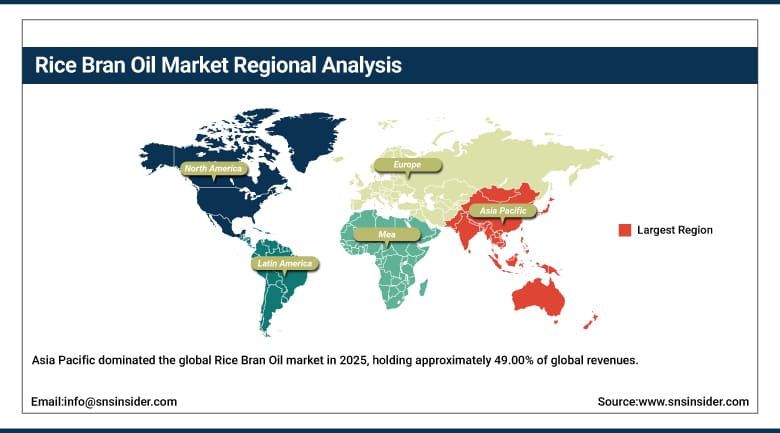
Asia Pacific dominated the global Rice Bran Oil market in 2025, holding approximately 49.00% of global revenues. India accounts for approximately 34.82% of Asia Pacific revenues as the world's second-largest rice producer and a rapidly growing rice bran oil consumer market where brands including Fortune by Adani Wilmar, Emami Healthy and Tasty, and Saffola Rice Bran Oil are building premium brand awareness among health-conscious urban consumers. Japan is the most mature per-capita rice bran oil consuming market globally, with the oil deeply embedded in traditional Japanese cuisine and pharmaceutical applications.
According to the Food and Agriculture Organization, global rice production exceeds 780 million tonnes annually, with Asia contributing over 90%, generating large volumes of rice bran as a key by-product used in edible oil extraction and food processing industries worldwide.
India’s Ministry of Agriculture reports rice production exceeds 135 million tonnes annually, making the country one of the largest sources of rice bran oil production, supported by strong agricultural output and expanding food processing and value-added agro-industries.
The World Health Organization reports cardiovascular diseases cause over 10 million deaths annually in Asia, increasing demand for healthier edible oils that support heart health and balanced dietary consumption patterns across growing populations.
Get Customized Report as Per Your Business Requirement - Enquiry Now
North America Rice Bran Oil Market Insights
North America is the fastest-growing regional Rice Bran Oil market, projected to expand at a CAGR of approximately 8.84% through 2035. The United States accounts for approximately 82.47% of regional revenues. Consumer health trends emphasising heart-healthy dietary choices, the growing natural and organic food retail sector, and the food manufacturing sector's increasing adoption of rice bran oil for premium product formulation positioning are collectively sustaining above-average market growth. The region's higher per-unit pricing, driven by premium retail channel concentration and organic product mix, generates revenue growth rates that exceed volume growth rates and support favourable market economics for both domestic producers and import suppliers serving U.S. specialty and natural food retail accounts.
According to the U.S. Centers for Disease Control and Prevention, about 6 in 10 U.S. adults live with at least one chronic disease, while heart disease remains the leading cause of death, highlighting major long-term dietary and healthcare challenges nationwide.
The United States Department of Agriculture reports Americans consume over 40 pounds of added fats and oils per capita annually, with a gradual shift toward healthier unsaturated fat-based dietary choices across the population.
Europe Rice Bran Oil Market Insights
Europe held approximately 14.84% of global Rice Bran Oil revenues in 2025, growing at a CAGR of approximately 4.60% through 2035. The European market is characterised by premium positioning concentrated in natural and organic food retailers, specialty Asian food grocery channels, and food service operations serving Asian cuisine whose traditional use of rice bran oil creates ongoing procurement demand. Germany, the United Kingdom, France, and the Netherlands are the leading national markets. European consumers are progressively discovering rice bran oil's nutritional profile through natural food media and health-focused retail promotional programmes, building a growing premium segment that is supplementing the historically small specialty Asian grocery channel base from which rice bran oil was initially distributed in European markets.
The European Society of Cardiology states that cardiovascular diseases cause approximately 1.7 million deaths annually in the EU, driving growing demand for heart-healthy, cholesterol-friendly edible oil alternatives.
MEA & Latin America Rice Bran Oil Market Insights
Middle East and Latin America are smaller but growing Rice Bran Oil markets where rising health consciousness, dietary diversification among urban middle-class consumers, and growing food manufacturing sector adoption are creating commercial development opportunities. The UAE leads MEA revenues at approximately 18.73% of the regional total through its diverse expatriate population with established Asian culinary traditions that include rice bran oil consumption, and its well-developed premium food retail infrastructure that provides accessible distribution for imported premium rice bran oil brands.
According to the Food and Agriculture Organization, the Middle East imports over 85% of its edible oil requirements, creating strong demand for dietary diversification and healthier oil alternatives across the region’s food consumption markets.
According to the Pan American Health Organization, cardiovascular diseases account for around 31% of all deaths in Latin America, while FAO data shows regional cereal production exceeding 250 million tonnes annually, supporting by-product utilization for rice bran oil production and agro-processing value chains.
Market Dynamics
Growth Drivers: Growing health awareness and high-heat cooking benefits driving sustained global rice bran oil demand expansion.
Rice bran oil's commercial growth momentum is fundamentally driven by scientific evidence validation that is progressively becoming mainstream consumer knowledge. Peer-reviewed clinical studies demonstrating gamma-oryzanol's cholesterol-modifying effects, tocotrienol's antioxidant superiority over conventional tocopherol vitamin E, and the oil's balanced omega fatty acid profile relative to competing edible oils have provided the evidence base that health-focused consumers, dietitians, and food manufacturers reference in making oil selection decisions. As this evidence has been communicated through health media, physician education programmes, and brand marketing campaigns in major markets including India, Japan, and the United States, consumer willingness to pay the premium that rice bran oil commands over commodity cooking oils has strengthened measurably.
Restraints: Limited rice bran supply and raw material competition constraining large-scale production capacity expansion globally.
Rice bran is available only at rice milling locations, and its oil extraction requires prompt processing because the bran's lipase enzyme activity rapidly degrades the oil's quality through hydrolytic rancidity if the bran is not stabilised or processed within hours of milling. This stabilisation requirement and the geographic concentration of bran supply at rice mills whose locations are determined by agricultural geography rather than oil production logistics create infrastructure challenges for rice bran oil industry expansion. The proportion of global rice production that is processed through facilities with rice bran oil extraction capabilities remains substantially below the theoretical maximum, meaning that significant latent supply potential exists but requires capital investment in stabilisation and extraction equipment at individual mill locations to realise.
Opportunities: Gamma-oryzanol extraction and international market development creating premium value opportunities for rice bran oil producers.
Pharmaceutical-grade gamma-oryzanol extraction represents a value-added conversion opportunity that can significantly improve the economics of rice bran oil production by capturing the functional compound whose cardiovascular, menopausal symptom management, and sports performance applications are generating growing nutraceutical market demand at prices far exceeding bulk edible oil market values. Producers who invest in the concentration and standardisation processes required to produce certified pharmaceutical-grade gamma-oryzanol extract can sell this premium product into nutraceutical, pharmaceutical, and functional food markets where per-kilogram values are multiples of conventional cooking oil pricing.
Recent Developments:
-
2025: Adani Wilmar launched expanded Fortune Rice Bran Oil marketing campaign in India featuring cardiac specialist endorsements and digital health education initiatives, targeting urban Tier 1 and Tier 2 consumers and strengthening premium cooking oil brand preference significantly.
-
2024: Riceland Foods expanded rice bran oil extraction capacity in Arkansas, strengthening U.S. domestic supply chains and meeting rising demand from food manufacturers seeking locally sourced, high-quality rice bran oil for premium formulations.
-
2024: Tsuno Group launched premium cold-pressed rice bran oil product line in Japan, targeting natural food retail and export markets, emphasizing retention of bioactive compounds and positioning against conventionally refined rice bran oil products globally.
Rice Bran Oil Market Key Players are:
-
Ricela Health Foods Ltd.
-
Wilmar International
-
King Rice Oil Group
-
BCL Industries Ltd.
-
Agrotech Foods Ltd.
-
3F Industries Ltd.
-
Sethia Oils Ltd.
-
Vaighai Agro Products Ltd.
-
Tsuno Rice Fine Chemicals Co., Ltd.
-
Cargill Inc.
-
Marico Ltd.
-
Modi Naturals Ltd.
-
Ruchi Soya Industries Ltd.
-
Wanyuan Food & Oil Co., Ltd.
-
SVR Oil
-
Gustav Heess GmbH
-
Gemini Edibles & Fats India Ltd.
-
California Rice Oil Company
-
Emami Agrotech Ltd.
-
Bunge Limited.
Rice Bran Oil Market Report Scope:
| Report Attributes | Details |
|---|---|
| Market Size in 2025 | USD 9.10 Billion |
| Market Size by 2035 | USD 18.04 Billion |
| CAGR | CAGR of 7.10% From 2026 to 2035 |
| Base Year | 2025 |
| Forecast Period | 2026-2035 |
| Historical Data | 2022-2024 |
| Report Scope & Coverage | Market Size, Segments Analysis, Competitive Landscape, Regional Analysis, DROC & SWOT Analysis, Forecast Outlook |
| Key Segments | • By Type (Refined, Filtered, Others) • By Category (Organic, Conventional) • By Application (Food & Beverages, Cosmetics, Pharmaceuticals, Industrial) • By Distribution Channel (Supermarkets & Hypermarkets, Convenience Stores, Online Retail, Specialty Stores, Others) |
| Regional Analysis/Coverage | North America (US, Canada), Europe (Germany, UK, France, Italy, Spain, Russia, Poland, Rest of Europe), Asia Pacific (China, India, Japan, South Korea, Australia, ASEAN Countries, Rest of Asia Pacific), Middle East & Africa (UAE, Saudi Arabia, Qatar, South Africa, Rest of Middle East & Africa), Latin America (Brazil, Argentina, Mexico, Colombia, Rest of Latin America). |
| Company Profiles | Ricela Health Foods Ltd., Wilmar International, King Rice Oil Group, BCL Industries Ltd., Agrotech Foods Ltd., 3F Industries Ltd., Sethia Oils Ltd., Vaighai Agro Products Ltd., Tsuno Rice Fine Chemicals Co., Ltd., Cargill Inc., Marico Ltd., Modi Naturals Ltd., Ruchi Soya Industries Ltd., Wanyuan Food & Oil Co., Ltd., SVR Oil (Sri Venkatrama Oil), Gustav Heess GmbH, Gemini Edibles & Fats India Ltd., California Rice Oil Company, Emami Agrotech Ltd., Bunge Limited |
Frequently Asked Questions
Asia Pacific dominated the Rice Bran Oil Market in 2025, holding approximately 49.00% of global revenues.
The food & beverages segment dominated the Rice Bran Oil Market with 58.80% share in 2025.
Growing health awareness, bioactive compounds, food industry adoption, nutraceutical demand, and premium cooking oil trade-up driving Rice Bran Oil Market growth.
The Rice Bran Oil Market was valued at USD 9.10 Billion in 2025.
The Rice Bran Oil Market is expected to grow at a CAGR of 7.10% from 2026 to 2035.
