
Robotic Endoscopy Devices Market Report Scope & Overview:
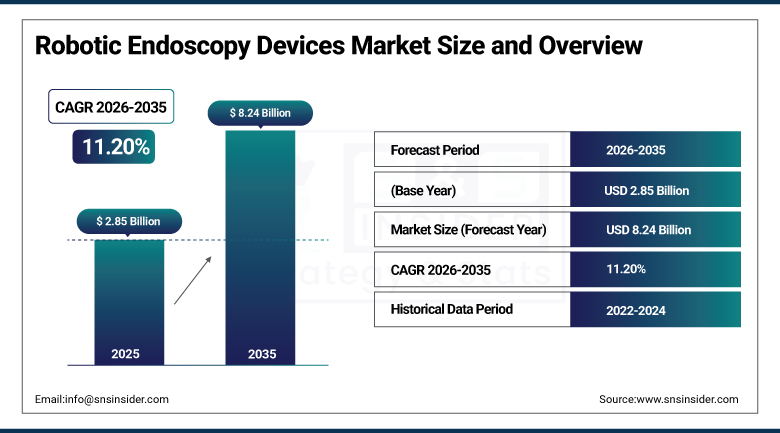
The Robotic Endoscopy Devices Market was valued at USD 2.85 Billion in 2025 and is expected to reach USD 8.24 Billion by 2035, growing at a CAGR of 11.20% from 2026 to 2035.
The robotic endoscopy devices market experiences constant and stable growth due to the increase in the prevalence of gastrointestinal, pulmonary, and urological diseases that demand precise diagnosis and treatment; increasing preference by physicians and hospitals for less invasive endoscopy compared to traditional open and manual ones, and constant progress in robotic motion, imaging, and navigation technologies. Robotic endoscopy systems integrate robotics technology, imaging, and artificial intelligence for navigation to allow doctors access to more difficult areas than in case of manual endoscopy.
In 2026, Intuitive Surgical and Medtronic extended their flexible robotic endoscopy systems because of increased need by hospitals of combined diagnostic to therapeutic robotic navigation systems due to an increase in use of minimally invasive procedures in gastroenterology, pulmonology, and urology applications globally.
To Get more information On Robotic Endoscopy Devices Market - Request Free Sample Report
Robotic Endoscopy Devices Market Trends:
-
Rising integration of AI-assisted navigation and lesion-detection software is improving diagnostic accuracy and procedural efficiency across robotic endoscopy platforms.
-
Growing adoption of robotic-assisted bronchoscopy for early-stage lung cancer diagnosis is expanding the pulmonology application base for robotic endoscopy systems.
-
Increasing preference for single-use and disposable robotic endoscopic components is reducing cross-contamination risk and reprocessing costs across hospital endoscopy units.
-
Expanding miniaturization of robotic actuators and catheter-based platforms is enabling access to smaller and more complex anatomicTo Get more information On Robotic Endoscopy Devices Market - Request Free Sample Reportal structures.
-
Strategic collaborations between robotic platform developers and hospital networks are accelerating clinical validation and commercial rollout of next-generation endoscopy systems.
U.S. Robotic Endoscopy Devices Market Outlook:
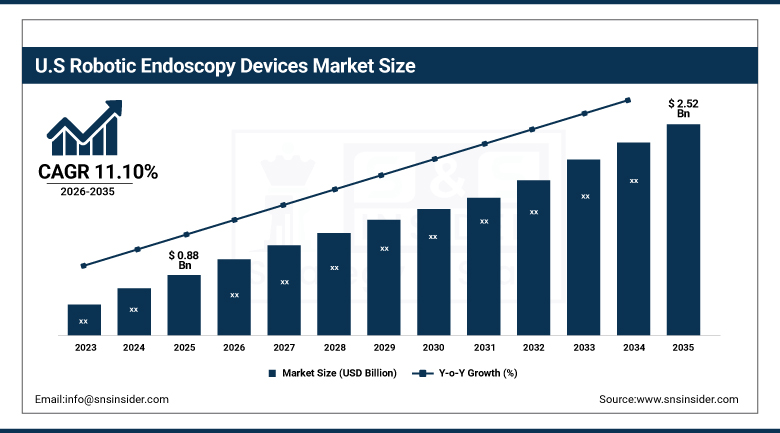
The U.S. Robotic Endoscopy Devices Market was valued at USD 0.88 Billion in 2025 and is projected to reach USD 2.52 Billion by 2035, growing at a CAGR of 11.10% during 2026–2035.
In the United States, top-tier hospitals and ASCs are increasingly utilizing robotic endoscopic technology as the result of increased screenings of patients who have gastrointestinal cancer, increased initiatives aimed at lung cancer screening which boost the need for robotic bronchoscopy and improved funding that is available for performing minimally invasive endoscopic procedures. There are several reasons behind the future robust demand for robotic endoscopy solutions including the highly developed manufacturing base of medical devices in the country, presence of top-end robotic endoscope manufacturers and funding for robotic surgery suites.
In 2026, Boston Scientific expanded its U.S. commercial rollout of its robotic-assisted single-use duodenoscope platform, strengthening its ability to supply infection-control-focused robotic endoscopy solutions to domestic hospital and ambulatory surgical center customers.
Robotic Endoscopy Devices Market Segment Analysis:
-
By Product, Robotic-Assisted Therapeutic Endoscopy Systems dominated the Robotic Endoscopy Devices Market with a 58.20% share in 2025, while Diagnostic Endoscopy Systems is the fastest-growing product segment with a CAGR of 13.60% from 2026–2035.
-
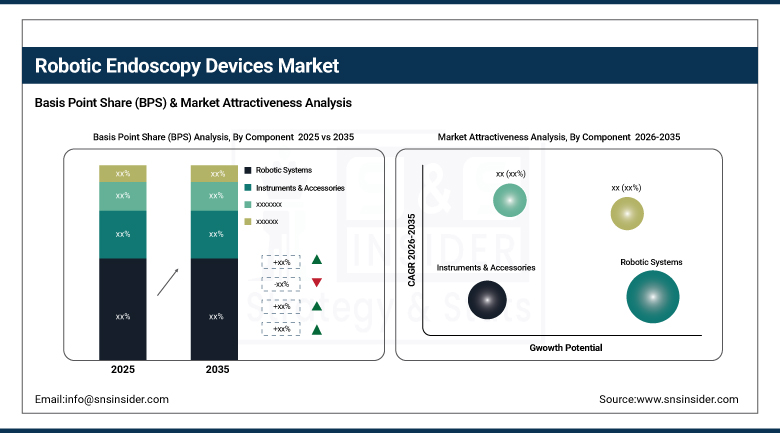
By Component, Robotic Systems dominated the Robotic Endoscopy Devices Market with a 47.60% share in 2025, while Software & Services is the fastest-growing component segment with a CAGR of 15.30% from 2026–2035.
-
By Application, Gastrointestinal Endoscopy dominated the Robotic Endoscopy Devices Market with a 42.30% share in 2025, while Bronchoscopy is the fastest-growing application segment with a CAGR of 14.20% from 2026–2035.
-
By End User, Hospitals dominated the Robotic Endoscopy Devices Market with a 68.50% share in 2025, while Ambulatory Surgical Centers is the fastest-growing end user segment with a CAGR of 14.60% from 2026–2035.
By Product, Robotic-Assisted Therapeutic Endoscopy Systems, while Diagnostic Systems is the fastest-growing segment.
The Robotic-Assisted Therapeutic Endoscopy Systems segment dominated the Robotic Endoscopy Devices Market in 2025. Therapeutic systems dominate as they enable the diagnosis and therapy, encompassing tumor excision, polyp removal, and biopsies, using one robotic-assisted surgery only. Increasing popularity among procedures for the gastrointestinal system, lungs, and urological intervention, alongside hospitals' investment in flexible robotic systems, will boost the use of the systems. Tertiary care hospitals with advanced robotic surgery and interventional endoscopy program will continue to be primary adopters of the systems.
Robotic-Assisted Diagnostic Endoscopy Systems is expected to show fastest CAGR from 2026 to 2035. Increasing focus on early detection of disease, especially colorectal and lung cancer, is driving the need for advanced robotic technology, offering high-definition images and navigation of complex anatomic pathways. Integration of AI-based imaging systems is helping in the detection of lesions, even if they are tiny or hard to reach. Such advancements are driving above average segment growth.
By Component, Robotic Systems dominated the Robotic Endoscopy Devices Market, while Software & Services is the fastest-growing segment.
The Robotic Systems category dominated the Robotic Endoscopy Devices Market in 2025. Robotic platforms, consoles, and controller units represent the largest upfront investment in robotic endoscopy installations, making them a major contributor to overall market revenue. Hospitals increasingly prioritize integrated robotic systems that can support multiple endoscopic applications across gastrointestinal, pulmonary, and urologic procedures. Their relatively long replacement cycles compared with instruments and accessories further strengthen the category’s revenue contribution.
The Software & Services segment is anticipated to grow at the fastest rate during the forecast period 2026-2035. Increasing demand for AI-powered navigation, lesion-detection, and procedural analytics software, alongside growing hospital reliance on recurring service, calibration, and training contracts to maintain robotic platform uptime, is driving accelerated growth in this segment as manufacturers increasingly monetize their installed robotic system base through subscription-based software upgrades and long-term service agreements.
By Application, Gastrointestinal Endoscopy dominated the Robotic Endoscopy Devices Market, while Bronchoscopy is the fastest-growing segment.
The Gastrointestinal Endoscopy segment dominated the Robotic Endoscopy Devices Market in 2025. Gastrointestinal procedures remain the largest application category owing to the high global incidence of colorectal cancer, Barrett's esophagus, and inflammatory bowel disease, all of which require frequent diagnostic and therapeutic endoscopic evaluation, combined with well-established robotic-assisted colonoscopy and upper GI procedure protocols across leading hospital gastroenterology departments. Widespread national colorectal cancer screening programs across North America, Europe, and parts of Asia Pacific continue to sustain strong procedure volumes, reinforcing continued robotic platform demand across both hospital and specialty outpatient gastroenterology settings worldwide.
The Bronchoscopy segment is expected to register the fastest CAGR during the forecast period 2026-2035. Rising global lung cancer incidence and expanding low-dose CT-based lung cancer screening programs are driving strong demand for robotic-assisted bronchoscopy platforms capable of navigating small, peripheral pulmonary nodules with greater precision than conventional bronchoscopy, enabling earlier biopsy and diagnosis while reducing the need for more invasive surgical procedures across the global pulmonology and interventional oncology treatment landscape.
By End User, Hospitals dominated the Robotic Endoscopy Devices Market, while Ambulatory Surgical Centers is the fastest-growing segment.
The Hospitals segment dominated the Robotic Endoscopy Devices Market in 2025. Hospitals remain the overwhelmingly dominant end-user category owing to their capacity to absorb the high upfront capital cost of robotic endoscopy platforms, availability of specialized interventional endoscopy and surgical teams trained in robotic-assisted procedures, and ability to support the full range of diagnostic and therapeutic robotic endoscopic applications across multiple clinical departments, reinforcing hospitals' position as the primary purchasing and procedural setting for robotic endoscopy technology worldwide.
The Ambulatory Surgical Centers segment is expected to witness the fastest CAGR during the forecast period 2026-2035. Growing healthcare system emphasis on cost containment and same-day discharge is encouraging migration of appropriate robotic-assisted diagnostic and minor therapeutic endoscopic procedures into outpatient ambulatory settings, supported by the introduction of more compact and cost-efficient robotic platforms specifically designed for ambulatory surgical center adoption, gradually improving accessibility and expanding the addressable procedure volume for this segment relative to established microbial fermentation approaches used in traditional hospital-based capital planning cycles.
Regional Analysis:
|
Region |
Major Country |
Share within Region, 2025 (%) |
|---|---|---|
|
North America |
United States |
85.00% |
|
Europe |
Germany |
28.00% |
|
Asia Pacific |
China |
24.00% |
|
Middle East & Africa |
UAE |
5.00% |
|
Latin America |
Brazil |
6.50% |
North America Robotic Endoscopy Devices Market Insights
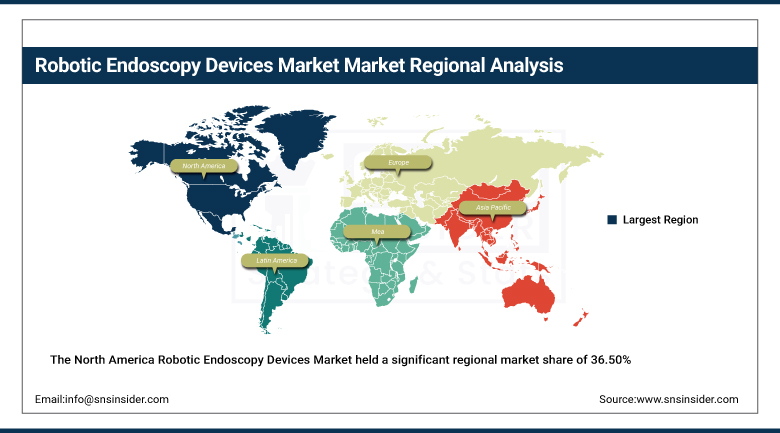
The North America Robotic Endoscopy Devices Market held a significant regional market share of 36.50% in 2025, driven by advanced robotic surgical infrastructure, leading robotic endoscopy platform developers, and growing awareness of the clinical and cost benefits of robotic-assisted procedures over conventional techniques. Positive payment structures have been encouraging the use of minimally invasive endoscopy techniques within the field of gastrointestinal, pulmonology, and urology. Large health care delivery systems with sufficient finances and well-endowed academic medical centers have been rapidly adopting next generation robotic systems. In addition, increased lung and colon cancer screening programs have boosted volume levels and robotic platform usage.
The US was the leading country within the North America Robotic Endoscopy Devices Market in 2025 with a market share of 85.00% of the regional market, driven by extensive hospital capital investment in robotic surgical infrastructure, strong domestic presence of leading robotic endoscopy manufacturers, and growing adoption of robotic-assisted bronchoscopy for lung cancer screening across major hospital systems. Canada is contributing to regional growth through its own expanding public hospital robotic surgery investment and growing adoption of minimally invasive gastrointestinal and pulmonary diagnostic procedures across major provincial healthcare networks.
Get Customized Report as per Your Business Requirement - Enquiry Now
Europe Robotic Endoscopy Devices Market Insights
The Europe region was a significant contributor to the Robotic Endoscopy Devices Market in 2025, expected to register comparatively higher growth for AI-integrated diagnostic robotic endoscopy platforms during the forecast period. This is attributed to the region's well-established hospital gastroenterology and pulmonology infrastructure, strong national cancer screening programs across member states, and growing regulatory support for minimally invasive robotic-assisted diagnostic and therapeutic technologies pursuing broader healthcare efficiency and early-detection objectives across both public and private hospital systems.
Germany is one of the major markets in Europe owing to its strong hospital robotic surgery infrastructure and presence of leading medical technology manufacturers serving both domestic and international customers. Other countries such as the UK, France, and Italy, home to well-established national cancer screening programs and academic medical centers, are also contributing to market growth through expanding robotic endoscopy procedure adoption and clinical research investment.
Asia Pacific Robotic Endoscopy Devices Market Insights
The Asia Pacific Robotic Endoscopy Devices Market is expected to witness the fastest growth rate during the forecast period 2026-2035, registering a CAGR of 13.80%. The market growth is driven by rapidly expanding hospital infrastructure investment, growing prevalence of gastrointestinal and lung cancers across the region's large population base, rising healthcare expenditure, and increasing government initiatives supporting early cancer detection and minimally invasive procedure adoption across the region's major and emerging healthcare economies pursuing broader medical technology modernization strategies.
China is one of the main growth drivers in the Asia Pacific Robotic Endoscopy Devices Market, owing to its rapidly expanding hospital robotic surgery infrastructure and growing domestic robotic endoscopy manufacturing capability supporting both local and export-oriented healthcare customers. India and Japan, both major regional healthcare markets, are also contributing to regional growth through expanding hospital capital investment and increasing adoption of robotic-assisted gastrointestinal and pulmonary diagnostic procedures.
Middle East & Africa and Latin America Robotic Endoscopy Devices Market Insights
Middle East & Africa and Latin American regions are gradually expanding robotic endoscopy adoption as hospital capital investment grows across both regions, supported by increasing government healthcare modernization initiatives and growing regional awareness of minimally invasive diagnostic and therapeutic procedure benefits.
Brazil is set to be a prominent Latin American market fueled by its large hospital network and growing investment in advanced surgical and endoscopic infrastructure across major private healthcare systems. The Middle East & Africa region has UAE and Saudi Arabia investing in modern hospital infrastructure that is gradually increasing demand for robotic endoscopy platforms across their expanding tertiary care and specialty hospital networks.
Market Dynamics:
Growth Drivers: Rising minimally invasive procedure adoption and technological advancement driving market growth
The rising global adoption of minimally invasive diagnostic and therapeutic procedures across gastrointestinal, pulmonary, and urologic specialties, combined with growing physician preference for robotic-assisted platforms offering superior precision, stability, and visualization compared with conventional manual endoscopy, are among the primary drivers of the Robotic Endoscopy Devices Market. Robotic endoscopy systems provide clinicians with enhanced navigational control, reduced procedure fatigue, and improved diagnostic yield, particularly in anatomically complex or difficult-to-reach regions, driving broader hospital adoption across virtually every major interventional endoscopy application, from early-stage cancer screening through complex therapeutic resection and biopsy procedures.
Technological advancements in flexible robotics and AI-based navigation have significantly increased procedural accuracy, with recent innovations improving lesion-detection rates and reducing average procedure time across commercial robotic endoscopy platforms. Rising hospital capital investment in robotic surgical infrastructure, growing integration of robotic-assisted bronchoscopy into national lung cancer screening programs, and continued medical device industry investment expanding robotic endoscopy manufacturing and R&D capacity are further supporting demand across the forecast period, as robotic platforms continue displacing conventional manual endoscopic techniques across an increasingly broad range of clinical specialties.
Restraints: High capital costs and reimbursement limitations restraining market expansion
One of the most critical obstacles to market growth is the substantial upfront capital cost associated with robotic endoscopy platform acquisition, installation, and staff training, which limits adoption among smaller hospitals, outpatient facilities, and healthcare systems operating in cost-constrained or emerging markets. This comes down to the fact that many robotic endoscopy applications remain in relatively early stages of clinical adoption compared with more established robotic surgical categories, and as such, procurement decisions often require extensive institutional budget justification and multi-year return-on-investment analysis before approval.
Moreover, inconsistent reimbursement coverage for robotic-assisted endoscopic procedures across different healthcare systems directly impacts hospital purchasing decisions and causes adoption variability across regions and provider types. Besides, the high technical requirements in terms of maintaining calibration, software updates, and procedural training for robotic endoscopy systems across changing clinical protocols and evolving regulatory requirements require considerable ongoing institutional investment beyond the initial platform purchase.
Opportunities: Expansion of AI-driven navigation and outpatient adoption creating new growth avenues
The increasing integration of AI-powered navigation and lesion-detection software into robotic endoscopy platforms, the rise of single-use and disposable robotic endoscopic components addressing infection-control priorities, and greater emphasis on miniaturized robotic catheter technology due to increased funding in medical robotics will provide ample growth opportunities in the Robotic Endoscopy Devices Market. The need for earlier, more accurate cancer detection through national screening programs across gastrointestinal and pulmonary specialties will ensure future growth as healthcare systems worldwide prioritize early intervention over late-stage treatment.
There is immense potential for growth in the area of compact, cost-efficient robotic endoscopy platforms designed specifically for ambulatory surgical centers and outpatient settings, expanding access beyond large tertiary hospitals while reducing per-procedure costs for healthcare providers. The increase in hospital infrastructure investment across emerging economies of Asia Pacific and Latin America, along with growing government focus on cancer screening and early-detection healthcare standards, will drive sustained demand growth.
Recent Developments:
-
2025: Intuitive Surgical received regulatory clearance for its Ion 2.0 robotic bronchoscopy platform, expanding peripheral lung nodule biopsy accuracy for pulmonology customers seeking earlier lung cancer diagnosis capability.
-
2025: Medtronic expanded its Hugo RAS platform with a dedicated flexible endoscopy module, enabling single-console integration of laparoscopic and endoluminal procedures for hospital surgical teams.
-
2025: Noah Medical expanded U.S. commercial deployment of its Galaxy robotic bronchoscopy system, strengthening its footprint among community hospital pulmonology programs.
-
2026: Olympus Corporation launched an AI-integrated robotic colonoscopy navigation system designed to improve polyp detection rates and reduce average procedure time for gastroenterology customers.
-
2026: CMR Surgical partnered with a regional distribution network to expand access to its Versius platform for flexible endoscopic procedures across new hospital systems in Asia Pacific.
Robotic Endoscopy Devices Market Key Players are:
-
Intuitive Surgical, Inc.
-
Medtronic plc
-
Boston Scientific Corporation
-
Olympus Corporation
-
Johnson & Johnson MedTech (Ethicon)
-
Stryker Corporation
-
KARL STORZ SE & Co. KG
-
Fujifilm Holdings Corporation
-
HOYA Corporation (PENTAX Medical)
-
Ambu A/S
-
CMR Surgical Ltd.
-
Asensus Surgical, Inc.
-
Vicarious Surgical Inc.
-
Noah Medical Corporation
-
EndoQuest Robotics, Inc.
-
Distalmotion SA
-
Levita Magnetics International Corp.
-
Virtuoso Surgical, Inc.
-
Auris Health, Inc. (a Johnson & Johnson company)
-
EndoMaster Pte Ltd.
Robotic Endoscopy Devices Market Report Scope:
| Report Attributes | Details |
|---|---|
| Market Size in 2025 | USD 2.85 Billion |
| Market Size by 2035 | USD 8.24 Billion |
| CAGR | CAGR of 11.20% From 2026 to 2035 |
| Base Year | 2025 |
| Forecast Period | 2026-2035 |
| Historical Data | 2022-2024 |
| Report Scope & Coverage | Market Size, Segments Analysis, Competitive Landscape, Regional Analysis, DROC & SWOT Analysis, Forecast Outlook |
| Key Segments | • By Product (Robotic-Assisted Therapeutic Endoscopy Systems, Robotic-Assisted Diagnostic Endoscopy Systems) • By Component (Robotic Systems, Instruments & Accessories, Software & Services) • By Application (Gastrointestinal Endoscopy, Bronchoscopy, Urology, Gynecology, Others) • By End User (Hospitals, Ambulatory Surgical Centers, Specialty Clinics) |
| Regional Analysis/Coverage | North America (US, Canada), Europe (Germany, France, UK, Italy, Spain, Russia, Poland, Rest of Europe]), Asia Pacific (China, India, Japan, South Korea, Australia, ASEAN Countries, Rest of Asia Pacific), Latin America (Brazil, Argentina, Mexico, Colombia, Rest of Latin America), Middle East & Africa (UAE, Saudi Arabia, Qatar, South Africa, Rest of Middle East & Africa) |
| Company Profiles | Intuitive Surgical, Inc., Medtronic plc, Boston Scientific Corporation, Olympus Corporation, Johnson & Johnson MedTech (Ethicon), Stryker Corporation, KARL STORZ SE & Co. KG, Fujifilm Holdings Corporation, HOYA Corporation (PENTAX Medical), Ambu A/S, CMR Surgical Ltd., Asensus Surgical, Inc., Vicarious Surgical Inc., Noah Medical Corporation, EndoQuest Robotics, Inc., Distalmotion SA, Levita Magnetics International Corp., Virtuoso Surgical, Inc., Auris Health, Inc. (a Johnson & Johnson company), EndoMaster Pte Ltd. |

Frequently Asked Questions
Key Players in the Robotic Endoscopy Devices Market include Intuitive Surgical, Inc., Medtronic plc, Boston Scientific Corporation, Olympus Corporation, and Johnson & Johnson MedTech (Ethicon), among others.
key opportunities include AI-assisted navigation, robotic bronchoscopy, outpatient endoscopy expansion, single-use systems, advanced imaging, and emerging-market adoption.
The market is driven by rising adoption of minimally invasive diagnostic and therapeutic procedures, growing prevalence of gastrointestinal and pulmonary disorders, and continued advancement in robotic navigation and imaging technology.
The Gastrointestinal Endoscopy segment dominated the Robotic Endoscopy Devices Market in 2025, accounting for approximately 42.30% market share.
The North America region dominated the Robotic Endoscopy Devices Market in 2025 with a 36.50% share, driven by advanced hospital robotic surgical infrastructure and strong presence of leading robotic endoscopy platform developers.
