
Robotics Dentistry Market Report Scope & Overview:
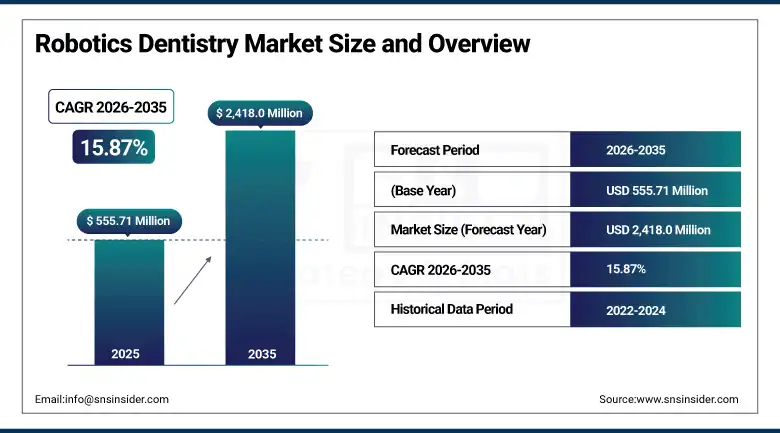
The Robotics Dentistry Market was valued at USD 555.71 million in 2025 and is projected to reach USD 2,418.0 million by 2035, expanding at a CAGR of 15.87% during the forecast period 2026–2035.
There are ongoing technological changes in the field of robotics dentistry through the fast development of artificial intelligence (AI), robotic implant placement, real-time guidance systems, cloud computing procedure analysis tools, and digital workflow process automation technologies within modern dental healthcare systems. There is a significant rise in investments in robot-assisted surgery processes among dental health professionals in order to increase procedural accuracy, minimize surgery differences, achieve successful implantation results, and maximize efficiency in treatment processes within specialist oral healthcare settings.
Cloud-based robotics workflow management tools that can help in analyzing treatments, procedure monitoring, and operational standardization from multiple sites are being used by dental hospitals, specialty oral surgery facilities, and dental service organizations (DSOs). The use of AI-based treatment planning systems in conjunction with investment in digitization of dentistry initiatives is anticipated to drive commercial growth prospects for providers of robotic dentistry technologies.
A number of dental robots vendors unveiled robotic implantology systems equipped with AI technology and CBCT scanning along with cloud computing solutions for treatment planning that helped increase the accuracy of implants while decreasing variability in procedures.
To Get more information On Robotics Dentistry Market - Request Free Sample Report
Robotics Dentistry Market Trends
-
AI-enabled robotic implantology workflow expansion
-
Growth of RFID-based dental instrument tracking systems
-
Growth of RFID-based dental instrument tracking systems
-
Expansion of sterilization traceability and UDI compliance systems.
-
Increasing deployment of real-time surgical asset monitoring solutions
The U.S. Robotics Dentistry Market Size Outlook
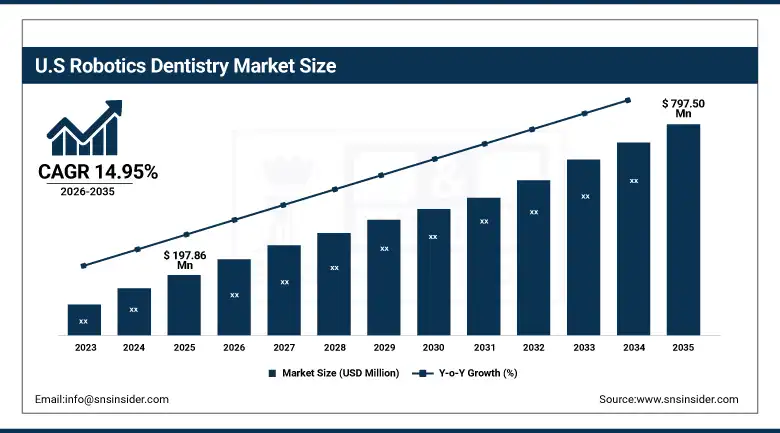
The U.S. Robotics Dentistry Market was valued at USD 197.86 million in 2025 and is expected to reach approximately USD 797.50 million by 2035, expanding at a CAGR of 14.95% during 2026–2035.
It can be stated that the US continues to dominate the robotics dentistry market in North America due to high quality digital dentistry facilities, growing adoption rates of robotically assisted Implantology operations, and high investments in AI-supported technologies for conducting oral surgeries. In this regard, specialty dental hospitals and dental service organizations that operate across multiple locations are using robotic implant placements along with AI-based navigational technologies. Cloud-based treatment planning solutions are also driving the market in favor of further development.
In the year 2025, several dental service organizations within the United States have increased the use of artificial intelligence-based robotic implant surgery systems with predictive procedure analysis and simulation technology. Robotic navigation systems that provide for automated implant planning and surgical assistance continue to gain more commercial traction, improving procedural accuracy at high-end oral healthcare facilities.
Robotics Dentistry Market Segment Analysis
-
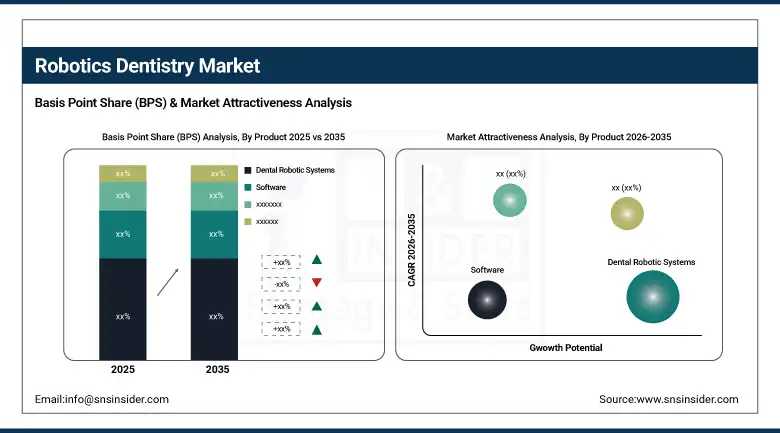
By product, dental robotic systems held a 45.01% market share in 2025, while Robot-Assisted Navigation Systems are projected to register the highest CAGR of 19.90% through 2035.
-
By Component, hardware dominated the market with a 52.02% share in 2025, while software is projected to witness the fastest growth through 2035.
-
By Application, the implantology segment dominated the market with a 42.01% share in 2025, while the orthodontics segment is projected to register the fastest CAGR during the forecast period.
-
By End User, DSO/group practices dominated the market with a 38.00% share in 2025, while the academic & research institutes segment is projected to register the fastest growth during the forecast period.
By Product, dental robotic systems segment dominates; software segment is fastest-growing.
The Dental Robotic Systems segment was estimated at around USD 250.13 million in 2025 and accounted for dominant market share owing to rising usage of robotic-assisted implant placement systems, automated oral surgery solutions, and robotic treatment devices across specialized dental care clinics and oral healthcare centers. The Software segment is expected to record a high CAGR of 18.44% during the forecast period owing to rising adoption of AI-enabled treatment planning platforms, procedural predictive analysis software solutions, cloud-based workflow management systems, and robot surgery management software platforms. With the advent of digital transformation in dental healthcare industry.
In 2026, a few specialized dental clinics installed robotic workflow systems that were cloud-based, which combined unique device identification with traceability features, as well as monitoring sterilization capabilities and predictive maintenance software.
By Component, hardware segment dominates; software segment is fastest-growing.
The Hardware category contributed around USD 289.08 million in 2025 and holds the highest market share due to the increased installation of robotic surgical arms, intraoral scanner, CBCT scanning systems, RFID technology for dental instruments, sterilization monitoring devices, and robotic navigation systems in dental health care facilities. Investment in advanced infrastructure and procedure ecosystem continues to promote hardware adoption in the global market. The services category contributed in healthcare organizations, there is growing demand for software services with a growing CAGR of 18.75%, for robotic integration, sterilization monitoring analysis, software upgrades, and remote procedural monitoring services.
In 2026, various companies providing robotic dentistry services rolled out more AI-enabled cloud services for analysis of procedures in real time and asset management systems to facilitate smart infrastructure for dentistry. In addition, some dental hospitals increased the use of sterilization monitoring services with RFID and UDI systems for traceability of surgical instruments.
By Application, implantology segment dominates; orthodontics segment is fastest-growing.
The Implantology segment contributed around USD 233.45 million in 2025 and captured a dominant market share because of the rise in the demand for robotic-assisted implant placement procedures, preference for minimally invasive surgery, and increased use of AI-based implant navigation. The use of robotics in implantology enhances accuracy and helps to ensure precise angulations in surgeries. On the other hand, the orthodontics segment will be the fastest-growing during the forecast period with a CAGR of 19.01%, as there is an increasing trend toward the use of robotic-assisted periodontal therapy, cosmetic dental surgery, advanced diagnostics, and AI-enabled preventive oral health solutions.
During the period of 2025–2026, a number of providers of dental technology advanced their commercial application of implant placement robots that were augmented by AI-enabled procedural analysis, haptic guided navigation, and surgical monitoring. Advanced specialist dental care centers also rapidly implemented RFID-based tracking for surgical instruments, in addition to robotic implantology processes, to improve UDI traceability and prevent infections among other things.
By End User, DSO/group practices segment dominates; academic & research institutes segment is fastest-growing.
In 2025, DSO/Group Practices contributed around USD 211.17 million and continued to be the leading end-user segment because of growing investment in centralizing robotic treatment equipment, artificial intelligence-driven workflow management systems, and multi-site operation solutions based in cloud technology. The academic & research institutes segment is estimated to experience a high CAGR of 16.22%, which is attributed to the rising utilization of robotic assistance dental solutions within specialized cosmetic dentistry centers, mobile dental operations, and new outpatient oral care clinics.
A number of DSOs have implemented AI-enabled robotic implantology systems with cloud-based workflow analytics, along with RFID-enabled sterilization monitoring systems.
Regional Analysis
|
Region |
Major Country |
Share within Region, 2025 (%) |
|---|---|---|
|
North America |
United States |
44.50% |
|
Europe |
Germany |
26.02% |
|
Asia Pacific |
China |
21.00% |
|
Middle East & Africa |
UAE |
5.00% |
|
Latin America |
Brazil |
3.50% |
North America Robotics Dentistry Market Insights
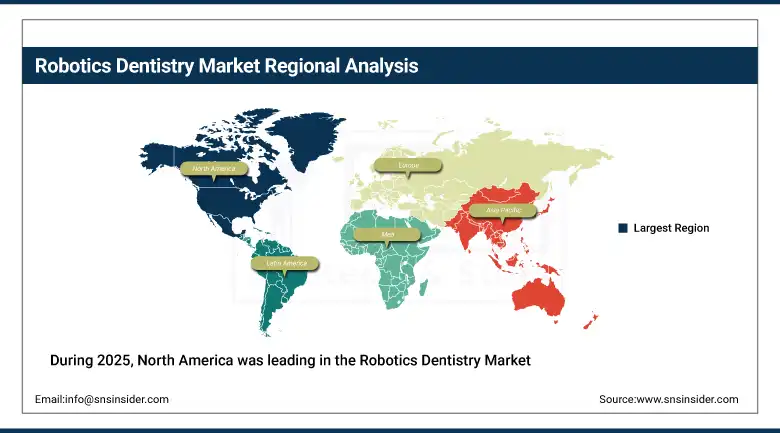
During 2025, North America was leading in the Robotics Dentistry Market due to digitized infrastructure of healthcare industry, increased utilization of robotics-based implantology processes, and growing investment in the application of AI in dental surgeries. Advantages such as the availability of companies offering advanced dental solutions, existence of several dental organizations, and higher adoption of minimally invasive procedures in oral health services contribute to the leadership of North America.
A number of dental care networks operating in North America increased the application of AI-driven robotic Implantology systems combined with cloud analysis and CBCT navigation technology.
Get Customized Report as per Your Business Requirement - Enquiry Now
Europe Robotics Dentistry Market Insights
A substantial portion of the world’s robotics dentistry market revenue share belonged to Europe in 2025 due to high emphasis on regulations concerning infection prevention, sterilization process documentation, and healthcare digitalization. Among those European nations investing in robotic dentistry procedures and devices are Germany, France, Italy, Spain, and the United Kingdom. Europe maintains continuous development and improvement of standards relating to UDI systems in dentistry and surgical sterilization documentation. As a result of these regulations, there is a rising need in RFID tracking systems, cloud-based monitoring solutions, and robotic procedures management systems.
Align Technology rolled out Align X-ray Insights in the European Union and the UK, featuring AI-driven radiography analysis and cloud-based workflow optimization in digital dentistry systems exhibited at IDS Cologne 2025.
Asia Pacific Robotics Dentistry Market Insights
Increasing investments in smart hospitals and digitized dentistry services in the Asia Pacific region have led to a significant surge in demand for robot-based surgical instruments, imaging analytics systems powered by AI, and other technologies supporting procedure management. China holds the position of the dominant contributor among the nations of the region owing to increased manufacturing of robots and dental technologies.
Several Asia Pacific-based dental care service providers have started to increase their investments in AI-driven robotic Implantology systems along with image analytics and workflow automation solutions.
Middle East & Africa and Latin America Robotics Dentistry Market Insights
The robotics dentistry market in the Middle East & Africa is projected to register the highest CAGR of 18.24%, during the forecast period due to high investment in premium dental healthcare infrastructure, smart hospital renovation projects, and artificial intelligence (AI) integrated health care solutions. Increasing adoption of robotic dental surgeries integrated with cloud workflow automation solutions will create many business opportunities in the coming years. Latin America is steadily becoming an attractive destination for robotics dentistry due to growing demands for cosmetic dentistry treatments and dental implant surgeries as well as modernization of oral healthcare infrastructure.
Align Technology introduced its iTero Lumina™ intraoral scanner in Saudi Arabia at the conference SIDC 2026, contributing to the widespread use of AI-driven digital dental practices in the region.
Market Dynamics
Growth Drivers: AI-driven precision dentistry accelerating robotic workflow adoption
The continued incorporation of AI, robotic navigation systems, imaging analytics in real-time, and cloud-based workflow automation systems is dramatically changing the delivery methods of modern dental healthcare. There have been several attempts at using robotic assistance in dentistry in order to provide accuracy, lower surgical variability, and enhance patient results while conducting treatments through Implantology and oral surgery. The demand for minimal incision surgical procedures, together with the increased incorporation of digital connectivity within dental environments, continues to drive market growth.
The suppliers of dental technology have increased the use of cloud-computerized robotic ecosystems that incorporate instrument tracking, sterilization, and workflow optimization using RFID technologies.
Restraints: High capital investment and integration complexity limiting deployment
Although there have been a number of technological innovations, the adoption of robotics dentistry technology is still constrained by high investment cost, complexity involved in integrating the system with existing dentistry procedures, and extensive training needs. In many cases, small dental centers and independent practitioners encounter financial constraints when deploying robotic surgery systems integrated with AI-driven image-processing software and cloud computing platforms.
A number of dental healthcare providers have had to postpone plans to implement robotic workflows in their facilities due to increased costs incurred from incorporating AI-based imaging and procedures.
Opportunities: Smart dental infrastructure and AI analytics creating long-term commercial potential
The exponential growth seen in smart hospital environments, AI-driven treatment planning ecosystem, and digitally connected oral healthcare centers is providing immense opportunities from a business standpoint for the robotics dentistry service providers. Health care organizations are focusing on adopting a centralized robotic surgery system along with the integration of RFID-based medical instrument tracking system, sterilization monitoring cloud-based technologies, and predictive workflow analytics software.
Multiple dental robotics providers expanded AI-assisted implantology platforms integrated with CBCT-guided navigation systems and cloud-based procedural analytics to improve precision-driven oral surgeries.
Recent Developments
-
2026: Multiple dental technology providers launched AI-powered robotic implantology systems integrated with cloud-based procedural analytics and real-time CBCT imaging platforms.
-
2026: Several advanced dental hospitals expanded deployment of RFID-enabled instrument tracking systems integrated with sterilization compliance monitoring and UDI traceability platforms.
-
2025: Robotics dentistry manufacturers introduced cloud-connected treatment planning ecosystems supporting predictive procedural analytics and centralized robotic workflow optimization.
-
2025: Multiple specialty dental clinics expanded adoption of robotic-assisted oral surgery platforms integrated with AI-powered navigation systems and real-time procedural monitoring technologies.
Robotics Dentistry Market Key Players Are:
-
Envista Holdings Corporation
-
Straumann AG
-
Planmeca Oy.
-
Carestream Dental LLC.
-
Neocis Inc.
-
Vatech Co. Ltd.
-
Stranger BMX
-
3Shape A/S
-
A-dec Inc
-
Midmark Corporation
-
Image Navigation Ltd
-
Yoshida Dental Mfg. Co. Ltd
-
Morita Holdings Corporation
-
BIOLASE Inc.
-
Pearl Inc.
-
Medit Corp.
-
PlanSys Robotics
-
Shining 3D Dental
Robotics Dentistry Market Report Scope:
| Report Attributes | Details |
|---|---|
| Market Size in 2025 | USD 555.71 Million |
| Market Size by 2035 | USD 2,418.0 Million |
| CAGR | CAGR of 15.87% From 2026 to 2035 |
| Base Year | 2025 |
| Forecast Period | 2026-2035 |
| Historical Data | 2022-2024 |
| Report Scope & Coverage | Market Size, SMarket Size Analysis, Revenue Forecasting, Segment Analysis, Competitive Landscape, Regional Analysis, RFID & Barcode Technology Assessment, Smart Sterilization Management Analysis, AI-Driven Surgical Workflow Optimization, Regulatory Compliance Analysis, UDI Tracking Assessment, Real-Time Surgical Asset Monitoring, DROC & SWOT Analysis, Investment Trends, Hospital Digitization Assessment, and Future Market Opportunity Analysisegments Analysis, Competitive Landscape, Regional Analysis, DROC & SWOT Analysis, Forecast Outlook |
| Key Segments | • By Product (Dental Robotic Systems, Robotic-Assisted Navigation Systems, Robotic CAD/CAM Milling Systems, Software) • By Component (Hardware, Software, Services) • By Application (Implantology, Endodontics, Prosthodontics, Orthodontics, Oral & Maxillofacial Surgery, Others) • By End User (DSO/Group Practices, Dental Hospitals & Clinics, Academic & Research Institutes, Others) |
| Regional Analysis/Coverage | North America (US, Canada), Europe (Germany, UK, France, Italy, Spain, Russia, Poland, Rest of Europe), Asia Pacific (China, India, Japan, South Korea, Australia, ASEAN Countries, Rest of Asia Pacific), Middle East & Africa (UAE, Saudi Arabia, Qatar, South Africa, Rest of Middle East & Africa), Latin America (Brazil, Argentina, Mexico, Colombia, Rest of Latin America).Asia Pacific), Middle East & Africa (UAE, Saudi Arabia, Qatar, South Africa, Rest of Middle East & Africa), Latin America (Brazil, Argentina, Mexico, Colombia, Rest of Latin America). |
| Company Profiles | Dentsply Sirona Inc., Envista Holdings Corporation, Straumann AG, Align Technology Inc., Planmeca Oy., Carestream Dental LLC., Neocis Inc, Vatech Co. Ltd., Zimmer Biomet Holdings Inc., Stranger BM, 3Shape A/S, A-dec Inc, Midmark Corporation, Image Navigation Ltd, Yoshida Dental Mfg. Co. Ltd, Morita Holdings Corporation, BIOLASE Inc., Pearl Inc., Medit Corp., PlanSys Robotics, Shining 3D Dental. |
Frequently Asked Questions
The Robotics Dentistry Market was valued at USD 555.71 million in 2025.
The market is projected to reach USD 2,418.0 million by 2035.
The market is expected to expand at a CAGR of 15.87% during the forecast period.
North America dominated the global market owing to advanced digital dentistry infrastructure and increasing deployment of robotic-assisted implantology systems.
Dental Robotic Systems accounted for the largest revenue share in 2025.
