
Robotic Wheelchair Market Report Scope & Overview:
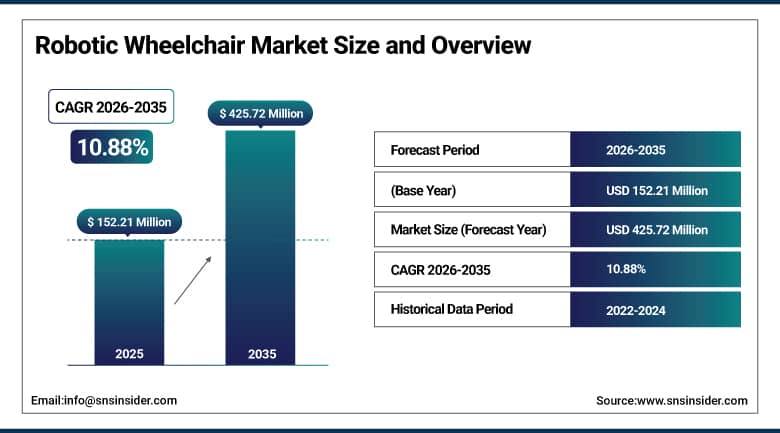
The global Robotic Wheelchair Market size was valued at USD 152.21 Million in 2025 and is expected to reach USD 425.72 Million by 2035, growing at a CAGR of 10.88% from 2026 to 2035.
The Robotic Wheelchair Market is witnessing considerable expansion due to rising demand for advanced assistive mobility solutions, growing ageing population, increasing prevalence of mobility impairments and quick integration of artificial intelligence, sensor technologies and smart navigation systems in healthcare devices. Robotic wheelchairs are emerging as important mobility aids for the elderly and disabled, providing increased independence, automatic navigation, obstacle identification and improved user safety. Further, increasing adoption of IoT-enabled healthcare technologies, rehabilitation robotics and advanced electric mobility systems in hospitals, rehabilitation centres and home care settings is driving the market growth.
In 2026, Sunrise Medical announced the acquisition of Ergoflix, a German innovator in foldable power wheelchairs, further strengthening its global position in smart, lightweight and design-conscious power mobility solutions. This acquisition will speed up the innovation of next-generation robotic and intelligent wheelchair technologies for users who need advanced mobility assistance.
Market Size and Forecast
-
Market Size in 2026E: USD 168.03 Million
-
Market Size by 2035: 425.72 Million
-
CAGR: 10.88% from 2026 to 2035
-
Fastest Growing Region: Asia Pacific
-
Largest Region: North America
To Get More Information On Robotic Wheelchair Market - Request Free Sample Report
Robotic Wheelchair Market Trends
-
Rising adoption of artificial intelligence, smart sensors, and autonomous navigation technologies is increasing demand for advanced robotic wheelchairs with improved mobility assistance and safety features.
-
Growing aging population and increasing prevalence of mobility impairments are accelerating the adoption of robotic wheelchairs across healthcare facilities, rehabilitation centers, and home care environments.
-
Increasing integration of IoT connectivity, cloud-based monitoring, and assistive technologies is driving the development of connected and intelligent wheelchair solutions.
-
Expansion of rehabilitation robotics and personalized mobility solutions is creating strong demand for customizable robotic wheelchairs with enhanced user independence and comfort.
-
Strategic collaborations among medical device companies, robotics developers, and healthcare providers are supporting the development of energy-efficient, AI-enabled, and next-generation robotic mobility systems.
U.S. Robotic Wheelchair Market Size Outlook
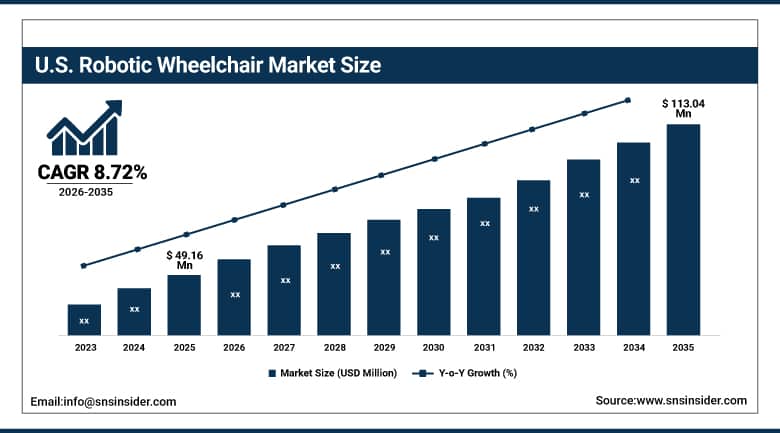
The U.S. Robotic Wheelchair Market was valued at USD 49.16 Million in 2025 and is expected to reach USD 113.04 Million by 2035, growing at a CAGR of 8.72% from 2026 to 2035.
The U.S. Robotic Wheelchair Market is estimated to register healthy growth driven by an increasing ageing population, rising mobility disability incidence rates, and increasing acceptance of cutting-edge assistive mobility technologies. The United States has advanced healthcare facilities, an advanced medical device manufacturing industry and increasing investment in artificial intelligence, robotics, and digital healthcare. The rising need for mobility independence, rehabilitation and smart healthcare devices drives the demand for robotic wheelchairs incorporating AI-based navigation, obstacle avoidance, IoT connectivity and autonomous safety features. In addition, the growth in hospital and rehabilitation facilities along with homecare settings is boosted by favorable reimbursement policies, the rising demand for home healthcare services and product innovation.
In 2026, Apple updated visionOS to integrate Apple Vision Pro’s eye tracking technology to control power wheelchairs with the smart safety module from LUCI. It offers hands-free navigation via eye-gaze control along with an autonomous safety system of LUCI which prevents collisions and tip-overs in real-time, making it a significant advancement in intelligent assistive mobility technologies.
Robotic Wheelchair Market Segment Analysis
-
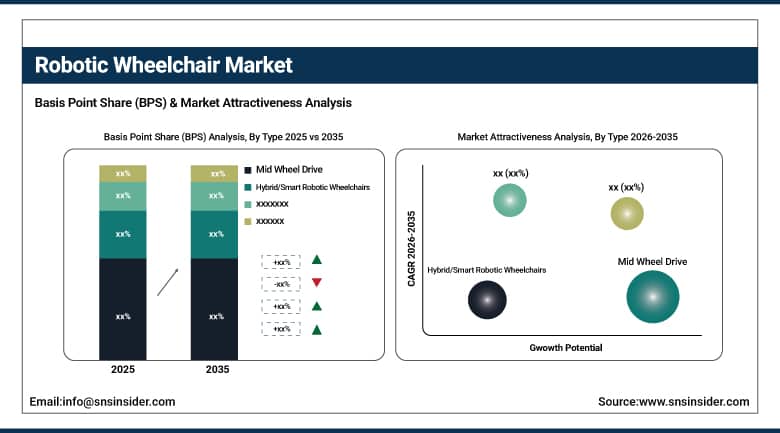
By Type, Mid Wheel Drive dominated the Robotic Wheelchair Market with a 28.40% share in 2025, while Hybrid/Smart Robotic Wheelchairs are the fastest-growing type segment with a CAGR of 14.31% from 2026–2035.
-
By Technology, Obstacle Detection & Navigation AI dominated the market with a 34.60% share in 2025, while Connectivity (IoT/Cloud Enabled) is the fastest-growing technology segment with a CAGR of 12.87% from 2026–2035.
-
By Control Mode, Joystick Control dominated the market with a 42.80% share in 2025, while Brain Computer Interface (BCI) is the fastest-growing control mode segment with a CAGR of 18.50% from 2026–2035.
-
By Application, Healthcare & Rehabilitation dominated the market with a 38.60% share in 2025, while Elderly Care Support is the fastest-growing application segment with a CAGR of 13.38% from 2026–2035.
-
By End User, Hospitals & Clinics dominated the market with a 32.80% share in 2025, while Elderly Care Facilities are the fastest-growing end-user segment with a CAGR of 13.61% from 2026–2035.
-
By Propulsion System, Electric Powered dominated the market with a 62.80% share in 2025 and is also the fastest-growing propulsion system with a CAGR of 12.46% from 2026–2035.
By Type, Mid Wheel Drive dominated the Robotic Wheelchair Market, while Hybrid/Smart Robotic Wheelchairs are expected to register the fastest growth.
The Mid Wheel Drive segment dominated the Robotic Wheelchair Market with a 28.40% revenue share in 2025. It has good manoeuvrability, small turning radius and improved indoor mobility which makes it very suitable for hospitals, rehabilitation centres and home environment. Mid-wheel drive robotic wheelchairs provide better stability and accurate manoeuvrability in confined spaces, increasing the user’s comfort and safety. The continuous adoption of assistive mobility devices in healthcare and home-care environments is driven by the growing demand from disabled and elderly people and the continuous technological advancements.
The Hybrid/Smart Robotic Wheelchairs segment is expected to record the fastest CAGR of 14.31% during the forecast period of 2026-2035. The growth is fuelled by increasing integration of artificial intelligence, autonomous navigation, obstacle detection, IoT connectivity and smart assistance technologies. These high-tech wheelchairs provide increased independence and real-time monitoring and adaptive mobility for individuals with complex disabilities. Rising investments in smart healthcare devices, favourable reimbursement policies and increasing demand for personalised mobility solutions are expected to drive the adoption across the globe.
By Technology, Obstacle Detection & Navigation AI dominated the Robotic Wheelchair Market, while Connectivity (IoT/Cloud Enabled) is expected to register the fastest growth.
The Obstacle Detection & Navigation AI segment dominated the Robotic Wheelchair Market with a revenue share of 34.60% in 2025. The segment is witnessing a rise in adoption of AI-powered mobility systems with the ability to perform autonomous path planning, collision avoidance and real-time navigation. Advanced vision systems, LiDAR sensors and AI algorithms are a great help for wheelchair users, improving safety, reliability and independence. Another driver for the market growth is the rising demand for intelligent mobility devices by hospitals, rehabilitation centres and elderly care homes.
The Connectivity (IoT/Cloud Enabled) segment is expected to grow at the fastest CAGR of 12.87% during the forecast period. Growth is driven by increasing demand for remote monitoring, predictive maintenance, cloud-based diagnostics and connected healthcare ecosystems. IoT-enabled robotic wheelchairs enable carers and healthcare providers to monitor the performance of the device, the location of the patient and its operating status in real time. The expansion of smart healthcare infrastructure and digital health initiatives will likely further accelerate deployment of connected mobility solutions.
By Control Mode, Joystick Control dominated the Robotic Wheelchair Market, while Brain Computer Interface (BCI) is expected to register the fastest growth.
The Joystick Control segment dominated the Robotic Wheelchair Market with a 42.80% revenue share in 2025. Joystick-controlled systems are still the most preferred solution due to their ease of use, affordability, reliability, and widespread clinical acceptance. They allow precise directional control, require little training, and are therefore appropriate for individuals with moderate upper-body mobility. Ongoing improvements in ergonomic joystick designs and programmable controls for use in hospitals, rehabilitation centres and home-care settings also support demand.
The Brain Computer Interface (BCI) segment is expected to grow at the fastest CAGR of 18.50% during the period 2026–2035. This fast development is driven by progress in neurotechnology, AI signal processing, and brainwave decoding systems that enable wheelchair control using neural activity. BCI technology offers an amazing level of independence for patients with severe paralysis and neurologic disorders. Lucrative market opportunities are expected to arise from increasing research funding, commercialisation of neuro-assistive technologies and developments in wearable brain sensors.
By Application, Healthcare & Rehabilitation dominated the Robotic Wheelchair Market, while Elderly Care Support is expected to register the fastest growth.
The Healthcare & Rehabilitation segment dominated the Robotic Wheelchair Market with a 38.60% revenue share in 2025. Strong adoption in hospitals, rehabilitation centres and long-term care facilities underpins market leadership. Robotic wheelchairs are used to help patients with injuries, neurological disorders and mobility impairments to rehabilitate and increase their independence. Demand for advanced mobility assistance solutions is driven by rising prevalence of disabilities, development of rehabilitation infrastructure and increasing healthcare costs
The Elderly Care Support segment is expected to register the fastest CAGR of 13.38% during the forecast period. Demand Drivers include the ageing population, growing prevalence of chronic diseases, and preference for independent living. The elderly are fond of robotic wheelchairs with AI for their smart navigation, ability to detect falls and remote monitoring features. Government initiatives to promote elder care and development of technology in assistive devices will further accelerate adoption.
By End User, Hospitals & Clinics dominated the Robotic Wheelchair Market, while Elderly Care Facilities are expected to register the fastest growth.
The Hospitals & Clinics segment dominated the Robotic Wheelchair Market with a 32.80% revenue share in 2025. Healthcare institutions continue to invest heavily in advanced robotic mobility systems to enhance patient transport, rehabilitation outcomes, and operational efficiency. The increasing number of orthopaedic procedures, neurological treatments and rehabilitation programmes is estimated to fuel the demand for technologically advanced robotic wheelchairs. The segment is also supported by supportive healthcare infrastructure and increasing patient volumes.
The Elderly Care Facilities segment is expected to account for the fastest CAGR of 13.61% during 2026-2035. The ageing populations with increasing life expectancy, increasing long-term care facilities and increasing demand for autonomous mobility solutions are driving the rapid growth of the market. AI-enabled robotic wheelchairs enhance resident safety, mobility and quality of life by enabling intelligent navigation and obstacle avoidance. Long-term growth is likely to be fuelled by rising investment in smart healthcare technology and senior living communities.
By Propulsion System, Electric Powered dominated the Robotic Wheelchair Market and is expected to register the fastest growth.
The Electric Powered segment dominated the Robotic Wheelchair Market with a 62.80% revenue share in 2025. Generally, electric powered robotic wheelchairs are preferred because of increased mobility, easier control, less physical effort and compatibility with contemporary AI navigation technologies. Advances in lithium-ion battery technology, motor efficiency and charging infrastructure have improved product performance and user convenience. The robust market demand is due to the rising adoption in healthcare facilities and home-care settings.
Electric Powered segment is also expected to witness fastest CAGR of 12.46% during the period 2026-2035. Growth is driven by continued innovations in battery technology, smart power management systems, autonomous driving and connected mobility solutions. The adoption is expected to grow at a rapid pace in the forecast period due to the growing demand for eco-friendly mobility devices, government incentives for assistive technologies and growing integration of smart healthcare ecosystems.
Regional Analysis:
|
Region |
Major Country |
Share within Region, 2025 (%) |
|---|---|---|
|
North America |
United States |
84.11% |
|
Europe |
Germany |
26.40% |
|
Asia Pacific |
China |
52.80% |
|
Middle East & Africa |
UAE |
28.60% |
|
Latin America |
Brazil |
41.40% |
North America Robotic Wheelchair Market Insights
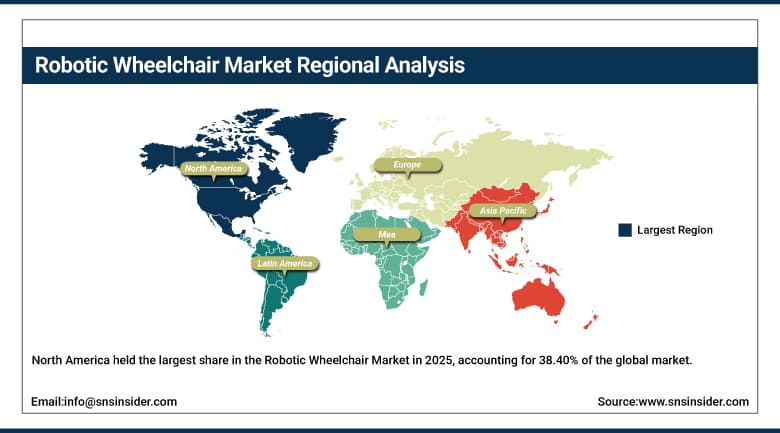
North America held the largest share in the Robotic Wheelchair Market in 2025, accounting for 38.40% of the global market. The region’s dominance is attributed to the advanced healthcare infrastructure, rising adoption of mobility technologies, favourable reimbursement landscape, and increasing investments in intelligent healthcare services. Market growth is projected to be fuelled by rising awareness of mobility aid solutions for the elderly and disabled population as well as technological innovations in robotic mobility devices. The presence of leading medical device manufacturers, rehabilitation centres and innovation in AI-driven mobility technologies will further drive the market in the region.
The United States dominated the North America Robotic Wheelchair Market in 2025, holding an 84.11% share of the regional market. The growth in the region is driven by increasing demand for advanced mobility aids, growing elderly population, high healthcare expenditure and adoption of intelligent mobility devices. Increasing investments in the infrastructure of rehab centres and home healthcare services, coupled with government initiatives aimed at accessibility, will propel the market forward.
Get Customized Report as Per Your Business Requirement - Enquiry Now
Europe Robotic Wheelchair Market Insights
Europe held a significant share of the Robotic Wheelchair Market in 2025, owing to the growth of the healthcare sector, the ageing population, and the use of rehabilitation technology in the region. Increase in government funding for the disabled people, increase in awareness about the need of mobility solutions, and technological advancement are some of the factors encouraging the use of robotic wheelchairs in healthcare institutions and even homes.
Germany is estimated to be one of the largest regions in Robotic Wheelchair Market due to the developed medical devices industry and healthcare infrastructure in Germany along with the high adoption of innovative rehabilitation technology. The UK, France, Italy and Netherlands are also contributing largely in the market due to their investments in modernisation of healthcare system and elderly care services.
Asia Pacific Robotic Wheelchair Market Insights
The Asia Pacific Robotic Wheelchair Market is projected to witness the fastest CAGR growth of 14.07% during 2026-2035. The growth of the regional market is driven by the increasing awareness about the mobility assistance technologies, rapid ageing population, increasing disposable income, and increasing healthcare infrastructure. Several countries’ governments are investing in disability support programmes, smart healthcare systems, and rehabilitation facilities, creating favourable conditions for the adoption of robotic wheelchairs. Demand is growing at an even faster pace across the region, driven by increasing urbanisation, higher spending on healthcare, and greater access to technologically advanced assistive devices.
China is the largest contributor in the Asia Pacific Robotic Wheelchair Market. The country's strong manufacturing base, ageing population and increasing investments in intelligent healthcare technologies support the market growth. The demand is strong in Japan, South Korea and India, driven by rapid healthcare modernisation, growing rehabilitation services, rising adoption of AI-enabled assistive devices and increasing government initiatives to improve mobility solutions for ageing and disabled populations.
Middle East & Africa and Latin America Robotic Wheelchair Market Insights
The Middle East & Africa and Latin America Robotic Wheelchair Markets are seeing slow but steady growth due to the improvement of the healthcare industry and awareness of advanced mobility assistance technology products. Increasing investments in rehabilitation centres, old age homes and programmes supporting disabled persons will provide ample growth opportunity for robotic wheelchairs adoption. Government and healthcare providers are now focusing on making the life of patients with disabilities and elderly more comfortable and accessible, which is providing impetus to the market growth in the coming years.
Brazil is taking the lead in the Latin American market with the increase in healthcare services, the use of assistive mobility devices and greater investments in rehabilitation centres. The Middle East & Africa Robotic Wheelchair Market is led by the UAE because of continuous investments in advanced healthcare infrastructure, smart hospitals, and digital healthcare services. Saudi Arabia and South Africa are also anticipated to contribute significantly to the regional growth with respect to the rehabilitation facilities, healthcare accessibility, and innovative mobility assistance for elderly and physically challenged persons.
Market Dynamics
Growth Drivers: Rising aging population and increasing adoption of intelligent mobility assistance driving market growth
The Robotic Wheelchair Market is witnessing significant growth owing to the rising ageing of the global population, rising incidences of mobility disorders and demand for better assistive mobility solutions. The growing awareness for independent living technology, advancements in rehabilitation solutions and increasing health care expenditure are driving the adoption of robotic wheelchairs in hospitals, rehabilitation centres, old age homes and even personal care. The demand for the market is growing significantly with the usage of technologies like artificial intelligence, autonomous driving, obstacle detection systems and smart control systems, leading to improvement in the safety and mobility of users.
Recent progress in robotic mobility technologies is changing the future of robotic wheelchairs. These technologies include AI-based navigation, driving assistance sensors, IoT connectivity, voice control systems and brain-computer interfaces. Market adoption is driven by government initiatives for accessibility, favourable reimbursement schemes and investment in smart healthcare infrastructure. Moreover, the rising demand for customised solutions and product innovations by the key players is creating a plethora of growth opportunities for the Robotic Wheelchair Market.
Restraints: High product costs and limited accessibility restricting wider market adoption
The acquisition cost still continues to be a major constraint for the growth in this market. Robotic wheelchairs with AI, self-navigation systems, lots of sensors and connected devices are much more expensive than the normal powered wheelchairs. Furthermore, the increased cost of maintenance, battery replacement, software updates and special care increases the overall cost which limits the use of robotic wheelchairs, especially in developing countries where people may not have adequate insurance or financial support.
The other major concern is the complexity of operating and maintaining such robotic mobility devices. They might require training for users to run efficiently. Adoption of the products can be hindered by limited reimbursement policies in some countries, lack of accessibility, and approval policies. In addition, technical challenges remain in terms of battery life, sensor operations and interface with the healthcare system.
Opportunities: Expansion of smart healthcare technologies and AI-enabled mobility solutions creating new growth avenues
Growing use of smart healthcare technologies, artificial intelligence and connected medical devices is opening up big opportunities for the Robotic Wheelchair Market. Increasing demand for smart mobility assistance for the elderly and people with disabilities is driving manufacturers to develop robotic wheelchairs with features such as autonomous navigation, obstacle avoidance, remote monitoring, and personalised mobility. Increasing investments in home healthcare, rehabilitation robotics, and digital healthcare platforms are likely to drive the deployment of advanced robotic mobility solutions across the developed and emerging markets.
Improving healthcare infrastructure, expanding rehabilitation services and increasing government initiatives supporting disability inclusion, are presenting substantial growth opportunities across Asia Pacific, Latin America and the Middle East & Africa emerging economies. Continuous advancements in battery technologies, lightweight materials, AI-powered navigation systems and cloud-connected mobility platforms are expected to further boost product capabilities. Throughout the forecast period, long-term market growth will be supported and innovation will be driven by strategic collaborations between healthcare providers, technology companies, and medical device manufacturers.
Recent Developments:
-
2025: Sunrise Medical introduced voice-activation technology for its Switch-It CTRL+5 power seating module, enabling hands-free seating adjustments for users with severe upper-limb mobility impairments in complex rehabilitation and smart robotic wheelchairs.
-
2025: Sunrise Medical acquired Made for Movement (MfM) to strengthen its rehabilitation portfolio by integrating robotic neurorehabilitation and therapeutic mobility technologies with advanced powered wheelchair solutions.
-
2025: France implemented a policy providing 100% public reimbursement for motorized and power-assist mobility devices under its National Health Insurance system, improving accessibility and accelerating adoption of robotic wheelchairs.
-
2025: Motion Canada partnered with LUCI to deploy sensor-fusion safety technology across healthcare networks, adding collision avoidance, anti-tip protection, and drop-off detection capabilities to existing powered wheelchairs.
Robotic Wheelchair Companies are:
-
Sunrise Medical LLC
-
Invacare Corporation
-
Pride Mobility Products Corporation
-
WHILL, Inc.
-
Ottobock SE & Co. KGaA
-
DEKA Research & Development Corp.
-
Karman Healthcare, Inc.
-
Matsunaga Manufactory Co., Ltd.
-
MEYRA GmbH
-
LEVO AG
-
Panterra HEC Ltd.
-
Numotion LLC
-
Motion Concepts LP
-
LUCI Technologies, Inc.
-
GF Health Products, Inc.
-
Drive DeVilbiss Healthcare
-
KD Smart Chair Co., Ltd.
-
Nissin Medical Industries Co., Ltd.
Robotic Wheelchair Market Report Scope:
| Report Attributes | Details |
|---|---|
| Market Size in 2025 | USD 152.21 Million |
| Market Size by 2035 | USD 425.72 Million |
| CAGR | CAGR of 10.88% From 2026 to 2035 |
| Base Year | 2025 |
| Forecast Period | 2026-2035 |
| Historical Data | 2022-2024 |
| Report Scope & Coverage | Market Size, Segments Analysis, Competitive Landscape, Regional Analysis, DROC & SWOT Analysis, Forecast Outlook |
| Key Segments | • By Type (Mid Wheel Drive, Rear Wheel Drive, Front Wheel Drive, Hybrid/Smart Robotic Wheelchairs, Indoor/Outdoor Robotic Wheelchairs, Personal Robotic Wheelchairs, Hospital Robotic Wheelchairs) • By Technology (Obstacle Detection & Navigation AI, Sensor-Based Assistance, Connectivity (IoT/Cloud Enabled), Basic Automation) • By Control Mode (Joystick Control, Voice Control, Gesture Control, Head Array Control, Brain Computer Interface (BCI), Smartphone/Remote App Control) • By Application (Healthcare & Rehabilitation, Daily Mobility Assistance, Elderly Care Support, Education & Training Facilities, Industrial & Commercial Mobility) • By End User (Hospitals & Clinics, Rehabilitation Centers, Elderly Care Facilities, Home Users, Research & Development Institutions, Commercial Spaces) • By Propulsion System (Electric Powered, Hydraulic Powered, Pneumatic Powered) |
| Regional Analysis/Coverage | North America (US, Canada), Europe (Germany, UK, France, Italy, Spain, Russia, Poland, Rest of Europe), Asia Pacific (China, India, Japan, South Korea, Australia, ASEAN Countries, Rest of Asia Pacific), Middle East & Africa (UAE, Saudi Arabia, Qatar, South Africa, Rest of Middle East & Africa), Latin America (Brazil, Argentina, Mexico, Colombia, Rest of Latin America). |
| Company Profiles | Sunrise Medical LLC, Permobil AB, Invacare Corporation, Pride Mobility Products Corporation, WHILL, Inc., Ottobock SE & Co. KGaA, Yamaha Motor Co., Ltd., DEKA Research & Development Corp., Karman Healthcare, Inc., Matsunaga Manufactory Co., Ltd., MEYRA GmbH, LEVO AG, Panterra HEC Ltd., Numotion LLC, Motion Concepts LP, LUCI Technologies, Inc., GF Health Products, Inc., Drive DeVilbiss Healthcare, KD Smart Chair Co., Ltd., Nissin Medical Industries Co., Ltd. |
Frequently Asked Questions
The market is driven by the rising elderly population, increasing prevalence of mobility disabilities, and growing adoption of AI-enabled robotic mobility and rehabilitation technologies.
The Mid Wheel Drive segment dominated the Robotic Wheelchair Market in 2025, accounting for approximately 28.40% market share.
North America dominated the Robotic Wheelchair Market in 2025, accounting for approximately 38.40% market share.
