
Robotic Refueling System Market Report Scope & Overview
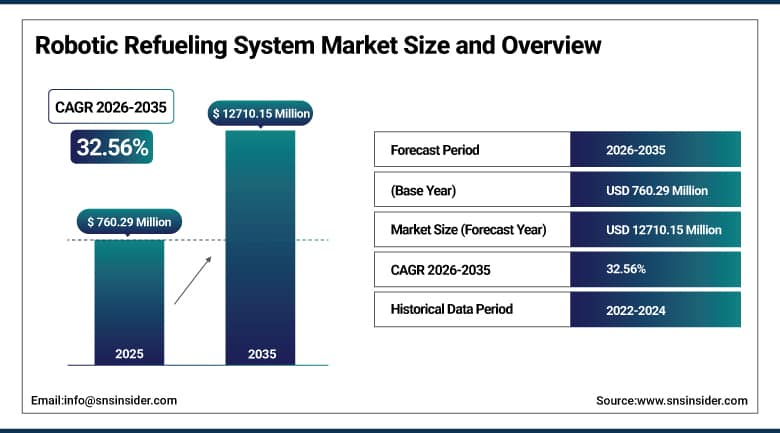
The Robotic Refueling System Market was valued at USD 760.29 Million in 2025 and is expected to reach USD 12710.15 Million by 2035, growing at a CAGR of 32.56% from 2026 to 2035.
The demand for automation, improved operational safety and higher fueling efficiency in automotive, aviation, mining, defense and industrial sectors is driving the growth of robotic refueling system market. Labor shortages and the need to reduce human exposure to dangerous fueling environments are accelerating the acquisition of robotic refueling technologies. The increasing investments in hydrogen fueling infrastructure, autonomous vehicles and smart fuel stations are also aiding the market growth. The use of artificial intelligence, machine vision, IoT-enabled monitoring and robotic automation is helping to improve precision and reduce operational downtime. Meanwhile huge opportunities are being created by worldwide government initiatives for building clean energy infrastructure and autonomous mobility for advanced robotic refueling systems.
REFLEX-J robotic spacecraft programme and collaboration with Honda Motor Co. to co-develop standardized robotic refueling port connections to enable future in-orbit satellite refueling, servicing and autonomous spacecraft operations across next-generation space infrastructure.
To Get More Information On Robotic Refueling System Market - Request Free Sample Report
Market Trends
-
Increasing deployment of AI-powered robotic refueling systems is improving fueling precision, operational safety, and autonomous station management.
-
Rising investments in hydrogen refueling infrastructure are accelerating adoption of automated fueling technologies for next-generation mobility.
-
Growing integration of IoT, machine vision, and robotic automation is enabling real-time monitoring and predictive maintenance of refueling operations.
-
Expansion of autonomous vehicles and smart fuel stations is driving demand for contactless and fully automated refueling solutions.
-
Increasing adoption of robotic refueling across aerospace, defense, and industrial applications is creating new opportunities for autonomous fueling infrastructure.
U.S. Robotic Refueling System Market Outlook
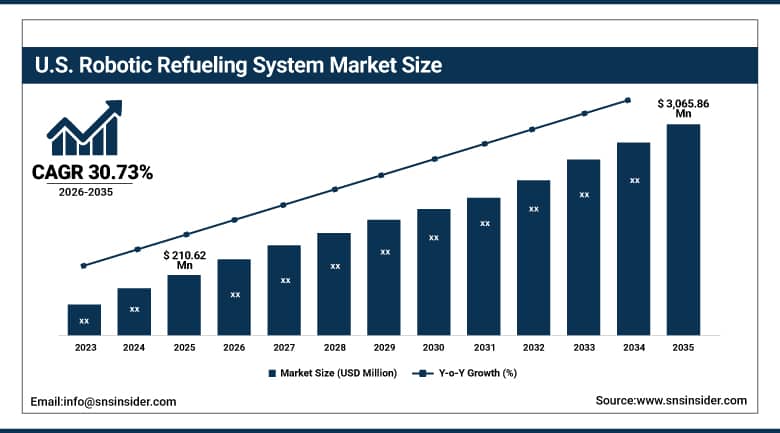
The U.S. Robotic Refueling System Market was valued at approximately USD 210.62 Million in 2025 and is expected to reach approximately USD 3,065.86 Million by 2035, growing at a CAGR of approximately 30.73% from 2026 to 2035.
North American U.S. Robotic Refueling System Market is projected to grow at a CAGR of 27.4% during the forecast period 2023-2030. The rising use of unmanned ground, air and maritime vehicles is driving demand for automated refueling technologies that enhance operational efficiency and reduce human intervention. The growth of the hydrogen fueling infrastructure, the increasing adoption of AI-enabled robots and the rising automation of industrial processes in the logistics, mining and energy industries are also fueling the market. Continued government investment in autonomous defense systems and next generation transportation technologies, combined with advances in machine vision, robotic manipulation and IoT-enabled monitoring are driving the commercialization of robotic refueling solutions across the United States.
Stratom has been contracted by the U.S. Navy to develop the Deployable Onboard Refueling Interface (DORI), an autonomous robotic refueling system that will allow Unmanned Surface Vessels (USVs) to refuel at sea without human intervention. The award came in 2025. This would greatly enhance mission endurance and operational autonomy for maritime defense applications.
Robotic Refueling System Market Segment Analysis
-
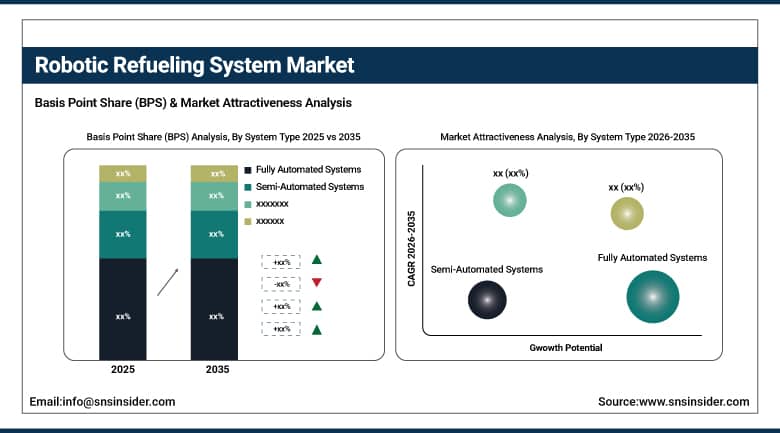
By System Type, Fully Automated Systems dominated the robotic refueling system market with 48.00% share in 2025, while Semi-Automated Systems are the fastest growing system segment from 2026 to 2035.
-
By Fuel Type, Hydrogen dominated the robotic refueling system market with 34.00% share in 2025, while Electricity is the fastest growing fuel type from 2026 to 2035.
-
By Application, Military dominated the robotic refueling system market with 31.00% share in 2025, while Aviation is the fastest growing application segment from 2026 to 2035.
-
By End Use, Commercial dominated the robotic refueling system market with 59.00% share in 2025, while Research & Development is the fastest growing end-user segment from 2026 to 2035.
By System Type, Fully Automated Systems dominate, Semi-Automated Systems grow fastest
Fully Automated Systems dominated the robotic refueling system market in 2025, accounting for approximately 48% revenue share of the market. The growth is driven by the increasing deployment of automated fuel stations, military bases, industrial units, and intelligent transportation systems. They make sure of safety in operation, reduce human intervention and make fueling processes highly efficient with the use of artificial intelligence, robotic vision and sensor technology.
The Semi-Automated Systems segment is projected to register the fastest CAGR owing to the lower cost of implementation and compatibility with existing fueling infrastructure. Fleet owners and transport firms are turning to semi-automated fueling systems to make the process more efficient and effective, while still involving the operator.
By Fuel Type, Hydrogen dominates, Electricity grows fastest
Hydrogen dominated the robotic refueling system market with a revenue share of over 34% in 2025. Along with the rapid expansion of hydrogen mobility infrastructure, fuel cell vehicles and government-backed clean energy initiatives, robotic hydrogen refueling systems are being deployed at a rapid pace. Increasing investments in hydrogen stations in industrial and commercial transportation further strengthen the segment’s leadership position in the market.
The electricity segment is projected to record the fastest CAGR during the forecast period due to growing electric vehicle adoption and development of autonomous EV charging infrastructure. Robotic charging systems are increasingly being deployed in smart cities, commercial fleets, and autonomous mobility ecosystems. The segment growth continues to be strong driven by continuous investments in automated charging technologies and smart energy management platforms.
By Application, Military dominates, Aviation grows fastest
Military dominated the robotic refueling system market in 2025 and accounted for approximately 31% of total revenue. Defense organizations continue investing in robotic refueling technologies to support autonomous ground vehicles, unmanned surface vessels, and unmanned aerial systems while improving operational readiness and minimizing personnel exposure in hazardous environments. Increasing defense modernization programs continue strengthening market demand globally.
Aviation is expected to record the fastest CAGR owing to increasing automation of airport ground operations and growing deployment of autonomous aircraft servicing technologies. Airports and aerospace companies are investing in robotic refueling systems to reduce turnaround time, improve fueling precision, and enhance operational safety. Rising investments in autonomous aviation infrastructure continue creating strong long-term growth opportunities.
By End Use, Commercial dominates, Research & Development grows fastest
Commercial dominated the robotic refueling system market in 2025, accounting for almost 59% of the revenue share. The growth in the market is driven by the rise in number of commercials fueling stations, logistics operators, mining sites, industrial facilities and transportation fleets. The use of robotic refueling systems is increasing among organizations to improve operational efficiency, reduce reliance on labor and enable automated fueling operations 24/7.
The Research & Development segment is projected to grow at the highest CAGR during the forecast period due to increased investments in defense robotics, autonomous mobility, hydrogen technologies, and intelligent fueling platforms. Innovation in AI-enabled robotic refueling systems continues to accelerate among research entities, technology developers and government agencies. Future commercialization opportunities are expected to be provided by growing pilot projects and prototype deployments.
Regional Analysis
|
Region |
Major Country |
Global Market Share (2025 %) |
|---|---|---|
|
North America |
United States |
83.82% |
|
Europe |
Germany |
31.51% |
|
Asia Pacific |
China |
28.80% |
|
Middle East & Africa |
UAE |
3.12% |
|
Latin America |
Brazil |
3.52% |
North America Robotic Refueling System Market Insights
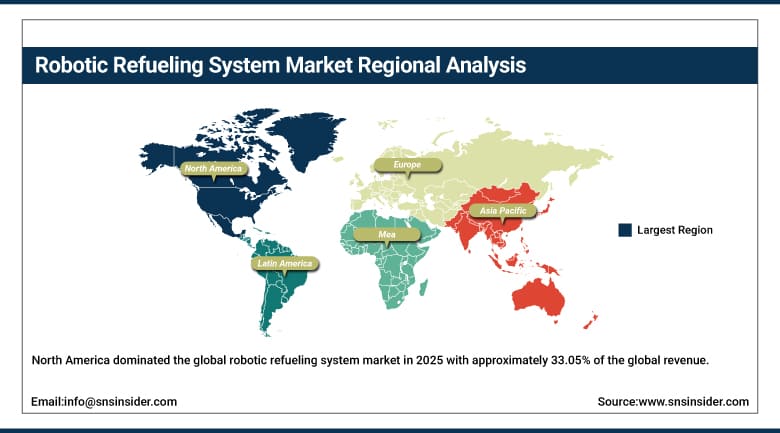
North America dominated the global robotic refueling system market in 2025 with approximately 33.05% of the global revenue. Leadership is supported regionally by advanced defense modernization programmers, autonomous vehicles proliferation and rising investments in hydrogen refueling infrastructure. The United States continues to be the biggest contributor, on the back of growing use of robotic fueling technologies in military, aerospace, aviation and commercial mobility applications, supported by strong government funding and technology commercialization initiatives.
The region is witnessing continued growth in investments in AI-based robotic automation, autonomous fleet management, and unmanned vehicle operations that demand full automated refueling capabilities. Increasing use of robotic fueling systems by defense agencies, airport operators and energy companies to improve operational safety, reduce reliance on human labor and improve fueling accuracy. Long-term hydrogen infrastructure, autonomous logistics platforms and smart fueling technology innovation are expected to continue driving market growth across North America.
Get Customized Report as Per Your Business Requirement - Enquiry Now
Europe Robotic Refueling System Market Insights
Europe was a major participant in the global robotic refuelling system market, spurred by its substantial investments in hydrogen mobility, sustainable transportation, and industrial automation. Germany, France, the United Kingdom and the Netherlands continued their efforts to develop automated fuelling systems for fleet operations, aviation, defence and industrial applications. In addition, government efforts to support low carbon transportation and clean energy infrastructure further supported the uptake of intelligent robotic refuelling solutions in the region.
The incorporation of robotics, artificial intelligence and sophisticated sensing technologies into automated fueling platforms has enhanced operational efficiency, precision and safety. Hydrogen fuel stations, autonomous industrial vehicles and smart logistics infrastructure are also being rolled out throughout Europe. Further investment in clean energy projects and next generation manufacturing technologies in the region further reinforce its position as a key market for robotic refuelling system providers.
Asia Pacific Robotic Refueling System Market Insights
Asia Pacific is expected to witness the fastest CAGR of 34.86% over the forecast period. The regional demand remains driven by rapid industrialization, increasing investments in autonomous transportation, expanding hydrogen infrastructure and growing defense modernization programmers. China dominates the regional market, whereas Japan, South Korea, and India are quickly investing in robotic fueling technologies for commercial mobility, aerospace, industrial automation, and next-generation energy applications.
Governments and private companies are ramping up investment in autonomous vehicles, smart factories, hydrogen fueling stations and advanced robotics to boost operational productivity and energy efficiency. Continued support for the widespread deployment of automated fueling technologies comes from the expansion of aviation infrastructure, mining automation, industrial robotics and defense modernization programmers. Asia Pacific is the fastest-growing regional market during the forecast period owing to strong manufacturing capabilities and continuous innovation.
Middle East & Africa & Latin America Robotic Refueling System Market Insights
The Middle East & Africa and Latin America markets are steadily gaining ground as promising markets for the robotic refueling system market due to growing investments in infrastructure, automation, and autonomous transportation systems. Brazil, UAE, Saudi Arabia, and Mexico are making further progress in providing smart refueling technologies in oil & gas, mining, aviation, defense, and commercial vehicle sectors.
Opportunities in the regions are becoming more apparent in terms of robotic refueling systems due to growing deployment of hydrogen energy solutions, autonomous mining machinery, and other automation processes. The governments are focusing on smart infrastructure projects, digital transformation, and green energy projects that will enhance efficiency and safety of the operations. The diversification of the industries and infrastructure development in these regions should ensure long-term growth.
Market Dynamics
Growth Driver: Rising Adoption of Autonomous Vehicles and Smart Refueling Infrastructure
The robotic refueling system market is experiencing growth due to rising deployment of autonomous vehicles, expansion of hydrogen refueling infrastructure, and growing demand for automated fueling solutions in commercial, industrial, aerospace, and defense sectors. Organizations are investing in robotic refueling technologies to improve operational safety, reduce human intervention and improve fueling accuracy for autonomous fleets, unmanned platforms and heavy equipment. The growing acceptance of artificial intelligence, robotics, and industrial automation is also speeding up the deployment of next-generation mobility ecosystems.
Rising investments in smart fueling stations, autonomous logistics and hydrogen-powered transportation further support the market expansion. AI-based monitoring, machine vision, and IoT-enabled diagnostics, and remote-control systems allow the operators to optimize fueling operations and minimize downtime and operational risks. The long-term commercial opportunities for robotic refueling system providers worldwide are enormous as governments continue to support clean energy infrastructure, autonomous mobility and industrial automation.
Restraints: High Deployment Costs and Infrastructure Limitations
The robotic refueling system market faces various constraints due to the high amount of capital investment required in robotic systems, advanced sensor technology, automation software, and dedicated fueling infrastructure. For small scale commercial firms and developing countries, there are many barriers in implementation of such robotic fueling systems due to high installation cost, system complexities and maintenance issues.
Furthermore, the lack of standard robotic fueling interfaces in vehicles is an obstacle to market deployment. Moreover, safety regulations are missing, and there are problems with interoperability and limited deployment of hydrogen and robotic fueling infrastructure in some regions. These kinds of limitations lead to delays in the implementation process due to certification issues, cybersecurity concerns of connected automation systems and validation process in defense and aerospace.
Opportunities: Expansion of Hydrogen Mobility and AI-Enabled Robotic Automation
The robotic refueling system market is witnessing major opportunities due to the rapid growth of hydrogen mobility, autonomous transportation, and intelligent fueling infrastructure. Companies are increasingly developing robotic refueling platforms that autonomously recognize vehicles with artificial intelligence, precisely align nozzles, perform predictive diagnostics and allow remote monitoring. The market for advanced robotic fueling technologies continues to grow due to the increasing use of unmanned ground vehicles, autonomous mining equipment, airport automation, and smart logistics fleets.
The adoption is expected to be driven by increasing investments in smart cities, defense modernization, industrial robotics, and renewable energy infrastructure over the forecast period. Computer vision combined with digital twins, machine learning and cloud-based fleet management platforms make fueling operations safer, faster and more efficient. Fast technological advancements in hydrogen refueling systems and autonomous mobility ecosystem are expected to create significant long-term growth opportunities in commercial, industrial, aerospace and military applications.
Recent Developments
-
2026: Orbit Fab officially unveiled its RAVEN autonomous shuttle and NEST fuel depot systems, establishing the core architecture for a scalable in-space robotic refueling network.
-
2026: NASA selected Orbit Fab to develop specialized automated fluid transfer and coupling technologies designed to support robotic refueling interfaces for the Lunar Gateway program.
-
2025: ABB Group expanded its autonomous mobile robotics and refueling intelligence portfolio through the acquisition of the industrial autonomous navigation software division of Clearpath Robotics.
-
2025: Honeywell International Inc. announced a collaborative investment and technology partnership with KUKA AG to accelerate the development of autonomous robotic refueling modules for hazardous industrial facilities.
Key Players
-
Orbit Fab, Inc.
-
Astroscale Holdings Inc.
-
ABB Ltd.
-
KUKA AG
-
Honeywell International Inc.
-
Siemens AG
-
Shell plc
-
Bosch Rexroth AG
-
Stratom, Inc.
-
Fuelmatics Systems AB
-
Neste Oyj
-
Air Liquide S.A.
-
Linde plc
-
Nel ASA
-
H2 MOBILITY Deutschland GmbH & Co. KG
-
Toyota Industries Corporation
-
FANUC Corporation
-
Yaskawa Electric Corporation
-
Oceaneering International, Inc.
-
Cimcorp Oy
Robotic Refueling System Market Report Scope:
| Report Attributes | Details |
|---|---|
| Market Size in 2025 | USD 760.29 Million |
| Market Size by 2035 | USD 12710.15 Million |
| CAGR | CAGR of 32.56% from 2026 to 2035 |
| Base Year | 2025 |
| Forecast Period | 2026-2035 |
| Historical Data | 2022-2024 |
| Report Scope & Coverage | Market Size, Segments Analysis, Competitive Landscape, Regional Analysis, DROC & SWOT Analysis, Forecast Outlook |
| Key Segments | • By System Type (Fully Automated Systems, Semi-Automated Systems, Manual Systems) • By Fuel Type (Hydrogen, Natural Gas, Liquefied Petroleum Gas, Electricity, Biofuels) • By Application (Aerospace, Military, Automotive, Marine, Industrial, Mining & Construction Equipment, Aviation) • By End Use (Commercial, Military, Research and Development) • By Payload Capacity (Up to 50 kg, 50–100 kg, Above 100 kg) • By Fuel Pumped (Gasoline, Natural Gas, Petrochemicals) |
| Regional Analysis/Coverage | North America (US, Canada, Mexico), Europe (Eastern Europe [Poland, Romania, Hungary, Turkey, Rest of Eastern Europe] Western Europe] Germany, France, UK, Italy, Spain, Netherlands, Switzerland, Austria, Rest of Western Europe]), Asia Pacific (China, India, Japan, South Korea, Vietnam, Singapore, Australia, Rest of Asia Pacific), Middle East & Africa (Middle East [UAE, Egypt, Saudi Arabia, Qatar, Rest of Middle East], Africa [Nigeria, South Africa, Rest of Africa], Latin America (Brazil, Argentina, Colombia, Rest of Latin America) |
| Company Profiles | Orbit Fab, Inc., Astroscale Holdings Inc., ABB Ltd., KUKA AG, Honeywell International Inc., Siemens AG, Shell plc, Bosch Rexroth AG, Stratom, Inc., Fuelmatics Systems AB, Neste Oyj, Air Liquide S.A., Linde plc, Nel ASA, H2 MOBILITY Deutschland GmbH & Co. KG, Toyota Industries Corporation, FANUC Corporation, Yaskawa Electric Corporation, Oceaneering International, Inc., Cimcorp Oy |
Frequently Asked Questions
Asia Pacific is projected to register the fastest growth, with a CAGR of 34.86% during the forecast period.
The market is expected to grow at a CAGR of 32.56% during the forecast period.
North America dominated the market in 2025, accounting for approximately 33.05% of global revenue.
The Robotic Refueling System Market was valued at USD 760.29 million in 2025.
The market is projected to reach USD 12,710.15 million by 2035.
