
Robotics and Automation Actuators Market Report Scope & Overview:
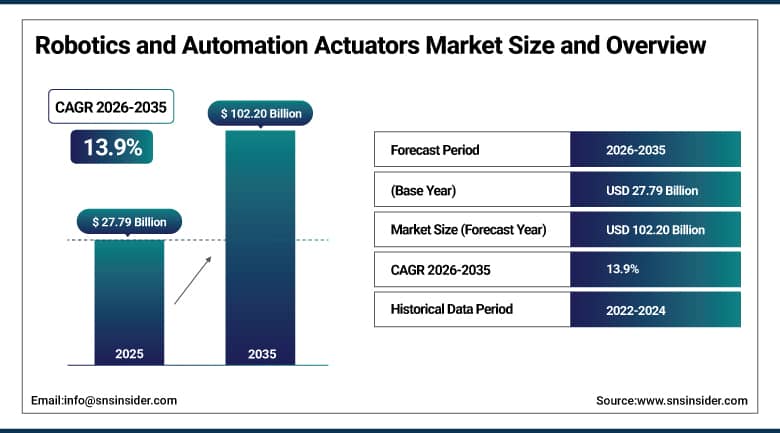
The global robotics and automation actuators market was valued at USD 27.79 Billion in 2025 and is expected to reach USD 102.20 Billion by 2035, growing at a CAGR of 13.9% from 2026 to 2035.
Actuators play an important role in robotics and automation applications, providing mechanical motion through conversion of electrical, pneumatic, or hydraulic energy to move robotic arms, grippers, and other end-effectors. This market is set for substantial growth in the coming years due to increased adoption of robotics in industries, especially the APAC region that is fast emerging as the technology hub and manufacturing center, along with various manufacturing industries based in Germany, Italy, USA, Mexico, and Brazil increasing demand.
The Nvidia Corporation signed a deal with the South Korean Doosan Group in 2026 with regard to physical AI, robotics, and AI factories, bringing together the power of computing systems of Nvidia with the industrial automation and power generation systems of the Doosan group, showing how quickly the world of AI and robotics is evolving and changing investment strategies for the automation actuator industry.
To Get More Information On Robotics and Automation Actuators Market - Request Free Sample Report
Robotics and Automation Actuators Market Trends
- Growing recent advances in sensor fusion, embedded control, and additive manufacturing continue pushing actuator design beyond traditional force-precision-efficiency trade-offs.
- Rising collaborative robot deployment, with logistics robot deployment growing 22% year-over-year, continues to accelerate actuator demand across service sectors.
- Expanding compact linear actuator adoption, achieving 30% lower energy use, continues boosting integration across portable robots and automated guided vehicles.
- Increasing autonomous vehicle and drone reliance on precision rotary actuators for motion control continues fueling demand across emerging application categories.
- Growing green manufacturing emphasis continues encouraging development of actuators made from recyclable composites, increasing environmental compliance rates.
U.S. Robotics and Automation Actuators Market Outlook
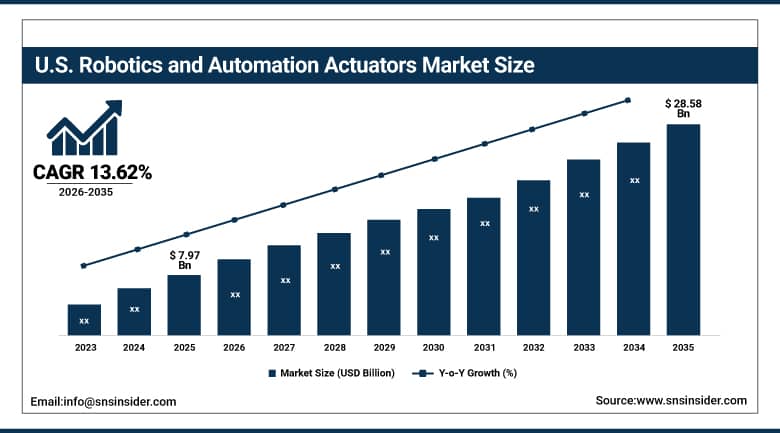
The U.S. Robotics and Automation Actuators Market was valued at USD 7.97 Billion in 2025 and is projected to reach USD 28.58 Billion by 2035, growing at a CAGR of 13.62% during 2026-2035.
The dominance in the market is created due to a stable manufacturing system and the government’s initiative encouraging the use of Industry 4.0 all over the US. The major companies are developing electric and piezoelectric actuators that meet the requirements of the increasing demand for advanced robotics. The strengthening of the supplier network, where firms such as Parker Hannifin contribute greatly, encourages market development.
More than 50,000 attendees were expected at Automate 2026 in Chicago, billed as North America's largest robotics and automation event, with Fanuc and Google advancing industrial robotics partnerships as part of recent AI deals, reflecting the surging investor and manufacturer interest converging on the American robotics and automation actuator ecosystem as multinationals and family-owned businesses alike stake claims in this lucrative growth vertical.
Robotics and Automation Actuators Market Segment Analysis
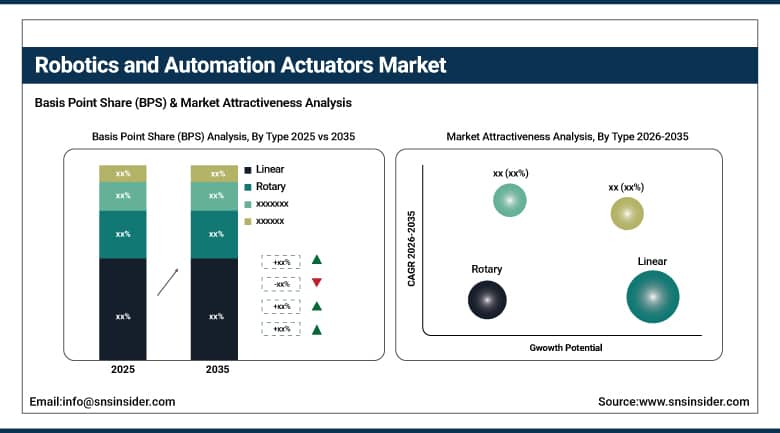
- By Type, linear led the robotics and automation actuators market with around 46.35% share in 2025, while rotary is the fastest-growing type segment with a CAGR of 11.20% from 2026-2035.
- By Actuation Method, electric led the robotics and automation actuators market share in 2025, while pneumatic is the fastest-growing actuation method segment with a CAGR of 15.50% from 2026-2035.
- By Application, process automation led the robotics and automation actuators market with around 58.60% share in 2025, while robotics is the fastest-growing application segment with a CAGR of 14.20% from 2026-2035.
- By End-User, automotive led the robotics and automation actuators market share in 2025, while aerospace & defense is the fastest-growing end-user segment with a CAGR of 11.60% from 2026-2035.
By Type, Linear Dominated the Market While Rotary Is the Fastest-Growing Segment
Linear segment held leadership in the robotics and automation actuators market, accounting for 46.35% revenue share in 2025 owing to the accurate movement, positioning, and power generation capabilities of these products in robotic systems used in various industrial applications. Linear actuators continue to provide accuracy necessary for accurate industrial applications and assembly line automation, thereby ensuring that this segment remains in the pole position in the larger robotics and automation actuators market.
Rotary segment is expected to witness the highest CAGR of 11.20% over the forecast period of 2026-2035, as these actuators utilize electric power to generate rotary motion and are widely employed in automation applications such as gates, valves, and robotic joints. Increasing importance placed by the autonomous vehicles and drones on precise rotary actuators for motion control continues to drive above-average growth rate for this segment compared to linear actuators.
By Actuation Method, Electric Dominated the Market While Pneumatic Is the Fastest-Growing Segment
The electric segment led the robotics and automation actuators market revenue in 2025, holding a dominant position due to superior precision, controllability, and energy efficiency. Electric actuators continue to be increasingly preferred over pneumatic and hydraulic alternatives in automated production lines, robotics, and smart manufacturing applications, sustaining this actuation method's dominant position across the broader robotics and automation actuators market worldwide.
The Pneumatic segment is expected to register the fastest CAGR of 15.50% during the forecast period 2026-2035, driven by continued cost-effectiveness and reliability advantages for high-speed, repetitive motion applications across manufacturing environments. Growing demand for pneumatic solutions in food and beverage and packaging automation continues to reinforce this segment's above-average growth trajectory relative to more established electric actuator systems.
By Application, Process Automation Dominated the Market While Robotics Is the Fastest-Growing Segment
The process automation sub-segment was the highest-grossing segment in the robotics and automation actuators market, accounting for a revenue share of 58.60% in 2025, owing to its high demand in manufacturing lines for quality assurance, welding and packaging purposes due to the need for constant and repetitive motion control. The process automation sub-segment still boasts the widest deployment base of applications in various manufacturing industries, hence maintaining this dominance in the larger robotics and automation actuators market.
The robotics sub-segment is predicted to witness the highest CAGR of 14.20% throughout the forecast period 2026-2035 due to increasing demand for industrial robots by big organizations for use in manufacturing plants along with service robots. Increasing usage of collaborative robots in logistics and medical robotics continues to drive the growth of this sub-segment at above-average rates compared to traditional process automation applications.
Regional Analysis
|
Region |
Country |
Regional Share (2025) |
|---|---|---|
|
North America |
United States |
84.60% |
|
Europe |
Germany |
22.80% |
|
Asia Pacific |
China |
34.60% |
|
Middle East & Africa |
UAE |
20.60% |
|
Latin America |
Brazil |
24.60% |
North America Robotics and Automation Actuators Market Insights
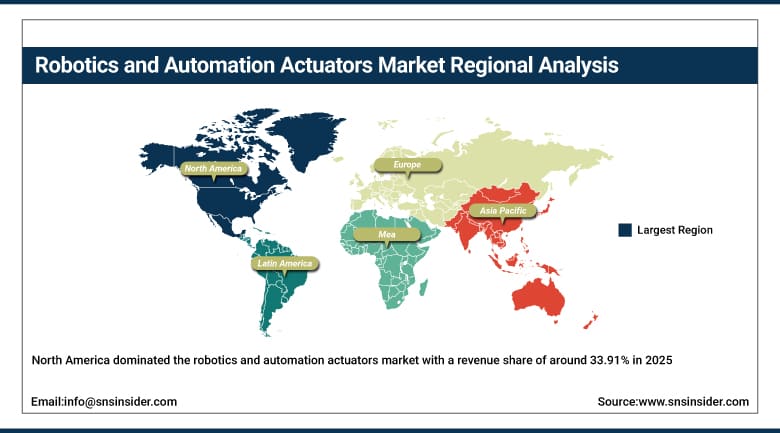
North America dominated the robotics and automation actuators market with a revenue share of around 33.91% in 2025, with market dominance arising from a well-established manufacturing ecosystem combined with government policies incentivizing Industry 4.0 adoption. Extensive R&D investments by local companies in electric and piezoelectric actuators continue to underpin sustained growth and reinforce North America's leadership position across the broader landscape.
The United States accounted for approximately 84.60% of the North American market in 2025, reflecting its concentration of leading actuator manufacturers including Parker Hannifin, and its strong supplier networks supporting innovation and expansion. Canada is contributing to regional growth through steady industrial automation adoption and growing consumer interest in advanced robotics technology.
Get Customized Report as Per Your Business Requirement - Enquiry Now
Europe Robotics and Automation Actuators Market Insights
Europe had a significant stake in the robotics and automation actuators market of the world in 2025 due to the variety of manufacturing industries in Germany and Italy, resulting in the increase in demand for industrial robots and automation actuators. Strategic acquisitions of leading companies in Europe and around the globe keep boosting the consistent demand for robotics and automation actuators in the region.
Germany had the largest regional share of 22.80% in 2025, driven by the industrial manufacturing industry and the demand for automation technology from consumers. Italy, France, and Switzerland are also significantly contributing to the regional growth of the market, fueled by the presence of leading manufacturers of automation actuators in the region.
Asia Pacific Robotics and Automation Actuators Market Insights
Asia Pacific is expected to grow at the highest rate due to rapid industrialization in this region, government programs to automate processes, and the presence of huge manufacturing in nations such as China and India. The Asia Pacific market will have a compound annual growth rate (CAGR) greater than 12% due to rising imports of highly accurate actuators and increasing manufacturing capacity in this region.
China contributed about 34.60% to the Asia Pacific market in 2025 owing to the huge installations of industrial robots and a supply chain of rare-earth magnets and motor laminations. Other contributors to the region include Japan, India, and South Korea. Electric actuator revenues increased by 18% in 2025 owing to customer inclination towards clean and efficient energy usage.
Middle East & Africa and Latin America Robotics and Automation Actuators Market Insights
The Middle East & Africa region is exhibiting steady growth as industrial automation infrastructure investment continues expanding across the Gulf states. Latin America is similarly benefiting from emerging manufacturing centers, with countries offering cost-effective land, raw materials, and labor promoting new industrial developments.
The UAE led the Middle East & Africa market with a 20.60% regional share in 2025, supported by growing industrial diversification and expanding automation infrastructure investment. Brazil represented 24.60% of the Latin American market in 2025, driven by expanding industrial robot demand, with Mexico also contributing to regional growth through rising automotive manufacturing automation.
Market Dynamics
Growth Drivers: Industrial Robotics Adoption and Smart Manufacturing Expansion Driving Market Growth
The robotics and automation actuators market is being driven primarily by the increasing trend of industrial robotics, particularly with APAC emerging as a new frontier in the industrial robotics market, where advanced robotics supports growth in technology and manufacturing. Recent advances in sensor fusion, embedded control, and additive manufacturing continue pushing actuator design beyond traditional trade-offs between force density, precision, and energy efficiency, creating a dynamic field where incremental improvements yield outsized operational benefits.
Growing recent advances in sensor fusion, embedded control, and additive manufacturing continue pushing actuator design forward. Rising collaborative robot deployment continues to accelerate actuator demand across service sectors. Expanding compact linear actuator adoption continues boosting integration across portable robots and automated guided vehicles, reinforcing sustained industry investment.
Restraints: High Precision Component Costs and Supply Chain Concentration Limiting Market Expansion
Although there are positive fundamentals regarding demand, there remain significant constraints in terms of the prohibitive cost structure of the precision components, especially for actuators intended for aerospace and defense applications with a need for absolute reliability and resilience under harsh conditions. The consolidation of the supply chain of the rare-earth magnets and motor laminates that are sourced mostly from Asia Pacific remains an area of concern.
The heightened competition amongst a growing number of actuator suppliers in light of increased footprint expansion efforts remains a driver of margin erosion in the mainstream actuator offerings. Increased complexity arising from integration challenges of actuators into AI-enabled robotics systems remains another source of ongoing engineering expenses.
Opportunities: Collaborative Robot Integration and AI-Robotics Convergence Creating New Growth Avenues
Substantial opportunity exists in continued development of actuator technology optimized for collaborative robots, which represent the fastest-growing sector within industrial robotics deployment. Companies that successfully commercialize compact, energy-efficient actuators for autonomous guided vehicles and service robots stand to capture significant share of category growth as logistics and medical robotics deployment continues accelerating.
Growing AI-robotics convergence presents a further significant growth avenue, as computing platform providers increasingly partner with industrial automation companies to advance physical AI capabilities. Expanding green manufacturing initiatives, including recyclable composite actuator development, also represent meaningful untapped opportunity for robotics and automation actuator manufacturers.
Recent Developments:
- 2026: ABB agreed to acquire UK-based Rotork for approximately USD 5.5 billion, strengthening its automation and electrification portfolio and expanding its position in industrial motion and actuation technologies.
- 2026: Blackstone invested in South Korean robotics supplier Futronic, valuing the high-precision actuator manufacturer at approximately USD 676 million, highlighting rising investment in actuator technologies for automotive and industrial robotics.
- 2025: Synapticon showcased its ActiLink family of integrated actuators for robots and cobots, including dynamic actuators for lightweight and humanoid robots, precision actuators for medical applications, and integrated wheel modules for mobile robots.
Robotics and Automation Actuators Market key players are:
- Parker Hannifin Corporation
- ABB Ltd
- FANUC Corporation
- Rockwell Automation, Inc.
- Siemens AG
- Moog Inc.
- THK Co., Ltd.
- SMC Corporation
- Festo SE & Co. KG
- Curtiss-Wright Corporation
- Thomson Industries, Inc.
- Bosch Rexroth AG
- Emerson Electric Co.
- Kollmorgen Corporation
- Yaskawa Electric Corporation
- Nabtesco Corporation
- Harmonic Drive Systems Inc.
- Schaeffler Group
- Physik Instrumente (PI) GmbH & Co. KG
- IAI Corporation
Robotics and Automation Actuators Market Report Scope:
| Report Attributes | Details |
|---|---|
| Market Size in 2025 | USD 27.79 Billion |
| Market Size by 2035 | USD 102.20 Billion |
| CAGR | CAGR of 13.9% From 2026 to 2035 |
| Base Year | 2025 |
| Forecast Period | 2026-2035 |
| Historical Data | 2022-2024 |
| Report Scope & Coverage | Market Size, Segments Analysis, Competitive Landscape, Regional Analysis, DROC & SWOT Analysis, Forecast Outlook |
| Key Segments | • By Type (Linear, Rotary) • By Actuation Method (Electric, Pneumatic, Hydraulic, Mechanical) • By Application (Process Automation, Robotics) • By End-User (Automotive, Aerospace & Defense, Healthcare, Electronics & Electrical, Food & Beverage) |
| Regional Analysis/Coverage | North America (US, Canada), Europe (Germany, UK, France, Italy, Spain, Russia, Poland, Rest of Europe), Asia Pacific (China, India, Japan, South Korea, Australia, ASEAN Countries, Rest of Asia Pacific), Middle East & Africa (UAE, Saudi Arabia, Qatar, South Africa, Rest of Middle East & Africa), Latin America (Brazil, Argentina, Mexico, Colombia, Rest of Latin America). |
| Company Profiles | Parker Hannifin Corporation; ABB Ltd; FANUC Corporation; Rockwell Automation, Inc.; Siemens AG; Moog Inc.; THK Co., Ltd.; SMC Corporation; Festo SE & Co. KG; Curtiss-Wright Corporation; Thomson Industries, Inc.; Bosch Rexroth AG; Emerson Electric Co.; Kollmorgen Corporation; Yaskawa Electric Corporation; Nabtesco Corporation; Harmonic Drive Systems Inc.; Schaeffler Group; Physik Instrumente (PI) GmbH & Co. KG; IAI Corporation. |
Frequently Asked Questions
The Robotics and Automation Actuators Market was valued at USD 27.79 Billion in 2025.
The Robotics and Automation Actuators Market is expected to grow at a CAGR of 13.9% from 2026 to 2035.
The market is driven by the increasing trend of industrial robotics, with APAC emerging as a new frontier in technology and manufacturing.
The Linear segment dominated the Robotics and Automation Actuators Market in 2025, accounting for approximately 46.35% market share.
The North America region dominated the Robotics and Automation Actuators Market in 2025, accounting for approximately 33.91% market share.
