
SCR Power Controller Market Report Scope & Overview:
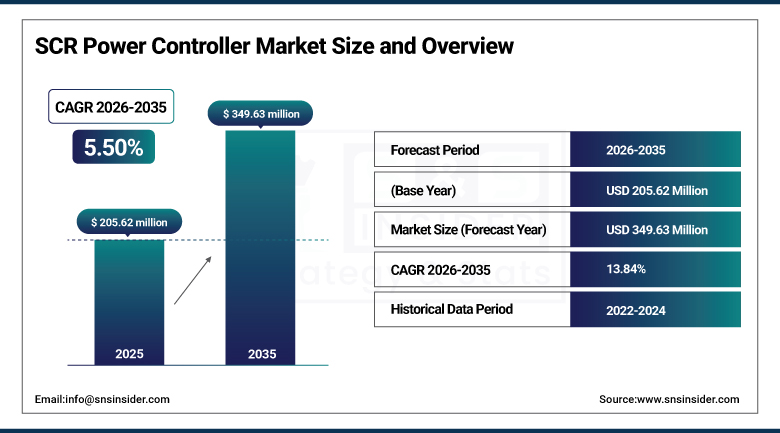
The SCR Power Controller Market was valued at USD 205.62 Million in 2025 and is expected to reach USD 349.63 Million by 2035, growing at a CAGR of 5.50% from 2026 to 2035.
Silicon-controlled rectifiers (SCRs), alternatively referred to as SCR power controllers or thyristor power controllers, are a type of solid state power control device that regulates power flow to industrial loads through adjustment of the conductance angle of silicon thyristors that serve as switches for the power regulation process. Instead of the instantaneous switching operations associated with contactor or relay-based switching systems that results in power surges and interference from electromagnetic fields, SCR power controllers utilize smooth and continuous modulation of power flow from zero to maximum capacity through the switching techniques based on phase angle control or whole-cycle control.
ABB Ltd announced the launch of its ACS880 SCR power controller range in March 2023, designed for industrial automation, renewable energy integration, and electric drive applications across the chemical, glass, semiconductor, and food processing industries. The ACS880 incorporated digital communication interfaces including Modbus RTU and PROFIBUS DP protocols that enable direct integration with programmable logic controllers and distributed control systems, transforming the SCR controller from a standalone power regulation device into a networked node within the industrial automation hierarchy whose power delivery data, fault status, and control parameters are accessible and adjustable from the plant SCADA system without manual intervention at the controller location.
To Get more information on SCR Power Controller Market - Request Free Sample Report
SCR Power Controller Market Trends
-
Digital communication protocol integration is enhancing Industry 4.0 connectivity and real-time power monitoring.
-
Renewable energy integration is expanding SCR power controller applications in clean energy systems.
-
Rising semiconductor fabrication investments are increasing demand for high-precision SCR temperature control.
-
Energy efficiency regulations are accelerating replacement of conventional heating control systems with SCR controllers.
-
Advanced SCR controllers for inductive and non-resistive loads are broadening industrial application areas.
The U.S. SCR Power Controller Market Outlook
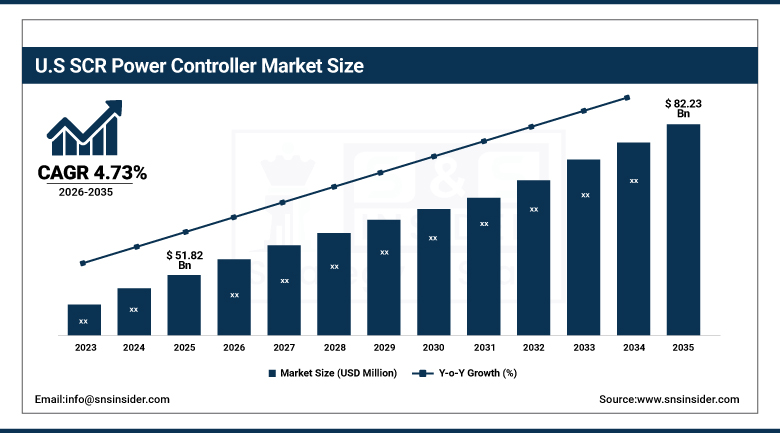
The U.S. SCR Power Controller Market was valued at approximately USD 51.82 Million in 2025 and is expected to reach approximately USD 82.23 Million by 2035, growing at a CAGR of approximately 4.73%.
The United States is the largest national SCR power controller market within the dominant North American region, driven by the domestic concentration of semiconductor wafer fabrication facilities whose wafer diffusion furnace and rapid thermal processing temperature control requirements create the highest-specification SCR power controller demand, the chemical and petrochemical industry's extensive electric process heating infrastructure whose large installed base of SCR controllers at refineries, polymer plants, and specialty chemical facilities creates recurring replacement and upgrade demand, and the domestic food processing industry's growing adoption of precision electric heating for pasteurization, evaporation, and drying applications whose hygienic design requirements favour SCR-controlled electric heating over combustion alternatives.
Watlow Electric Manufacturing Company launched its ASPYRE series advanced SCR power controllers in 2025 with integrated power quality monitoring that continuously measures power factor, harmonic distortion, and energy consumption at the controller output, providing industrial users with the electrical efficiency data required to document energy savings for sustainability reporting, ISO 50001 energy management system certification, and utility energy efficiency incentive programme compliance. The ASPYRE series incorporated a 4.3-inch colour touchscreen for local configuration and real-time process visualisation whose graphical interface enables operators without specialist training to monitor power delivery, review historical load trends, and configure protection parameters without the instruction manuals and specialist tools that earlier-generation SCR controller configuration required.
SCR Power Controller Market Segment Analysis
-
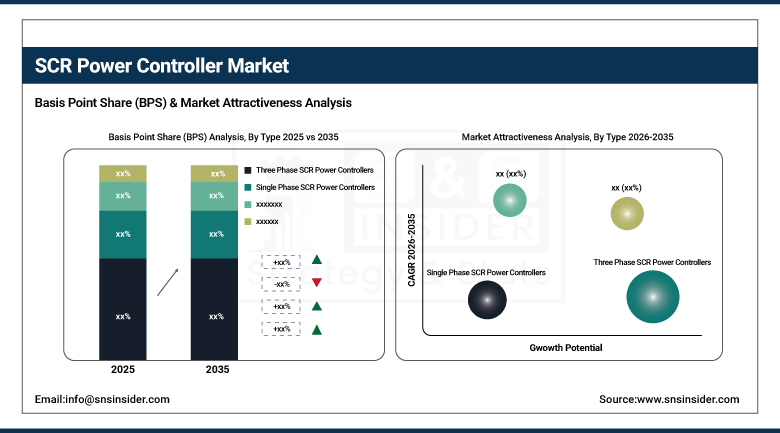
By Type, the three-phase SCR power controllers segment dominated the SCR power controller market with over 56.00% share in 2025, while the single-phase segment is growing steadily at a CAGR of approximately 4.70% during 2026 to 2035.
-
By Load Type, the resistive load segment dominated the SCR power controller market in 2025, while the non-resistive/inductive load segment is the fastest growing at a CAGR of 6.90% during 2026 to 2035.
-
By Control Method, the phase angle control segment dominated the SCR power controller market in 2025, while the integral cycle switching segment is growing in applications requiring RFI-free power control.
-
By End User, the chemical industry segment dominated the SCR power controller market in 2025, while the semiconductor industry segment is the fastest growing end user during 2026 to 2035.
-
By Application, temperature control dominated the SCR power controller market with approximately 46% share in 2025. Motor speed control is the fastest-growing segment, projected to register a CAGR of 8.90% during 2026–2035.
By Type, three-phase dominates, single-phase serves expanding SME base
Three-phase SCR power controllers retained over 56.00% of SCR Power Controller market revenue in 2025, reflecting their universal adoption across heavy industrial process heating. Three-phase controllers serve industrial electric furnaces, glass tank heaters, chemical reactor heat tracing, and kiln temperature zones whose three-phase supply designs require balanced SCR switching to prevent harmonic imbalance and neutral overloading. Applications span from 50-ampere specialty chemical controllers through 1,000-ampere steel furnace power sections sustaining a large recurring maintenance and upgrade market. Single-phase controllers serve the expanding SME market whose lower-power food processing, plastics, and textile heating needs align with single-phase service.
By End User, chemicals dominate, semiconductors grow fastest
The chemical industry retained the dominant end user position, reflecting the sector's reliance on precise electrical temperature control across reaction, distillation, crystallization, and drying operations. Chemical reactors requiring narrow temperature bands for yield optimization, polymer extrusion lines whose melt temperature determines product quality, and chemical plant heat tracing systems each represent recurring SCR procurement.
The semiconductor industry is growing fastest as CHIPS Act and national fab investment programmes are creating the most concentrated wafer fabrication investment in decades whose CVD furnaces, anneal tools, and epitaxial growth reactors each incorporate multiple high-accuracy SCR temperature control zones.
Regional Analysis
|
Region |
Major Country |
Share within Region, 2025 (%) |
|---|---|---|
|
North America |
United States |
84.73% |
|
Europe |
Germany |
28.47% |
|
Asia Pacific |
China |
31.75% |
|
Middle East & Africa |
UAE |
22.84% |
|
Latin America |
Brazil |
43.84% |
North America SCR Power Controller Market Insights
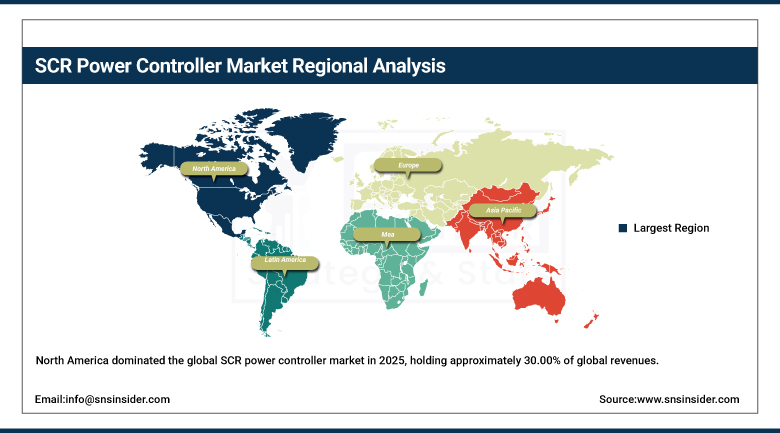
North America dominated the global SCR power controller market in 2025, holding approximately 30.00% of global revenues. The United States accounts for approximately 84.73% of regional revenue through its semiconductor industry's wafer fabrication temperature control requirements, chemical and petrochemical sector's large installed SCR base, and the domestic presence of Advanced Energy Industries and Watlow Electric whose combined SCR portfolio breadth and North American distribution networks serve the region's diverse industrial end user base. Canada contributes supplementary North American demand through its metals processing, oil sands thermal operations, and chemical manufacturing industries.
Get Customized Report as per Your Business Requirement - Enquiry Now
Europe SCR Power Controller Market Insights
Europe held prominent share of global SCR power controller revenues in 2025. Germany accounts for approximately 28.47% of European revenues through its glass manufacturing industry's large-scale electric furnace SCR demand, the domestic chemical industry's process heating requirements, and Eurotherm (Schneider Electric), Gefran SpA, and CD Automation's European SCR manufacturing operations whose product portfolios serve both domestic and export markets. The United Kingdom, Italy, France, and the Netherlands each contribute meaningful European demand through their chemical, food processing, and industrial manufacturing sectors whose electric process heating infrastructure creates recurring SCR controller procurement.
Asia Pacific SCR Power Controller Market Insights
Asia Pacific is the fastest-growing regional SCR power controller market, driven by rapid industrial capacity expansion and semiconductor fab investment. China accounts for approximately 31.75% of Asia Pacific revenues through its world-leading glass manufacturing, chemical, metals, and semiconductor industries whose combined electric process heating requirements create the largest regional SCR controller procurement volume. India is growing rapidly through its expanding chemical and pharmaceutical manufacturing base and steel industry's electric arc furnace expansion. Japan and South Korea contribute meaningful regional demand through their semiconductor, glass, and chemical industries.
MEA & Latin America SCR Power Controller Market Insights
Middle East and Latin America represent growing SCR power controller markets where petrochemical and metals industry expansion and food processing sector development are creating new demand. The UAE leads MEA revenues at approximately 22.84% of the regional total through its petrochemical industry's process heating control requirements and the regional presence of chemical and food manufacturing operations. Brazil leads Latin American revenues at approximately 43.84% of the regional total through its chemical, food processing, and metals industries and the growing adoption of SCR-controlled electric heating in industrial modernization programmes.
Market Dynamics
Growth Drivers: Industrial automation adoption requiring precise power control and energy efficiency regulation driving replacement of relay-based systems with SCR controllers are the primary market demand drivers.
The global industrial automation trend, whose investment in process control, supervisory systems, and manufacturing execution platforms is progressively replacing manual and relay-based control at legacy industrial facilities with networked, data-connected precision control systems, creates a recurring SCR power controller upgrade demand proportional to the pace of industrial automation investment. Facilities upgrading from relay-based to SCR-based temperature control at industrial furnaces, ovens, and dryers capture immediate benefits in process quality improvement from SCR's continuous power modulation, energy savings from elimination of relay inrush current peaks whose demand charges represent meaningful electricity cost components at large industrial facilities, and maintenance cost reduction from elimination of the mechanical wear and contact replacement cycles that relay switching requires.
Restraints: High initial investment cost relative to relay-based alternatives and the availability of competing power control technologies including IGBT-based controllers and solid-state relays create adoption barriers in cost-sensitive industrial segments.
SCR power controllers carry initial purchase costs ranging from USD 300 to USD 10,000 or more per controller depending on current rating, phase configuration, communication capability, and protective feature set, representing a capital investment relative to relay-based switching systems whose per-unit cost is substantially lower even when the relay system's ongoing maintenance and replacement costs are considered. Cost-sensitive small and medium industrial enterprises whose process quality specifications can be satisfied by relay switching or solid-state relay alternatives are less likely to invest in full SCR controller capability than large industrial operators whose continuous high-temperature processes make the performance and efficiency benefits of SCR control commercially justifiable. IGBT-based power controllers, which share SCR controllers' solid-state switching advantages while offering faster switching speeds and certain performance advantages for inductive load applications.
Opportunities: Smart grid integration for demand response participation and Industry 4.0 digital twin integration for predictive maintenance represent commercial opportunities expanding SCR controller value beyond basic power regulation.
Smart grid demand response programmes that compensate industrial electricity consumers for curtailing their process power consumption during peak grid demand periods create a new value proposition for SCR power controllers whose precise and rapid power modulation capability enables smooth, controlled power reduction responses to demand response signals that relay-based systems cannot deliver without process disruption. Industrial SCR controllers with demand response communication protocols can participate in utility demand response programmes whose financial compensation for controllable load curtailment creates ongoing revenue streams that partially offset the SCR controller investment cost, improving the ROI calculation that justifies SCR adoption over relay alternatives at cost-sensitive industrial operators.
Industry 4.0 digital twin integration using SCR controller real-time power and temperature data as inputs for equipment condition monitoring algorithms creates predictive maintenance capability that identifies heating element degradation, thermal insulation deterioration, and furnace lining wear before these develop into process quality failures or unplanned downtime events.
Recent Developments:
-
2025: Watlow Electric Manufacturing Company launched the ASPYRE series SCR power controllers with integrated power quality monitoring measuring power factor, harmonic distortion, and energy consumption at the controller output, providing industrial users with electrical efficiency data for sustainability reporting and ISO 50001 energy management system compliance.
-
2025: Schneider Electric's Eurotherm division reported growing demand for its EPower advanced SCR controller range from semiconductor and specialty chemical manufacturers, driven by the CHIPS Act-related fab expansion programmes requiring precision multi-zone furnace temperature control at wafer diffusion and anneal process steps.
-
2023: ABB Ltd launched the ACS880 SCR power controller with integrated Modbus RTU and PROFIBUS DP digital communication protocols for seamless PLC and DCS integration, enabling SCR power delivery data and fault status monitoring from plant SCADA systems without manual local intervention.
SCR Power Controller Market Key Players are:
-
ABB Ltd
-
Advanced Energy Industries Inc.
-
Watlow Electric Manufacturing Company
-
Schneider Electric SE (Eurotherm)
-
Control Concepts Inc.
-
Chromalox Inc.
-
Gefran SpA
-
RKC Instrument Inc.
-
CD Automation Srl
-
WINLING Technology Co. Ltd.
-
Ametek Inc.
-
Celduc Relais
-
SHIMADEN Co. Ltd.
-
Honeywell International Inc.
-
Omega Engineering Inc. (Spectris)
-
Taiwan Pan-Globe Instrument Control Co. Ltd.
-
Midmark Corporation
-
BriskHeat Corporation
-
JUMO GmbH & Co. KG
-
Sichuan Injet Electric Co. Ltd.
SCR Power Controller Market Report Scope:
| Report Attributes | Details |
|---|---|
| Market Size in 2025 | USD 205.62 Million |
| Market Size by 2035 | USD 349.63 Million |
| CAGR | CAGR of 5.50% From 2026 to 2035 |
| Base Year | 2025 |
| Forecast Period | 2026-2035 |
| Historical Data | 2022-2024 |
| Report Scope & Coverage | Market Size, Segments Analysis, Competitive Landscape, Regional Analysis, DROC & SWOT Analysis, Forecast Outlook |
| Key Segments | • By Type (Single Phase SCR Power Controllers, Three Phase SCR Power Controllers) • By Load Type (Resistive Load, Non-Resistive/Inductive Load) • By Control Method (Phase Angle Control, Integral Cycle Switching) • By Application (Temperature Control, Heater Control, Motor Speed Control, Lighting Control, Others) • By End User (Chemical Industry, Semiconductor Industry, Metals Industry, Glass Industry, Plastics & Rubber, Textile Industry, Food & Beverages, Oil & Gas, Others) |
| Regional Analysis/Coverage | North America (US, Canada), Europe (Germany, UK, France, Italy, Spain, Russia, Poland, Rest of Europe), Asia Pacific (China, India, Japan, South Korea, Australia, ASEAN Countries, Rest of Asia Pacific), Middle East & Africa (UAE, Saudi Arabia, Qatar, South Africa, Rest of Middle East & Africa), Latin America (Brazil, Argentina, Mexico, Colombia, Rest of Latin America). |
| Company Profiles | ABB Ltd, Advanced Energy Industries Inc., Watlow Electric Manufacturing Company, Schneider Electric SE (Eurotherm), Control Concepts Inc., Chromalox Inc., Gefran SpA, RKC Instrument Inc., CD Automation Srl, WINLING Technology Co. Ltd., Ametek Inc., Celduc Relais, SHIMADEN Co. Ltd., Honeywell International Inc., Omega Engineering Inc. (Spectris), Taiwan Pan-Globe Instrument Control Co. Ltd., Midmark Corporation, BriskHeat Corporation, JUMO GmbH & Co. KG, and Sichuan Injet Electric Co. Ltd. |

Frequently Asked Questions
North America dominated the SCR Power Controller Market in 2025, holding approximately 30.00% of global revenues.
The chemical industry segment dominated the SCR Power Controller Market in 2025.
The primary growth factors are industrial automation adoption requiring precise process temperature control replacing legacy relay switching systems, energy efficiency regulations mandating improved industrial process heating control performance.
The SCR Power Controller Market is expected to grow at a CAGR of 5.50% from 2026 to 2035.
The SCR Power Controller Market was valued at USD 205.62 Million in 2025.
