
Spatial Genomics and Transcriptomics Market Report Scope & Overview:
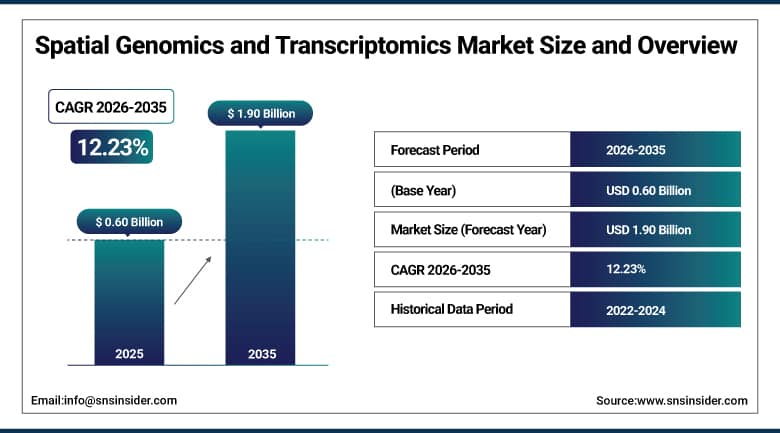
The Spatial Genomics and Transcriptomics Market was valued at USD 0.60 Billion in 2025 and is projected to reach USD 1.90 Billion by 2035, expanding at a CAGR of 12.23% during the forecast period 2026–2035.
The market of spatial genomics and transcriptomics is seeing tremendous growth because of the rise in the need for cutting-edge technologies for high-resolution molecular analysis and profiling that can examine the gene expression and cell interactions in their native tissue context. The pharma companies, academic institutes, biotech firms, and healthcare research facilities are resorting to using spatial biology platforms for biomarker discovery, precision medicines, oncology, and translational research. With the integration of next-generation sequencing, advanced imaging, AI-based analytics, and bioinformatics in the cloud, it is getting easier for researchers to explore the heterogeneous nature of tissue and complex disease biology. Multi-omics research and precision healthcare projects are continuing to make substantial investments towards commercialization of spatial biology.
During 2025-2026, a number of life science technologies suppliers are involved in the commercialization of AI-based spatial biology platforms with the help of high-throughput sequencing, advanced imaging, cloud computing, and automated tissue profiling.
To Get More Information On Spatial Genomics and Transcriptomics Market - Request Free Sample Report
Spatial Genomics and Transcriptomics Market Trends:
-
Increasing adoption of spatial transcriptomics technologies for precision medicine and oncology research.
-
Growing integration of artificial intelligence and cloud-based bioinformatics platforms in spatial biology workflows.
-
Rising commercialization of high-plex imaging and multi-omics spatial analysis technologies.
-
Expanding investments in biomarker discovery and translational research programs globally.
-
Growing utilization of spatial molecular profiling platforms across drug development pipelines.
U.S. Spatial Genomics and Transcriptomics Market Size Outlook:
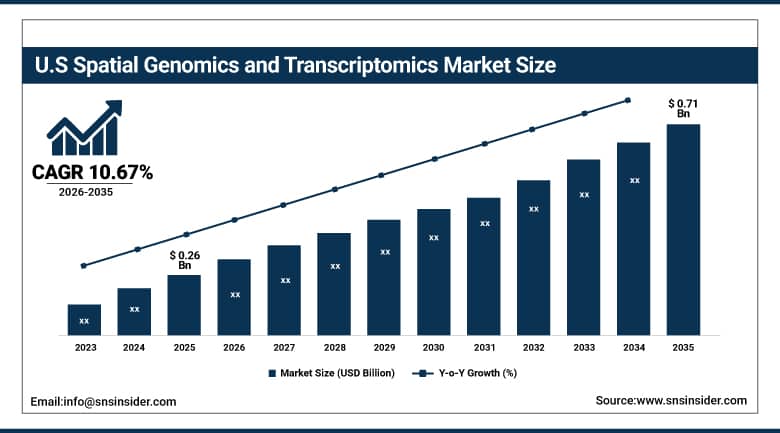
The U.S. Spatial Genomics and Transcriptomics Market was valued at USD 0.26 billion in 2025 and is expected to reach approximately USD 0.71 billion by 2035, expanding at a CAGR of 10.67% during 2026–2035.
The market leadership position of the United States is attributed to the considerable financial support for the genomics research, biotechnology innovations, precision medicine, and biomedical advancements. The demand for spatial biology solutions has grown among the pharmaceutical producers, biotech organizations, research institutes, and healthcare organizations in order to boost their knowledge about diseases, identification of biomarkers, and acceleration of the process of drug development. The availability of advanced sequencing technologies, bioinformatics tools, and funding of cancer and rare diseases research have been propelling the market. Collaborations among biotechnology companies and research institutions have been further boosting the usage of spatial genomics and transcriptomics technologies in the country.
In 2026, a number of life science companies based in the USA implemented spatial biology solutions enhanced by artificial intelligence technologies to perform tissue mapping and conduct precision oncology research.
Spatial Genomics and Transcriptomics Market Segment Analysis:
-
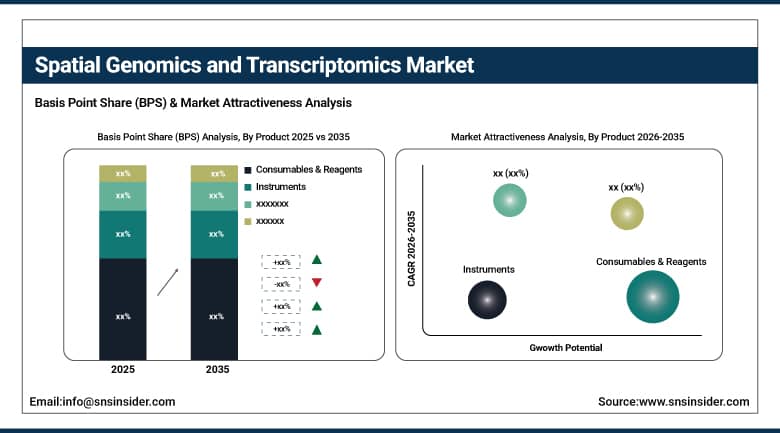
By Product, consumables & reagents dominated the market with 42.00% share in 2025, and are projected to witness the fastest growth with 13.50% CAGR during the forecast period.
-
By Technology, spatial transcriptomics dominated the market with 38.00% share in 2025, and are projected to witness the fastest growth with 13.09% CAGR during the forecast period.
-
By Application, oncology research dominated the market with 34.00% share in 2025, and is projected to witness the fastest growth with 13.22% CAGR during the forecast period.
-
By End User, pharmaceutical & biotechnology companies dominated the market with 34.00% share in 2025, while contract research organizations (CROs) are projected to witness the fastest growth with 14.63% CAGR during the forecast period.
By Product, consumables & reagents dominated and are also the fastest-growing segment.
The consumables & reagents held the leading position and contributed 42.00% towards total revenue in 2025 due to continuous demand for assay kits, probes, reagents, barcoding chemistries, sequencing consumables, staining solutions, and tissue preparation reagents that are required at each stage of spatial genomics and transcriptomics experiments. The research laboratories, pharmaceutical organizations, and academic institutes regularly purchase consumables to support each step of sample preparations, tissue processing, sequencing, imaging, and data generation. The demand for high-quality reagents and specialized consumables is on the rise with increasing complexities and scales of spatial biology projects. Due to its recurring purchases, the segment provides consistent revenue generation.
Consumables & reagents is expected to witness the fastest CAGR of 13.50% in the forecast period because of the rising adoption of spatial biology techniques, biomarker discovery programs, and high-throughput sequencing workflows. Advanced reagents are required by researchers that can offer high sensitivity, high resolution, and higher reproducibility for complicated biological studies. Increasing numbers of oncology, neuroscience, and immunology research programs are adding up to the rising demand for specialized consumables. Several players of life science technology segment launched their next-generation reagent portfolio in 2025–2026 to support multiplex spatial profiling and large-scale transcript detection experiments.
By Technology, spatial transcriptomics dominated and is also the fastest-growing segment.
The spatial transcriptomics segment registered the highest market share of 38.00% in 2025 owing to its capability to map the complete expression of genes while maintaining the spatial location within the biological tissue. Researchers are using spatial transcriptomics techniques to study the tumor microenvironment, interactions between cells, mechanisms of diseases, and structure of tissues with remarkable precision. This technology has several benefits over traditional transcriptomics techniques by allowing researchers to map molecular functions directly within the tissue sample. Growing usage of spatial transcriptomics in cancer research, precision medicine programs, and translational biology studies has been creating immense demand from various research organizations across the globe.
The spatial transcriptomics segment is projected to show the highest CAGR of 13.09% in 2026–2035 due to rapid innovations in sequencing, imaging, and bioinformatics technologies. Researchers are using spatial transcriptomics data for drug discovery, biomarker discovery, and precision oncology applications. The usage of AI, machine learning algorithms, and cloud computing technologies is greatly enhancing the data interpretation process and research productivity. In 2026, several biotechnology companies have extended the commercialization of spatial transcriptomics products enabled by artificial intelligence.
By Application, oncology research dominated and is also the fastest-growing segment.
Oncology research segment captured the largest revenue share of 34.00% in 2025 due to the rising demand for cutting-edge technologies that help characterize the tumor heterogeneity, cell interaction, immune reaction, and disease mechanism. Spatial genomics and transcriptomics technologies offer researchers the ability to study the gene expression in the tumor tissue, which helps in gaining deep knowledge of cancer biology and mechanisms of therapeutic reactions. Pharmaceutical companies and cancer research institutes are increasingly using spatial biology technologies for biomarker discovery, development of companion diagnostics and precision oncology. The rising incidences of cancer across the globe and rising investment in the cancer research programs are driving the demand.
The oncology research segment is expected to register the fastest CAGR of 13.22% over the forecast period owing to increasing investments in precision oncology, immune-oncology, and targeted therapies. Scientists are using spatial biology technologies to better understand tumor microenvironment, discover novel drug targets, and develop better stratification strategies. Integration of artificial intelligence, high-resolution imaging, and multi-omics analysis is adding further value to the oncology research capabilities. In 2025-2026, many cancer research institutes adopted spatial molecular profiling technologies in order to advance their biomarker discovery and personalized cancer therapy development programs.
Regional Analysis:
|
Region |
Major Country |
Share within Region, 2025 (%) |
|---|---|---|
|
North America |
United States |
94.00% |
|
Europe |
Germany |
27.00% |
|
Asia Pacific |
China |
21.00% |
|
Middle East & Africa |
UAE |
4.00% |
|
Latin America |
Brazil |
3.00% |
North America Spatial Genomics and Transcriptomics Market Insights
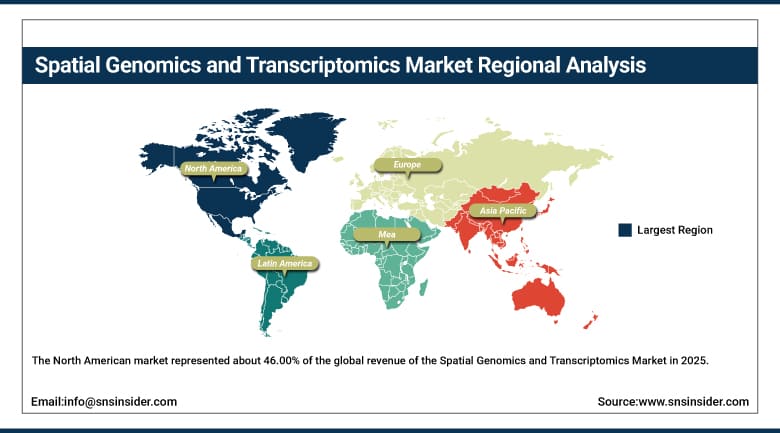
The North American market represented about 46.00% of the global revenue of the Spatial Genomics and Transcriptomics Market in 2025. This is the most developed market in the region due to large financial investments into genomics research, well-developed biotech industry, advanced sequencing technology, and implementation of precision medicine projects both in the USA and in Canada. There are many pharmaceutical companies, cancer institutes, and academic medical institutions that adopt spatial biology technology in order to advance biomarker discovery, disease diagnostics, and treatment program. Large government grants on genomics research, development of oncology pipeline and integration of AI-based bioinformatics solutions also stimulate the growth of commercial opportunities in the region.
During 2025–2026 several North American biotech companies implemented commercialization of the AI-driven spatial transcriptomics technology that can be used for large tissue samples profiling, automated biomarkers analysis, and precision medicine research.
Get Customized Report as Per Your Business Requirement - Enquiry Now
Europe Spatial Genomics and Transcriptomics Market Insights
Support from Europe has been in form of investments in molecular biology research, precision medicine programs and advanced genomics infrastructure in Germany, the UK, France, Switzerland, and the Netherlands. Academic research organizations as well as pharmaceutical companies in the region have been increasingly making use of spatial biology tools to enhance disease mechanism studies, oncology research and drug target discovery programs. Increased interest in translational medicine and personalized therapies has led to increased uptake of advanced molecular profiling platforms. Increased cooperation between academic research organizations and biotech firms has also enhanced innovation activities in the regional market.
In 2026, some research organizations in Europe adopted spatial transcriptomics and multi-omics analysis platforms with AI analytics for precision oncology and immunology research.
Asia Pacific Spatial Genomics and Transcriptomics Market Insights
APAC is expected to witness the highest CAGR of 16.69% in the forecasted period owing to growing investments in biotechnology infrastructure, rising genomics research activities, and growing healthcare innovations initiatives in countries including China, Japan, South Korea, India, Singapore, and Australia. There have been significant investments by governments and private research institutions in programs related to precision medicine, genome sequencing projects, and advanced infrastructure for life sciences research. Increasing pharma R&D activities, rising incidence rate of cancers, and growing demand for personalized medicine services are driving the growth of the market. Expansion of biotech startups and research partnerships within the region is presenting new opportunities for service providers in spatial genomics and transcriptomics technologies.
Between 2025 and 2026, there have been many Asia Pacific research centers adopting the AI integrated workflows for spatial biology applications such as tissue mapping, biomarker discovery, and translational research in oncology and neuroscience.
Middle East & Africa and Latin America Spatial Genomics and Transcriptomics Market Insights
The Middle East & Africa region saw steady growth driven by growing investments in biomedical research facilities, healthcare development projects, and genomics-based precision medicine programs in the UAE, Saudi Arabia, South Africa, and other developing healthcare markets. Strategies implemented by governments aimed at transforming healthcare sector have encouraged implementation of molecular profiling technologies by research organizations and specialized health care facilities. Increased awareness related to personalized medicine and genomic analysis of specific diseases will drive further expansion of the market.
Latin America accounted for owing to growing investments in biotechnology research, increased cancer research activities, and availability of genomics technologies in Brazil, Mexico, Argentina, and Chile. Spatial genomics platforms were increasingly adopted by academic institutions, pharmaceutical companies, and healthcare research organizations for use in translational medicine projects and biomarker discovery programs. Growing support from government for innovation in healthcare and collaborations with foreign life sciences organizations created favorable market environment throughout the region. During 2025–2026, multiple research organizations in Latin America and the Middle East established partnerships with global vendors of genomics technologies to advance spatial biology and precision medicine research programs.
Market Dynamics:
Growth Drivers: Increasing use of precision medicine strategies and advanced molecular profiling techniques.
Increasing use of precision medicine strategies and advanced molecular profiling techniques is one of the key factors driving the growth of the spatial genomics and transcriptomics market. Scientists and health organizations are trying to get deeper understanding of tissue architecture, cell interactions, and mechanisms of disease progression to develop personalized treatment therapies. The spatial biology tools offer unique advantages that allow visualizing gene expression patterns within intact tissues and preserving biological context.
Life science companies are increasingly adopting these tools in oncology, immunology, and neuroscience research studies in order to discover biomarkers and treatment targets. The increasing demand for better disease characterization and patient stratification is contributing to the rising demand for the advanced spatial biology analysis tools. In 2025-2026, several life sciences companies have developed next-generation spatial biology tools combining artificial intelligence, cloud analytics, and high-resolution tissue imaging for improving results of precision medicine research.
Restraints: Data quality issues and high costs of computational infrastructure.
With growing popularity, various issues related to data quality, model validation, high costs of computational infrastructure, and regulatory acceptance are hindering further commercialization of Spatial Genomics and Transcriptomics techniques. To ensure effectiveness of AI and computational biology methods, there is a need for the provision of large amounts of high-quality biological, genomic, and clinical data, which are not always accessible and standardized.
Moreover, advanced molecular modeling and simulations can have high demands on computing power, resulting in cost barriers for smaller biotech firms and research facilities. The lack of accepted standard framework for validation of some AI-based drug discovery results is another issue preventing wide acceptance of the technology. In 2026, various regulatory agencies and pharmaceutical industries kept discussing the standards for AI transparency, validation, and reproducibility within the pharma research environment.
Opportunities: High costs of technology and need for complex bioinformatics analysis.
Though technology has improved a lot, there are still some constraints in the market in relation to high costs of instruments, expensive materials used, and requirement of bioinformatics. There is a need for complicated analysis tools, sequencing equipment, computing hardware and software, and even analytical expertise when applying technologies of spatial genomics and transcriptomics.
The large amount of data that is collected during spatial biology experiments is hard to analyze, especially for those companies that do not have advanced bioinformatics capabilities. Such research institutions may have operational difficulties when introducing full spatial biology workflow due to the above-mentioned reasons. Industry participants paid much attention to automation of workflow, cloud-based platform for data analytics, and AI-driven data interpretation in 2026.
Recent Developments:
-
2026: 10x Genomics, Inc. expanded spatial biology capabilities through enhancements to high-resolution spatial transcriptomics workflows, enabling researchers to generate more comprehensive tissue-level gene expression maps for oncology and translational research applications.
-
2026: NanoString Technologies, Inc. continued advancement of spatial molecular imaging solutions supporting high-plex biomarker analysis, tissue architecture characterization, and precision medicine research across cancer and immunology studies.
-
2025: Illumina, Inc. expanded partnerships across the spatial biology ecosystem to strengthen integration between next-generation sequencing technologies and advanced spatial genomics workflows for life science research organizations.
-
2025: Vizgen, Inc. introduced enhancements to multiplex spatial transcriptomics platforms designed to improve cellular resolution, biomarker discovery capabilities, and large-scale tissue profiling efficiency for translational medicine applications.
Spatial Genomics and Transcriptomics Market Key Players are:
-
10x Genomics, Inc.
-
NanoString Technologies, Inc.
-
Illumina, Inc.
-
Bruker Corporation
-
Vizgen, Inc.
-
Akoya Biosciences, Inc.
-
Bio-Techne Corporation
-
Danaher Corporation
-
Oxford Nanopore Technologies plc
-
Standard BioTools Inc.
-
Resolve Biosciences GmbH
-
Parse Biosciences, Inc.
-
Curio Bioscience, Inc.
-
Leica Biosystems Nussloch GmbH
-
S2 Genomics, Inc.
-
RareCyte, Inc.
-
Pixelgen Technologies AB
-
Ultivue, Inc.
-
Lunaphore Technologies SA
-
Rebus Biosystems, Inc.
Spatial Genomics and Transcriptomics Market Report Scope:
| Report Attributes | Details |
|---|---|
| Market Size in 2025 | USD 0.60 Billion |
| Market Size by 2035 | USD1.90 Billion |
| CAGR | CAGR of 12.23% From 2026 to 2035 |
| Base Year | 2025 |
| Forecast Period | 2026-2035 |
| Historical Data | 2022-2024 |
| Report Scope & Coverage | Market Size, Segments Analysis, Competitive Landscape, Regional Analysis, DROC & SWOT Analysis, Forecast Outlook |
| Key Segments | • By Product (Instruments, Consumables & Reagents, Software & Analytics Platforms, Services, Sample Preparation Solutions) • By Technology (Spatial Transcriptomics, Spatial Genomics, Spatial Proteomics, In-Situ Sequencing, Multiplex Imaging Technologies) • By Application (Oncology Research, Drug Discovery & Development, Neuroscience Research, Immunology & Cell Biology, Clinical Diagnostics) • By End User (Pharmaceutical & Biotechnology Companies, Academic & Research Institutes, Hospitals & Diagnostic Laboratories, Contract Research Organizations (CROs), Government & Public Health Institutes, Others) |
| Regional Analysis/Coverage | North America (US, Canada), Europe (Germany, UK, France, Italy, Spain, Russia, Poland, Rest of Europe), Asia Pacific (China, India, Japan, South Korea, Australia, ASEAN Countries, Rest of Asia Pacific), Middle East & Africa (UAE, Saudi Arabia, Qatar, South Africa, Rest of Middle East & Africa), Latin America (Brazil, Argentina, Mexico, Colombia, Rest of Latin America). |
| Company Profiles | 10x Genomics, Inc., NanoString Technologies, Inc., Illumina, Inc., Bruker Corporation, Vizgen, Inc., Akoya Biosciences, Inc., Bio-Techne Corporation, Danaher Corporation, Oxford Nanopore Technologies plc, Standard BioTools Inc., Resolve Biosciences GmbH, Parse Biosciences, Inc., Curio Bioscience, Inc., Leica Biosystems Nussloch GmbH, S2 Genomics, Inc., RareCyte, Inc., Pixelgen Technologies AB, Ultivue, Inc., Lunaphore Technologies SA, Rebus Biosystems, Inc. |
Frequently Asked Questions
The Spatial Genomics and Transcriptomics Market was valued at USD 0.60 Billion in 2025.
The market is expected to expand at a CAGR of 12.23% during the forecast period.
The market is projected to reach USD 1.90 Billion by 2035.
Asia Pacific is projected to register the fastest CAGR of 16.69% during 2026–2035.
North America dominated the global market in 2025 with approximately 46.00% revenue share.
