
Smartphone Operating System Market Report Scope & Overview:
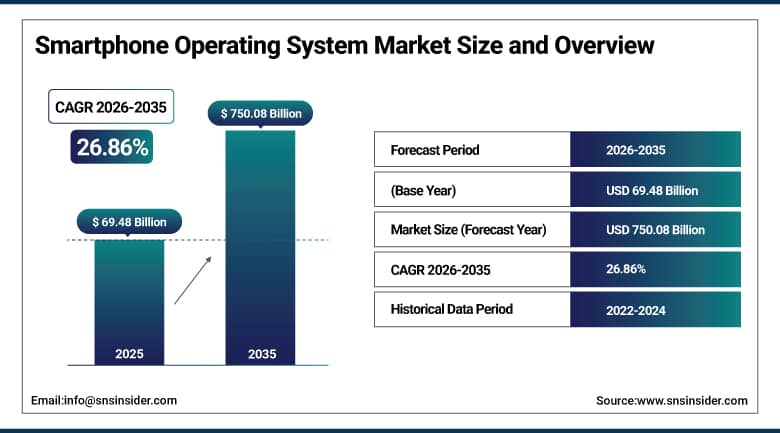
The Smartphone Operating System Market was valued at USD 69.48 Billion in 2025 and is expected to reach USD 750.08 Billion by 2035, growing at a CAGR of 26.86% from 2026 to 2035.
The Smartphone Operating System Market is growing rapidly because of increased adoption of smartphones, high demand for sophisticated mobile applications, and innovation in operating system functionalities. Incorporation of artificial intelligence, security improvements, cloud integration, and improved user experience is driving the OS upgrade process. Growth in 5G network coverage, development in enterprise mobility solutions, and increasing demand for smart devices is another driver behind the growth of this market. Competitive pressure among technology vendors, ecosystem development, and growth in connected devices adoption are generating additional growth opportunities in the smartphone operating systems segment.
Smartphone operating system deployments exceeded 1.4 billion active devices in 2025, supported by expanding smartphone penetration and accelerating 5G adoption.
To Get more information Smartphone Operating System Market - Request Free Sample Report
Smartphone Operating System Market Trends:
-
Rising adoption of predictive maintenance technologies using AI, IoT, and advanced analytics to minimize equipment downtime and improve asset reliability
-
Growing focus on industrial automation and smart manufacturing driving demand for advanced maintenance services across production facilities
-
Increasing need for cost optimization and extended asset lifecycle management encouraging outsourcing of industrial maintenance activities
-
Expanding use of remote monitoring and digital maintenance platforms enabling real-time equipment tracking, diagnostics, and proactive issue resolution
-
Rising investments in energy, automotive, aerospace, pharmaceutical, and chemical industries supporting demand for specialized industrial maintenance solutions and services
U.S. Smartphone Operating System Market Outlook:
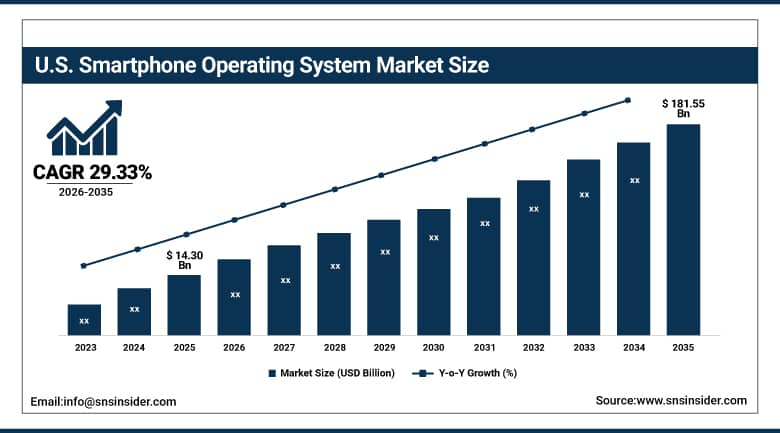
The U.S. Smartphone Operating System Market was valued at approximately USD 14.30 Billion in 2025. It is expected to reach approximately USD 181.55 Billion by 2035, growing at a CAGR of approximately 29.33%.
The United States is the world's most valuable national smartphone OS market by revenue per device. Apple's iOS commands premium brand positioning in the U.S. market. iOS holds approximately 55 to 60 percent of U.S. smartphone market share. This is significantly above iOS's global share of approximately 28 to 30 percent. U.S. consumers are disproportionately likely to purchase premium iPhone devices. Apple generates among the highest per-device revenue globally from U.S. iPhone sales. Android serves the remaining U.S. market across Samsung Galaxy, Google Pixel, and other OEM devices.
Enterprise market growth is particularly significant in the U.S. Corporate mobility investment is high. BYOD policies are widespread. Healthcare, logistics, and field service operators are deploying smartphone-based workflow tools at scale.
Smartphone Operating System Market Segment Analysis:
-
By Operating System Type, Android segment dominated the Smartphone Operating System Market in 2025 with 71% share; HarmonyOS segment is the fastest growing segment.
-
By Device Price Tier, Mid-Range segment dominated the market in 2025 with 42% share; Premium segment is the fastest growing segment.
-
By Deployment Type, Factory-Installed segment dominated the market in 2025 with 68% share; OTA (Over-the-Air) Upgradable segment is the fastest growing segment.
-
By Distribution Channel, OEM Bundled segment dominated the market in 2025 with 54% share; Online App Stores segment is the fastest growing segment.
-
By End Use, Individual Consumers segment dominated the market in 2025 with 76% share; Enterprise Users segment is the fastest growing segment.
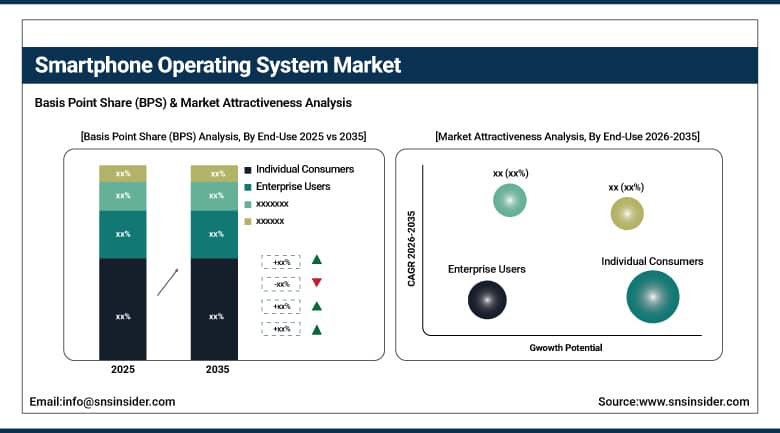
By End Use, Individual Consumers segment dominates the Smartphone Operating System Market, Enterprise Users segment expected to grow fastest
The Individual Consumers segment dominated the Smartphone Operating System Market in 2025 owing to the wide-scale adoption of smartphones among individuals for communication purposes, entertainment, online services, digital transactions, and various other tasks. Smartphones have now turned out to be indispensable consumer electronics thanks to greater access to the internet and development in mobile applications. Technological advancements in the capabilities of smartphones, affordability of devices, and reliance on digital platforms have boosted the demand. Individual consumers are still expected to remain dominant due to the large user base of personal smartphones globally.
The Enterprise Users segment is the fastest growing as more and more smartphones are being adopted for business communication purposes, remote working, workforce management, and enterprise applications. Companies are now making investments in secured mobile solutions for improving productivity and carrying out digital collaboration and operations of mobile workforce. Greater adoption of mobile device management, cyber security solutions, and enterprise applications via the cloud platform is fuelling the adoption of smartphones among enterprises.
By Operating System Type, Android segment dominates the Smartphone Operating System Market, HarmonyOS segment expected to grow fastest
The Android segment dominated the Smartphone Operating System Market in 2025 owing to its high adoption rate on various smartphone brands, wide device compatibility, and flexible open-source environment. Android is compatible with various devices from different price ranges, making it possible for manufacturers to produce smartphones that cater to different customers. With the high app environment, customization, and integration with Google services, the segment has been positioned as the leader in the smartphone operating system market.
The HarmonyOS segment is the fastest growing owing to the increasing investment in ecosystems development, cross-device connection, and independent operating systems capabilities. The increased demand for seamless integration of the smartphones, wearables, smart home products, and others is promoting the adoption of the operating system. Growth in device compatibility, privacy and security features, and increased developer support are some of the growth factors for the segment. Increased demand for alternative operating systems is promoting the segment growth.
By Device Price Tier, Mid-Range segment dominates the Smartphone Operating System Market, Premium segment expected to grow fastest
The Mid-Range segment dominated the Smartphone Operating System Market in 2025 due to growing consumer preference for budget-friendly smartphones with advanced features and performance. The mid-range smartphones combine affordability with processing speed, high-quality cameras, long-lasting batteries, and other capabilities. Increased usage of smartphones in developing economies, value-driven consumerism, and continuous new launches from manufacturers are some of the reasons behind the dominance of this segment.
The Premium segment is the fastest growing because of the growing demand for feature-rich smartphones, high-performance processors, high-quality cameras, better security, and high-end experiences. Growing demand for artificial intelligence-based smartphones, connectivity capabilities, and long-term software support is driving consumers towards premium smartphones. Increased disposable income, growing digital lives of consumers, and adoption of flagship smartphones by professionals and technology enthusiasts are some of the driving factors behind the growth of the premium price segment.
By Deployment Type, Factory-Installed segment dominates the Smartphone Operating System Market, OTA (Over-the-Air) Upgradable segment expected to grow fastest
The Factory-Installed segment dominated the Smartphone Operating System Market in 2025 because smartphones are normally supplied along with installed operating systems that are compatible with the hardware of the phone and enhance its functionality. Factory-installed operating systems offer users direct access to all the features and applications offered by the smartphone upon purchasing it. Smartphone manufacturing companies continue to favor this segment as a result of the high production rate of smartphones and standard practices in the industry.
The OTA (Over-the-Air) Upgradable segment is the fastest growing due to increased demand for continued improvements in software, enhancements in security and functionality of the devices through updates after they have been purchased. Smartphones are being manufactured with a focus on improving the lifespans of the devices through software updates over the air. Cybersecurity, improvements in user experience and increased lifetimes of the software are some factors contributing to the growth of this segment.
By Distribution Channel, OEM Bundled segment dominates the Smartphone Operating System Market, Online App Stores segment expected to grow fastest
The OEM Bundled segment dominated the Smartphone Operating System Market in 2025 because main operating system delivery method was through integration into smartphones directly from the manufacturer prior to delivery to consumers. This allows the OEMs to ensure that there is optimized hardware and software performance, customization of user interface and pre-installation of applications and services. The consumers normally purchase their smartphones together with the operating system that has been installed by the manufacturer in their devices. Close associations between operating system companies and smartphone manufactures will keep this segment leading.
The Online App Stores segment is the fastest growing owing to the growing use of smartphones, mobile app ecosystems, and demand for digital services. Consumers have become more dependent on using app stores to download apps, update their software, and enhance the functionality of their smartphones. The growth in mobile gaming, finance applications, productivity tools, and entertainment apps is fueling the use of app stores.
Regional Analysis:
|
Region |
Major Country |
Share within Region, 2025 (%) |
|---|---|---|
|
North America |
United States |
84.73% |
|
Europe |
Germany |
27.84% |
|
Asia Pacific |
China |
38.47% |
|
Middle East & Africa |
UAE |
22.84% |
|
Latin America |
Brazil |
43.84% |
Asia Pacific Smartphone Operating System Market Insights
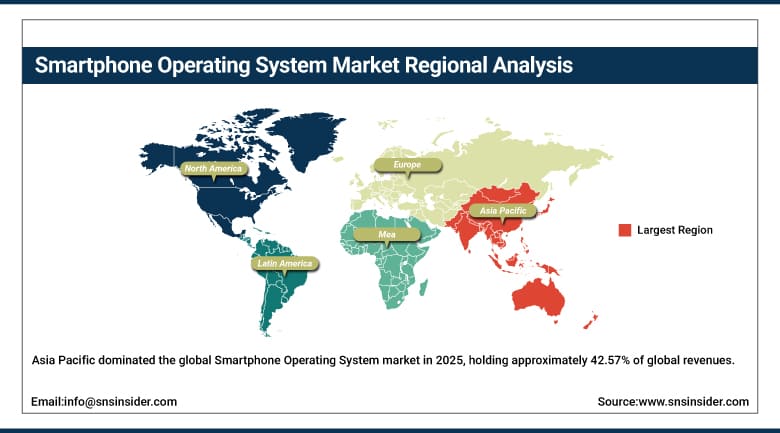
Asia Pacific dominated the global Smartphone Operating System market in 2025, holding approximately 42.57% of global revenues. China accounts for approximately 38.47% of Asia Pacific revenues. Android variants and HarmonyOS collectively dominate Chinese smartphone market share. U.S. sanctions restrictions on Huawei's access to Google Mobile Services have accelerated HarmonyOS adoption. India is growing extremely rapidly through smartphone market expansion. Indian smartphone shipments exceeded 170 million units in 2024. Android dominates the Indian market overwhelmingly across budget and mid-range price tiers.
Get Customized Report as per Your Business Requirement - Enquiry Now
North America Smartphone Operating System Market Insights
North America is the fastest-growing regional Smartphone Operating System market, expanding at a CAGR of 30.61% during the forecast period. The United States accounts for approximately 84.73% of regional revenue. iOS dominates U.S. market share. Apple's ecosystem strength sustains premium device pricing and above-average per-user app store and services revenue. Enterprise mobile deployment growth is concentrated in North America. Regulatory and healthcare mobile application deployment is expanding. Canada contributes meaningful supplementary demand through its advanced smartphone market and enterprise mobile adoption.
Europe Smartphone Operating System Market Insights
Europe held a significant share of the global Smartphone Operating System market in 2025. Germany accounts for approximately 27.84% of European revenues. The German smartphone market is balanced between Android and iOS. Samsung and Apple are the leading brands. EU Digital Markets Act provisions are reshaping app distribution requirements. Apple opened alternative app marketplace access to EU users in response to DMA requirements. This regulatory development has commercial implications for App Store revenue models in Europe. The United Kingdom, France, and the Netherlands contribute meaningful European market revenues.
MEA & Latin America Smartphone Operating System Market Insights
Middle East and Latin America are growing Smartphone Operating System markets driven by rising smartphone penetration. The UAE leads MEA revenues at approximately 22.84% of the regional total. The UAE has one of the highest smartphone penetration rates globally. The market is balanced between iOS in premium segments and Android in broader consumer demographics. Brazil leads Latin American revenues at approximately 43.84% of the regional total. Brazil is one of the largest smartphone market by volume in Latin America. Android dominates across all price tiers in Brazil. Budget and mid-range Android devices serve the mass market.
Market Dynamics:
Growth Drivers: 5G adoption and AI integration accelerate smartphone upgrades and operating system ecosystem growth.
5G network deployment is creating hardware upgrade incentives at scale. Consumers in 5G-covered markets are upgrading to 5G-capable devices. These devices run the latest iOS and Android versions with full 5G feature support. The upgrade cycle creates OS platform license and ecosystem revenue growth proportional to 5G device shipment volumes. AI feature integration is creating the most commercially significant OS value expansion in the smartphone industry's history.
On-device AI features including generative AI writing tools, AI photography enhancement, real-time translation, and AI-powered summarisation are driving device upgrades among consumers who would otherwise retain their existing smartphones longer. Each AI-enabled upgrade is a revenue event for the OS ecosystem through app store, services, and advertising.
Restraints: Market saturation and app store regulations constrain smartphone OS revenue expansion opportunities.
Smartphone penetration exceeds 90 percent in most developed markets. The GSMA reported approximately 320 million mobile internet subscribers in North America in 2024. This near-total saturation means new device sales are almost entirely replacement rather than new user purchases. Replacement cycles are lengthening. Consumers retain smartphones for 3 to 4 years on average. This compresses the revenue opportunity from upgrade-driven OS ecosystem growth. Regulatory scrutiny of App Store policies is intensifying globally.
The EU Digital Markets Act required Apple to allow alternative app distribution in Europe. Multiple jurisdictions are investigating Google Play Store commission structures. These regulatory pressures create risk to the high-margin app store commission revenue that sustains iOS and Android ecosystem profitability.
Opportunities: Emerging markets and AI-native features create new smartphone OS growth opportunities.
India, Southeast Asia, and Sub-Saharan Africa represent the final large-scale smartphone adoption frontiers. Indian smartphone penetration reached approximately 65 percent in 2024 with significant upside toward 80 percent by 2028. Each new smartphone adopter represents a new OS platform user. They enter the app ecosystem, create advertising inventory, and establish long-term brand relationships with Android or iOS.
The monetisation potential of this mass adoption wave is substantial. AI-native operating system features are creating a new premium tier of device differentiation. Consumers who value AI capabilities, enhanced photography, and extended battery life through AI-optimised resource management are willing to pay premium prices. This premiumisation supports above-average revenue growth relative to unit shipment growth.
Recent Developments:
-
2025: Huawei released HarmonyOS 6 with improved AI functionality, enhanced cross-device connectivity, and upgraded security, with deployments exceeding 48 million smartphone devices globally and accelerating the ecosystem's independence from Google Mobile Services.
-
2025: Samsung unveiled the Galaxy S25 with AI-enhanced Android powered by Google's Gemini language models. Google announced general availability of Gemini AI integration across Android 16, enabling on-device large language model capabilities through standard developer APIs.
-
2025: Apple expanded Apple Intelligence features across iOS 18+ throughout 2025, including writing tools, image generation, notification summarisation, and integrated ChatGPT access, positioning AI features as a primary driver of iPhone upgrade decisions.
Smartphone Operating System Market Key Players are:
-
Google
-
Apple
-
Samsung
-
Xiaomi
-
Oppo
-
Vivo
-
OnePlus
-
Sony
-
LG
-
Lenovo
-
Motorola
-
Nokia
-
Asus
-
ZTE
-
TCL
-
Meizu
-
Infinix
-
Tecno
Smartphone Operating System Market Report Scope:
| Report Attributes | Details |
|---|---|
| Market Size in 2025 | USD 69.48 Billion |
| Market Size by 2035 | USD 750.08 Billion |
| CAGR | CAGR of 26.86% From 2026 to 2035 |
| Base Year | 2025 |
| Forecast Period | 2026-2035 |
| Historical Data | 2022-2024 |
| Report Scope & Coverage | Market Size, Segments Analysis, Competitive Landscape, Regional Analysis, DROC & SWOT Analysis, Forecast Outlook |
| Key Segments | • By Operating System Type (Android, iOS, HarmonyOS, KaiOS, Others) • By Device Price Tier (Entry-Level, Mid-Range, Premium, Ultra-Premium) • By Deployment Type (Factory-Installed, OTA Upgradable, OEM-Customized, Enterprise-Managed) • By Distribution Channel (OEM Bundled, Telecom Operator Bundling, Online App Stores, Third-Party Integrators) • By End-Use (Individual Consumers, Enterprise Users, Government & Public Sector, Educational Institutions) |
| Regional Analysis/Coverage | North America (US, Canada), Europe (Germany, UK, France, Italy, Spain, Russia, Poland, Rest of Europe), Asia Pacific (China, India, Japan, South Korea, Australia, ASEAN Countries, Rest of Asia Pacific), Middle East & Africa (UAE, Saudi Arabia, Qatar, South Africa, Rest of Middle East & Africa), Latin America (Brazil, Argentina, Mexico, Colombia, Rest of Latin America). |
| Company Profiles | Google, Apple, Huawei, Samsung, Xiaomi, Oppo, Vivo, OnePlus, Sony, LG, Lenovo, Motorola, Realme, Nokia, Asus, ZTE, TCL, Meizu, Infinix, Tecno |
Frequently Asked Questions
Key players include Google, Apple, Huawei, Samsung, and Xiaomi, among others.
Key opportunities include AI-native features, emerging-market smartphone adoption, 5G upgrades, enterprise mobility, premiumization, and cross-device ecosystem expansion.
5G adoption, AI integration, ecosystem expansion, enterprise mobility, and emerging market smartphone growth drive Smartphone Operating System Market expansion globally.
The Android segment dominated the Smartphone Operating System Market.
Asia Pacific dominated the Smartphone Operating System Market in 2025.
