
Special Effect Pigments Market Report Scope & Overview:
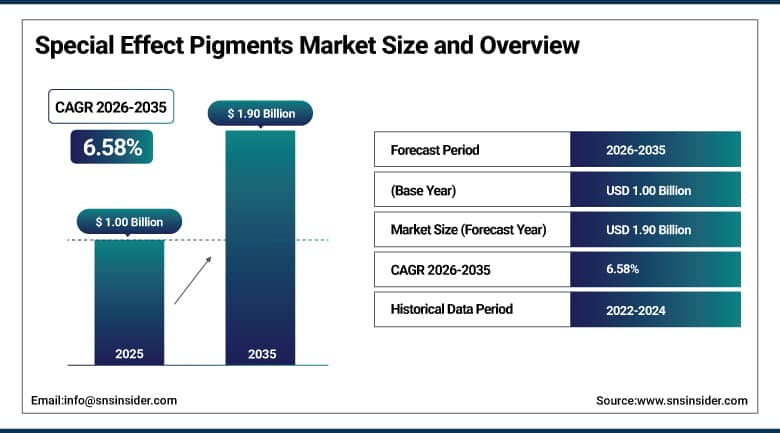
The Special Effect Pigments Market was valued at USD 1.00 Billion in 2025 and is expected to reach USD 1.90 Billion by 2035, growing at a CAGR of 6.58% from 2026–2035.
The global special effect pigments market is experiencing consistent growth driven by consumer and industrial demand for visually differentiated, aesthetically premium product finishes that standard opaque and transparent pigments cannot deliver. Special effect pigments generate their distinctive visual impact through light interference, metallic reflection, fluorescent emission, or holographic diffraction effects that create color-shifting, shimmering, and light-reactive surface appearances in paints, coatings, cosmetics, inks, and plastics. The market’s commercial importance is amplified by the brand differentiation value these pigments provide. Premium automotive paints, luxury cosmetics packaging, security printing inks, and high-end consumer electronics coatings all depend on special effect pigments to create the visual premium that justifies pricing above commodity equivalents. Anti-counterfeit packaging represents a growing commercial application where optically variable pigments whose color-shift characteristics are difficult to reproduce provide brand authentication at retail without additional security infrastructure investment.
BASF SE and a leading Asian coatings manufacturer partnered in April 2023 to co-develop a new color-shifting pigment series specifically for electric vehicle body coatings. The collaboration targets the growing OEM demand for EV-exclusive visual differentiation through dynamic color effects that shift between hues at different viewing angles, creating an aesthetic signature that reinforces the premium brand positioning that EV manufacturers are building around their vehicle aesthetics and technology credentials.
To Get More Information On Special Effect Pigments Market - Request Free Sample Report
Special Effect Pigments Market Trends
- Rising adoption of synthetic and lab-grown mica is supporting sustainable and ethical pigment sourcing.
- Growing demand for color-shifting pigments in anti-counterfeit packaging is expanding functional security applications.
- Increasing regulations on heavy metal usage are accelerating development of safer pigment formulations.
- Expanding automotive customization and EV branding trends are driving demand for advanced metallic and interference pigments.
- Rising adoption of water-based and low-VOC coatings is encouraging environmentally compliant pigment innovations.
The U.S. Special Effect Pigments Market Outlook
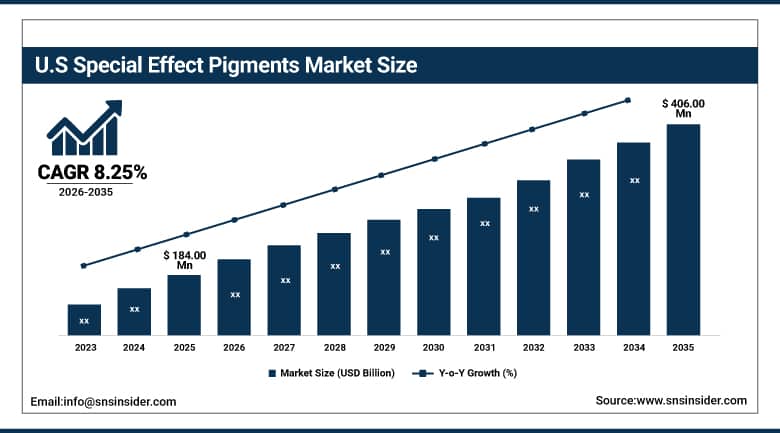
The U.S. Special Effect Pigments Market was valued at approximately USD 184.00 Million in 2025 and is expected to reach approximately USD 406.00 Million by 2035, growing at a CAGR of approximately 8.25%.
The United States is North America’s largest and fastest-growing special effect pigments market, driven by the country’s premium consumer goods sector, technically demanding automotive coatings industry, and sophisticated cosmetics market whose innovation investment sustains consistent demand for new pigment effects and performance credentials. The U.S. automotive OEM coating programmes generate particularly high-value special effect pigment demand, as custom metallic and color-shifting basecoat formulations represent one of the most commercially important vehicle customization options that OEM paint suppliers invest in differentiating across model ranges. The beauty industry’s dynamic color cosmetics segment sustains consistent new product development demand for innovative pearlescent and holographic pigment effects that drive seasonal collection launches.
DIC Corporation and Sun Chemical completed the acquisition of high-volume special effect pigment production portfolios in China and India in 2024, alongside investments in green mica-based pearlescent pigment manufacturing lines. The move directly targets the growing North American cosmetics and food packaging customer base seeking sustainably sourced, high-quality pearlescent pigments whose supply chain provenance aligns with corporate ESG commitments.
Special Effect Pigments Market Segment Analysis
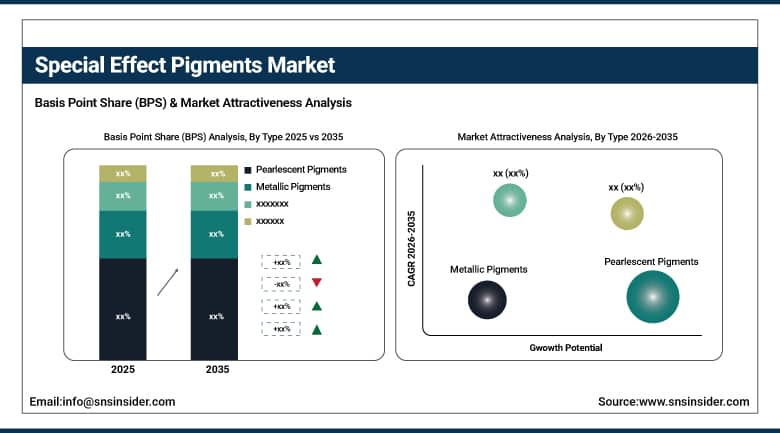
- By Type, pearlescent pigments segment dominated the special effect pigments market with 51.13% share in 2025, while the metallic pigments segment is the fastest growing during 2026–2035 as automotive OEM color programmes and premium packaging applications increase demand for high-chroma metallic effect coatings.
- By Application, paints & coatings segment dominated the special effect pigments market with approximately 35% share in 2025, while the cosmetics & personal care segment is the fastest growing at a CAGR of approximately 8.5% during 2026–2035 as premium beauty product innovation drives sustained new pigment effect development.
- By End Use Industry, automotive segment dominated the special effect pigments market in 2025, while the consumer goods segment is the fastest growing during 2026–2035 as premium packaging, personal care, and lifestyle product brands invest in visually distinctive special effect finishes.
By Type, pearlescent dominates, metallic grows fastest
Pearlescent pigments retained the dominant type position with 51.13% of the special effect pigments market in 2025. Their commercial primacy reflects the extraordinary breadth of application environments in which pearlescent effects deliver commercially valuable visual differentiation. From automotive basecoat shimmer to lip gloss luminosity, from luxury packaging sheen to nail polish sparkle, pearlescent pigments serve the widest range of industry applications of any special effect pigment type with consistent formulation compatibility across water-based, solvent-based, and powder coating systems. The segment’s dominance is reinforced by the well-established commercial and technical infrastructure for pearlescent pigment manufacture from both natural and synthetic mica substrates, whose production scale and supply chain depth creates competitive procurement economics that new pigment types cannot initially match.
Metallic pigments are the fastest-growing type in the special effect pigments market. The commercial driver is the convergence of premium packaging investment, electric vehicle coating programme expansion, and consumer electronics finish differentiation that collectively create growing demand for the high-chroma, light-reflective metallic effects that aluminium flake, copper, bronze, and zinc pigment formulations uniquely deliver. Automotive OEM custom color programmes are particularly commercially significant for metallic pigment demand, as each new model generation introduces new color offerings whose distinctiveness depends on proprietary metallic flake geometry, surface treatment, and particle size distribution that pigment suppliers develop exclusively for individual OEM partners. The EV market’s emphasis on premium visual identity is amplifying this investment.
By Application, paints & coatings dominate, cosmetics grows fastest
Paints and coatings retained the dominant application position with approximately 35% of the special effect pigments market in 2025. The segment’s dominance reflects the automotive industry’s role as the single largest consumer of special effect pigments by volume and the architectural and industrial coatings market’s growing adoption of metallic and pearlescent effects for premium building material and consumer product surface treatments. Automotive coating special effect pigment demand is defined by OEM color programme investment cycles where each new vehicle platform introduction generates demand for new proprietary pigment formulations that differentiate the model’s visual identity from predecessors and competitors. Premium architectural coating brands similarly depend on special effect pigments to create distinctive product ranges that justify pricing above standard decorative coating alternatives.
Cosmetics and personal care is the fastest-growing application at a CAGR of approximately 8.5% through 2035. The commercial logic is the beauty industry’s extraordinary innovation velocity in color cosmetics where seasonal collection launches, influencer-driven trend cycles, and consumer appetite for novel visual effects create consistent demand for new pigment capabilities. Holographic highlighters, duo-chrome eyeshadows, color-shifting lip products, and sparkle-effect body cosmetics have each created substantial new commercial categories whose growth sustains above-average special effect pigment demand growth within the cosmetics application. The sustainability imperative is simultaneously reshaping the cosmetics pigment supply chain toward lab-grown synthetic mica whose conflict-free sourcing credentials and consistent particle quality align with both regulatory requirements and consumer ethical purchasing expectations.
Regional Analysis
|
Region |
Major Country |
Share within Region, 2025 (%) |
|---|---|---|
|
North America |
United States |
87.4% |
|
Europe |
Germany |
28.4% |
|
Asia Pacific |
China |
55.2% |
|
Middle East & Africa |
UAE |
32.1% |
|
Latin America |
Brazil |
44.2% |
Asia Pacific Special Effect Pigments Market Insights
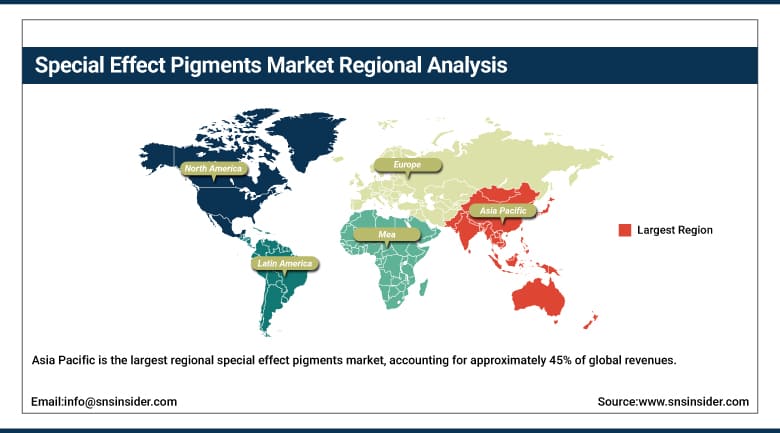
Asia Pacific is the largest regional special effect pigments market, accounting for approximately 45% of global revenues, driven by China’s world-leading automotive production and cosmetics manufacturing sectors, India’s rapidly expanding premium consumer goods and packaging markets, and Japan’s technically sophisticated coating and printing industries whose quality standards sustain above-average per-unit pigment value. China accounts for approximately 55.2% of Asia Pacific revenues through its combination of the world’s largest automotive production base, a rapidly growing premium cosmetics consumption market, and a domestic special effect pigment manufacturing industry whose production scale drives competitive pricing across pearlescent and metallic pigment categories globally.
India and South Korea represent commercially significant secondary markets within Asia Pacific. India’s booming consumer goods packaging sector and growing premium cosmetics industry are creating demand for innovative pearlescent and holographic pigment effects whose application in domestic brand products is progressively elevating the visual quality standard across Indian retail segments. South Korean cosmetics brands’ global influence in setting color effect trends has made the country a commercially important early-adoption market for novel pigment technologies whose South Korean commercial validation accelerates international adoption.
Get Customized Report as Per Your Business Requirement - Enquiry Now
North America Special Effect Pigments Market Insights
North America is the fastest-growing regional special effect pigments market at a CAGR of approximately 8.25%, driven by the United States’ premium automotive coating programmes, dynamic beauty industry innovation investment, and the growing anti-counterfeit packaging market whose security printing and packaging applications create specialized demand for optically variable pigments. The United States accounts for approximately 87.4% of North American revenues through its concentration of global automotive OEM design and engineering operations, its world-leading color cosmetics industry, and its premium packaging market whose brand differentiation investment sustains consistent demand for new visual effect capabilities.
Canada contributes approximately 12.6% of North American revenues through its automotive assembly operations, personal care product manufacturing sector, and industrial coatings market. Canadian environmental regulations regarding heavy metal content in coatings and cosmetics are aligned with U.S. EPA and FDA standards, creating consistent compliance-driven demand for the heavy-metal-free special effect pigment formulations that BASF, Merck KGaA, and Altana’s ECKART division are actively developing to meet North American regulatory requirements.
Europe Special Effect Pigments Market Insights
Europe is a technically advanced special effect pigments market where EU REACH regulation’s restrictions on specific pigment chemistries, cosmetics safety standards under EU Regulation 1223/2009, and automotive coating environmental compliance requirements collectively create a regulatory framework that shapes both product development and procurement specifications across all application categories. Germany accounts for approximately 28.4% of European revenues as the region’s largest market, anchored by Volkswagen Group, BMW, and Mercedes-Benz’ premium automotive coating programmes and the presence of Merck KGaA’s Performance Materials division, whose Xirallic and Iriodin special effect pigment product lines define the global standard for automotive and cosmetics pearlescent and interference pigment performance.
BASF SE’s Glasurit and Ultraglimmer pigment lines, Altana’s ECKART metallic pigment division, and Schlenk Metallic Pigments’ European operations collectively represent a technically sophisticated European manufacturing base whose R&D investment in eco-friendly formulations, radar-compatible automotive coatings, and synthetic mica substrates is setting the commercial and regulatory compliance standards that global pigment suppliers are progressively adopting as market entry requirements for premium application categories.
MEA & Latin America Special Effect Pigments Market Insights
The Middle East and Africa and Latin America are growing special effect pigments markets where expanding premium consumer goods manufacturing, growing packaging sophistication, and the cosmetics industry’s progressive adoption of international visual quality standards are creating demand for special effect pigment applications. UAE leads MEA revenues at approximately 32.1% of the regional total through its luxury goods retail sector, high-end cosmetics consumption market, and the premium packaging requirements of food and beverage brands targeting the Gulf’s affluent consumer demographic whose visual quality expectations for product presentation align with the highest international standards.
Brazil leads Latin American revenues at approximately 44.2% of the regional total through its significant automotive production base, large and commercially sophisticated cosmetics industry, and growing premium packaging sector. Brazilian cosmetics brands have developed internationally recognized color cosmetics lines whose pigment quality standards create consistent demand for premium special effect pigments from both domestic and international suppliers serving the Brazilian beauty market.
Market Dynamics
Growth Drivers: Automotive OEM premium color programme investment, cosmetics industry innovation driving new effect development
Automotive OEM color programme investment is the most commercially significant recurring demand driver for special effect pigments. Each new vehicle platform introduces new color offerings whose competitive differentiation depends on proprietary pigment formulations. The EV transition is amplifying this investment as manufacturers seek visual identity signatures that distinguish their electric models from combustion vehicle predecessors. Premium color effects whose dynamism and depth cannot be replicated by standard pigments are being specified as signature features in flagship EV models across Volkswagen Group, BMW, and Asian OEM programmes simultaneously.
The cosmetics industry’s seasonal collection launch cycle creates consistent recurring demand for innovative pigment effects that provide seasonal product differentiation without fundamental formulation redesign. New particle size distributions, novel substrate materials, surface treatment innovations, and multi-layer interference structures each represent incremental product development directions whose commercial value is validated through the beauty industry’s rapid adoption of new visual effects across influencer-driven launch cycles that compress the time from pigment innovation to mass-market product availability.
Restraints: Regulatory restrictions on heavy metal content and mining-sourced mica limiting conventional pigment formulations
EU REACH restrictions on chromium, lead, and cadmium compounds in decorative and cosmetics pigments are progressively restricting the chemical palette available for conventional special effect pigment formulation. Reformulation to heavy-metal-free alternatives requires R&D investment whose cost is proportionally greater for smaller pigment manufacturers whose scale limits the amortization efficiency of compliance-driven product development. The transition to compliant formulations is creating both a competitive challenge for incumbents and a market entry opportunity for companies whose product portfolios were designed from inception around regulatory compliance requirements.
Natural mica supply chain concerns, centered on artisanal mining conditions and child labor documentation challenges in Indian and Madagascan mica production, are creating procurement risk for cosmetics companies whose ethical sourcing commitments require supply chain transparency that naturally mined mica cannot always provide with the documentation depth required. This concern is accelerating the transition to synthetic fluorophlogopite mica whose manufacturing process provides complete supply chain control and consistent particle quality, but at higher production cost than naturally mined alternatives.
Opportunities: Synthetic mica commercialization supporting sustainable supply chain credentials, EV color innovation creating new OEM pigment development programmes
Synthetic mica commercialization represents one of the most commercially significant structural opportunities in the special effect pigments market because it simultaneously addresses regulatory compliance requirements, ethical supply chain concerns, and technical performance optimization in a single material transition. Manufacturers who establish cost-competitive synthetic mica production capacity are positioning themselves to capture the cosmetics and premium packaging markets’ progressive migration from natural to synthetic substrates, whose timeline is being accelerated by retailer sustainability commitments and brand ethical sourcing policies that are creating procurement mandates for traceable ingredient supply chains.
Optically variable pigments for anti-counterfeit applications represent a high-value, specification-protected market whose commercial growth is driven by brand protection investment that is independent of consumer demand cycles. Currency security, pharmaceutical packaging authentication, luxury goods protection, and brand-critical consumer product authentication each represent application categories whose security pigment procurement is determined by brand protection budget rather than consumer preference, creating durable commercial demand for the most technically sophisticated special effect pigment developments.
Recent Developments:
- 2024: DIC Corporation and Sun Chemical completed acquisitions of high-volume special effect pigment production portfolios in China and India in 2024, alongside investments in green mica-based pearlescent pigment manufacturing lines targeting the rapidly growing cosmetics and food packaging markets in Asia Pacific and North America whose sustainable sourcing requirements are driving migration from naturally mined to synthetically produced pearlescent pigment substrates.
- 2023: BASF SE partnered with a leading Asian coatings manufacturer in April 2023 to co-develop a new color-shifting pigment series for electric vehicle body coating applications, targeting the growing OEM demand for proprietary visual differentiation effects that reinforce premium EV brand positioning through dynamic hue-shifting color appearances at different viewing angles.
- 2024: Merck KGaA expanded its Xirallic special effect pigment range in 2024 with new interference pigment grades optimized for water-based automotive basecoat systems, responding to OEM coating environmental compliance requirements that are progressively mandating water-based formulations across European and North American automotive manufacturing operations.
Special Effect Pigments Market Key Players are:
- Merck KGaA (Performance Materials)
- BASF SE
- Altana AG (ECKART)
- Sun Chemical (DIC Corporation)
- Schlenk Metallic Pigments GmbH
- Sudarshan Chemical Industries Ltd.
- Kolortek Co., Ltd.
- Eckart GmbH
- Toyal Group
- CQV Co., Ltd.
- Silberline Manufacturing Co. Inc.
- Nihon Koken Kogyo Co., Ltd.
- Oxen Special Chemicals
- Kuncai Materials Technology Co., Ltd.
- Fujian Kuncai Material Technology Co., Ltd.
- IrisTech (Guangzhou Yortay Fine Chemicals Co.)
- Cristal (Tronox Holdings)
- Sympatec GmbH
- Rika Technology Co., Ltd.
- Ronald Britton Ltd.
Special Effect Pigments Market Report Scope :
| Report Attributes | Details |
|---|---|
| Market Size in 2025 | USD 1.00 Billion |
| Market Size by 2035 | USD 1.90 Billion |
| CAGR | CAGR of 6.58% From 2026 to 2035 |
| Base Year | 2025 |
| Forecast Period | 2026-2035 |
| Historical Data | 2022-2024 |
| Report Scope & Coverage | Market Size, Segments Analysis, Competitive Landscape, Regional Analysis, DROC & SWOT Analysis, Forecast Outlook |
| Key Segments | •By Type (Pearlescent Pigments, Metallic Pigments, Fluorescent Pigments, Holographic/Interference Pigments, Others) •By Application (Paints & Coatings, Cosmetics & Personal Care, Printing Inks, Plastics, Packaging, Others) •By End Use Industry (Automotive, Consumer Goods, Industrial, Food & Beverage, Others) |
| Regional Analysis/Coverage | North America (US, Canada), Europe (Germany, UK, France, Italy, Spain, Russia, Poland, Rest of Europe), Asia Pacific (China, India, Japan, South Korea, Australia, ASEAN Countries, Rest of Asia Pacific), Middle East & Africa (UAE, Saudi Arabia, Qatar, South Africa, Rest of Middle East & Africa), Latin America (Brazil, Argentina, Mexico, Colombia, Rest of Latin America). |
| Company Profiles | Merck KGaA (Performance Materials), BASF SE, Altana AG (ECKART), Sun Chemical (DIC Corporation), Schlenk Metallic Pigments GmbH, Sudarshan Chemical Industries Ltd., Kolortek Co., Ltd., Eckart GmbH, Toyal Group, CQV Co., Ltd., Silberline Manufacturing Co. Inc., Nihon Koken Kogyo Co., Ltd., Oxen Special Chemicals, Kuncai Materials Technology Co., Ltd., Fujian Kuncai Material Technology Co., Ltd., IrisTech (Guangzhou Yortay Fine Chemicals Co.), Cristal (Tronox Holdings), Sympatec GmbH, Rika Technology Co., Ltd., Ronald Britton Ltd. |

Frequently Asked Questions
Automotive premium color programs, cosmetics product innovation, and rising adoption of optically variable pigments in anti-counterfeit packaging are driving consistent demand growth in the special effect pigments market.
