
Specimen Collection Cards Market Report Scope & Overview:
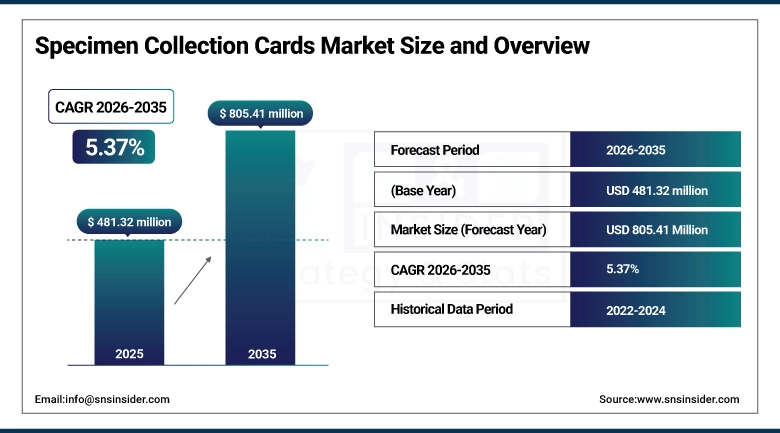
The Specimen Collection Cards Market is valued at USD 481.32 Million in 2025 and is projected to reach around USD 805.41 Million by 2035, growing at a CAGR of 5.37% during the forecast period 2026–2035.
Among other factors, Specimen Collection Cards Market research reports emphasize the growing popularity of DBS and FTA technology usage, demand for decentralized or at-home diagnostics, and growing applicability to newborn screening, infectious diseases, and forensics. Additionally, innovation in sample stabilization technology, digital traceability system application, and preference for efficient biological sample-taking are contributing to market expansion.
Specimen collection card application across the globe has exceeded hundreds of millions of samples yearly in 2025 due to the extensive use of newborn screening and the expansion of infectious disease surveillance projects.
Market Size and Forecast:
-
Market Size in 2025: USD 481.32 Million
-
Market Size by 2035: USD 805.41 Million
-
CAGR: 5.37% from 2026 to 2035
-
Base Year: 2025
-
Forecast Period: 2026–2035
-
Historical Data: 2022–2024
To Get more information on Specimen Collection Cards Market - Request Free Sample Report
Specimen Collection Cards Market Trends:
-
Rising demand for decentralized and remote diagnostic testing (including at-home sample collection) is driving widespread adoption of specimen collection cards.
-
Expanding newborn screening programs and national public health initiatives are significantly increasing the utilization of dried blood spot (DBS) and Guthrie cards.
-
Growing prevalence of infectious diseases and genetic disorders is accelerating demand for cost-effective, high-accuracy sample collection and transport solutions.
-
Increasing shift toward ambient-stable and cold-chain–free specimen preservation technologies is reducing logistics costs and improving diagnostic reach.
-
Advancements in chemically treated FTA cards, DNA/RNA stabilization technologies, and enhanced filter membranes are improving sample integrity and testing accuracy.
-
Rapid integration of digital tracking systems (barcodes, QR codes, and LIMS connectivity) is enhancing traceability, workflow automation, and laboratory efficiency.
-
Rising adoption of non-invasive sampling methods (saliva and buccal swab collection) is expanding application scope beyond traditional blood-based diagnostics.
U.S. Specimen Collection Cards Market Insights:
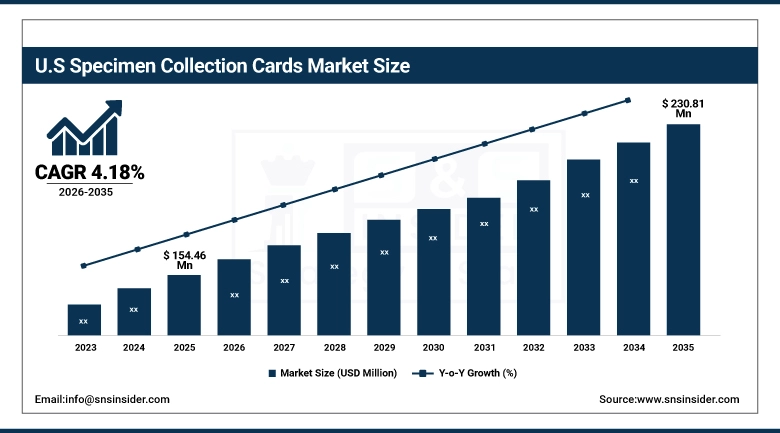
The Specimen Collection Cards Market is projected to grow from USD 154.46 Million in 2025 to around USD 230.81 Million by 2035, at a CAGR of 4.18%. The growth will be fueled by increasing adoption of decentralized and point-of-care diagnostic testing, expansion of national newborn screening programs, rising demand for infectious disease and genetic testing, and growing preference for cost-effective, ambient-stable sample collection solutions.
Specimen Collection Cards Market Growth Drivers:
-
Rising demand for reliable, cost-effective, and contamination-free biological sample collection is driving strong adoption of specimen collection cards across diagnostic workflows.
One of the key drivers behind the increasing popularity of Specimen Collection Cards Market is the rising importance of early disease diagnosis and large-scale screening programs (including newborn screening and infectious disease monitoring). In today’s medical systems, there is a strong emphasis on adopting quick, simple, and transportable sampling techniques that allow for accurate diagnostic procedures without the use of cold chain logistics. This has led to a massive uptake of DBS, FTA, and Guthrie cards in hospitals, diagnostic centers, and public health initiatives.
More than 65% of the world’s large-scale screening and infectious disease monitoring programs used dried specimen sampling technology by 2025.
Specimen Collection Cards Market Restraints:
-
Limited access to standardized sample collection infrastructure and variability in handling practices is restraining optimal adoption of specimen collection cards across some healthcare systems.
Specimen collection cards have proved to be effective but the efficiency largely depends upon how samples are collected, dried, stored, and transported. In many regions, these processes cannot be made completely uniform as there is an absence of standardized guidelines in many places. In some places, due to inadequate resources and scattered diagnostic network, improper sample collection and storage may cause samples to become unfit for use, thus decreasing their efficiency and raising the rate of rejection in testing by means of specimen collection cards.
Specimen Collection Cards Market Opportunities:
-
Expanding integration of digital health ecosystems and laboratory automation platforms is creating significant growth opportunities for the Specimen Collection Cards Market.
Greater integration of diagnostic workflow with digitization and cloud-based LIMS and sample processing equipment makes it possible for end-to-end specimen tracking and increased efficiencies in operations. Barcodes and QR codes are being integrated into specimen cards, providing more efficient tracking and reducing manual errors during test procedures. The growing popularity of AI-based diagnostics, remote laboratory networks, and analytical data platforms that make use of standardized and high-quality specimens (such as dried blood spot or FTA cards) drives this trend.
Furthermore, there is a rapid development in the number of decentralized clinical trials and at-home diagnostic environments, providing an opportunity for companies to design smart specimen collections.
Specimen Collection Cards Market Segmentation Analysis:
-
By Product Type, Dried Blood Spot (DBS) Cards held the largest market share of 46.25% in 2025, while Protein Saver Cards are expected to grow at the fastest CAGR of 7.06% during 2026–2035.
-
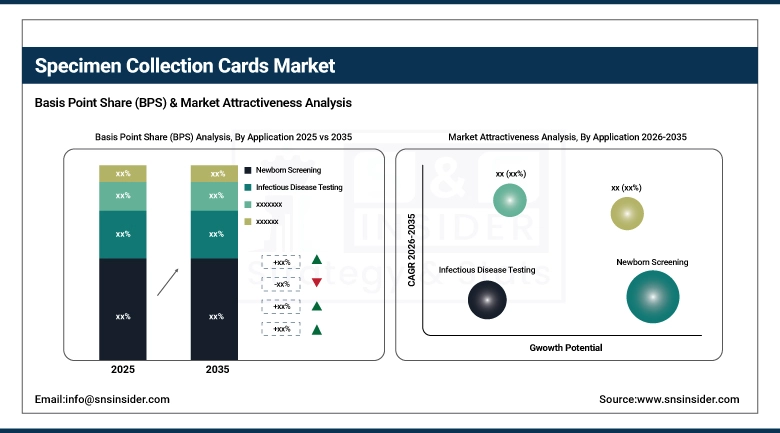
By Application, Newborn Screening accounted for the largest share of 38.55% in 2025, while Infectious Disease Testing is expected to grow at the fastest CAGR of 6.89% during 2026–2035.
-
By End User, Hospitals & Clinics held the largest share of 36.25% in 2025, while Diagnostic Laboratories are expected to grow at the fastest CAGR of 5.24% during 2026–2035.
-
By Sample Type, Blood Samples dominated with a 72.12% market share in 2025, while Saliva Samples are projected to grow at the fastest CAGR of 6.29% during 2026–2035.
-
By Distribution Channel, Direct Sales held the largest market share of 44.23% in 2025, while Online Channels are expected to grow at the fastest CAGR of 7.28% during 2026–2035.
By Application, Newborn Screening Dominates While Infectious Disease Testing Grows Rapidly:
The Newborn Screening segment was the leading segment due to the fact that it is mandated to be integrated into national healthcare systems. This segment has been favored by early detection programs and well-defined clinical guidelines which make it possible for it to be used universally in newborn screening.
The Infectious Disease Testing segment had the fastest growth rate due to the increased attention being given to epidemics, outbreak surveillance, and rapid diagnostic systems. The development of decentralized testing systems and sample collection systems is fueling the adoption of this segment.
By Product Type, Dried Blood Spot (DBS) Cards Dominate While Protein Saver Cards Grow Rapidly:
Dried Blood Spot (DBS) Cards segment dominated the market, mainly due to their extensive use in newborn screening tests, infectious disease testing, and health monitoring campaigns. The reasons for this market share include the reliability, convenience of transport, and popularity of the cards in hospitals and laboratories.
Protein Saver Cards is the fastest-growing segment due to the increasing demand for biomarker stabilization and precise molecular analysis. The growth of proteomics research and personalized medicine will fuel the use of such technologies.
By End User, Hospitals & Clinics Dominate While Diagnostic Laboratories Grow Rapidly:
The Hospitals & Clinics segment was the most dominant in its contribution, owing to its key importance in diagnosing patients, conducting regular screening of individuals, and collecting samples from patients in point-of-care settings. Due to the constant inflow of patients and well-established infrastructure, these institutions are the largest users of specimen collection cards.
The Diagnostic Laboratories end-user segment is growing at the fastest rate due to an increasing number of outsourcings of diagnostic tests to laboratories, increase in testing volume, and increasing consolidation of laboratories networks.
By Sample Type, Blood Samples Dominate While Saliva Samples Grow Rapidly:
Blood Samples segment dominated the market in terms of market share owing to its extensive use as the primary biological medium for diagnostic testing through specimen collection cards. Its high diagnostic accuracy, compatibility with a wide range of assays, and established role in newborn screening and infectious disease detection continue to make it the most widely adopted sample type across healthcare and laboratory settings.
Saliva Samples is the fastest-growing segment, driven by increasing demand for non-invasive, patient-friendly sampling methods and expanding use in home-based diagnostics and genetic testing.
By Distribution Channel, Direct Sales Dominate While Online Channels Grow Rapidly:
Direct Sales channel was the most dominant due to effective procurement connections of the manufacturers with large hospitals, diagnostic labs, and government healthcare organizations. This channel is driven by the advantages associated with purchasing products in larger volumes, customization, and long-term contractual agreement which ensures consistent orders for the specimens collection cards.
Online Channels are the fastest-growing segment due to fast digitalization of the healthcare procurement process and increased adoption of e-commerce platforms for laboratory and diagnostic consumables.
Specimen Collection Cards Market Regional Analysis:
North America Specimen Collection Cards Market Insights:
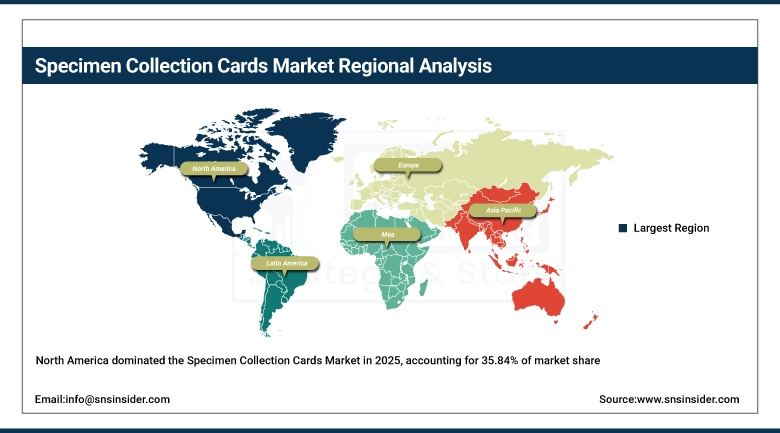
The North America Specimen Collection Cards Market is dominated, holding a 35.84% share in 2025, Backed by a robust network of diagnostic facilities, highly penetrated advanced screening programs, and use of standardized sample collection technology by hospitals across the U.S. and Canada. The region sees extensive use of newborn screening tests, large volume of infectious disease testings, and strong use of specimen collection cards by hospitals and laboratories. The presence of key diagnostic companies, laboratory automation systems, and biobanking platforms is adding value to the existing strengths and enabling market dominance. Improvements in molecular diagnostics, digital traceability, and remote testing are expected to maintain the dominance.
Get Customized Report as per Your Business Requirement - Enquiry Now
U.S. Specimen Collection Cards Market Insights:
The U.S. Specimen Collection Cards Market will witness growth due to the extensive adoption of preventive healthcare programs, extensive use of dried blood spot tests for newborn screening, and rising demand for advanced and complex diagnostic testing. The extensive presence of key diagnostic laboratories, biotech companies, and research institutes is supporting market growth. Increasing focus on decentralized testing approaches, home sample collection kits, and digital laboratory systems is supporting the growth of the market.
Asia-Pacific Specimen Collection Cards Market Insights:
The Asia-Pacific Specimen Collection Cards Market is the fastest-growing region, projected to expand at a CAGR of 6.63% during 2026–2035. Its growth is attributed to increased access to healthcare facilities, growing awareness of the importance of early diagnosis, and the fast rollout of national screening programs in emerging economies such as China, India, Japan, and Southeast Asia. The escalating prevalence of infectious diseases and genetic disorders is driving the need for affordable and scalable diagnostic tools. The growth potential will also be enhanced by the expansion of laboratory networks, growing investments in public health initiatives, and the increasing use of decentralized diagnostics. There is also a significant trend toward adopting non-invasive and low-cost sample collection processes.
China Specimen Collection Cards Market Insights:
The China Specimen Collection Cards Market is experiencing robust growth due to increased modernization of the healthcare system, rising investments in public health screening programs, and advances in diagnostic technologies. The increasing need for large-scale infectious disease surveillance and newborn screening programs is propelling the adoption of specimen collection cards.
Europe Specimen Collection Cards Market Insights:
Factors fueling the growth of Europe Specimen Collection Cards Market include the presence of a well-developed healthcare sector, stringent guidelines for diagnostic tests, and the use of standard specimen collection techniques. There are high rates of newborn screening, infectious disease monitoring, and laboratory facilities in the region. The need for high-quality and traceable diagnostic sample collection is another factor fueling market growth. Additionally, high investments in molecular diagnostic services, biobanks, and digitization of laboratory services in leading European countries are contributing to market expansion.
Germany Specimen Collection Cards Market Insights:
Germany is a dominant market for specimen collection cards in Europe due to its high capabilities in biomedical research, advanced laboratory facilities for diagnosis, and efficient healthcare sector. The growing use of specimen collection systems in clinical diagnostic tests, pharmaceutical studies, and biobanks is fueling the market growth. There is increased emphasis on quality management, laboratory automation, and precision in diagnostic processes, which further boosts market growth.
Latin America Specimen Collection Cards Market Insights:
The Latin America Specimen Collection Cards Market is experiencing gradual growth owing to increased healthcare accessibility, enhanced importance of early disease detection, and increasing adoption of economical diagnosis procedures. Countries such as Brazil, Mexico, and Argentina are majorly responsible for contributing to the growth of this market owing to improvements in lab facilities and public health screening. Increased requirement for testing for diseases such as infections and neonatal diseases is contributing toward market growth. Difficulties with access to central laboratories are driving the adoption of specimen collection cards that can be easily transported.
Middle East & Africa Specimen Collection Cards Market Insights:
The Middle East & Africa Specimen Collection Cards Market is experiencing gradual growth owing to increased healthcare investments, growing emphasis on preventative diagnosis, and increased use of advanced lab techniques. Countries such as Saudi Arabia, United Arab Emirates, and South Africa are largely responsible for driving the market through modernization of their healthcare and increased ability to conduct tests.
Specimen Collection Cards Market Competitive Landscape:
PerkinElmer Inc. is one of the leading players in the Specimen Collection Cards Market, with a strong presence in newborn screening, genetic testing, and infectious disease diagnostics. The company is widely recognized for its advanced dried blood spot (DBS) card solutions and integrated sample collection and analytical workflows. Its strengths lie in high-precision diagnostic platforms, strong public health program partnerships, and end-to-end screening solutions that support large-scale population health initiatives.
-
In September 2025, PerkinElmer Inc. expanded its newborn screening solutions portfolio by enhancing its dried blood spot-based workflow systems, aimed at improving early disease detection efficiency and supporting large-scale national screening programs across emerging healthcare markets.
Thermo Fisher Scientific Inc. is a dominant player in the Specimen Collection Cards Market, offering a comprehensive portfolio of sample collection materials, laboratory consumables, and molecular diagnostic technologies. The company plays a key role in supporting infectious disease testing, pharmacogenomics, and research-based diagnostics through its highly advanced biospecimen collection and stabilization solutions. Its strong distribution network, combined with integrated laboratory automation and digital tracking capabilities, strengthens its leadership position in clinical and research applications.
-
In August 2025, Thermo Fisher Scientific Inc. announced the expansion of its specimen collection and stabilization technology platform, focusing on enhanced DNA/RNA preservation for remote diagnostics and decentralized clinical trial applications across healthcare networks.
GE HealthCare Technologies Inc. is a key competitor in the Specimen Collection Cards Market, with a strong focus on diagnostic imaging integration, laboratory diagnostics, and advanced healthcare informatics. The company supports specimen-based diagnostic workflows through its ecosystem of clinical diagnostics solutions and data-driven healthcare platforms. Its strengths include strong hospital partnerships, advanced laboratory integration systems, and continuous investment in AI-enabled diagnostics and digital health infrastructure.
-
In July 2025, GE HealthCare Technologies Inc. announced enhancements to its diagnostic workflow integration platform, enabling improved traceability and interoperability of specimen-based testing data across hospital and laboratory networks, supporting faster and more accurate clinical decision-making
Specimen Collection Cards Market Key Players:
Some of The Specimen Collection Cards Market Companies are:
-
PerkinElmer Inc.
-
Thermo Fisher Scientific Inc.
-
GE HealthCare Technologies Inc.
-
QIAGEN N.V.
-
F. Hoffmann-La Roche Ltd.
-
Abbott Laboratories
-
Danaher Corporation
-
Cytiva (Danaher Life Sciences)
-
Greiner Bio-One International GmbH
-
Becton, Dickinson and Company (BD)
-
Whatman (Cytiva / GE Heritage Brand)
-
Ahlstrom-Munksjö
-
Pall Corporation (Danaher)
-
Copan Diagnostics Inc.
-
Noble BioMaterials
-
SpotOn Sciences Inc.
-
DBS System SA
-
Bio-Rad Laboratories Inc.
-
FTA / GE Whatman legacy ecosystem suppliers
-
Hologic Inc.
| Report Attributes | Details |
|---|---|
| Market Size in 2025 | USD 481.32 Million |
| Market Size by 2035 | USD 805.41 Million |
| CAGR | CAGR of 5.37% From 2026 to 2035 |
| Base Year | 2025 |
| Forecast Period | 2026-2035 |
| Historical Data | 2022-2024 |
| Report Scope & Coverage | Market Size, Segments Analysis, Competitive Landscape, Regional Analysis, DROC & SWOT Analysis, Forecast Outlook |
| Key Segments | • By Product Type (Dried Blood Spot (DBS) Cards, FTA (Flinders Technology Associates) Cards, Guthrie Cards (Neonatal Screening Cards), Protein Saver Cards, Others) • By Application (Newborn Screening, Infectious Disease Testing, Forensic & DNA Analysis, Therapeutic Drug Monitoring, Pharmacogenomics, Others) • By End User (Hospitals & Clinics, Diagnostic Laboratories, Research & Academic Institutes, Forensic Laboratories, Blood Banks,) • By Sample Type (Blood Samples, Saliva Samples, Buccal Swabs, Other Biological Samples) • By Distribution Channel (Direct Sales, Distributors & Suppliers, Online Channels,Others ) |
| Regional Analysis/Coverage | North America (US, Canada), Europe (Germany, UK, France, Italy, Spain, Russia, Poland, Rest of Europe), Asia Pacific (China, India, Japan, South Korea, Australia, ASEAN Countries, Rest of Asia Pacific), Middle East & Africa (UAE, Saudi Arabia, Qatar, South Africa, Rest of Middle East & Africa), Latin America (Brazil, Argentina, Mexico, Colombia, Rest of Latin America). |
| Company Profiles | PerkinElmer Inc., Thermo Fisher Scientific Inc., GE Healthcare Technologies Inc., QIAGEN N.V., F. Hoffmann-La Roche Ltd., Abbott Laboratories, Danaher Corporation, Cytiva (Danaher Life Sciences), Greiner Bio-One International GmbH, BD (Becton, Dickinson and Company), Whatman (Cytiva/GE heritage brand), Ahlstrom-Munksjö, Pall Corporation (Danaher), Copan Diagnostics Inc., Noble BioMaterials, SpotOn Sciences Inc., DBS System SA, Bio-Rad Laboratories Inc., FTA/GE Whatman legacy suppliers ecosystem players, Hologic Inc. |
Frequently Asked Questions
North America dominated with a 35.84% share in 2025, while Asia-Pacific is the fastest-growing region, expected to expand at a CAGR of 6.63% during 2026–2035.
Dried Blood Spot (DBS) Cards dominated with a 46.25% share in 2025, while Protein Saver Cards are projected to grow at the fastest CAGR of 7.06% during 2026–2035.
Growth is driven by rising adoption of decentralized diagnostics and newborn screening programs, along with increasing demand for cost-effective, stable, and easy-to-transport biological sample collection solutions.
The market is valued at USD 481.32 Million in 2025 and is projected to reach USD 805.41 Million by 2035.
The Specimen Collection Cards Market is projected to grow at a CAGR of 5.37% during 2026–2035.
Get in Touch
