
Urban Planning Software and Services Market Report Scope & Overview:
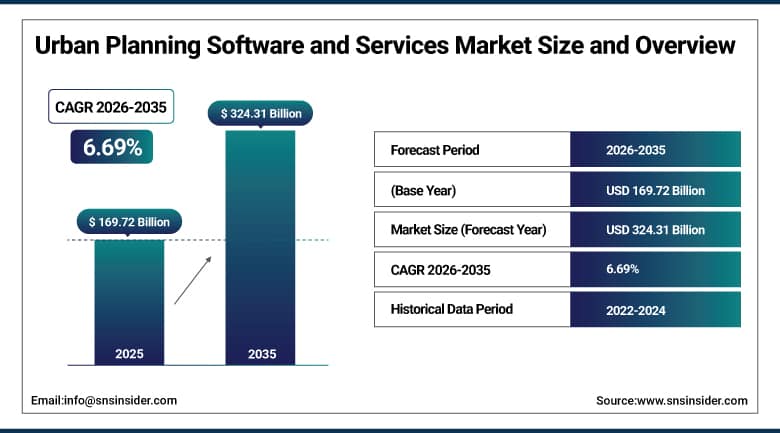
The Urban Planning Software and Services Market was valued at USD 169.72 Billion in 2025 and is expected to reach USD 324.31 Billion by 2035, growing at a CAGR of 6.69% from 2026–2035.
Urban planning software helps cities and developers make sense of everything that goes into building and managing a modern city: land use, zoning, transportation networks, utilities, and environmental impact, often layered onto detailed GIS and 3D maps. As more of the world's population moves into cities, municipal planning departments and private developers alike are turning to these tools to model scenarios, test infrastructure decisions before committing money to them, and keep multiple stakeholders working from the same data. Smart city programs across Asia Pacific and North America are a major driver of this shift, pushing governments to replace paper-based zoning processes with software that can simulate traffic patterns, energy use, and population growth years in advance.
In June 2024, Esri released an update to ArcGIS Urban that added the ability to design the spaces between buildings, configure elevation layers for different planning scenarios, and sketch boundaries and study areas with greater precision using built-in measurement tools. The update reflects growing demand among city planners for software that can model not just individual buildings but the broader urban fabric around them, a shift that's becoming increasingly important as cities plan for denser, mixed-use development.
To Get More Information On Urban Planning Software and Services Market - Request Free Sample Report
Urban Planning Software and Services Market Trends
-
Cloud-based, AI-enhanced planning platforms are becoming the default choice for new urban planning software purchases, replacing older desktop-only GIS tools that require heavy local infrastructure.
-
3D mapping and digital twin technology are moving from novelty features into standard planning workflows, letting cities simulate how a new development will actually look and function before construction begins.
-
Web-based collaboration tools are opening up the planning process to a wider range of stakeholders, letting residents and community groups weigh in on proposals without attending in-person meetings.
-
Integration between urban planning software and IoT sensor networks is giving cities real-time data on traffic, energy use, and environmental conditions that feeds directly into planning decisions.
-
Public sector budgets for urban infrastructure software are expanding steadily in developing economies, as governments look to leapfrog older planning methods rather than replicate legacy systems.
U.S. Urban Planning Software and Services Market Outlook
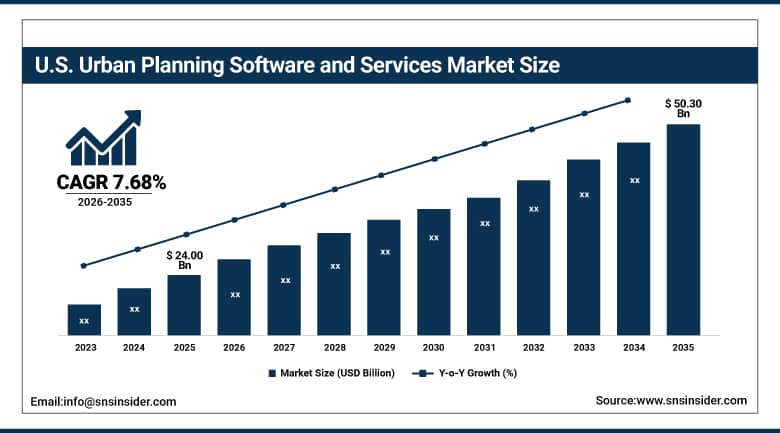
The U.S. Urban Planning Software and Services Market was valued at approximately USD 24.00 Billion in 2025 and is expected to reach approximately USD 50.30 Billion by 2035, growing at a CAGR of approximately 7.68%.
The USA is among the countries that boasts a vibrant market of urban planning software, supported by infrastructure investments on the federal level, implementation of pilot programs for smart cities, as well as development of many urban renewal projects in major metros and mid-size cities. Cities are expected to develop modern systems of zoning and permitting, while infrastructure consultants and private investors adopt software solutions for more complicated planning processes. Among leading companies offering planning software in the USA are Esri, Autodesk, Bentley Systems, and Trimble. All four companies have sizable operations in the USA and constantly enlarge their offerings in planning software.
In November 2024, Trimble announced that its SketchUp platform had crossed one-million barrier of active subscribers due to its change to subscription-based pricing and the addition of new functions oriented towards needs of professionals in architecture, engineering, and construction.
Urban Planning Software and Services Market Segment Analysis
-
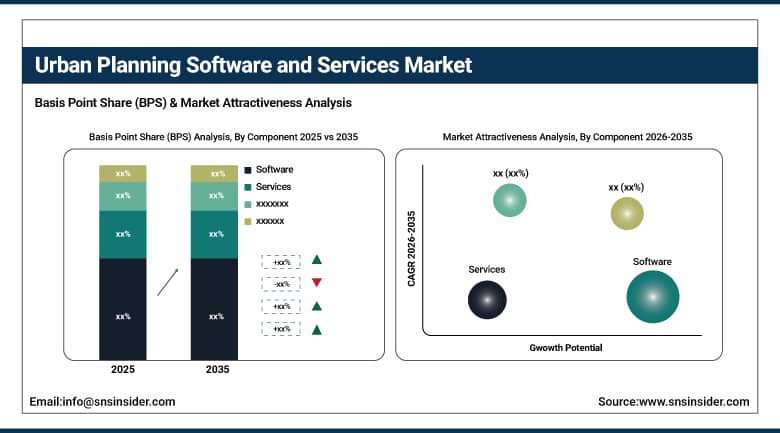
By Component, the Software segment dominated the Urban Planning Software and Services Market with a 74% revenue share in 2025, while the Services segment is the fastest growing.
-
By Deployment, the Cloud-based segment dominated the Urban Planning Software and Services Market with a 60% revenue share in 2025, while the Web-based segment is the fastest growing.
-
By End-Use, the Government segment dominated the Urban Planning Software and Services Market in 2025, while the Real Estate and Infrastructure Companies segment is the fastest growing.
By Component, software dominates, services grow fastest
The software segment accounted for almost 74% share of the urban planning software and services market in 2025, owing to the increased need for analysis, modeling and visualization from planners dealing with increasing urban complexities. The urban populations are expected to constitute almost 68% of the world's population by 2050, according to projections from the United Nations.
Services are currently the fastest-growing segment, as the complexity of urban challenges requires the intervention of experts from external firms in order to navigate urban planning processes. These include consulting services, implementation services, and training services required by the urban planning departments in order to operate within the regulatory environment and engagement process.
By Deployment, cloud-based dominates, web-based grows fastest
Cloud-based deployment made up about 60% of the market in 2025, in line with the general trend towards a flexible and scalable way to deliver software in the industry. Cloud platforms provide better access to planners, reduce cost, and facilitate collaboration with other organizations and external consultants, which is increasingly important as urban planning projects become more complicated and data-driven.
The web-based tool is the most rapidly growing deployment type due to the increasing need for web applications that would allow different stakeholders to collaborate and exchange information without having specific software installed in their local computer systems. Such software helps planners receive feedback on different land use scenarios from the community.
By End-Use, government dominates, real estate & infrastructure companies grow fastest
Government agencies dominated end-use demand in 2025, since public sector organizations set the zoning laws, development guidelines, and regulations that shape how land gets used in the first place. These agencies are investing in planning software and services to advance public infrastructure projects and address pressing issues like climate change and population growth.
Real estate and infrastructure companies are the fastest-growing end-use segment, fueled by rising construction activity and urban redevelopment projects. These companies rely on sophisticated scheduling and modeling tools to streamline workflows, run project viability studies, and check regulatory compliance, and as demand for housing and commercial space climbs in fast-growing urban areas, timely project delivery increasingly depends on this kind of software.
Regional Analysis
|
Region |
Major Country |
Share within Region, 2025 (%) |
|---|---|---|
|
Asia Pacific |
China |
42.0% |
|
North America |
United States |
80.0% |
|
Europe |
Germany |
24.0% |
|
Middle East & Africa |
UAE |
31.0% |
|
Latin America |
Brazil |
39.0% |
Asia Pacific Urban Planning Software and Services Market Insights
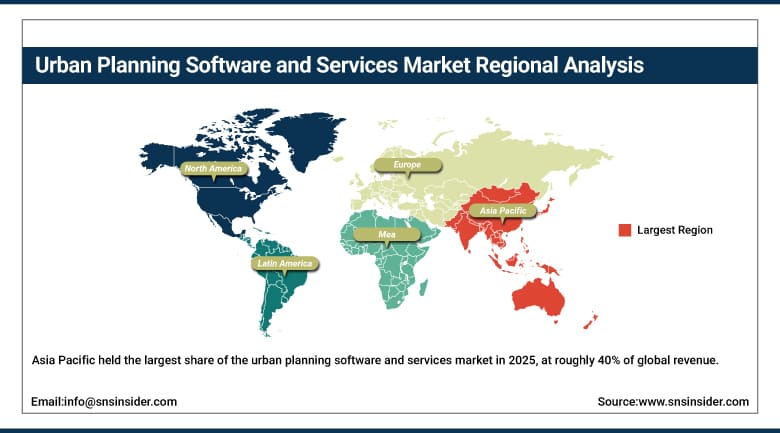
Asia Pacific held the largest share of the urban planning software and services market in 2025, at roughly 40% of global revenue, driven by rapid urbanization and sustained economic growth. China and India in particular are seeing urban populations grow faster than almost anywhere else in the world, creating enormous pressure on planning departments to manage resources and infrastructure efficiently.
The region is also the fastest-growing market for urban planning software, as smart city programs multiply across China, India, Japan, and South Korea and governments push for more sustainable, technology-driven development. Rising demand for tools that can address complex urban challenges while improving quality of life for residents is expected to keep Asia Pacific ahead of other regions through the forecast period.
Get Customized Report as Per Your Business Requirement - Enquiry Now
North America Urban Planning Software and Services Market Insights
North America remains a mature and technically sophisticated urban planning software market, anchored by the United States, where federal infrastructure investment and a wave of smart city pilot programs are driving steady demand. Established vendors including Esri, Autodesk, Bentley Systems, and Trimble maintain deep roots in the region and continue to expand their planning software portfolios.
Growing urbanization and rising infrastructure requirements across major U.S. metros and mid-sized cities are pushing municipalities to adopt faster, more efficient planning tools. Canada contributes a smaller but steady share of regional demand, supported by its own municipal modernization efforts and growing interest in GIS-based planning platforms.
Europe Urban Planning Software and Services Market Insights
Europe is a consistent and established market for urban planning software as a result of a rich history of organized urban planning along with stringent regulations regarding the use of land and environmental impacts. Germany emerges as the strongest regional market due to its density of population as well as sustainable urban development programs.
The UK, France, and Netherlands emerge as secondary markets due to their strong historical urban cores and stringent heritage regulations that make the need for modeling solutions essential in balancing conservation with development. Sustainable urban development plans have kept up growth consistently but unspectacularly in Europe.
MEA & Latin America Urban Planning Software and Services Market Insights
The Middle East and Africa region is an emerging market for urban planning software, which is driven by the UAE’s smart city initiatives related to their economic diversification strategy. Similarly, Saudi Arabia is moving towards the creation of planned cities, whereas South Africa leads demand on the rest of the continent due to well-developed municipal governance practices.
The Latin American market is gaining popularity due to the activities of Brazil, where urbanization and infrastructure investments drive the use of data-driven approaches to urban planning. Mexico comes second in terms of demand within the region.
Market Dynamics
Growth Drivers: Smart city initiatives and infrastructure modernization fueling software demand
Increasing initiatives by smart cities and upgrades of infrastructure are among the major driving factors behind the growth of urban planning software. Various cities and municipalities worldwide are launching smart city initiatives to enhance their living standards, provide better services, and make effective use of their available resources, and in doing so, they need advanced software that utilizes real-time data, GIS, and 3D modeling capabilities to facilitate informed decision-making.
The US federal infrastructure investment initiatives and urban renewal projects are currently contributing to the rapid growth of this market, whereas increasing demands for integrated planning platforms from private developers and consultants are driving the demand for urban planning software.
Restraints: High implementation costs limiting adoption among smaller municipalities
Although there are evident advantages to using such advanced software, the high initial cost involved, along with the expense of training employees and integrating the tool, still poses as a challenge to many municipal bodies and other small-scale organizations. Besides the difficulty in integrating various sets of data, creating and handling three-dimensional models and running real-time analysis may be another challenge by itself.
For many local authorities, especially from developing countries, having enough resources to fully utilize such tools is just not an option after purchasing them. These challenges of costs and complexities usually affect the adoption rate in price-conscious or infrastructure-deficient regions more than anywhere else.
Opportunities: AI, IoT, and cloud convergence opening new avenues for planning software
Convergence of AI, IoT, and cloud solutions within urban planning solutions is generating significant business opportunities. AI technology is able to provide predictive analysis in traffic management, energy usage, and infrastructure maintenance, and IoT is able to provide real-time data for these processes in terms of environmental factors and utilities.
The cloud allows for collaborative urban management through many agencies and cuts costs, while at the same time scaling up. Urban planning becomes more and more digitalized and adaptive, and those companies which develop and offer cloud-based solutions with AI and interoperability will be gaining the most from it. Such a trend is particularly noticeable in North America and Asia Pacific regions..
Recent Developments:
-
2025: In February 2025, Trimble unveiled new visualization and interoperability capabilities in SketchUp, including photorealistic materials and environment lighting options, enhancing designers' ability to create, manage, and share complex projects.
-
2024: In November 2024, SketchUp surpassed one million active subscribers, attributed to its transition to a subscription model and steady rollout of features valued by the architecture, engineering, and construction industry.
-
2024: In June 2024, Esri released an update to ArcGIS Urban introducing features like designing spaces between buildings, configuring elevation layers per plan scenario, and enhanced precision in sketching surfaces and boundaries.
Urban Planning Software and Services Market Key Players
-
Esri
-
Autodesk
-
Bentley Systems
-
Trimble
-
Hexagon AB
-
CityFormLab (MIT)
-
SimWalk
-
UrbanFootprint
-
Sidewalk Labs (Google)
-
Pitney Bowes
-
SuperMap
-
Oracle Corporation
-
Geodesign Hub
-
PTV Group
-
INRO
-
Cityzenith
-
Nemetschek SE
-
Nearmap
-
CoStar Group
-
Deloitte Digital Cities
Urban Planning Software and Services Market :
| Report Attributes | Details |
|---|---|
| Market Size in 2025 | USD 169.72 Billion |
| Market Size by 2035 | USD 324.31 Billion |
| CAGR | CAGR of 6.69% From 2026 to 2035 |
| Base Year | 2025 |
| Forecast Period | 2026-2035 |
| Historical Data | 2022-2024 |
| Report Scope & Coverage | Market Size, Segments Analysis, Competitive Landscape, Regional Analysis, DROC & SWOT Analysis, Forecast Outlook |
| Key Segments | • by Component (Software, Services) • by Deployment (Cloud-based, Web-based) • by End-Use (Government, Real Estate and Infrastructure Companies) |
| Regional Analysis/Coverage | North America (US, Canada, Mexico), Europe (Eastern Europe [Poland, Romania, Hungary, Turkey, Rest of Eastern Europe] Western Europe] Germany, France, UK, Italy, Spain, Netherlands, Switzerland, Austria, Rest of Western Europe]), Asia Pacific (China, India, Japan, South Korea, Vietnam, Singapore, Australia, Rest of Asia Pacific), Middle East & Africa (Middle East [UAE, Egypt, Saudi Arabia, Qatar, Rest of Middle East], Africa [Nigeria, South Africa, Rest of Africa], Latin America (Brazil, Argentina, Colombia, Rest of Latin America) |
| Company Profiles | Esri, Autodesk, Bentley Systems, Trimble, Hexagon AB, CityFormLab (MIT), SimWalk, UrbanFootprint, Sidewalk Labs (Google), Pitney Bowes, SuperMap, Oracle Corporation, Geodesign Hub, PTV Group, INRO, Cityzenith, Nemetschek SE, Nearmap, CoStar Group, Deloitte Digital Cities |
Frequently Asked Questions
Asia Pacific dominated the Urban Planning Software and Services Market in 2025 with approximately 40% market share and is also the fastest-growing region.
The Urban Planning Software and Services Market is expected to grow at a CAGR of 6.69% from 2026 to 2035.
The Urban Planning Software and Services Market was valued at USD 169.72 Billion in 2025.
Growing smart city initiatives and infrastructure modernization, which are driving demand for advanced urban planning software across government agencies and private developers.
Software dominated with a 74% revenue share in 2025, while Services is the fastest growing segment.
