
Warm Autoimmune Hemolytic Anemia Market Report Scope & Overview:
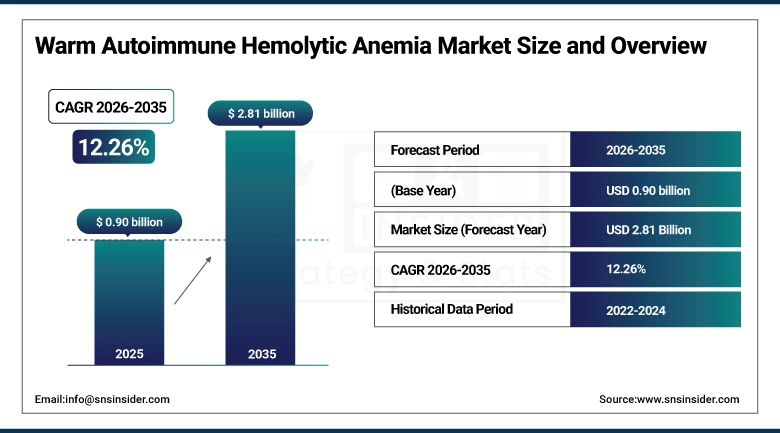
The Warm Autoimmune Hemolytic Anemia Market size is valued at USD 0.90 Billion in 2025 and is projected to reach USD 2.81 Billion by 2035, growing at a CAGR of 12.26% during the forecast period 2026–2035.
The Warm Autoimmune Hemolytic Anemia Market report presents an extensive analysis of market dynamics, advancements in the drug class, and applications of treatments. The increasing incidence rate of autoimmune and hematological diseases, increased number of organ transplant surgeries boosting the requirement of immunosuppressive drugs and enhanced healthcare facilities in developed and developing countries are key growth drivers for the Warm Autoimmune Hemolytic Anemia Market between 2026 and 2035.
Adoption of Biologicals in Warm Autoimmune Hemolytic Anemia crossed 800 million prescriptions in 2025 due to the rising incidence rate of autoimmune disorders and second-line and refractory treatments.
Market Size and Forecast:
-
Market Size in 2025: USD 0.90 Billion
-
Market Size by 2035: USD 2.81 Billion
-
CAGR: 12.26% from 2026 to 2035
-
Base Year: 2025
-
Forecast Period: 2026–2035
-
Historical Data: 2022–2024
To Get more information on Warm Autoimmune Hemolytic Anemia Market - Request Free Sample Report
Warm Autoimmune Hemolytic Anemia Market Trends:
-
Shift from corticosteroids to biologics as physicians increasingly prefer monoclonal antibodies for second-line and refractory cases.
-
Rising adoption of targeted and novel therapies with pipeline drugs expected to reshape treatment protocols by 2035.
-
Hospital pharmacies dominate distribution, but specialty clinics and online platforms are expanding rapidly with biologics uptake.
-
Increasing prevalence of autoimmune and hematological disorders is expanding the patient pool.
-
Improved diagnostics and early detection are driving higher treatment rates and market penetration.
-
Supportive reimbursement policies in developed regions are accelerating biologics adoption.
-
Geriatric population growth is contributing to higher incidence and demand for advanced treatments.
-
Digital health and online pharmacy growth are improving patient access to therapies, especially in emerging markets.
U.S. Warm Autoimmune Hemolytic Anemia Market Insights:
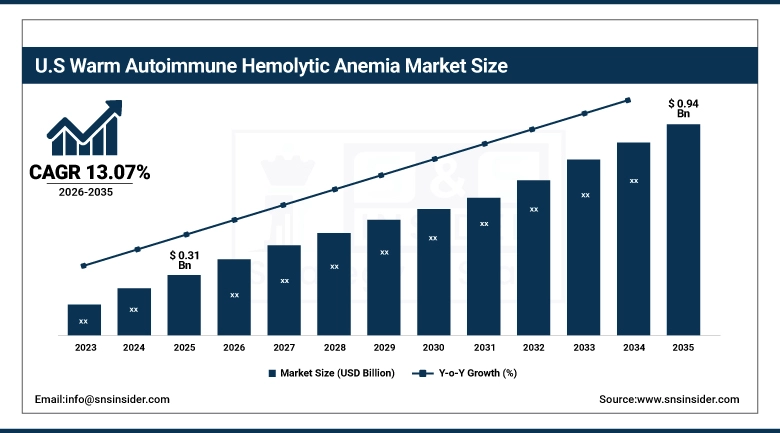
The U.S. Warm Autoimmune Hemolytic Anemia Market is projected to grow from USD 0.31 Billion in 2025 to USD 0.94 Billion by 2035, at a CAGR of 13.07%. The growth is driven by the growing incidence of hematological diseases and autoimmune disorders, increase in the demand for second and third line treatments, increasing acceptance of biologicals and mAbs, and a robust pipeline for targeted treatment modalities.
Warm Autoimmune Hemolytic Anemia Market Growth Drivers:
-
Rising adoption of targeted biologics and precision therapies driving market expansion
The growing uptake of innovative targeted treatments such as monoclonal antibodies and immunomodulators will drive the market for Warm Autoimmune Hemolytic Anemia. Traditional treatment options using corticosteroids are gradually being replaced by newer biological treatments that have better efficacy and safety profiles for treating the condition. Advances in FcRn inhibitors, BTK inhibitors, and complement pathway inhibitors are expected to improve patient health conditions and reduce relapses.
Over 55% of specialty treatment centers adopted biologics-based therapies for WAIHA management in 2025, reflecting a strong transition toward precision medicine and supporting sustained market growth.
Warm Autoimmune Hemolytic Anemia Market Restraints:
-
High cost burden and limited accessibility of advanced therapies restraining market growth
The high price tag associated with innovative drugs, such as biologicals and monoclonal antibodies, poses a major limitation in the WAIHA market. Several patients find it difficult to afford these medications due to the lack of adequate insurance coverage and their expensive nature, especially in developing countries. Budget restrictions at hospitals and specialty clinics may pose an obstacle in adopting these expensive drugs. Moreover, the difficulty in diagnosing the condition poses another barrier.
In 2025, nearly 45% of patients experienced delayed or limited access to advanced WAIHA therapies, hindering overall market growth despite increasing clinical demand.
Warm Autoimmune Hemolytic Anemia Market Opportunities:
-
Growing innovation in targeted therapies and robust pipeline development creating expansion opportunities
Technological developments in terms of specific therapy approaches have been seen as a significant factor driving WAIHA sales. Research and investments into innovative drugs such as FcRn inhibitors, BTK inhibitors, and advanced versions of monoclonal antibodies have been changing current approaches to therapy. The emphasis on new approaches in therapy lies in their effectiveness, safety, and efficiency in controlling the disease in the long term.
By 2025, over 60% of pipeline drugs for WAIHA were focused on targeted mechanisms, highlighting a shift toward personalized treatment and creating significant opportunities for innovation-driven market expansion.
Warm Autoimmune Hemolytic Anemia Market Segmentation Analysis:
-
By Treatment / Drug Class, Corticosteroids held the largest market share of 36.58% in 2025, while Targeted / Novel Therapies are expected to grow at the fastest CAGR of 14.64% during 2026–2035.
-
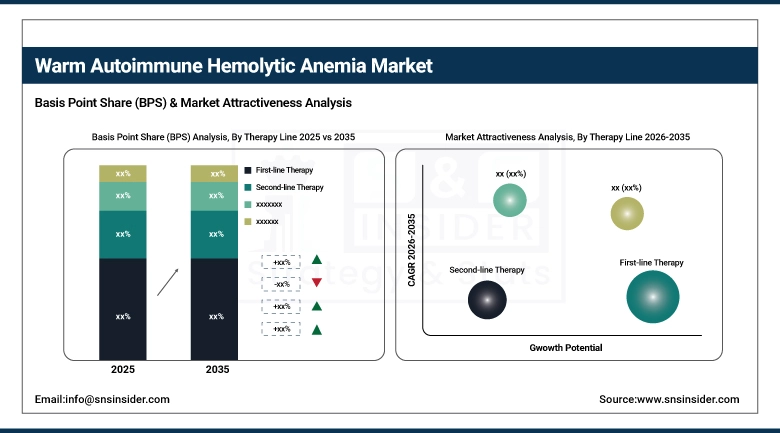
By Therapy Line, First-line Therapy dominated with 41.36% market share in 2025, whereas Refractory / Rescue Treatment are projected to record the fastest CAGR of 13.79% through 2026–2035.
-
By Route of Administration, Oral accounted for the highest market share of 47.69% in 2025, while Subcutaneous are expected to grow at the fastest CAGR of 14.34% during the forecast period.
-
By Distribution Channel, Hospital Pharmacies dominated with a 42.28% share in 2025, while Online Pharmacies are anticipated to expand at the fastest CAGR of 14.07% through 2026–2035.
By Treatment / Drug Class, Corticosteroids Dominate While Targeted / Novel Therapies Grow Rapidly:
The Corticosteroids segment is the dominant one within the WAIHA market, since this type of therapy acts as the gold standard initial therapy and has a broad application in controlling diseases. These types of medications are frequently used in both general and specialized hematology facilities due to their ability to immediately reduce hemolysis.
Targeted/Novel Therapies is one of the most fastest growing segments, since there is increasing demand for new drugs that provide greater precision and fewer adverse reactions. Recent developments in biologic drugs, such as FcRn inhibitors and BTK inhibitors, have greatly changed the treatment of the disease.
By Therapy Line, First-line Therapy Dominates While Refractory / Rescue Treatment Grow Rapidly:
First-line Therapy is the dominant segment in WAIHA due to its importance in treating the disease in its early stages. There are many types of drugs that can be used as first-line therapy in the treatment of the disease. Corticosteroids have proven to be one of the most popular drugs used by physicians in the treatment process.
Refractory / Rescue Treatment is expected to grow at the fastest rate over the forecast period. The growth will be influenced by the increasing number of patients who show resistance to first-line therapies. There is an increasing number of patients using innovative biologics, immunosuppressants, and targeted therapy drugs for relapsed or refractory conditions.
By Route of Administration, Oral Dominates While Subcutaneous Grow Rapidly:
Oral remains the most dominant segment within the market due to its convenience, easy administration, and high compliance from patients. Oral drugs such as corticosteroids and immunosuppressants are commonly prescribed for the management of chronic diseases in hospitals and even homes. The low cost and non-invasiveness of oral medication make them popular among patients and physicians.
The subcutaneous segment is currently experiencing the fastest growth rate due to the increased prescription of biological and targeted therapies that need accurate administration. The subcutaneous method provides an added advantage to patients since they can easily administer themselves without undergoing IV therapy.
By Distribution Channel, Hospital Pharmacies Dominate While Online Pharmacies Grow Rapidly:
Hospital Pharmacies is the dominant segment within the WAIHA industry due to the high number of patients who receive treatments at hospitals, especially those who have serious and recent health issues. Hospitals continue to be the key venues where diagnosis and the initial stages of treatment take place using modern medication.
The Online Pharmacies segment is experiencing the fastest growth, thanks to the ongoing development of internet pharmacies and increased patient interest in easy access to their medication. Many people who suffer from various chronic diseases often use online platforms for obtaining recurring prescriptions.
Warm Autoimmune Hemolytic Anemia Market Regional Analysis:
North America Warm Autoimmune Hemolytic Anemia Market Insights:
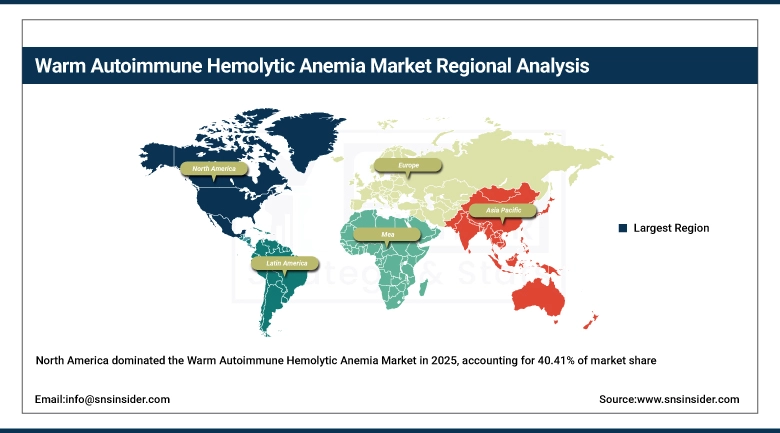
North America is still the dominant market region with a market share of 40.41% due to the established infrastructure of health care facilities, large numbers of organ transplants, and increased adoption of biologics and monoclonal antibodies. Hospitals and specialist clinics form the main avenue for the provision of care services, and an effective reimbursement model facilitates the uptake of new and innovative medicines. The growing cases of auto-immune and hematological disorders alongside continued development of oral, injectable, and subcutaneous drug formulations make North America a dominant market in the period 2026–2035.
Get Customized Report as per Your Business Requirement - Enquiry Now
U.S. Warm Autoimmune Hemolytic Anemia Market Insights:
The U.S. dominates the North American market on the back of its high number of organ transplants, the widespread use of corticosteroids, immunosuppressants, and biological agents, and its efficient healthcare infrastructure. Specialized care centers and hospital pharmacies form the key channel for drug distribution, along with favorable insurance coverage. The increasing incidences of autoimmune diseases and the rising demand for treatment will keep driving growth in the future.
Asia-Pacific Warm Autoimmune Hemolytic Anemia Market Insights:
Asia-Pacific is the fastest-growing regional market with CAGR of 14.14%, fueled by rising autoimmune disorder prevalence, expanding healthcare infrastructure, and increasing awareness of rare hematological conditions. Countries across the region are investing heavily in biologics and targeted therapies, with subcutaneous formulations gaining traction due to patient convenience. Hospital pharmacies dominate distribution, but online platforms are expanding rapidly. Government initiatives to improve access, coupled with growing clinical trial activity, position Asia-Pacific as a key growth engine for WAIHA treatments during the forecast period.
Japan Warm Autoimmune Hemolytic Anemia Market Insights:
Japan represents an important market for WAIHAs within the Asia-Pacific region, characterized by sophisticated health care systems, high investment in research and development activities, and high usage rates of biologicals and targeted therapies. Some of the favorable factors that could boost the growth prospects for WAIHAs in Japan include strong governmental focus on the management of rare diseases, high expertise of local clinicians in the field of hematology.
Europe Warm Autoimmune Hemolytic Anemia Market Insights:
The European region is a key contributor to the WAIHA market due to its sophisticated healthcare infrastructure, high acceptance of biological drugs, and proficiency in treating autoimmune diseases. The countries within the region enjoy effective reimbursement mechanisms and access to cutting-edge drug options. The increased incidence of blood-related disorders, along with the development of specialized clinics, fuels the need for specific drug therapies. The constant development of oral and injectable agents, and their involvement in international clinical studies, underscores Europe’s maturity and innovation-oriented environment.
United Kingdom Warm Autoimmune Hemolytic Anemia Market Insights:
The UK is one of the most prominent markets in Europe owing to the robust framework for rare diseases, a well-developed healthcare system, and wide usage of biological agents and monoclonal antibodies. NHS-driven reimbursement strategies guarantee that patients have access to new treatments, and specialized clinics offer high-level care for treatment-resistant patients. The increase in cases of autoimmune disorders and hematology and the involvement of the UK in international clinical trials confirms its role as an important center for WAIHA treatment innovation and therapy uptake.
Latin America Warm Autoimmune Hemolytic Anemia Market Insights:
Latin America is experiencing constant growth, with increased cases of autoimmune diseases, organ transplants, and improvement in the healthcare facilities. Usage of corticosteroids and immunosuppressive drugs is still high; however, biologics are increasingly used in specialty hospitals. Hospital pharmacies are dominating the sales channel, although online channels are being developed in cities. With government campaigns for access to orphan drugs along with increasing physician awareness, market expansion is anticipated to be rapid in the region from 2026 to 2035.
Middle East & Africa Warm Autoimmune Hemolytic Anemia Market Insights:
The Middle East & Africa market is growing due to an increase in the number of cases of autoimmune disorders, more investment in healthcare facilities, and greater use of biologics in specialized clinics. The hospital pharmacy continues to be the key channel, especially for injectable medications. There are efforts being undertaken by the government to enhance the treatment of rare diseases in collaboration with major pharmaceutical companies in the global market, making the region poised for consistent growth over the forecast period.
Warm Autoimmune Hemolytic Anemia Market Competitive Landscape:
Roche
Roche Holding AG is one of the biggest players in the field of biotechnology and diagnostics in the world, with significant expertise in autoimmune diseases and hematology. The company's range of biological drugs consists of such products as Gazyva/Gazyvaro (obinutuzumab), which have proven their effectiveness in autoimmune diseases including lupus nephritis and systemic lupus erythematosus. Roche provides an innovative approach to biologics and diagnostics, which gives the possibility for precision medicine approaches and increases its position in the area of rare diseases treatment.
-
In January 2026, Roche reported positive Phase III results for Gazyva/Gazyvaro in primary membranous nephropathy, expanding its autoimmune applications. The company also advanced pipeline biologics targeting refractory autoimmune disorders, while investing in next-generation diagnostics to improve early detection and treatment personalization.
Novartis
Novartis AG is another Swiss-based multinational drug company that holds its own in terms of a product pipeline in the fields of immunology, hematology, and rare diseases. Novartis specializes in the development of biologics and cell-based therapies, such as CAR-T cells, and remains committed to the advancement of personalized treatment solutions. Innovation in the treatment of autoimmune diseases forms the basis of Novartis’s business strategy, and the firm is dedicated to developing solutions for hard-to-treat conditions.
-
In November 2025 provided good results for ianalumab (NEPTUNUS trial) in Sjogren syndrome, demonstrating its strength in the autoimmune pipeline. Further, Novartis progressed rapcabtagene autoleucel (YTB323), which is a CAR-T cell therapy for systemic lupus erythematosus, indicating their dedication
Pfizer
Pfizer Inc., with its headquarters in the United States, is one of the biggest biopharmaceutical companies, with substantial market shares in the autoimmune and hematologic sectors. It has Rapamune (sirolimus), which is an mTOR inhibitor drug that is prescribed for transplant rejection prevention and autoimmune disorders, among other biologic drugs and biosimilars including RUXIENCE™ (rituximab pvvr). The organization places a priority on efficacy, safety, and affordability, backed up by comprehensive clinical data and reliable logistics.
-
In June 2025, Pfizer expanded RUXIENCE™ indications to include rheumatoid arthritis and other autoimmune conditions, enhancing patient access to its biosimilar portfolio. The company also progressed Dekavil (F8‑IL10) in early-phase development for autoimmune disorders and entered collaborations to accelerate discovery of novel therapies for lupus and other rare autoimmune diseases.
Warm Autoimmune Hemolytic Anemia Market Key Players:
Some of the Warm Autoimmune Hemolytic Anemia Market Companies are:
-
Roche
-
Novartis
-
Pfizer
-
Johnson & Johnson (Janssen)
-
Bristol Myers Squibb
-
Amgen
-
GlaxoSmithKline (GSK)
-
Sanofi
-
AbbVie
-
Merck & Co.
-
Takeda
-
AstraZeneca
-
Eli Lilly
-
Biogen
-
Regeneron Pharmaceuticals
-
Alexion Pharmaceuticals (AstraZeneca Rare Disease)
-
CSL Behring
-
Teva Pharmaceuticals
-
UCB Pharma
-
Otsuka Holdings
| Report Attributes | Details |
|---|---|
| Market Size in 2025 | USD 0.90 Billion |
| Market Size by 2035 | USD 2.81 Billion |
| CAGR | CAGR of 12.26% From 2026 to 2035 |
| Base Year | 2025 |
| Forecast Period | 2026-2035 |
| Historical Data | 2022-2024 |
| Report Scope & Coverage | Market Size, Segments Analysis, Competitive Landscape, Regional Analysis, DROC & SWOT Analysis, Forecast Outlook |
| Key Segments | • By Treatment/Drug Class (Corticosteroids, Monoclonal Antibodies, Immunosuppressants, Targeted / Novel Therapies, Others), • By Therapy Line (First-line Therapy, Second-line Therapy, Third-line Therapy, Refractory / Rescue Treatment, Others), • By Route of Administration (Oral, Injectable (IV), Subcutaneous, Combination (oral + injectable), Others), • By Distribution Channel (Hospital Pharmacies, Retail Pharmacies, Online Pharmacies, Specialty Clinics, Others) |
| Regional Analysis/Coverage | North America (US, Canada), Europe (Germany, UK, France, Italy, Spain, Russia, Poland, Rest of Europe), Asia Pacific (China, India, Japan, South Korea, Australia, ASEAN Countries, Rest of Asia Pacific), Middle East & Africa (UAE, Saudi Arabia, Qatar, South Africa, Rest of Middle East & Africa), Latin America (Brazil, Argentina, Mexico, Colombia, Rest of Latin America). |
| Company Profiles | Roche, Novartis, Pfizer, Johnson & Johnson (Janssen), Bristol Myers Squibb, Amgen, GlaxoSmithKline (GSK), Sanofi, AbbVie, Merck & Co., Takeda, AstraZeneca, Eli Lilly, Biogen, Regeneron Pharmaceuticals, Alexion Pharmaceuticals (AstraZeneca Rare Disease), CSL Behring, Teva Pharmaceuticals, UCB Pharma, Otsuka Holdings. |
Frequently Asked Questions
North America dominated with a 40.41% share in 2025, while Asia-Pacific is the fastest-growing region, expected to expand at a CAGR of 14.14% during 2026–2035.
Corticosteroids dominated with a 36.58% share in 2025, while Targeted / Novel Therapies are projected to grow at the fastest CAGR of 14.64% during 2026–2035
Growth is driven by the rising prevalence of autoimmune disorders and hematological conditions, increasing organ transplants that heighten demand for immunosuppressive therapies.
The market is valued at USD 0.90 Billion in 2025 and is projected to reach USD 2.81 Billion by 2035.
The Warm Autoimmune Hemolytic Anemia Market is projected to grow at a CAGR of 12.26% during 2026–2035.
