
Wireless Portable Medical Devices Control Market Report Scope & Overview:
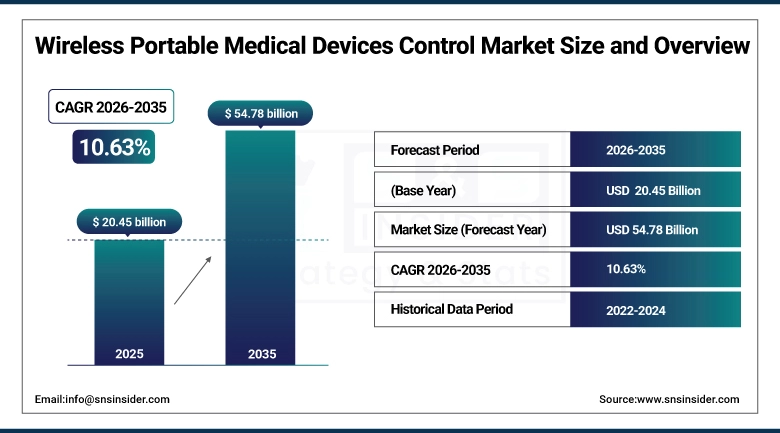
The Wireless Portable Medical Devices Market is valued at USD 20.45 Billion in 2025 and is projected to reach USD 54.78 Billion by 2035, growing at a CAGR of 10.63% during the forecast period 2026–2035.
Insights on the Wireless Portable Medical Devices Market highlight a rapidly transforming healthcare ecosystem driven by the convergence of digital health, IoT-enabled medical devices, and AI-powered remote monitoring technologies. The market growth is strongly supported by the rising prevalence of chronic diseases such as cardiovascular disorders, diabetes, respiratory illnesses, and neurological conditions, which is accelerating demand for continuous and real-time patient monitoring solutions outside traditional hospital settings. In AI-enabled wearable devices, cloud-connected diagnostic platforms, and miniaturized wireless sensor technologies are further accelerating market expansion from 2026 to 2035.
Wireless portable medical device adoption is expanding across millions of connected patient monitoring systems globally in 2025, and is expected to grow exponentially with widespread integration of AI-enabled, cloud-connected, and fully interoperable healthcare ecosystems by 2035.
Market Size and Forecast:
-
Market Size in 2025: USD 20.45 Billion
-
Market Size by 2035: USD 54.78 Billion
-
CAGR: 10.63% from 2026 to 2035
-
Base Year: 2025
-
Forecast Period: 2026–2035
-
Historical Data: 2022–2024
To Get more information on Wireless Portable Medical Devices Market - Request Free Sample Report
Wireless Portable Medical Devices Control Market Trends:
-
Rising adoption of AI-enabled wearables and RPM systems is enabling continuous monitoring and predictive healthcare insights.
-
Increasing demand for RPM solutions is driving growth of connected platforms for chronic and post-acute care management.
-
Expansion of home healthcare is accelerating the shift toward decentralized, patient-centric care delivery.
-
Integration of Bluetooth, Wi-Fi, and 5G connectivity is improving real-time data transmission and device interoperability.
-
Rising prevalence of chronic diseases is boosting demand for continuous monitoring and portable diagnostics.
-
Miniaturization of biosensors is enabling lightweight, non-invasive, and long-duration wearable monitoring devices.
-
Growing use of AI and cloud analytics is transforming patient data into real-time predictive health intelligence.
U.S. Wireless Portable Medical Devices Control Market Insights:
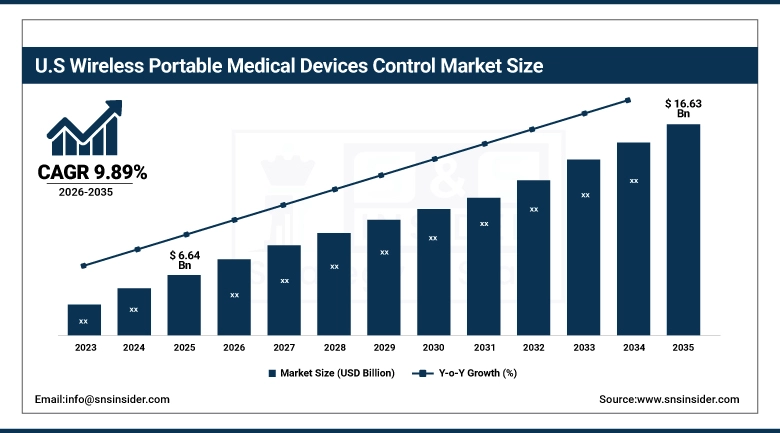
The Wireless Portable Medical Devices Market is projected to grow from USD 6.64 Billion in 2025 to USD 16.63 Billion by 2035, at a CAGR of 9.89%. The positive drivers that favor industry growth include the quick growth of the RPM ecosystem, use of wearables and home health care services, together with the rise in chronic diseases including cardiovascular disease, diabetes, respiratory problems, and neurological diseases. Moreover, the trend towards the decentralization of healthcare service provision, use of telehealth, and the ongoing development of miniaturized biosensor technology with improved wireless connectivity technologies like Bluetooth, Wi-Fi, and 5G, have made health care delivery much easier from 2026 through 2035.
Wireless Portable Medical Devices Control Market Growth Drivers:
-
Rising adoption of AI-enabled wearable devices and remote patient monitoring (RPM) systems across hospitals and homecare settings is driving continuous patient tracking, early diagnosis, and improved clinical outcomes in chronic disease management.
The digital revolution happening at a rapid pace in the healthcare ecosystem has led to the widespread adoption of internet-of-things based medical devices, cloud-based healthcare platforms, and real-time analytics, allowing seamless communication among patients, their carers, and healthcare providers. The rising incidence of chronic ailments like cardiovascular diseases, diabetes, respiratory diseases, and neurological diseases is driving the adoption of continuous monitoring solutions.
Investments in artificial intelligence-based diagnosis techniques, miniaturization of biosensors, and development of wearable devices are facilitating healthcare predictions and personalized treatments.
Wireless Portable Medical Devices Control Market Restraints:
-
High cost and integration complexity of advanced wireless medical devices, including AI-enabled wearables, RPM systems, and cloud-connected diagnostic platforms, is restraining large-scale adoption across cost-sensitive healthcare systems and emerging markets.
Market for Wireless Portable Medical Devices faces challenges owing to the persistent use of conventional monitoring systems in hospitals and a healthcare system that is fragmented and restricts the effective use of telehealth services. High costs involved in wearable devices, IoT-powered technology, artificial intelligence, as well as cybersecurity measures, are major hurdles in their implementation, especially in developing nations.
Wireless Portable Medical Devices Control Market Opportunities:
-
Rapid expansion of personalized and continuous healthcare monitoring ecosystems is creating strong opportunities for next-generation wireless portable medical devices globally.
The market for Wireless Portable Medical Devices is seeing positive growth due to the rise in preventive healthcare practices, which involve health monitoring through portable wearables, diagnostics, and treatment devices. The rising trend of value-based healthcare is making hospitals spend money on remote monitoring technologies, which will help them reduce re-hospitalizations and offer good patient outcomes. Digital therapeutics, AI health analysis, and real-time monitoring is paving the way for personalized therapy approaches for various diseases.
More than 55% of healthcare facilities worldwide will adopt AI-enabled remote monitoring and cloud-connected wearables by 2035.
Wireless Portable Medical Devices Control Market Segmentation Analysis:
-
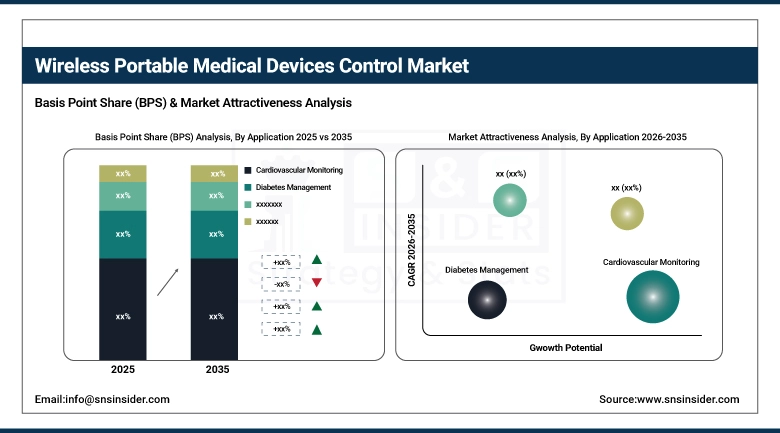
By Product Type, Wearable Medical Devices held the largest market share of 32.55% in 2025, while Remote Patient Monitoring (RPM) Systems are expected to grow at the fastest CAGR of 11.57% during 2026–2035.
-
By Application, Cardiovascular Monitoring dominated with 28.45% market share in 2025, while Diabetes Management is expected to grow at the fastest CAGR of 11.52% during 2026–2035.
-
By Connectivity Technology Bluetooth / BLE held the largest share of 34.85% in 2025, while IoT / Cloud Integrated Systems are expected to grow at the fastest CAGR of 15.45% during 2026–2035.
-
By End User, Hospitals & Clinics dominated with 40.21% market share in 2025, while Home Healthcare is expected to grow at the fastest CAGR of 15.45% during 2026–2035.
-
By Distribution Channel, Direct Institutional Sales held the largest share of 35.51% in 2025, while Online / E-commerce Platforms are expected to grow at the fastest CAGR of 15.37% during 2026–2035.
By Application, Cardiovascular Monitoring Dominates While Diabetes Management Grows Rapidly:
Wearable Medical Devices segment dominated the market in terms of market share on account of its wide use in health monitoring, monitoring chronic ailments, and capturing real-time physiology data in both hospital and home settings. The seamless integration of wearable medical devices with smart sensors, mHealth solutions, and patient monitoring systems guarantees their dominance in the wireless portable medical devices market.
Remote Patient Monitoring (RPM) Systems is the fastest growing segment owing to the growing trend of providing healthcare services in homes, increasing incidences of chronic diseases, and growing demand for patient monitoring solutions.
By Product Type, Wearable Medical Devices Dominates While Remote Patient Monitoring (RPM) Systems Grows Rapidly:
Wearable Medical Devices segment dominated the market in terms of market share on account of its wide use in health monitoring, monitoring chronic ailments, and capturing real-time physiology data in both hospital and home settings. The seamless integration of wearable medical devices with smart sensors, mHealth solutions, and patient monitoring systems guarantees their dominance in the wireless portable medical devices market.
Remote Patient Monitoring (RPM) Systems is the fastest growing segment owing to the growing trend of providing healthcare services in homes, increasing incidences of chronic diseases, and growing demand for patient monitoring solutions.
By Connectivity Technology, Bluetooth / BLE Dominates While IoT / Cloud Integrated Systems Grows Rapidly:
Bluetooth / BLE segment dominated the market owing to the extensive usage of the technology in wearable medical devices, low energy consumption, and its compatibility with mobile phones and portable monitoring systems. The high level of integration within the existing digital health ecosystem assures dominance in the segment of wireless medical device connectivity.
The IoT/Cloud Integrated Systems Segment is the fastest growing, owing to increased requirements for remote patient monitoring, centralized data management, and AI-based predictive analytics. The growing popularity of cloud health care infrastructures is helping fuel its rapid growth rate.
By End User, Hospitals & Clinics Dominates While Home Healthcare Grows Rapidly:
The Hospitals & Clinics segment held dominance in the market owing to its well-established infrastructure, huge patient inflow, and advanced technologies used in diagnostics and patient monitoring for critical care management. The role of hospitals and clinics in providing acute care and specialized treatments makes them dominant players in the market.
Home Healthcare is the fastest-growing segment, on account of the growing trend towards decentralized healthcare services, increasing numbers of geriatrics, and patient-centric and cost-effective care models.
By Distribution Channel, Direct Institutional Sales Dominates While Online / E-commerce Platforms Grows Rapidly:
Direct Institutional Sales segment dominated the market due to effective purchase processes undertaken by healthcare facilities such as hospitals and clinics in their buying of devices through bulk purchases.
The Online/E-Commerce Platform represents the fastest-growing market segment because of the growing trend of using digital healthcare services, increasing consumer inclination towards home purchases, and increasing availability of approved portable and wearable healthcare products online.
Wireless Portable Medical Devices Control Market Regional Analysis:
North America Wireless Portable Medical Devices Market Insights:
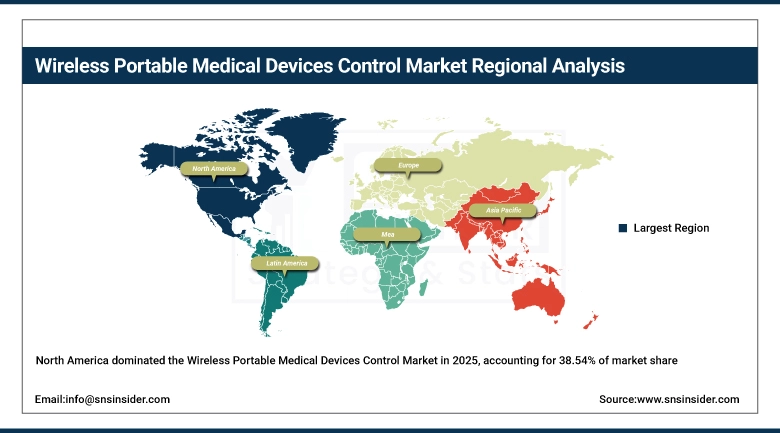
The North America Wireless Portable Medical Devices Market dominates the global landscape, dominating the regional market share of 38.54% owing to its highly developed healthcare infrastructure, robust digital health adoption rate, and widespread penetration of wearable medical devices and patient monitoring devices. The growth of the region can be attributed to the presence of prominent medtech companies, established reimbursement models, and swift incorporation of AI integrated healthcare solutions in clinical and home care facilities. Innovations in cloud-based patient monitoring tools, real-time healthcare analytics solutions, and connectivity in wearable medtech are contributing significantly to the dominance of the region.
Get Customized Report as per Your Business Requirement - Enquiry Now
United States Wireless Portable Medical Devices Market Insights:
The United States Wireless Portable Medical Devices Market is leading the regional market scenario owing to its highly advanced healthcare system, digital health solutions adoption, and increasing focus on remote patient monitoring devices. With AI-powered wireless medical devices, IoT enabled diagnostics tools, and mobile apps making significant strides in both hospital and home settings, there has been a notable rise in innovations in continuous monitoring technology.
Asia-Pacific Wireless Portable Medical Devices Market Insights:
The Asia-Pacific Wireless Portable Medical Devices Market is the fastest-growing region, projected to expand at a CAGR of 11.76% during 2026–2035. The industry is fueled by rising digitization in healthcare, rising middle-income population base, and increased incidence of chronic illnesses. Nations like China, India, Japan, and South Korea have been experiencing rapid adoption rates of wearable health monitoring equipment, remote patient monitoring tools, and portable diagnostic devices. Investments in intelligent healthcare ecosystem, digitization efforts by governments, and rise in telemedicine networks are positively contributing to market expansion. Rising requirement for cost-effective, easy-to-access, and timely healthcare facilities among urban and rural populace is further catalyzing industry growth.
China Wireless Portable Medical Devices Market Insights:
China’s Wireless Portable Medical Devices Market is expected to witness robust growth in response to increasing government support for digitization in healthcare industry, growing adoption of intelligent medical devices, and high investments in AI-powered healthcare system. The nation is observing considerable implementation of wearable health monitoring devices, connected diagnostic systems, and cloud-based patient management solutions in hospitals and community healthcare centers.
Europe Wireless Portable Medical Devices Market Insights:
The growth drivers for the Europe Wireless Portable Medical Devices market are well-established healthcare infrastructure, significant uptake of digital health innovations, and an increasing inclination towards preventive and value-based healthcare models. Nations like Germany, France, the United Kingdom, Italy, and Nordic countries are rapidly adopting wearable medical devices, remote monitoring platforms, and cloud-connected diagnostic technologies in hospital and home healthcare settings. The European nations are characterized by favorable regulation policies, strong public healthcare system, and increased investment in telemedicine services and AI-based healthcare solutions. Increasing focus on the management of elderly patients, chronic diseases, and the implementation of hospital at home concept is bolstering the demand for wireless portable medical devices in Europe.
Germany Wireless Portable Medical Devices Market Insights:
The Germany Wireless Portable Medical Devices Market is driven by its superior health care facilities, robust production of medical technology, and advanced digital health solutions. There is an increasing emphasis on incorporating AI-powered monitoring systems, smart wearables, and diagnostics platforms within the treatment process for enhanced patient results. Higher incidences of chronic illnesses, aging population, and favorable government initiatives towards digitization of healthcare are expected to boost adoption rates.
Latin America Wireless Portable Medical Devices Market Insights:
The Latin America Wireless Portable Medical Devices Market is experiencing steady growth owing to increased digitization in the healthcare sector, growing incidences of chronic diseases, and greater availability of mobile health applications. Nations like Brazil, Mexico, and Argentina are incorporating wearable medical devices and RPM solutions in order to ensure better access to healthcare facilities in both urban and rural areas. Increasing adoption of telemedicine systems and growing demand for effective and portable diagnostic techniques are contributing towards market expansion.
Middle East & Africa Wireless Portable Medical Devices Market Insights:
The Middle East & Africa Wireless Portable Medical Devices Market is seeing emergence owing to increasing modernization in the healthcare industry, rising incidence of chronic diseases, and increased investments in smart healthcare systems. Countries like the UAE, Saudi Arabia, Israel, and South Africa are increasingly incorporating wearable health devices, RPM technology, and connected diagnostic equipment in hospitals and homecare facilities. Increasing emphasis on digital health revolution, hospital-at-home models, and remote care delivery systems is fueling market demand.
Wireless Portable Medical Devices Control Market Competitive Landscape:
Medtronic plc is one of the major players in medical technologies and a market leader in wireless portable medical devices, having excellent proficiency in RPM systems, wearable cardiac monitors, and connected diagnostic platforms. The company is known for its cutting-edge biosensors, cloud connectivity in patient management platforms, and AI-based prediction and analytics to help manage chronic illnesses. Medtronic's competitive advantage stems from its clinical experience, broad healthcare network across the globe, and constant innovations in connected care solutions for transforming healthcare from hospitals to home.
-
In May 2025, Medtronic expanded its connected care ecosystem by enhancing its next-generation wearable cardiac monitoring and remote patient management platforms, strengthening real-time data transmission and AI-driven patient risk prediction capabilities across chronic care programs.
Philips Koninklijke N.V. is a world-renowned health technology corporation with extensive knowledge in remote patient monitoring, diagnostic wearables, and digital health ecosystems. The organization is pivotal in facilitating care at home by providing advanced patient monitoring technology, cloud-based health informatics systems, and artificial intelligence-driven clinical decision support systems. The key strength of the company is its robust hospital integration platform, expansive implementation in critical care monitoring, and pioneering role in healthcare interoperability solutions.
-
In March 2025, Philips strengthened its digital health portfolio by expanding its AI-enabled remote patient monitoring ecosystem and cloud-connected patient management solutions, enhancing continuous monitoring capabilities for cardiovascular and respiratory care applications.
GE Healthcare Technologies Inc. is one of the leading companies globally that deals with the provision of imaging and monitoring technologies for patients and their diagnosis through digital health care technologies. The firm's expertise lies in the implementation of advanced patient monitoring systems, portable diagnostic tools, and health care analytics powered by artificial intelligence technology. The firm's competitive advantage is based on strong collaborations with hospitals, high-quality imaging and diagnostic integration, and consistent innovation in health care analytics technologies.
-
In June 2025, GE HealthCare advanced its digital health capabilities by enhancing its AI-powered patient monitoring and portable diagnostic systems, improving real-time clinical data integration and expanding remote monitoring applications across hospital networks.
Wireless Portable Medical Devices Control Market Key Players:
Some of the Wireless Portable Medical Devices Control Market Companies are:
-
Medtronic plc
-
Koninklijke Philips N.V.
-
GE HealthCare Technologies Inc.
-
Nihon Kohden Corporation
-
iRhythm Technologies Inc.
-
AliveCor Inc.
-
Abbott Laboratories
-
ZOLL Medical Corporation
-
Bittium Corporation
-
CardioComm Solutions Inc.
-
Aerotel Medical Systems Ltd.
-
Preventice Solutions (Boston Scientific Corporation)
-
Schiller AG
-
Qardio Inc.
-
VitalConnect Inc.
-
Withings
-
Contec Medical Systems Co. Ltd.
-
Norav Medical Ltd.
-
BPL Medical Technologies
-
EDAN Instruments Inc.
| Report Attributes | Details |
|---|---|
| Market Size in 2025 | USD 20.45 Billion |
| Market Size by 2035 | USD 54.78 Billion |
| CAGR | CAGR of 10.63% From 2026 to 2035 |
| Base Year | 2025 |
| Forecast Period | 2026-2035 |
| Historical Data | 2022-2024 |
| Report Scope & Coverage | Market Size, Segments Analysis, Competitive Landscape, Regional Analysis, DROC & SWOT Analysis, Forecast Outlook |
| Key Segments | • By Product Type (Wearable Medical Devices, Remote Patient Monitoring (RPM) Systems, Portable Diagnostic Devices , Smart Therapeutic Devices) • By Technology (Bluetooth / BLE-enabled Devices, Wi-Fi-enabled Systems, Cellular (4G/5G) Connected Devices, IoT / Cloud-integrated Remote Monitoring Platforms) • By Application (Cardiovascular Monitoring, Diabetes Management, Respiratory Monitoring, Neurology Monitoring, Preventive & Fitness Monitoring) • By End-User (Hospitals & Clinics, Home Healthcare, Ambulatory Care Centers, Long-Term Care Facilities) • By Distribution Channel (Direct Institutional Sales, Retail Pharmacies, Online / E-commerce Platforms, Medical Device Distributors) |
| Regional Analysis/Coverage | North America (US, Canada), Europe (Germany, UK, France, Italy, Spain, Russia, Poland, Rest of Europe), Asia Pacific (China, India, Japan, South Korea, Australia, ASEAN Countries, Rest of Asia Pacific), Middle East & Africa (UAE, Saudi Arabia, Qatar, South Africa, Rest of Middle East & Africa), Latin America (Brazil, Argentina, Mexico, Colombia, Rest of Latin America). |
| Company Profiles | Medtronic plc, Koninklijke Philips N.V., GE HealthCare Technologies Inc., Nihon Kohden Corporation, iRhythm Technologies Inc., AliveCor Inc., Abbott Laboratories, ZOLL Medical Corporation, Bittium Corporation, CardioComm Solutions Inc., Aerotel Medical Systems Ltd., Preventice Solutions (Boston Scientific), Schiller AG, Qardio Inc., VitalConnect Inc., Withings, Contec Medical Systems Co. Ltd., Norav Medical Ltd., BPL Medical Technologies, EDAN Instruments Inc. |
Frequently Asked Questions
North America dominated with a 38.54% share in 2025, while Asia-Pacific is the fastest-growing region, expected to expand at a CAGR of 11.76% during 2026–2035.
Wearable Medical Devices dominated with a 32.55% share in 2025, while Remote Patient Monitoring (RPM) Systems are projected to grow at the fastest CAGR of 11.57% during 2026–2035.
Growth is driven by rising demand for remote patient monitoring, increasing prevalence of chronic diseases, rapid adoption of wearable and connected medical devices, and integration of AI-enabled digital health and cloud-based healthcare technologies.
The market is valued at USD 20.45 Billion in 2025 and is projected to reach USD 54.78 Billion by 2035.
The Wireless Portable Medical Devices Control Markets projected to grow at a CAGR of 10.63% during 2026–2035.
