
Yacht Market Report Scope & Overview:
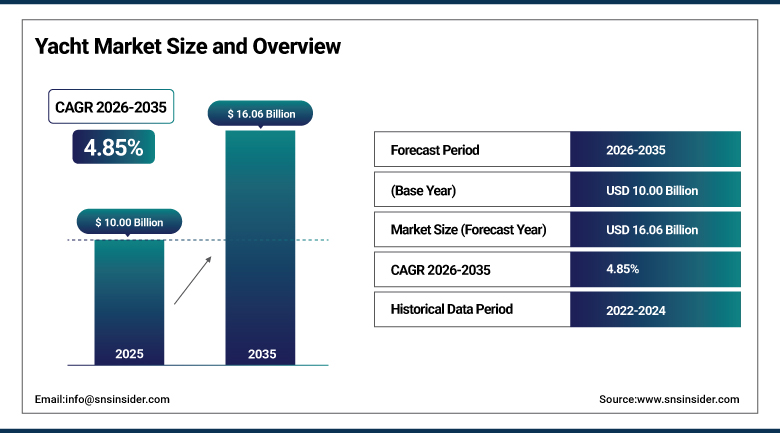
The Yacht Market was valued at USD 10.00 Billion in 2025 and is expected to reach USD 16.06 Billion by 2035, growing at a CAGR of 4.85% from 2026-2035.
Growth in the Yacht Market is being largely propelled by the continuous rise in the number of high-net-worth individuals and ultra-high-net-worth individuals worldwide, whose discretionary income remains the main driver of demand for large-sized recreational boats, including mid-sized motor yachts and fully equipped superyachts. Interest in luxurious maritime tourism and personalized leisure experiences keeps adding new potential customers to the target market, moving away from conventional yacht ownership to yacht chartering as a way to enjoy the advantages of owning a yacht without all the expenses of the latter. Innovation in yacht design, efficiency of propulsion, and on-board facilities keep stimulating the demand by allowing shipyards to distinguish themselves with advanced technologies and personalized design options. An increasing interest in eco-friendly and hybrid propulsion systems and growing marinas in emerging luxury tourism locations position the market for further growth throughout the next decade.
Azimut-Benetti Group launched a EUR 160 million investment plan for the 2025-2027 period, allocating approximately EUR 99.3 million to expand production capacity across its shipyards to meet growing demand, EUR 43.2 million to research and development for more technologically advanced and environmentally sustainable yachts, and EUR 13.9 million to digital transformation initiatives including virtual reality design tools.
To Get more information Yacht Market - Request Free Sample Report
Yacht Market Trends
-
Growing shipyard investment in hybrid and sustainable propulsion technology to reduce fuel consumption and emissions.
-
Rising popularity of commercial yacht charter as an accessible entry point into the yachting lifestyle.
-
Continued shipyard consolidation and brand acquisition activity among leading Italian and Dutch builders.
-
Expanding demand for mid-sized yachts suited to renewable energy integration such as solar and wind power.
-
Growing partnership activity between shipyards and automotive or aerospace technology companies on propulsion systems.
U.S. Yacht Market Outlook
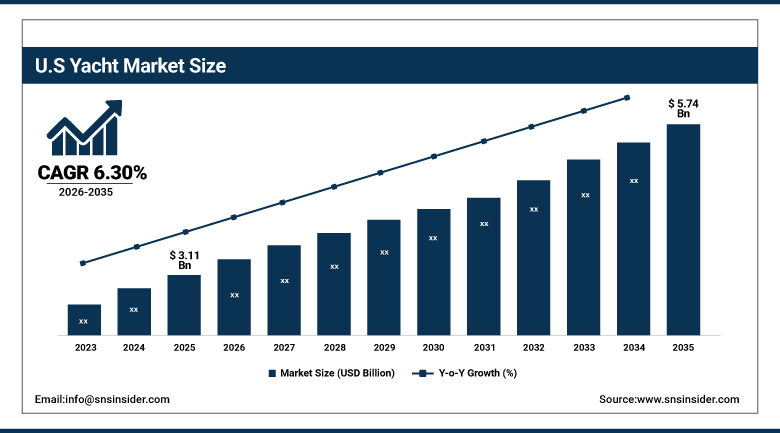
The U.S. Yacht Market was valued at USD 3.11 Billion in 2025 and is expected to reach USD 5.74 Billion by 2035, growing at a CAGR of 6.30% from 2026-2035.
U.S. Yacht Market growth will continue to be driven by the substantial base of wealthy individuals in the country and the existing marinas and boating facilities in the major coastal recreational boating locations. The domestic demand will also benefit from the presence of major U.S. boat shows where international shipyards can demonstrate their products to Americans and spark interest for direct sales. Growth in the domestic market for yacht charters will also contribute to demand as affluent people look to enjoy luxury yachts without having to bear the full ownership and management costs.
In February 2025, Sunseeker, a leading international luxury motor yacht brand, unveiled an extensive line-up of eight models, including the Superhawk 55, Predator 55, Manhattan 55, Manhattan 68, Predator 75, 76 Yacht, Ocean 182, and 95 Yacht, at the Miami International Boat Show 2025. The unveiling reflects continued international shipyard investment in showcasing new models directly to the U.S. market, one of the world's largest markets for luxury motor yacht sales.
Yacht Market Segment Analysis
-
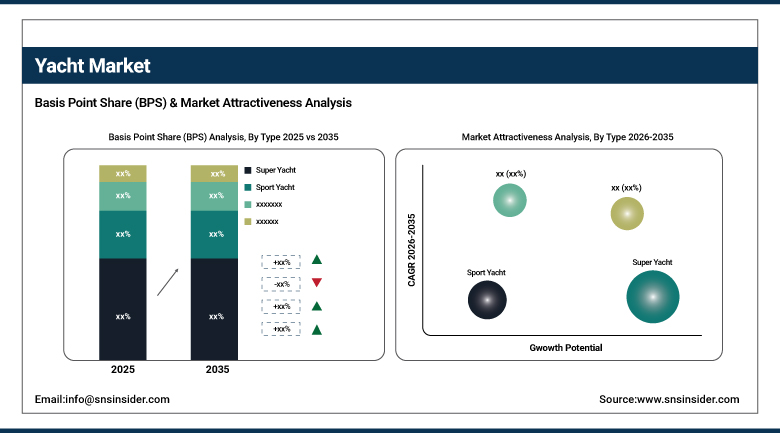
By Type, the Super Yacht segment dominated the Yacht Market with approximately 31.30% share in 2025, while the Sport Yacht segment is the fastest growing with a CAGR of approximately 6.90%.
-
By Length, the 20-50 Meters segment dominated the Yacht Market with approximately 49.50% share in 2025, while the Under 20 Meters segment is the fastest growing with a CAGR of approximately 6.20%.
-
By Propulsion, the Motor Yacht segment dominated the Yacht Market with approximately 89.00% share in 2025, while the Sailing Yacht segment is the fastest growing with a CAGR of approximately 5.90%.
-
By Application, the Personal Use segment dominated the Yacht Market with approximately 78.50% share in 2025, while the Commercial Charter segment is the fastest growing with a CAGR of approximately 6.74%.
By Type, Super Yacht dominates and Sport Yacht grows fastest
The Super Yachts type segment has been the leader in the Yacht Market due to their popularity among ultra-high-net-worth customers who are always looking for larger, fully customized and feature-packed yachts. The growth of the Super Yachts type segment is supported by the increasing number of ultra-wealthy individuals globally as well as by the increasing interest towards luxury experiences on board including entertainment space, water activities and wellness facilities.
The Sport Yachts type segment shows the highest growth rates due to the increasing need for high-performing versatile vessels that can be used for both racing purposes and leisure in such countries as China and France that are experiencing growth of recreational boating and maritime sports. Sport yachts pay special attention to performance as well as to comfort, which allows this segment to attract a wider customer base.
By Length, 20-50 Meters dominates and Under 20 Meters grows fastest
The 20-50 meters length segment holds the position of the major category in the Yacht Market due to the optimal combination of space and performance in this range as compared to more complex superyachts. It is also notable that the given length range enjoys popularity owing to its high compatibility with personal ownership as well as commercial charter purposes, which provides for stable demand for the given length range among various customer types.
The Under 20 Meters length range has recently become one of the fastest-growing segments in the market due to its compact size and lightweight hull, which makes it highly effective in using renewable energy sources like solar and wind power. This length range concentrates on energy-saving vessels, which are targeted at ecologically-conscious customers.
By Propulsion, Motor Yacht dominates and Sailing Yacht grows fastest
Motor Yachts have been and will be the predominant segment of propulsion in the Yacht Market, given the preference of buyers for speed, ease, and flexibility associated with motorization in varied forms of marine usage. This segment is aided by further technological advancements in engine efficiency and hybrid propulsion systems, keeping the popularity of motor yachts alive in almost every class of yacht.
Sailing Yachts are fast becoming one of the most rapidly growing segments of propulsion in specific markets, owing to the revival of interest in old sailing skills as well as increasing concern for the environment in buyers interested in eco-friendly means of cruising. This segment is working towards the modernization of traditional sailing yachts with comfort features as well as hybrid auxiliary propulsion.
By Application, Personal Use dominates and Commercial Charter grows fastest
Personal Use is the major application segment within the Yacht Market industry because of the essentiality of a yacht as a discretionary product purchased primarily for recreation and entertainment purposes. The Personal Use segment is positively impacted by the increase in the number of wealthy individuals around the world and continues to experience high demand regardless of the type or length of yachts.
The Commercial Charter segment appears to be the most promising one as it is expected to be the fastest-growing application segment because of the increasing interest in being able to use the yachting experience without making the necessary investments and covering the cost of operations. The primary goal of this segment is to expand the availability of yachts within the charter fleet and improve online booking services for potential guests.
Regional Analysis
|
Region |
Major Country |
Share within Region, 2025 (%) |
|---|---|---|
|
Europe |
Italy |
42.60% |
|
North America |
United States |
85.50% |
|
Asia Pacific |
China |
38.60% |
|
Latin America |
Brazil |
41.80% |
|
Middle East & Africa |
United Arab Emirates |
46.90% |
Europe Yacht Market Insights
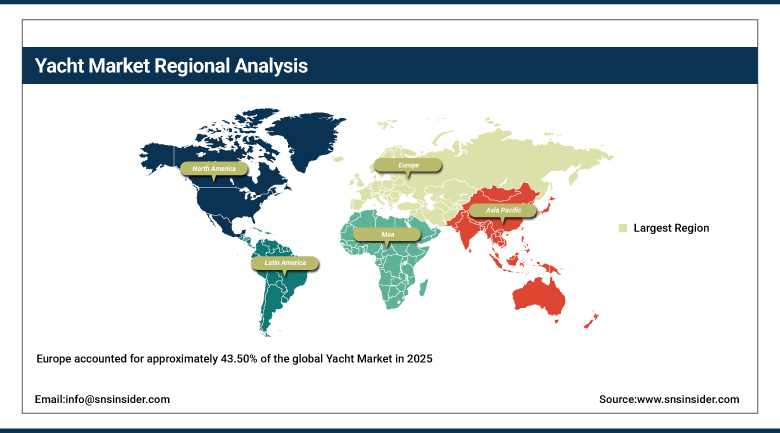
Europe accounted for approximately 43.50% of the global Yacht Market in 2025, reflecting the region's position as the world's leading center of yacht design, engineering, and shipbuilding craftsmanship. Italy represents the largest single contributor within the region, home to leading shipyards including Azimut-Benetti, Ferretti Group, and Sanlorenzo, which collectively anchor the country's globally recognized yacht manufacturing ecosystem.
France and the Netherlands contribute additional regional demand and manufacturing capacity, with France supporting strong sport and sailing yacht demand and the Netherlands home to renowned superyacht builders such as Feadship and Oceanco. The French Riviera and Monaco continue to anchor Europe's luxury yachting culture, hosting major industry events that reinforce the region's central role in the global yacht market.
Get Customized Report as per Your Business Requirement - Enquiry Now
North America Yacht Market Insights
The North American market is estimated to witness the highest rate of growth among all regional markets in terms of a CAGR of around 6.30% in the Yacht market between 2026 and 2035, due to increased demand for recreational yachting activities as well as a growing number of HNWIs in the region. The region's share of demand is largely driven by the US due to its high population of wealthy consumers and advanced coastal facilities.
Leading international shipyards use major boat shows in the US, such as the Miami International Boat Show, as a means to launch their latest product range in front of potential buyers from the region. Canada serves as an additional source of regional demand due to increasing interest of consumers in recreational boating in its coastal and lakeside regions.
Asia Pacific Yacht Market Insights
The Asia Pacific region is becoming an increasingly important market for yachts, driven by the growth in numbers of the rich population in China and increased governmental support for the development of domestic tourism infrastructure in marine. China is becoming the biggest individual player in the region due to increased interest of recreational boating among the rich population.
India, Indonesia, and Malaysia are providing further opportunities for growth in the region because of their governments' supportive tourism policies and growth of middle-class and rich population. Further development of the marina infrastructure will provide further support for the growth of the region in the global yacht market.
MEA & Latin America Yacht Market Insights
Latin America's Yacht Market is led by Brazil, which accounts for the majority of regional demand on the strength of its large coastal recreational boating community and growing population of affluent buyers. Gradual economic development and rising interest in luxury marine tourism across Brazil and neighboring markets continue to support steady regional demand growth.
The Middle East & Africa region continues to grow in importance within the global yacht market, with demand concentrated in Gulf Cooperation Council markets such as the United Arab Emirates, where Dubai has emerged as a significant regional hub for yacht sales, charter, and major industry boat shows. South Africa continues to anchor yacht-related demand on the African continent, supported by its established coastal recreational boating and marine tourism infrastructure.
Market Dynamics
Growth Drivers: Rising High-Net-Worth Population and Luxury Tourism Demand
A steady rise in the number of high-net-worth and ultra-high-net-worth people around the world is the key driver of growth in the Yacht Market because of the increasing ability of this demographic group to spend their discretionary income on big leisure craft irrespective of the yacht model and size. This factor is compounded by the increasing interest in luxury cruise and private experiences which broaden the addressable base of buyers.
The steady progress in terms of yacht design, propulsion efficiency, and the number of on-board amenities serves as another key source of demand because major shipyards try to differentiate themselves via innovation and engineering. The development of the marina infrastructure in luxury tourism destinations facilitates market expansion and makes yacht ownership and charting more widespread among geographic markets.
Restraints: High Ownership Costs and Economic Sensitivity
High acquisition, maintenance, and operating costs associated with yacht ownership represent a significant restraint on the Yacht Market, as vessels require substantial ongoing investment in crew, dockage, insurance, and maintenance that limits the addressable buyer base to a comparatively narrow segment of the global population. This dynamic is particularly pronounced for superyacht and larger vessel categories that require full-time professional crews and specialized maintenance facilities.
The market's fundamental dependence on discretionary luxury spending makes yacht demand particularly sensitive to broader economic uncertainty and fluctuations in global financial markets, which can meaningfully affect high-net-worth individuals' willingness to commit to major discretionary purchases. Continued volatility in shipbuilding material and labor costs adds further uncertainty to long-term pricing and production planning across the industry.
Opportunities: Sustainable Propulsion and Commercial Charter Expansion
Further development in hybrid and sustainable propulsion technology is likely to lead to significant growth potential for the Yacht Market, with environmentally-conscious buyers focusing more on minimizing fuel usage and emission in addition to conventional performance and luxury needs. Shipyards capable of delivering validated and dependable sustainable propulsion technology will benefit from such development in terms of gaining market share.
Interest in yacht chartering represents another long-term potential for growth of the industry through addressing a new group of consumers who are interested in getting access to yachting in a more flexible manner rather than purchasing their own vessel. Further development of digital platforms for yacht charter booking could lead to capturing a disproportional market share by shipyards and charter services with fleet readiness.
Recent Developments:
-
In 2024, Azimut-Benetti Group and Rolls-Royce signed a four-year partnership and framework agreement to collaborate more closely on advanced yacht propulsion systems, deepening cooperation between the two companies on next-generation marine engineering technology.
-
In January 2025, Ferretti S.p.A. launched the first unit of its brand-new Ferretti Yachts 940 model, which the company describes as a blend of spaciousness and contemporary design within its motor yacht product line.
-
In 2024, Sanlorenzo acquired a 60% stake in Nautor Swan for approximately EUR 48.5 million, adding a new yacht segment spanning 13 to 44 meters to its existing product portfolio and expanding its presence in the sailing yacht category.
Yacht Market Key Players
-
Azimut-Benetti Group
-
Ferretti Group
-
Sanlorenzo S.p.A.
-
Sunseeker International Ltd.
-
Feadship
-
Oceanco
-
Lürssen
-
Heesen Yachts
-
Baglietto S.p.A.
-
Royal Huisman
-
Abeking & Rasmussen
-
Princess Yachts International Ltd.
-
Riva (Ferretti Group)
-
CRN Yachts (Ferretti Group)
-
Amels (Damen Yachting)
-
Westport Yachts
-
Viking Yacht Company
-
Hatteras Yachts
-
Fincantieri Yachts
-
BENETEAU Group
Yacht Market Report Scope:
| Report Attributes | Details |
|---|---|
| Market Size in 2025 | USD 10.00 Billion |
| Market Size by 2035 | USD 16.06 Billion |
| CAGR | CAGR of 4.85% From 2026 to 2035 |
| Base Year | 2025 |
| Forecast Period | 2026-2035 |
| Historical Data | 2022-2024 |
| Report Scope & Coverage | Market Size, Segments Analysis, Competitive Landscape, Regional Analysis, DROC & SWOT Analysis, Forecast Outlook |
| Key Segments | • by Type (Super Yacht, Sport Yacht, Flybridge Yacht, and Long Range Yacht) • by Length (Under 20 Meters, 20-50 Meters, and Above 50 Meters) • by Propulsion (Motor Yacht and Sailing Yacht) • by Application (Personal Use and Commercial Charter) |
| Regional Analysis/Coverage | North America (US, Canada), Europe (Germany, UK, France, Italy, Spain, Russia, Poland, Rest of Europe), Asia Pacific (China, India, Japan, South Korea, Australia, ASEAN Countries, Rest of Asia Pacific), Middle East & Africa (UAE, Saudi Arabia, Qatar, South Africa, Rest of Middle East & Africa), Latin America (Brazil, Argentina, Mexico, Colombia, Rest of Latin America). |
| Company Profiles | Azimut-Benetti Group, Ferretti Group, Sanlorenzo S.p.A., Sunseeker International Ltd., Feadship, Oceanco, Lürssen, Heesen Yachts, Baglietto S.p.A., Royal Huisman, Abeking &, Rasmussen, Princess Yachts International Ltd., Riva (Ferretti Group), CRN Yachts (Ferretti Group), Amels (Damen Yachting), Westport Yachts, Viking Yacht Company, Hatteras Yachts, Fincantieri Yachts, BENETEAU Group |

Frequently Asked Questions
Leading companies in the Yacht Market include Azimut-Benetti, Ferretti Group, Sanlorenzo, Sunseeker International, and Feadship, among others.
A sustained increase in the global population of high-net-worth and ultra-high-net-worth individuals, combined with growing interest in luxury marine tourism, is the major factor driving market growth.
The Motor Yacht segment dominated the Yacht Market with approximately 89.00% share in 2025.
Europe dominated the Yacht Market in 2025 with approximately 43.50% share, reflecting the region's position as the world's leading center of yacht design and shipbuilding craftsmanship, led by Italy.
Key opportunities include continued advancement of hybrid and sustainable propulsion technology, and rising interest in commercial yacht charter as an accessible entry point into the yachting lifestyle.
