The global healthcare asset management market is entering a period of rapid expansion as hospitals, healthcare networks and pharmaceutical organizations invest in technologies that improve equipment visibility, utilization and operational efficiency. Growing adoption of radio frequency identification (RFID), real-time location systems (RTLS) and artificial intelligence-enabled asset monitoring is transforming how healthcare organizations manage medical equipment throughout its operational lifecycle.
According to SNS Insider, the global healthcare asset management market was valued at USD 31.46 Billion in 2025, is estimated to reach USD 36.94 Billion in 2026 and is projected to attain USD 156.74 Billion by 2035, growing at a CAGR of 17.42% during 2026–2035.
The rising investment in healthcare infrastructure, maintenance needs for equipment and the need for traceability of medical devices are driving the market growth. Hospitals are using connected systems to track infusion pumps, ventilators, wheelchairs, diagnostic equipment and surgical tools without having to make unnecessary investments and equipment downtime.
North America dominated the market with a 41.38% revenue share in 2025, while Asia Pacific is expected to experience the fastest expansion through 2035.
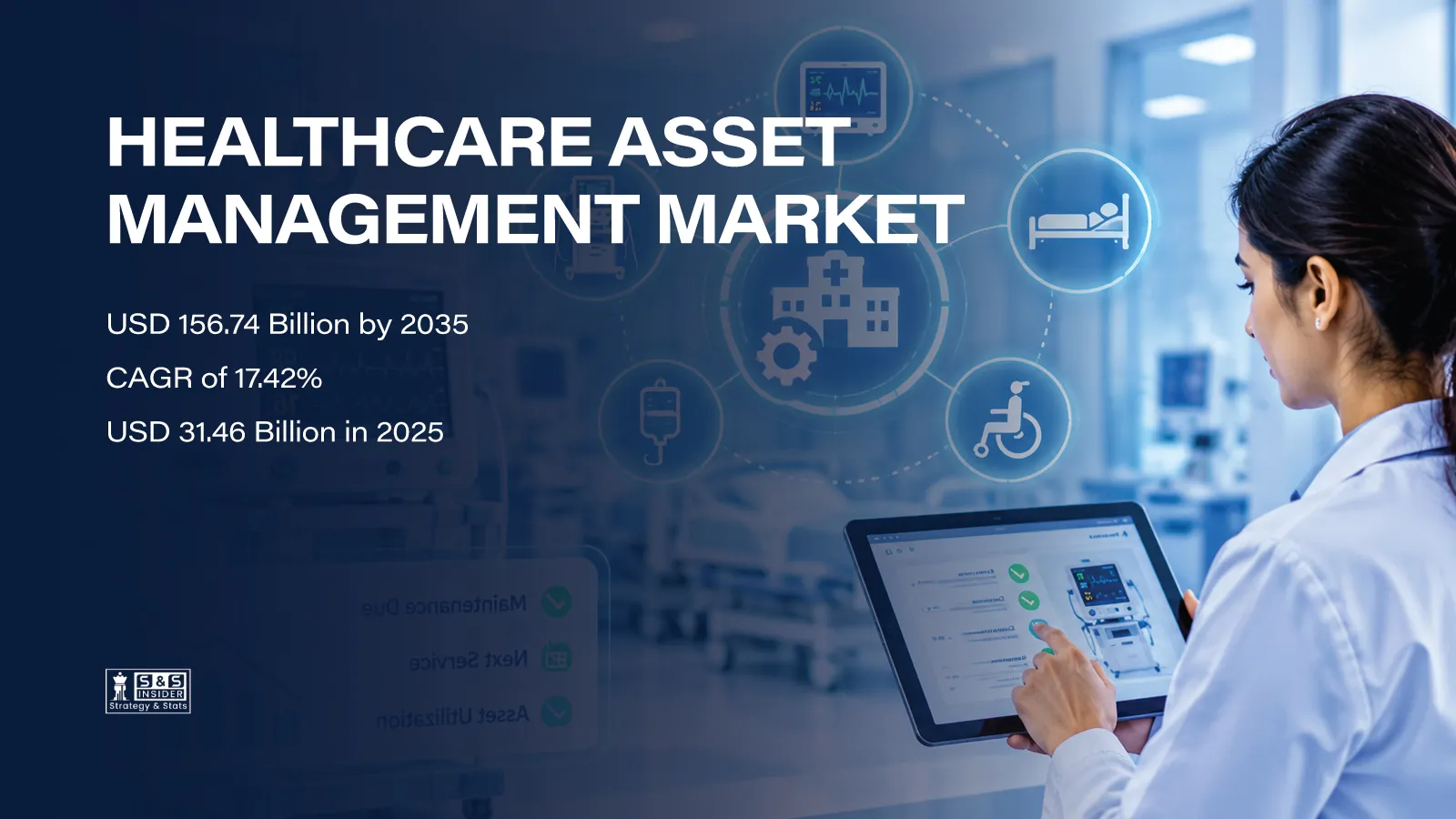
Market Size and Forecast
|
Market Indicator |
Value |
|---|---|
|
Market Size, 2025 |
USD 31.46 Billion |
|
Market Size, 2026 |
USD 36.94 Billion |
|
Market Forecast, 2035 |
USD 156.74 Billion |
|
CAGR, 2026–2035 |
17.42% |
|
Leading Region |
North America, 41.38% |
|
Fastest-Growing Region |
Asia Pacific, 18.63% CAGR |
|
Leading Technology |
RFID, 55.84% Share |
|
Leading End User |
Hospitals and Clinics, 66.37% Share |
Demand Drivers and Constraints
Primary Demand Drivers
- Increasing demand for equipment visibility: Hospitals are investing in tracking technologies to reduce time spent locating devices, improve utilization and minimize unnecessary equipment purchases.
- Expanding hospital digitalization: Connected hospital infrastructure and electronic healthcare systems are encouraging adoption of integrated asset management platforms.
- Rising medical device traceability requirements: Equipment identification, maintenance documentation and recall management are strengthening demand for reliable digital asset records.
- Integration of AI and IoT: Predictive maintenance, automated inventory monitoring and intelligent equipment allocation are creating additional opportunities for technology providers.
- Growing healthcare infrastructure investment: New hospitals, diagnostic centers and pharmaceutical facilities require comprehensive equipment tracking and management solutions.
Potential Growth Constraints
- High initial investment in RFID readers, location sensors, software and network infrastructure.
- Cybersecurity and patient privacy concerns associated with connected healthcare environments.
- Limited interoperability between tracking technologies and existing hospital information systems.
- Incomplete equipment inventories and difficulties integrating historical asset records.
Demand Structure by Technology
RFID (2025 Market Share: 55.84%)
Radio Frequency Identification held dominance in the healthcare asset management market accounting for approximately 55.84% revenue share in 2025. It has been extensively used due to its cost-effective tags, ability to track assets accurately as well as compatible nature with the current hospital infrastructures. Hospitals use RFID technology to track surgical instruments, medical devices, equipment and diagnostics. The use of passive RFID has an edge for those hospitals which have large inventories since these do not require individual batteries for their operation.
Current trend: Increasing deployment of RFID-enabled hospital inventory and medical equipment identification systems.
Major trends: Passive RFID tags, automated inventory audits, surgical instrument tracking, device identification integration and connected supply chain visibility.
Real-Time Location Systems (Forecast CAGR: 21.77%)
Real-time location systems (RTLS) is expected to exhibit the highest rate of growth within the technology market, with an estimated Compound Annual Growth Rate (CAGR) of 21.77% between 2026 and 2035. Hospitals are increasingly utilizing RTLS in order to gain real-time visibility on the movement and availability of medical devices, patients and health professionals. RTLS using Bluetooth, infrared, ultrasound and Wi-Fi enable accurate room-level tracking. Hybrid location technology has emerged as a potential choice for its ability to combine various sensors in order to enhance the location sensing precision in complicated hospital setups.
Current trend: Accelerating adoption of hybrid RTLS networks across large healthcare facilities.
Major trends: Bluetooth location tracking, cloud-based RTLS, smart patient flow management, predictive analytics and multi-technology sensor integration.
Demand Structure by Component
Hardware (2025 Market Share: 58.92%)
The value of hardware accounted for about 58.92% of total revenue generated from healthcare asset management solutions in 2025 and still retained its dominance among the component segments. Healthcare institutions need tangible infrastructure in the form of RFID tags, antennas, readers, gateways and location sensors to create a reliable tracking network. The hardware is used by large hospitals in various parts of a facility including patient wards, operation theaters, storage centers and equipment maintenance departments. The increase in the infrastructure of hospitals along with the renewal of old tracking equipment increases the demand for hardware.
Current trend: Increasing investment in connected equipment tracking infrastructure.
Major trends: Wireless sensors, compact identification tags, low-power hardware, hybrid readers and network modernization.
Services (Forecast CAGR: 19.47%)
It is anticipated that the Services segment will experience growth at a CAGR of 19.47% between 2026 and 2035 owing to rising requirements in terms of installation and maintenance along with system integration and asset management. Hospitals typically seek help from service providers in order to set up tracking networks as well as integrate asset management systems with clinical workflow process. Software update and personnel training fall within the scope of service providers' duties. Subscription services are presenting chances of recurring revenues for healthcare companies looking for steady expenditure and not large IT teams.
Current trend: Growing adoption of outsourced healthcare asset management services.
Major trends: Managed RTLS services, cloud subscriptions, system integration, technical support and equipment lifecycle consulting.
Demand Structure by Application
Equipment and Device Tracking (2025 Market Share: 46.18%)
Tracking of equipment and devices had a share of about 46.18% in the market in 2025, which was the largest application category. The hospitals use tracking technology to find their mobile medical devices, usage management and inventory management of equipment. Examples of applications include infusion pumps, ventilators, patient monitors, wheelchairs and portable imaging equipment. It will help to lower equipment searching time, improve departmental coordination, and maintenance management. The increasing focus on medical device recalls and cost management will drive the market.
Current trend: Increasing integration of equipment tracking with hospital maintenance systems.
Major trends: Automated asset identification, maintenance alerts, utilization analytics, recall management and equipment availability monitoring.
Patient and Staff Tracking (Forecast CAGR: 22.17%)
The fastest growth in applications is expected to be in patient and staff tracking, with a projected CAGR of 22.17% through 2035. Healthcare organizations are extending the use of RTLS beyond managing equipment to improve patient movement, staff safety and the coordination of clinical workflows. Location-aware badges and monitoring platforms can help in emergency alerts, patient waiting-time analysis and resource allocation. Hospitals are increasingly looking at unified tracking networks that can support equipment, patients and personnel with shared infrastructure. Even in those deployments, privacy protections and control of access are still a consideration.
Current trend: Growing adoption of location-enabled clinical workflow management.
Major trends: Staff safety badges, patient movement analytics, workflow automation, occupancy monitoring and privacy-controlled location platforms.
Demand Structure by End User
Hospitals and Clinics (2025 Market Share: 66.37%)
Hospitals and clinics dominated the healthcare asset management market with approximately 66.37% share in 2025. Large healthcare facilities have large inventories of diagnostic instruments, treatment equipment and mobile medical devices that need to be continuously monitored. Rising operational costs and a need to improve patient care efficiency are motivating hospitals to adopt centralized tracking systems. Multi location healthcare networks have the advantage of standard inventory records and equipment allocation across locations. Continued investment in smart hospitals, outpatient facilities and digital infrastructure is likely to support long-term demand.
Current trend: Expansion of enterprise-wide tracking solutions across hospital networks.
Major trends: Smart hospital infrastructure, centralized device management, automated maintenance and multi-campus asset visibility.
Pharmaceutical and Biotech Companies (Forecast CAGR: 20.67%)
Pharmaceutical and biotechnology companies are projected to be the fastest-growing end-user segment, registering a CAGR of 20.67% from 2026 to 2035. These organizations increasingly require reliable monitoring of manufacturing equipment, laboratory instruments, temperature-sensitive materials and distribution assets. RFID and connected sensor technologies help improve traceability, inventory control and cold-chain visibility. Expansion of biologics manufacturing and specialized pharmaceutical production is creating additional opportunities for asset monitoring platforms that support operational continuity and regulatory documentation.
Current trend: Increasing adoption of connected asset monitoring in pharmaceutical operations.
Major trends: Cold-chain tracking, laboratory asset visibility, automated inventory monitoring and manufacturing equipment traceability.
Regional Market Dynamics
North America (2025 Market Share: 41.38%)
North America dominated the global healthcare asset management market with approximately 41.38% revenue share in 2025. The United States accounted for 70.31% of regional revenue, supported by extensive hospital infrastructure, advanced healthcare technology adoption and increasing emphasis on medical equipment efficiency. Canada contributes additional demand through hospital modernization and digital health investments. Healthcare organizations are incorporating RFID, RTLS and AI-supported analytics to improve equipment allocation, maintenance planning and recall response. Growing demand for integrated hospital asset management platforms is expected to maintain regional leadership.
Direction: Market leadership supported by connected healthcare infrastructure and AI-enabled equipment management.
Europe (2025 Market Share: 26.71%)
Europe represented approximately 26.71% of the global market in 2025, making it the second-largest regional market. Germany accounted for 22.64% of European revenue, followed by important markets including the United Kingdom, France and Italy. Medical device identification requirements, hospital modernization programs and digital healthcare initiatives are supporting technology adoption. Healthcare providers are investing in equipment traceability and connected inventory platforms to improve operational efficiency and compliance. Expanding use of hybrid RTLS systems offers opportunities for technology suppliers.
Direction: Sustained growth driven by medical device traceability and public healthcare modernization.
Asia Pacific (Forecast CAGR: 18.63%)
Asia Pacific is expected to register the fastest regional expansion, growing at a CAGR of 18.63% during 2026–2035. China represented 35.87% of regional revenue in 2025, supported by hospital infrastructure development and healthcare digitalization. India is emerging as a rapidly expanding market as private hospital networks invest in operational efficiency and equipment monitoring. Japan, South Korea and Australia also contribute demand for advanced asset tracking technologies. Increasing hospital construction and adoption of affordable connected solutions are expected to accelerate market development.
Direction: Fastest regional growth supported by hospital expansion and increasing healthcare technology adoption.
Latin America (2025 Market Share: 6.02%)
Latin America accounted for approximately 6.02% of the global market in 2025, with Brazil representing 49.26% of regional revenue. Mexico, Argentina and Colombia are additional markets where private hospital investment and healthcare modernization are encouraging asset tracking adoption. Healthcare organizations increasingly prioritize affordable RFID systems for medical equipment identification, inventory control and operational cost reduction. Gradual expansion of diagnostic networks and hospital infrastructure is expected to create new opportunities.
Direction: Gradual expansion supported by private healthcare investment and cost-effective tracking technologies.
Middle East & Africa (2025 Market Share: 5.25%)
The Middle East and Africa represented approximately 5.25% of global revenue in 2025. Saudi Arabia led the region with a 33.18% share, supported by hospital construction, medical city development and national healthcare modernization initiatives. The UAE and Qatar are investing in connected healthcare facilities, while South Africa contributes demand from established private hospital networks. Infrastructure limitations and budget constraints remain challenges across parts of Africa, encouraging interest in scalable and lower-cost solutions.
Direction: Emerging opportunities supported by healthcare infrastructure development and digital transformation.
Competitive Landscape
The healthcare asset management market includes established medical technology companies and specialized tracking solution providers. Key participants include GE HealthCare, Zebra Technologies, CenTrak, Securitas Healthcare, AiRISTA Flow, Midmark RTLS, Sonitor Technologies, Kontakt.io and TRIMEDX.
Competition increasingly focuses on location accuracy, interoperability, AI-powered analytics, cloud integration and managed services. Companies are expanding hybrid tracking platforms to address healthcare providers' demand for comprehensive equipment visibility and operational intelligence.
Recent developments include CenTrak's introduction of AI-enhanced asset tracking capabilities in March 2026 and Securitas Healthcare's acquisition of cloud-based RTLS provider ZulaFly in May 2026.
Market Outlook (2026–2035)
The global healthcare asset management market is projected to reach USD 156.74 Billion by 2035, supported by increasing hospital digitalization, medical equipment traceability requirements and widespread adoption of connected tracking technologies.
RFID is expected to remain an important technology for cost-effective inventory management, while RTLS will gain momentum as hospitals pursue real-time equipment and workflow visibility. Growing adoption of AI-enabled analytics will further expand opportunities in predictive maintenance, automated resource allocation and equipment lifecycle management.
North America is expected to maintain a leading market position, while Asia Pacific offers the strongest regional growth prospects.
Overall, the healthcare asset management market is positioned for sustained expansion through 2035, with competitive advantage increasingly determined by tracking accuracy, integration capabilities, operational efficiency and intelligent asset utilization.