
According to the latest SNS Insider Industrial Microscope Market report, demand is rising as manufacturers inspect smaller parts against stricter quality targets. Electronics, vehicles, aircraft, medical devices and data center hardware all have tighter tolerances than before, so more of their production steps now need magnified checks.
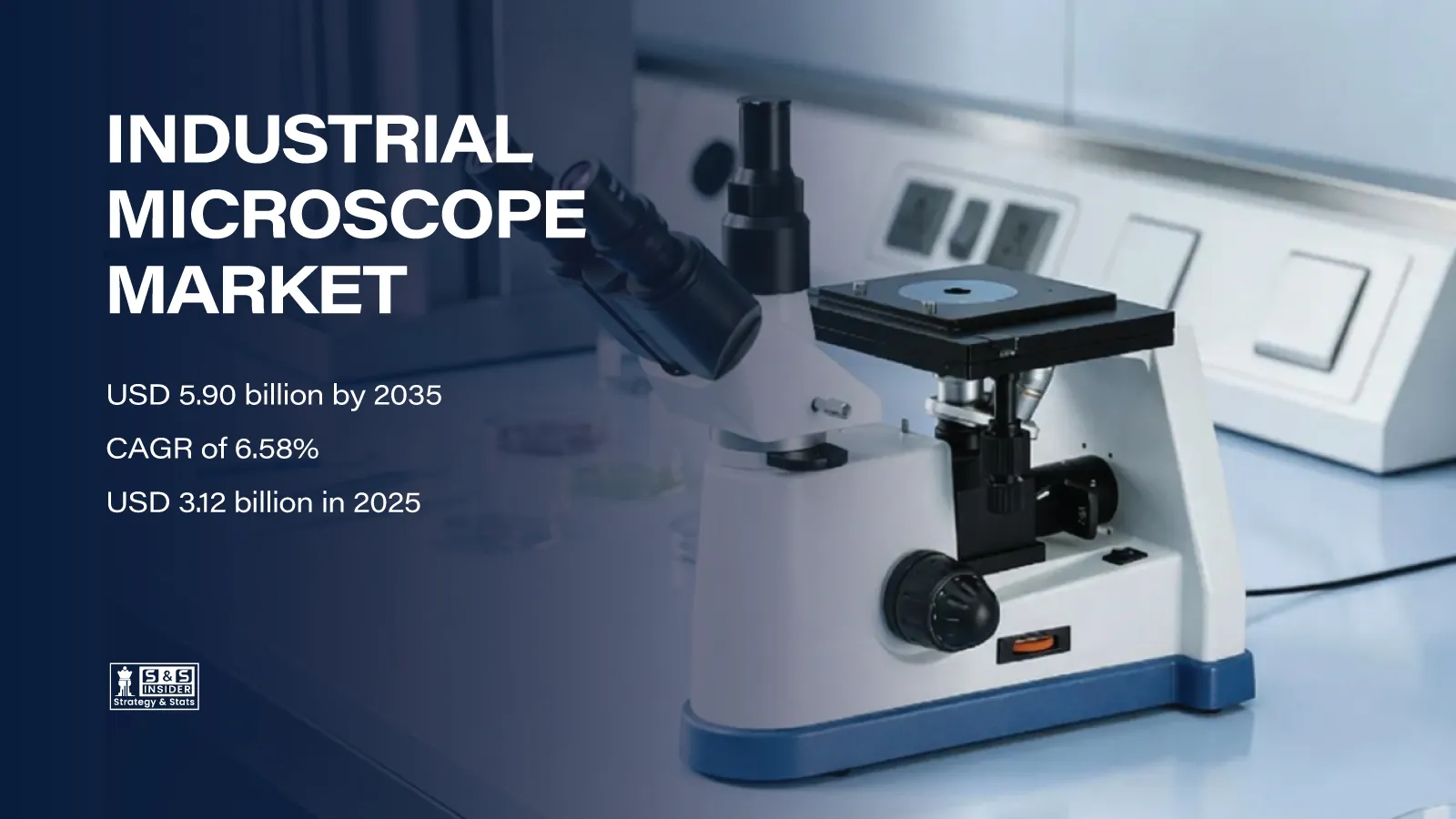
The global industrial microscope market was valued at USD 3.12 Billion in 2025 and is estimated at USD 3.33 Billion in 2026. It is projected to reach USD 5.90 Billion by 2035, growing at a CAGR of 6.58% during 2026–2035.
Inspection is becoming more automated. Digital microscopes, motorized stages and remote review tools let one operator check more samples. They also let teams in different sites review the same images.
Optical systems still hold the largest share. Electron microscopes are growing faster because chip and battery makers need detail that light-based tools cannot resolve. New government support for semiconductor plants in the United States and Europe adds to this demand.
North America is the largest regional market. Asia Pacific is growing fastest, supported by electronics production and new fabrication capacity.
Market Size and Forecast
|
Market Indicator |
Value |
|
Market Size, 2025 |
USD 3.12 Billion |
|
Market Size, 2026 |
USD 3.33 Billion |
|
Market Forecast, 2035 |
USD 5.90 Billion |
|
CAGR, 2026–2035 |
6.58% |
|
Leading Region, 2025 |
North America (32.67%) |
|
Fastest-Growing Region |
Asia Pacific (8.89% CAGR) |
Demand Drivers and Constraints
Primary Demand Drivers
-
Smaller parts and tighter quality targets: Miniaturized electronics and safety-critical components need closer inspection at more stages of production.
-
Semiconductor investment: In July 2025, the U.S. raised its tax credit for chip plant investment from 25% to 35%. In June 2026, a second EU Chips Act was proposed. Both support new fabs that buy inspection tools.
-
Automation and digital imaging: Digital microscopes and remote review software cut inspection time and reduce operator error.
-
Stricter measurement standards: A revised ISO 25178-605 standard, issued in February 2025, raises expectations for surface measurement accuracy.
-
Advanced materials research: New alloys, composites and battery materials need high-resolution analysis during development.
Potential Growth Constraints
-
High purchase prices for electron and scanning probe systems.
-
Ongoing service, maintenance and consumable costs.
-
A shortage of technicians trained to operate advanced instruments.
-
Export controls on high-end equipment, including a U.S. rule issued in January 2025.
-
Price pressure from low-cost Asian optical suppliers, along with currency and tariff swings.
Demand Structure by Type
Optical Microscopes (2025 Market Share: 42.58%)
Optical microscopes accounted for 42.58% of the industrial microscope market in 2025. They are affordable, simple to run and suitable for most routine checks on production lines. Factories use them to inspect solder joints, surface finishes, coatings and machined parts. Their low running cost suits high-volume work where many samples are checked each shift. Steady upgrades to cameras, lighting and measurement software keep these systems useful in modern plants. Demand should stay firm through 2035 as manufacturers add inspection points.
Current trend: Optical systems are being upgraded with digital cameras and measurement software.
Major trends: Digital optical inspection, LED illumination, automated focus and image-based measurement.
Electron Microscopes (Forecast CAGR: 7.62%)
Electron microscopes are projected to grow at the fastest rate, a CAGR of 7.62% during 2026–2035. Chipmakers, battery producers and materials laboratories need resolution far beyond the limits of light. These systems support failure analysis, defect review and process control at very small feature sizes. Compact benchtop models are lowering the cost of entry for smaller laboratories and factories. New chip plant investment in several regions is expected to keep demand strong for high-end systems.
Current trend: Benchtop scanning electron microscopes are being adopted in industrial laboratories.
Major trends: Focused ion beam SEM, benchtop SEM, automated defect review and AI-based image analysis.
Demand Structure by Application
Material Science (2025 Market Share: 33.46%)
Material science represented 33.46% of the market in 2025. Metals, polymers, ceramics and composites must be studied for structure, grain size and defects before and during production. Research centers and industrial laboratories rely on microscopes to confirm material quality and explain part failures. Development of lighter vehicle materials and new battery chemistries adds to the workload. This application should remain the largest through the forecast period.
Current trend: Analysis of advanced alloys, composites and battery materials is expanding.
Major trends: Correlative microscopy, 3D surface analysis, automated grain analysis and digital sample records.
Semiconductor Inspection (Forecast CAGR: 8.34%)
Semiconductor inspection is expected to grow at a CAGR of 8.34% during 2026–2035. Smaller chip features and complex packaging raise the number of inspection steps in each fab. Defects that once went unnoticed can now cause yield losses, so manufacturers inspect more often and in greater detail. New fabs in the United States, Europe and Asia will need large fleets of inspection tools. This makes semiconductors the main source of new demand for high-end systems.
Current trend: Inspection steps are being added for advanced packaging and smaller chip nodes.
Major trends: Plasma FIB analysis, wafer defect review, AFM metrology and inline automated inspection.
Demand Structure by End Use
Semiconductor & Electronics (2025 Market Share: 28.74%)
Semiconductor and electronics companies accounted for 28.74% of market revenue in 2025. They check wafers, circuit boards, connectors and finished components at many points in production. Shrinking devices and higher reliability targets increase the need for precise inspection. Large manufacturers run dedicated failure analysis laboratories with several microscope types. Ongoing fab construction and electronics output should keep this group the largest buyer.
Current trend: Inspection is expanding across chip, board and component production.
Major trends: Automated optical inspection, SEM-based failure analysis, digital records and cleanroom-ready systems.
Automotive (Forecast CAGR: 7.92%)
Automotive companies are projected to grow at a CAGR of 7.92% through 2035. Electric vehicles add batteries, power electronics and sensors that need close inspection. Carmakers and suppliers check welds, coatings and battery cells to prevent safety faults and recalls. Lightweight materials also require structural analysis during development. As electric vehicle output rises, spending on inspection equipment is expected to rise with it.
Current trend: Inspection is growing for battery cells, power electronics and sensors.
Major trends: Battery defect analysis, weld inspection, digital microscopy and traceable quality records.
Demand Structure by Sales Channel
Direct Sales (2025 Market Share: 61.82%)
Direct sales accounted for 61.82% of the market in 2025. High-end systems need configuration, installation, training and long-term service, which buyers prefer to get from the manufacturer. Large factories and laboratories also negotiate multi-unit contracts directly. Service agreements give suppliers steady revenue after the sale. This channel should remain the leading route for advanced instruments.
Current trend: Suppliers are pairing equipment sales with service contracts.
Major trends: Bundled service plans, application support, remote diagnostics and leasing options.
Online (Forecast CAGR: 8.21%)
Online sales are expected to grow at a CAGR of 8.21% during 2026–2035. Smaller buyers increasingly purchase optical and digital microscopes, cameras and accessories through online stores. Clear pricing and fast delivery suit routine replacement and entry-level purchases. Suppliers are expanding their own web stores and digital product demos. This channel should keep gaining share for standard products.
Current trend: Entry-level microscopes and accessories are increasingly bought online.
Major trends: Manufacturer web stores, online configurators, virtual demos and refurbished equipment sales.
Key Market Participants
The market includes precision optics makers, electron microscope manufacturers, metrology companies and digital imaging specialists.
Key participants include Carl Zeiss AG, Thermo Fisher Scientific, Evident, Nikon, Leica Microsystems (Danaher), Keyence, Hitachi High-Tech, JEOL, Bruker, Tescan (Shimadzu), Mitutoyo, Hirox, Vision Engineering, Motic, Meiji Techno, Oxford Instruments, CAMECA (AMETEK) and Veeco Instruments.
Suppliers compete on resolution, automation, analysis software and service coverage. Recent launches show the direction of the market. In January 2025, Evident released the DSX2000 digital microscope. In October 2025, Thermo Fisher introduced the Helios MX1 plasma FIB SEM. In March 2026, ZEISS launched the Crossbeam 750. In August 2026, JEOL introduced the JCM-7000Plus NeoScope benchtop SEM.
Regional Market Dynamics
North America (2025 Market Share: 32.67%)
North America led the global market with a 32.67% share in 2025. The United States is the leading country, with a market value of USD 889.85 Million in 2025 and a projected CAGR of 6.82%. Demand comes from semiconductor, aerospace, medical device and automotive manufacturers. The higher federal tax credit for chip plants is drawing new fab projects, and each one needs inspection equipment. Strong research spending at universities and national laboratories adds to the demand.
Direction: Continued leadership supported by chip plant construction and advanced manufacturing.
Europe (2025 Market Share: 27.16%)
Europe held 27.16% of the market in 2025. Its automotive, precision engineering and research sectors are long-standing users of high-end microscopes. Several leading suppliers are based in the region, which supports a strong installed base and service network. The proposed second EU Chips Act could add new semiconductor capacity. Stricter quality standards in vehicles and medical devices also keep inspection demand steady.
Direction: Steady growth driven by automotive quality needs, research spending and semiconductor policy.
Asia Pacific (Forecast CAGR: 8.89%)
Asia Pacific is the fastest-growing region, with a CAGR of 8.89% during 2026–2035, and held 30.38% of the market in 2025. The region produces most of the world's electronics, and new chip and battery plants continue to open there. China, Japan, South Korea and Taiwan are major buyers of inspection equipment. India is building local electronics manufacturing, which adds new demand. Local suppliers also offer low-cost optical systems for high-volume factories.
Direction: Fastest regional growth supported by electronics output and new fab capacity.
Middle East & Africa
The Middle East and Africa held 4.58% of the market in 2025. Demand comes mainly from oil and gas, mining, universities and new industrial zones. Gulf countries are investing in manufacturing and research centers as part of plans to diversify their economies. In Africa, uptake is limited by budgets and a shortage of trained staff. Leasing and refurbished systems give smaller buyers a practical way to access modern equipment.
Direction: Gradual growth supported by industrial diversification and research investment.
Latin America
Latin America held 5.21% of the market in 2025. Brazil and Mexico account for most regional demand through automotive, electronics assembly and mining activity. Mexico benefits from manufacturing moving closer to North American customers. Currency swings and import costs make buyers cautious about high-end purchases. Mid-range optical and digital systems therefore make up a large part of regional sales.
Direction: Moderate growth supported by nearshoring and expanding industrial production.
Market Outlook (2026–2035)
The global industrial microscope market is forecast to reach USD 5.90 Billion by 2035, supported by steady investment in quality control and research.
Semiconductor expansion, tighter manufacturing tolerances and automated inspection will remain the main growth drivers. Electron systems will gain share as more users need very fine detail.
AI-based defect recognition, benchtop electron microscopes and flexible ownership models such as leasing and pay-per-use will widen the buyer base.
North America will keep the largest share, while Asia Pacific will add the most new demand.
Overall, the industrial microscope market is set for steady growth through 2035, and suppliers that combine high resolution with automation, analysis software and reliable service will be best placed to win.



