
According to the latest SNS Insider Industry 5.0 Market report, manufacturers are moving beyond full automation toward systems where people and machines work side by side. Labor shortages and the demand for products built to individual orders are making this shift necessary, and it is turning Industry 5.0 from an idea into a planned investment.
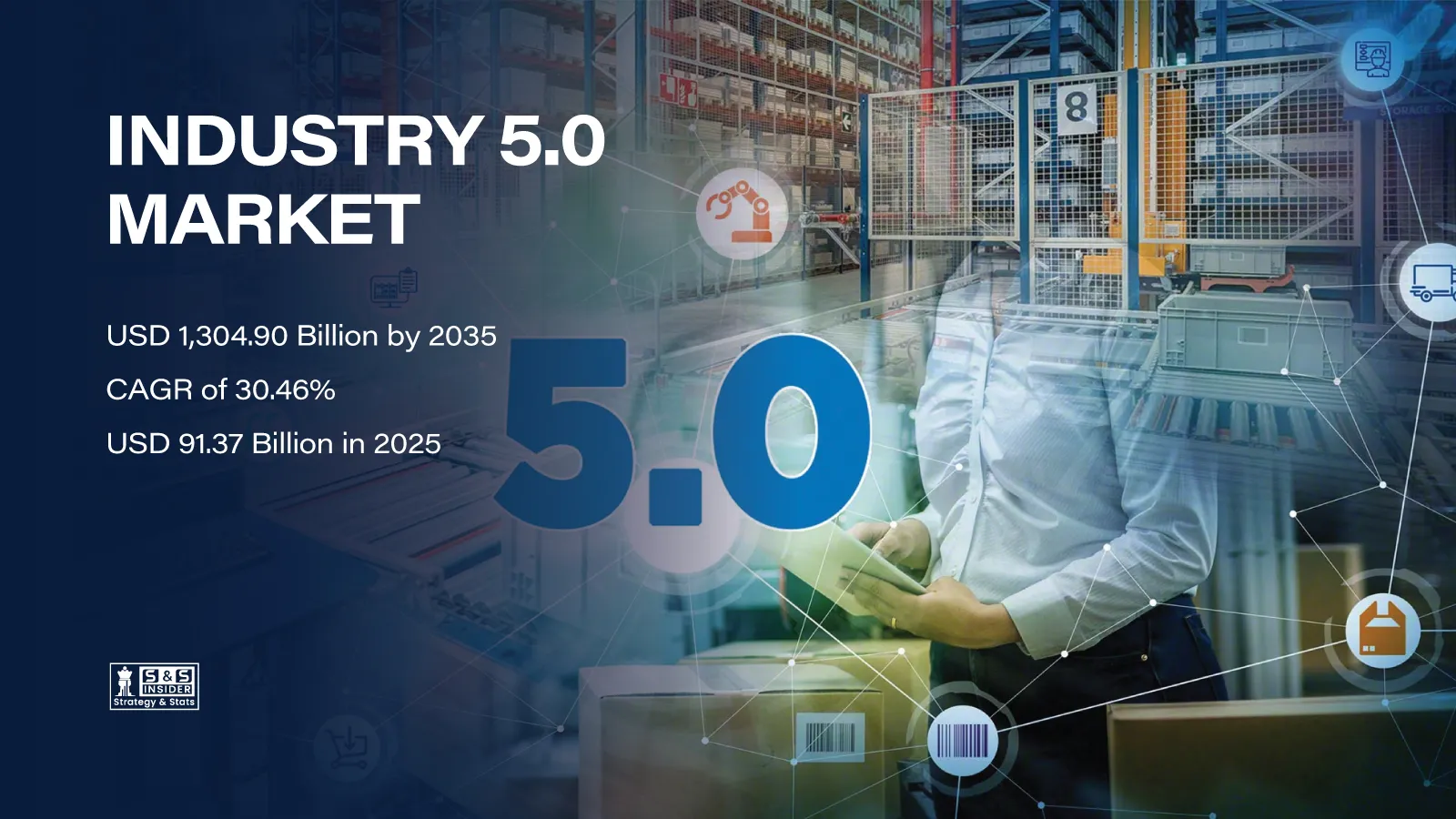
The global Industry 5.0 market was valued at USD 91.37 Billion in 2025 and is estimated at USD 119.20 Billion in 2026. It is projected to reach USD 1,304.90 Billion by 2035, growing at a CAGR of 30.46% during 2026–2035.
The biggest slice of spending today goes on hardware such as robots, sensors and controllers. Software is growing faster because factories need tools to plan, simulate, and coordinate work between people and machines.
Collaborative robots are still the most popular technology, while digital twins are rapidly proliferating as plants test changes virtually before implementing them on the floor. Automotive plants are the leaders in terms of adoption, electronics and semiconductor makers are adopting these systems at the fastest pace.
Asia Pacific is the fastest growing region with increasing factory investment in China, Japan, South Korea and India, while North America is the biggest regional market.
Market Size and Forecast
|
Market Indicator |
Value |
|
Market Size, 2025 |
USD 91.37 Billion |
|
Market Size, 2026 |
USD 119.20 Billion |
|
Market Forecast, 2035 |
USD 1,304.90 Billion |
|
CAGR, 2026–2035 |
30.46% |
|
Leading Region, 2025 |
North America (35.82%) |
|
Fastest-Growing Region |
Asia Pacific (33.06% CAGR) |
Demand Drivers and Constraints
Primary Demand Drivers
-
Skilled labor shortages: Factories struggle to fill skilled roles, so they use cobots and assistive tools that let fewer workers do more.
-
Mass customization: Buyers want products made to their own specifications, which calls for flexible lines that people and robots run together.
-
Growth of digital twins: Virtual models let plants test layouts and processes before they make costly physical changes.
-
AI on the factory floor: AI assistants and agent-based robots help workers make faster decisions and handle more varied tasks.
-
Focus on worker safety and wellbeing: Human-centric design reduces strain and injury, which supports investment in ergonomic, collaborative equipment.
Potential Growth Constraints
-
High upfront costs for robots, sensors, and software.
-
Difficulty connecting new systems to older plant equipment.
-
Slower adoption among small and mid-sized manufacturers.
-
New safety compliance duties, including the EU Machinery Regulation 2023/1230, which takes effect in January 2027.
-
Shortage of staff trained to manage combined human and machine operations.
Demand Structure by Component
Hardware (2025 Market Share: 46.38%)
Hardware accounted for 46.38% of the Industry 5.0 market in 2025. Every collaborative workplace needs physical equipment first, including robots, sensors, controllers, vision systems, and wearable devices. Manufacturers buy this equipment to automate repetitive tasks while keeping people in charge of judgment and quality. Each new production line adds demand for safer, lighter machines that can work near people. Replacement of older fixed automation also keeps hardware spending steady, because plants want equipment that can be reprogrammed quickly when products change.
Current trend: Steady replacement of fixed automation with flexible, collaborative equipment.
Major trends: Lightweight cobots, smart sensors, machine vision, and wearable assist devices.
Software (Forecast CAGR: 32.74%)
Software is projected to grow at the fastest CAGR of 32.74% during 2026–2035. Equipment is only as useful as the tools that plan and coordinate its work. Manufacturers are adding software for simulation, robot programming, analytics, and AI assistance, so that workers can direct machines without deep coding skills. As more plants connect their equipment, the value moves toward platforms that manage data across sites. Subscription pricing also lowers the entry cost, which helps smaller firms adopt these tools.
Current trend: Rising use of no-code robot programming and AI operator assistants.
Major trends: Factory orchestration platforms, AI copilots, simulation software, and cloud analytics.
Demand Structure by Technology
Industrial Robots and Cobots (2025 Market Share: 27.46%)
The technologies with the largest market share in 2025 were industrial robots and cobots, 27.46%. Cobots are built to work safely alongside people, so plants can add them without building cages or redesigning whole lines. They do the heavy lifting, welding, packing and inspection. Workers focus on setup and problem solving. With prices dropping and programming easier, these machines are within reach of mid-sized plants. In many countries, labor gaps provide manufacturers with a clear incentive to continue to add them.
Current trend: Wider use of cobots in mid-sized plants and mixed-model production lines.
Major trends: Higher payload cobots, AI-guided motion, easy teach programming, and mobile manipulators.
Digital Twin (Forecast CAGR: 34.12%)
Digital twin is expected to grow at a CAGR of 34.12% till 2035, the fastest among technologies. A digital twin is a live virtual model of a machine, line or plant. It allows teams to try out changes, train workers and predict failures before anything happens on the real floor.” This minimizes costly errors and downtime. Computing power and simulation software have made using twins more practical, and the partnership between automation and chip companies is accelerating adoption.
Current trend: Growing use of virtual factory models to plan layouts and train staff.
Major trends: Plant-wide twins, AI simulation, real-time data links, and virtual commissioning.
Demand Structure by Deployment
Cloud-Based (2025 Market Share: 54.71%)
The cloud-based deployment held 54.71% of the market in 2025. Manufacturers also use cloud platforms to gather data from multiple sites, conduct analysis and push updates to software without requiring on-premises servers. This model lowers upfront cost and lets companies scale capacity as they grow. It also allows sharing of models and insights across plants in different countries. For companies with a small IT staff, managed cloud services remove much of the work from running complex systems.
Current trend: Centralizing data from multiple plants on shared cloud platforms.
Major trends: Cloud analytics, remote monitoring, software updates over the air, and managed services.
On-Premises (Forecast CAGR: 32.13%)
On-premises deployment is projected to grow at a CAGR of 32.13% during 2026–2035. Many factories need control systems that respond instantly and keep running even if a network fails. Keeping key systems on site also gives companies tighter control over sensitive production data. Defense, semiconductor, and automotive plants often have strict rules about where data can sit. As AI moves closer to the machines, local computing becomes more important for fast and secure decisions.
Current trend: More edge computing and local AI processing on the factory floor.
Major trends: Edge servers, private networks, local AI models, and secure data control.
Demand Structure by End Use
Automotive (2025 Market Share: 27.84%)
Automotive held 27.84% of the market in 2025, the largest end-use share. Car makers have long used automation, and they are now adding collaborative tools to build more model variants on the same line. The shift to electric vehicles brings new battery and assembly steps that need flexible equipment. Workers and cobots share tasks such as fitting, inspection, and finishing. High production volumes and strong competition push automakers to keep investing in faster, more adaptable plants.
Current trend: Flexible assembly lines for mixed electric and conventional vehicle production.
Major trends: Battery assembly automation, cobot-assisted inspection, digital twins, and AI quality checks.
Electronics & Semiconductors (Forecast CAGR: 33.87%)
Electronics and semiconductors are expected to grow at a CAGR of 33.87% through 2035, the fastest among end uses. These products are small, precise, and change often, so makers need equipment that can switch tasks quickly. New chip plants are being built in many regions, and each one needs advanced automation from the start. Digital twins help these plants tune processes and reduce costly defects. Skilled technicians remain in short supply, which raises demand for tools that support them.
Current trend: Rapid automation of new chip and electronics plants.
Major trends: Precision cobots, process simulation, automated inspection, and AI yield control.
Key Market Participants
The Industry 5.0 market includes robot makers, industrial automation companies, and industrial software and simulation providers.
Key participants include Siemens AG, ABB Ltd, FANUC Corporation, Yaskawa Electric Corporation, KUKA AG, Universal Robots, OMRON Corporation, Rockwell Automation, Inc., Schneider Electric SE, Honeywell International Inc., Emerson Electric Co., Mitsubishi Electric Corporation, Bosch Rexroth AG, Yokogawa Electric Corporation, PTC Inc., Dassault Systèmes SE, Hexagon AB, and NVIDIA Corporation.
Competition centers on ease of use, safe human-machine interaction, AI features, and the ability to link hardware with software. Companies that offer complete systems, simple programming, and strong support are well placed as manufacturers seek tools their workers can adopt quickly.
Regional Market Dynamics
North America (2025 Market Share: 35.82%)
North America represented 35.82% of the global Industry 5.0 market in 2025. The United States is the primary driver of regional demand, with its market value projected to reach USD 28.28 Billion by 2025, with a CAGR of 31.12% from 2026 to 2035. Manufacturers are turning to cobots and AI tools due to labor shortages, reshoring of production and new semiconductor and battery plants. Canada contributes demand through automotive and food processing.
Direction: Continued leadership supported by reshoring, new factory construction, and AI adoption.
Europe (2025 Market Share: 26.41%)
Europe accounted for a share of 26.41% in 2025. The top country markets are Germany, the United Kingdom, and France. The region has influenced the concept of Industry 5.0, which has a strong focus on worker wellbeing, sustainability and resilience. Automotive, machinery makers drive adoption. New safety rules, such as the EU Machinery Regulation expected in 2027, are causing manufacturers to rethink how people and machines share the workspace.
Direction: Steady growth driven by human-centric policy, strong industrial bases, and safety compliance.
Asia Pacific (Forecast CAGR: 33.06%)
Asia Pacific held 30.67% share in 2025 and is expected to grow the fastest at a CAGR of 33.06% through 2035. China is the biggest market country with mass manufacturing and strong state support for smart factories. Japan and South Korea are creating new demand from advanced robotics and electronics manufacturing, while India is constructing new plants under its manufacturing programs.
Direction: Fastest regional growth supported by factory expansion and electronics production.
Middle East & Africa
Middle East and Africa accounted for 2.97% in 2025. Saudi Arabia and the United Arab Emirates are leading regional demand, creating new industrial zones to lessen dependence on oil. Often the start of such projects is modern automation. Africa’s adoption is limited by budgets and infrastructure.
Direction: Gradual growth driven by industrial diversification programs.
Latin America
Brazil and Mexico were the top countries in the region, which represented 4.13% in 2025. Nearshoring to Mexico benefits as companies move production closer to the U.S. market, especially in automotive and electronics. Demand is being added by Brazil through its automotive and food industries. Many firms are motivated by cost considerations to use cobots and cloud tools.
Direction: Moderate growth supported by nearshoring and automotive investment.
Market Outlook (2026–2035)
The global Industry 5.0 market is anticipated to reach USD 1,304.90 Billion by 2035, supported by strong and sustained investment in human-centric manufacturing.
Labor shortages and demand for customized products will continue to be the main drivers of growth, while software and digital twins will take a larger share of spending as factories become more connected.
The automotive sector will remain the largest end-use sector, while electronics and semiconductor plants will add new demand as chip capacity expands worldwide.
Asia Pacific will be the fastest-growing region through 2035, but North America will continue to lead.
Overall, the Industry 5.0 market is set for rapid expansion through 2035, with success depending on safe collaboration, easy-to-use software, AI capability, and smooth integration with existing plant systems.



