
The latest SNS Insider Photo Booth Kiosk Market report shows a market that is growing steadily. Booths now serve two needs. They produce compliant photos for passports and other documents, and they create shared moments at weddings, parties and brand events. Both uses bring repeat business for operators.
The global photo booth kiosk market was valued at USD 4.73 Billion in 2025 and is estimated at USD 5.19 Billion in 2026. It is projected to reach USD 11.89 Billion by 2035, growing at a CAGR of 9.66% during 2026–2035.
Software is changing what a booth can do. Augmented reality effects, cloud galleries and remote updates let operators refresh the experience without replacing hardware. Operators can also track machines from a distance and sell services on subscription.
Demand comes from more than one place. Biometric photo rules keep identity booths busy as people renew documents. Retailers, cinemas, malls and theme parks use booths to draw visitors and promote brands. Cashless and QR-code payment make each visit quicker.
North America is the largest regional market. Asia Pacific is growing fastest, helped by strong photo booth culture in Japan and South Korea and rising retail spending across the region.
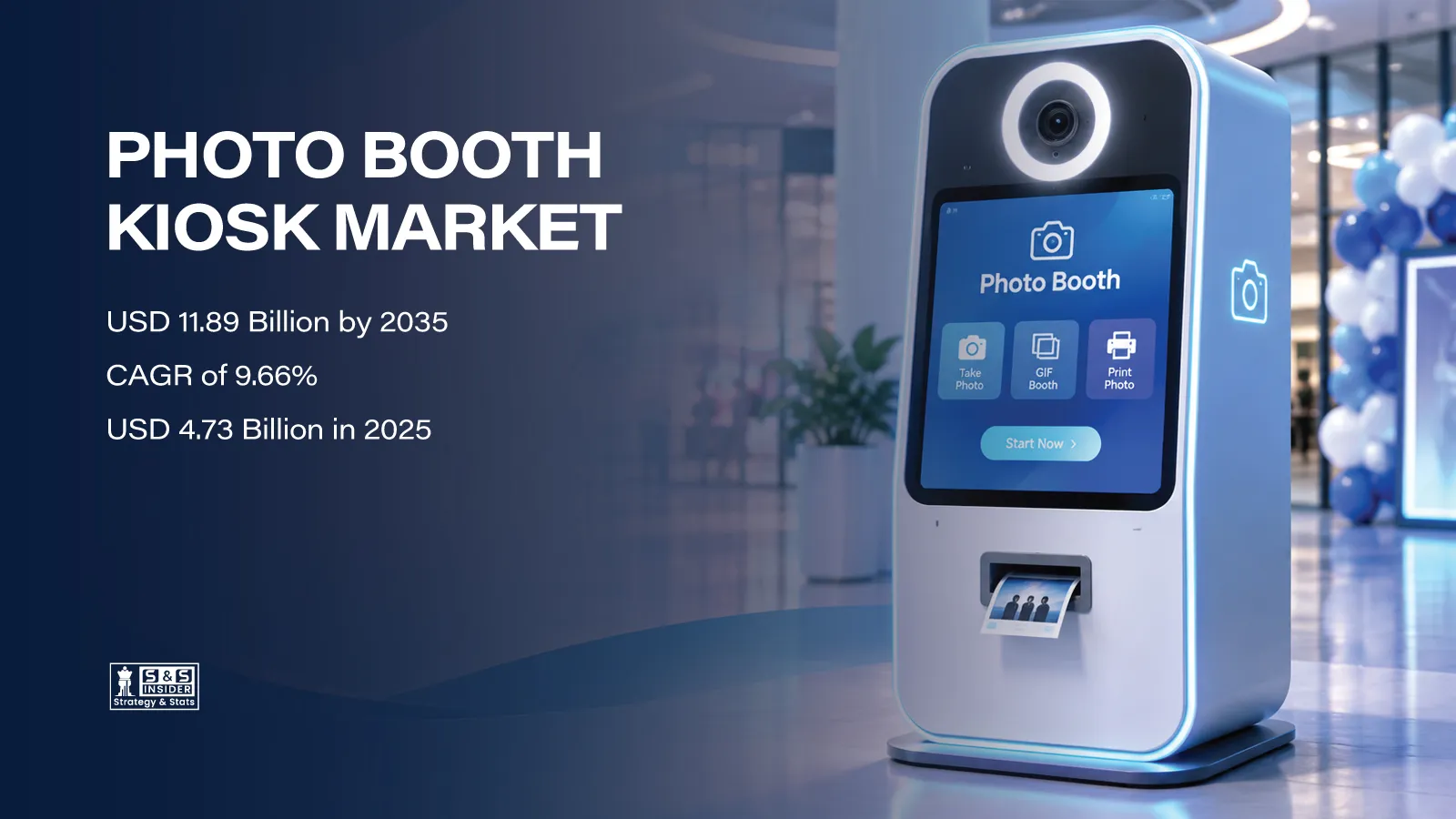
Market Size and Forecast
|
Market Indicator |
Value |
|
Market Size, 2025 |
USD 4.73 Billion |
|
Market Size, 2026 |
USD 5.19 Billion |
|
Market Forecast, 2035 |
USD 11.89 Billion |
|
CAGR, 2026–2035 |
9.66% |
|
Leading Region, 2025 |
North America (31.84%) |
|
Fastest-Growing Region |
Asia Pacific (12.31% CAGR) |
Demand Drivers and Constraints
Primary Demand Drivers
-
Biometric photo rules: Passport and ID photos must meet strict standards, so people return to booths each time a document is renewed.
-
Event and celebration demand: Weddings, parties and corporate events book booths to give guests instant prints and digital copies.
-
Brand activation: Companies sponsor photo stations to put their logo in front of visitors and gather social media reach.
-
Software features: Augmented reality, cloud galleries and remote updates keep booths fresh and lower service costs.
-
Easier payment: Cashless and QR-code payment remove friction and raise the number of sessions per machine.
Potential Growth Constraints
-
Smartphone cameras and online photo services that compete for identity photos.
-
Privacy and biometric data rules that add consent, storage and security costs.
-
Vandalism, insurance, paper and service visits that raise operating costs.
-
Rising rents at busy, high-traffic sites.
-
Uneven demand for event booths outside peak seasons.
Demand Structure by Type
Open Air Booths (2025 Market Share: 41.62%)
Open air booths accounted for 41.62% of the market in 2025. They have no walls, so groups can fit in one frame, and that makes them a natural choice for weddings, parties and corporate events. They are light, easy to move and quick to set up, which suits rental companies that serve several venues in a week. Many units now add digital props, instant sharing and branded overlays. Steady demand from events and brand activations is expected to keep this type in the lead through 2035.
Current trend: Wider use of portable open booths for events and sponsored activations.
Major trends: Digital props, instant social sharing, branded overlays, and lightweight portable frames.
Mirror Booths (Forecast CAGR: 12.84%)
Mirror booths are projected to grow fastest, at a CAGR of 12.84% during 2026–2035. A full-length mirror screen guides guests with animations and voice prompts, and they can sign or draw on their photos before printing. This interactive style feels like part of the entertainment, so event planners and brands pay a higher fee for it. Upscale weddings, product launches and venue openings are key buyers. As more rental firms add mirror units to their fleets, demand is expected to keep rising.
Current trend: Growing demand for interactive, full-length touch screen booths at premium events.
Major trends: Touch screen signatures, animated prompts, full-body framing, and premium rental packages.
Demand Structure by Application
Entertainment and Events (2025 Market Share: 48.35%)
Entertainment and events represented 48.35% of the market in 2025. Weddings, birthdays, festivals, corporate gatherings and holiday parties all book booths to give guests a lasting keepsake. The booth also works as an activity that keeps people together and talking. Organizers value fast prints and digital copies that guests can share at once. A large rental base and a steady calendar of social events keep this application the biggest source of booth revenue.
Current trend: Booths becoming a standard part of wedding and corporate event packages.
Major trends: Instant prints, digital galleries, custom templates, and event-themed backdrops.
Retail and Brand Activation (Forecast CAGR: 11.93%)
Retail and brand activation is expected to grow at a CAGR of 11.93% during 2026–2035. Brands use booths to turn a store visit or product launch into a moment that customers share online. Each shared photo carries the brand's logo and reaches people the company did not pay to reach directly. Malls, cinemas, museums, theme parks and airports are adding booths to draw foot traffic. Data from QR-code sharing also helps marketers measure the results of each campaign.
Current trend: More brands using sponsored booths in stores and at launch events.
Major trends: Branded photo frames, QR-code sharing, campaign analytics, and experiential retail.
Demand Structure by End Use
Commercial Venues (2025 Market Share: 52.18%)
Commercial venues accounted for 52.18% of the market in 2025. Shopping malls, supermarkets, transit stations, cinemas and entertainment centers host booths that run all day with little staff. Identity photo booths in these locations serve a steady stream of people renewing passports and ID cards. Fun booths in the same venues add extra income for site owners through revenue sharing. Long placement contracts and high foot traffic keep this end use the largest through 2035.
Current trend: Upgrading fixed booths in malls and stations with cashless payment and remote monitoring.
Major trends: Unattended operation, revenue-sharing placements, compliant ID photos, and remote diagnostics.
Events and Rentals (Forecast CAGR: 11.07%)
Events and rentals are projected to grow at a CAGR of 11.07% during 2026–2035. Small businesses buy booths and rent them out for weddings, parties and corporate functions, often running several units each weekend. Startup costs are modest, and booking platforms make it easy to find customers. Buyers in this group want portable units, simple software and strong print quality. As social events return to full calendars and planners add booths as standard, this group's demand is expected to grow steadily.
Current trend: Growth in small rental businesses running multi-unit booth fleets.
Major trends: Portable units, online booking, subscription software, and bundled event packages.
Key Market Participants
The photo booth kiosk market includes identity photo operators, camera and imaging companies, and specialist booth makers that serve the rental and event trade.
Key participants include ME Group International plc, Fujifilm Holdings Corporation, Dai Nippon Printing, Furyu Corporation, Kodak Alaris, Photobooth Supply Co., and Fotoautomat.
Companies compete on print quality, software features, ease of payment and the size of their placement networks. Operators that can monitor machines remotely, keep up with identity photo rules and update the user experience through software are well placed. In March 2026, ME Group International reported full-year photobooth revenue above GBP 168.00 million from more than 49,000 machines in 16 countries. In April 2026, Fujifilm introduced the instax SPOT Photobooth and Print Station in North America, with augmented reality effects and QR-code printing.
Regional Market Dynamics
North America (2025 Market Share: 31.84%)
North America led the global photo booth kiosk market with a 31.84% share in 2025. The United States accounts for most regional demand, with a market value of USD 1.24 Billion in 2025 and a projected CAGR of 9.12%. A large wedding and corporate event market keeps rental booths busy, while malls, cinemas and entertainment centers host fixed units. New products are adding augmented reality effects and phone-based printing. Canada adds demand through events and retail venues in its major cities.
Direction: Continued leadership supported by event rentals, retail placements and new software-led booths.
Europe (2025 Market Share: 29.12%)
Europe held 29.12% of the market in 2025. The United Kingdom, France, Germany, Italy and Spain are the main markets. Identity photo booths are a familiar part of daily life across the region, and strict document photo rules keep them in use. Operators are replacing older machines with next-generation booths that support digital photo codes and cashless payment. Fun booths are also spreading in malls, stations and tourist areas.
Direction: Steady growth driven by identity photo demand and fleet upgrades.
Asia Pacific (Forecast CAGR: 12.31%)
Asia Pacific is expected to grow fastest, at a CAGR of 12.31% during 2026–2035. Japan and South Korea have a strong culture of photo stickers and self-photo studios, and young people visit booths often with friends. China and India are adding booths in new malls and entertainment centers as retail spending grows. Southeast Asian countries such as Thailand, Vietnam and Indonesia are seeing fast growth in self-photo studios. Tourism and social media sharing add further demand.
Direction: Fastest regional expansion supported by youth photo culture and new retail spaces.
Middle East & Africa
The Middle East & Africa held 5.48% of the market in 2025. Saudi Arabia, the UAE and Qatar lead demand through large malls, entertainment destinations and a busy calendar of events and exhibitions. Brands use booths at launches and festivals to engage visitors. South Africa adds demand through events and retail. Growth in tourism and leisure projects is expected to create more placement sites over the forecast period.
Direction: Emerging opportunities driven by leisure projects, events and retail growth.
Latin America
Latin America held 6.21% of the market in 2025. Brazil and Mexico are the main markets, supported by large urban populations, a lively event scene and growing mall networks. Rental businesses serve weddings, quinceañeras and corporate functions. Buyers often prefer lower-cost portable booths and flexible rental terms because of currency swings. Cashless payment is helping fixed booths reach more customers.
Direction: Gradual growth supported by social events and affordable rental models.
Market Outlook (2026–2035)
The global photo booth kiosk market is forecast to reach USD 11.89 Billion by 2035, reflecting steady demand from both identity photos and entertainment.
Biometric photo rules will keep identity booths in regular use, while events and brand activations will remain the largest source of revenue for rental operators.
Software will play a bigger role. Augmented reality, cloud galleries, remote monitoring and subscription services will help operators earn more from each machine.
North America will keep its lead, while Asia Pacific will add the most new demand through youth photo culture and expanding retail spaces.
Overall, the photo booth kiosk market is set for steady expansion through 2035, with success depending on software features, compliant identity photos, easy payment and strong placement networks.



