
According to the latest SNS Insider Medical Refrigerators Market report, demand is rising steadily. Hospitals, blood banks, pharmacies, laboratories and drug makers all need more space to store temperature-sensitive products. Vaccines, biologics and blood products lose value fast if they get too warm or too cold, so reliable cold storage is now a basic part of daily care.
The global medical refrigerators market was valued at USD 4.55 Billion in 2025 and is estimated at USD 4.81 Billion in 2026. It is projected to reach USD 7.97 Billion by 2035, growing at a CAGR of 5.76% during 2026–2035.
Buyers are moving toward units with built-in monitoring, alarms and digital records. These features help facilities prove that products stayed in the right temperature range, which inspectors and quality teams now expect.
Blood storage remains the largest use, while ultra-low temperature freezers are growing fastest. Cell and gene therapies, mRNA products and biobanking all need storage far below freezing, which adds a new layer of demand.
North America holds the largest share of the market, while Asia Pacific is growing fastest as vaccine production and hospital capacity expand.
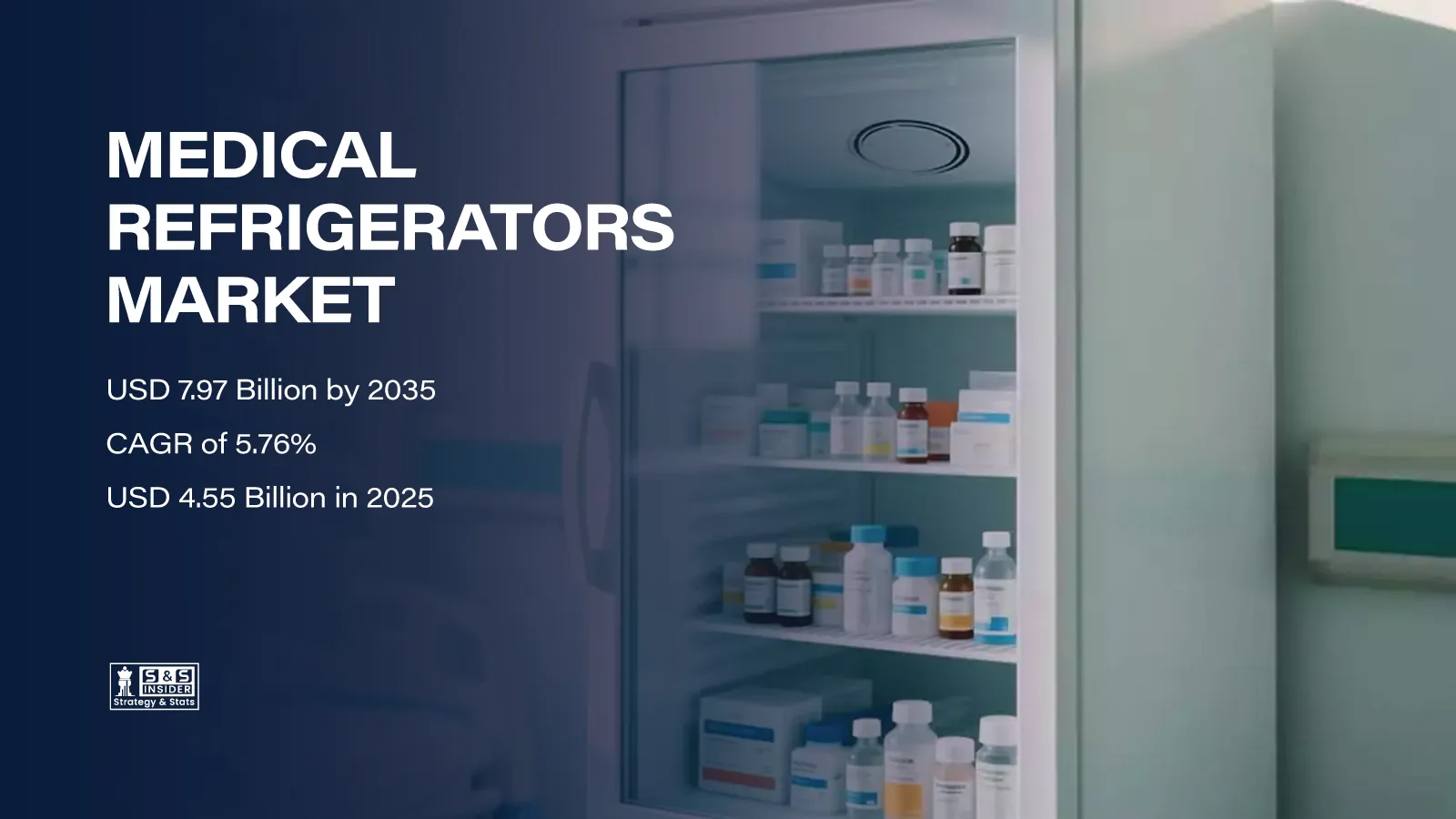
Market Size and Forecast
|
Market Indicator |
Value |
|
Market Size, 2025 |
USD 4.55 Billion |
|
Market Size, 2026 |
USD 4.81 Billion |
|
Market Forecast, 2035 |
USD 7.97 Billion |
|
CAGR, 2026–2035 |
5.76% |
|
Leading Region, 2025 |
North America (38.05%) |
|
Fastest-Growing Region |
Asia Pacific (7.35% CAGR) |
Demand Drivers and Constraints
Primary Demand Drivers
-
More biologics and blood products: Vaccines, biologics and blood-derived products keep growing in volume, and each one needs controlled storage.
-
Immunization programs: National vaccine programs need certified refrigerators at every step of the supply chain, from central stores to local clinics.
-
Advanced therapies and research: Cell and gene therapies, mRNA products, biobanks and genomics work all depend on ultra-low temperature storage.
-
Connected monitoring: Facilities want units that track temperature on their own and keep records ready for audits.
-
New vaccine plants: Vaccine manufacturing capacity is growing in Asia and Africa, and each new site needs cold storage.
Potential Growth Constraints
-
High costs to buy, install, calibrate, validate and maintain units.
-
Heavy power use by ultra-low freezers and the need for backup power.
-
Refrigerant phase-down rules that force product redesigns.
-
Unreliable power and weak service networks in parts of Africa, South Asia and Latin America.
-
Import duties and long public tenders that slow sales to government buyers.
Demand Structure by Product Type
Blood Bank Refrigerators and Plasma Freezers (2025 Market Share: 25.97%)
Blood bank refrigerators and plasma freezers held 25.97% of the market in 2025, the largest share by product type. Hospitals and blood services store whole blood, red cells and plasma every day, and each product has a narrow safe temperature range. A small error can mean a unit of blood has to be thrown away. This is why blood centers buy dedicated units with tight temperature control and alarms. Steady blood collection, regular equipment replacement and strict safety rules keep demand for this group stable.
Current trend: Replacement of older blood storage units with models that monitor and record temperatures on their own.
Major trends: Plasma freezers, alarm systems, digital temperature logs, and blood center upgrades.
Ultra-Low Temperature Freezers and Cryogenic Storage (Forecast CAGR: 7.66%)
Ultra-low temperature freezers and cryogenic storage are projected to grow at a CAGR of 7.66% during 2026–2035, the fastest rate by product type. Cell and gene therapies, mRNA vaccines and biobank samples must be kept at -60°C or colder, often for many years. Research labs and drug makers are adding freezer capacity as these programs grow. Buyers also want units that use less energy and have backup cooling, because a single failure can destroy samples that took years to collect.
Current trend: Rising purchases of energy-saving ultra-low freezers with backup cooling.
Major trends: Natural refrigerants, dual cooling systems, automated sample storage, and biobank expansion.
Demand Structure by End User
Hospitals and Clinics (2025 Market Share: 32.90%)
Hospitals and clinics accounted for 32.90% of the market in 2025, the largest share by end user. They store vaccines, insulin, blood products, lab samples and many other medicines, often across several departments in one building. Each area needs its own refrigerator that meets safety rules. Hospital pharmacies and labs also face regular inspections, so they prefer units that keep clear records. New hospital construction and routine replacement of old units keep this group the main source of demand.
Current trend: Greater use of monitored refrigerators across hospital pharmacies and labs.
Major trends: Pharmacy refrigerators, central monitoring systems, laboratory freezers, and equipment replacement.
Pharmaceutical Companies (Forecast CAGR: 7.12%)
Pharmaceutical companies are expected to grow at a CAGR of 7.12% through 2035, the fastest rate by end user. Drug makers handle raw materials, test samples and finished products that must stay within strict temperature limits. Growth in biologics, vaccines and cell therapies has raised the amount of product that needs cold storage at each site. New vaccine plants in Asia and Africa add further demand. Companies favor large, validated units that fit into their quality systems and support regulatory reviews.
Current trend: Expansion of cold storage at drug manufacturing and research sites.
Major trends: Large-capacity freezers, validated storage, vaccine production, and cell therapy pipelines.
Demand Structure by Temperature Range
2°C to 8°C (2025 Market Share: 46.75%)
The 2°C to 8°C range held 46.75% of the market in 2025, the largest share by temperature range. Most vaccines, insulin products and many common medicines are stored in this range. Pharmacies, clinics and hospitals need these units in large numbers, and immunization programs place them at every level of the supply chain. Because the products are used so widely, demand stays steady year after year. Solar-powered models are also helping programs reach clinics that have no reliable grid power.
Current trend: Wider use of certified vaccine refrigerators in immunization programs.
Major trends: Vaccine refrigerators, solar direct-drive units, remote monitoring, and pharmacy storage.
Below -40°C (Forecast CAGR: 7.66%)
The below -40°C range is projected to grow at a CAGR of 7.66% during 2026–2035, the fastest rate by temperature range. This growth follows the rise of mRNA vaccines, cell and gene therapies and long-term sample storage in biobanks. These products break down quickly at higher temperatures, so they need deep-freeze storage from production to use. Research centers and drug makers are adding capacity, and suppliers are releasing new models that use less power and offer more storage space.
Current trend: Growing demand for deep-freeze storage for advanced therapies and research samples.
Major trends: -80°C freezers, cryogenic storage, energy-saving designs, and biobank growth.
Demand Structure by Door Type
Double Door (2025 Market Share: 48.75%)
Double door units accounted for 48.75% of the market in 2025, the largest share by door type. They offer a good balance of storage space and floor space, which suits hospital pharmacies, blood banks and labs. Users can open one side without exposing the whole cabinet, which helps keep the temperature stable. Many facilities use these units as their main storage for medicines and samples, so they are a common choice when older equipment is replaced.
Current trend: Steady replacement of single units with larger double door models.
Major trends: Glass door models, separate temperature zones, pharmacy storage, and space-saving layouts.
Multiple Door (Forecast CAGR: 7.05%)
Multiple door units are expected to grow at a CAGR of 7.05% through 2035, the fastest rate by door type. Large hospitals, central pharmacies and drug makers need high capacity in one place. Multiple doors let staff reach one section at a time, which limits warm air entering the unit and protects stored products. These models also make it easier to sort items by type or use. Larger storage sites and central distribution centers are driving demand for this format.
Current trend: Rising use of high-capacity units at central pharmacies and distribution centers.
Major trends: Large-capacity cabinets, separate compartments, central storage, and inventory sorting.
Key Market Participants
The medical refrigerators market includes medical equipment makers, lab equipment suppliers and companies that focus on vaccine cold chain products.
Key participants include PHC Corporation (PHCbi), Haier Biomedical, Liebherr, B Medical Systems, Dulas, Philipp Kirsch GmbH, Stirling Ultracold, Esco Lifesciences, Labcold, Summit Appliance (Felix Storch), So-Low Environmental, NuAire, Vestfrost Solutions, Follett Products, SunDanzer, Thermo Fisher Scientific, Eppendorf, Helmer Scientific, Godrej Enterprises, and Zhongke Meiling Cryogenics.
Competition centers on temperature accuracy, energy use, reliability and built-in monitoring. Suppliers that offer certified products, strong service networks and lower running costs are best placed to win both hospital and public program contracts.
Regional Market Dynamics
North America (2025 Market Share: 38.05%)
North America led the global market with a 38.05% share in 2025. The United States accounts for 84.94% of regional demand, supported by a large hospital base, a strong biologics industry and strict storage rules. The U.S. market was valued at USD 1.47 Billion in 2025 and is projected to reach USD 2.54 Billion by 2035, at a CAGR of 5.62%. Growth in cell and gene therapy research and regular equipment upgrades keep demand steady across the region.
Direction: Continued market leadership supported by biologics production and advanced therapy research.
Europe (Second-Largest Regional Market)
Europe is a major market, with Germany accounting for 29.37% of regional demand in 2025. Germany has a large base of hospitals, labs and drug makers, and strict quality rules apply across the region. Refrigerant phase-down rules are pushing suppliers to release new models that use natural refrigerants. Buyers are replacing older units to meet these rules and to lower energy use, which supports steady demand.
Direction: Steady growth driven by equipment replacement, energy rules and pharmaceutical production.
Asia Pacific (Forecast CAGR: 7.35%)
Asia Pacific is expected to grow fastest, with a CAGR of 7.35% during 2026–2035. China accounts for 38.92% of regional demand, supported by large hospital networks, local equipment makers and growing vaccine production. India is also expanding vaccine manufacturing and immunization coverage. New hospitals, rising research spending and stronger cold chain networks are adding demand across the region.
Direction: Fastest regional growth supported by vaccine production and hospital expansion.
Middle East & Africa
The Middle East and Africa market is growing as governments invest in hospitals and vaccine supply chains. The UAE accounts for 31.46% of regional demand in 2025, supported by modern hospitals and a growing healthcare sector. In Africa, new vaccine plants and immunization programs are raising the need for certified storage. Weak power supply in rural areas is creating demand for solar-powered units.
Direction: Emerging growth driven by healthcare investment, vaccine programs and off-grid solutions.
Latin America
Latin America is a growing market, with Brazil accounting for 52.41% of regional demand in 2025. Brazil has a large public health system, a national immunization program and a growing private hospital sector. Other countries are improving their cold chain networks. Long public tenders and import duties slow some purchases, but steady vaccine and blood storage needs support demand.
Direction: Gradual growth supported by immunization programs and hospital investment.
Market Outlook (2026–2035)
The global medical refrigerators market is forecast to reach USD 7.97 Billion by 2035, reflecting steady investment in healthcare cold storage.
Biologics, vaccines and blood products will remain the core sources of demand. Ultra-low temperature storage will grow fastest as advanced therapies and biobanks expand.
Connected monitoring and energy-saving designs will become standard buying criteria, as facilities face stricter rules and higher power costs.
North America will keep its lead, while Asia Pacific will offer the strongest growth as vaccine production and hospital capacity rise.
Overall, the medical refrigerators market is set for steady growth through 2035, with success depending on temperature reliability, energy efficiency, built-in monitoring and strong service support.



