
The latest SNS Insider Programmable Logic Controller Market report finds that demand is growing steadily as manufacturers automate production lines and replace aging controllers. Plants want controllers that connect to networks, share data and resist cyber threats. As a result, buyers now treat the PLC as part of a wider digital system and less as a stand-alone device.
The global programmable logic controller market was valued at USD 13.08 Billion in 2025 and is estimated at USD 13.87 Billion in 2026. It is projected to reach USD 24.58 Billion by 2035, growing at a CAGR of 6.07% during 2026–2035.
Modular controllers remain the most common choice because users can add input, output and communication modules as lines grow. Compact controllers are gaining ground in smaller machines where space and cost matter most.
Automotive plants are still the largest users. Pharmaceutical producers are adding controllers fastest because they need precise, traceable process control. Services are also growing quickly, since many plants need help with migration, remote monitoring and training.
Asia Pacific is both the largest and the fastest-growing region, led by China, Japan, South Korea and India.
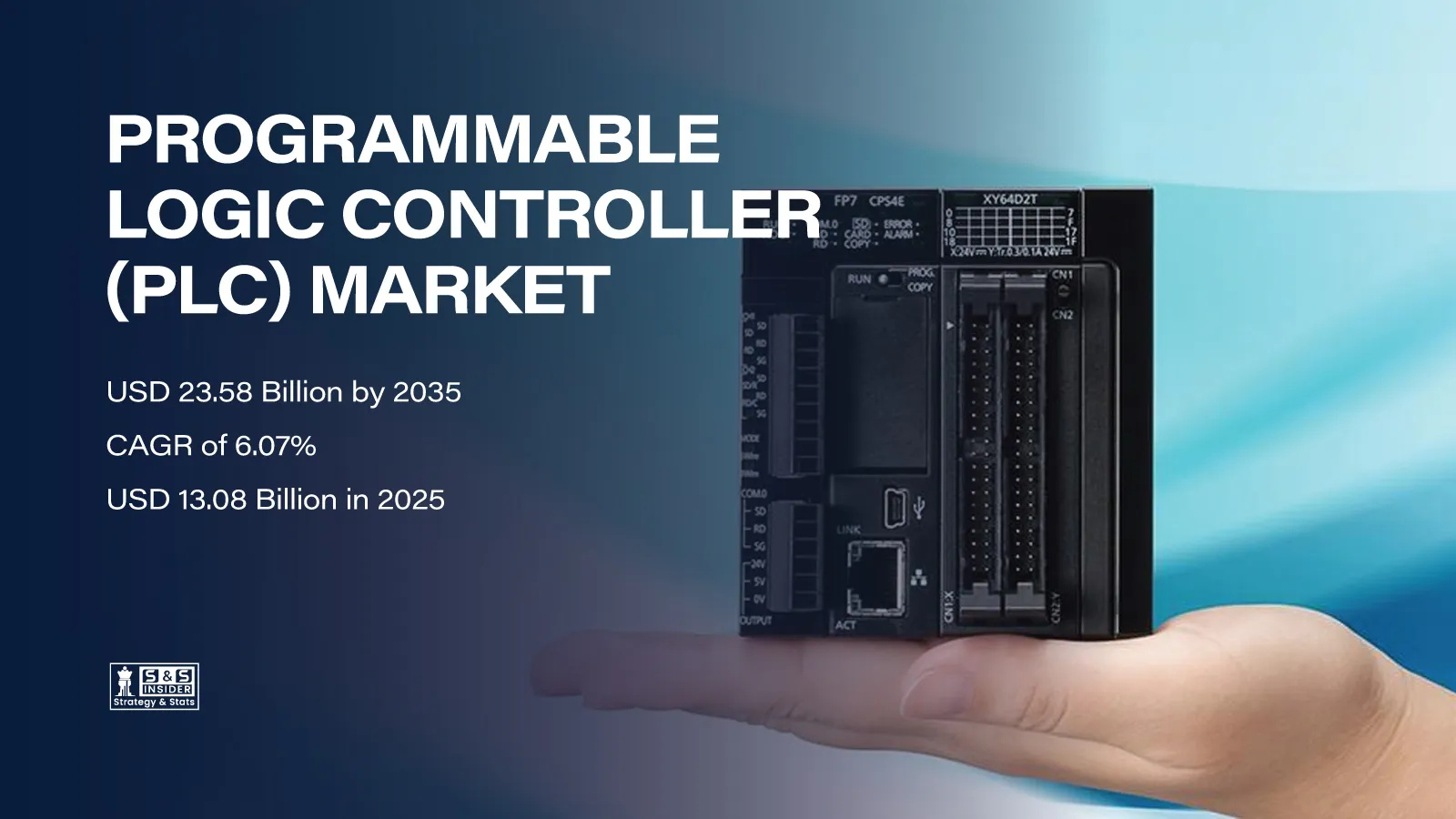
Market Size and Forecast
|
Market Indicator |
Value |
|
Market Size, 2025 |
USD 13.08 Billion |
|
Market Size, 2026 |
USD 13.87 Billion |
|
Market Forecast, 2035 |
USD 23.58 Billion |
|
CAGR, 2026–2035 |
6.07% |
|
Leading Region, 2025 |
Asia Pacific (38.46%) |
|
Fastest-Growing Region |
Asia Pacific (7.79% CAGR) |
Demand Drivers and Constraints
Primary Demand Drivers
-
Factory automation and replacement cycles: Plants are replacing old controllers with connected, secure models as they modernize their lines.
-
Robotics growth: About 542,000 industrial robots were installed in 2024 and each robot cell needs controllers to coordinate motion and safety.
-
Cybersecurity regulation: Rules such as the EU Cyber Resilience Act push buyers toward controllers with built-in security features.
-
Strong shipments in Asia: Japan's programmable controller shipments rose 11.90% year over year in July 2026, which points to firm regional demand.
-
Growth of services: Plants that lack automation staff rely more on supplier support for upgrades, monitoring and training.
Potential Growth Constraints
-
Cyber risk to PLCs connected to the internet.
-
Weak machinery demand in some regions, including Europe.
-
Tariffs and rising component costs.
-
Competition from software-based controllers on industrial PCs and edge devices.
-
Price pressure from lower-cost local brands in Asia.
Demand Structure by Type
Modular PLCs (2025 Market Share: 43.27%)
Modular PLCs held 43.27% of the global market in 2025. Plants choose them because they can add input, output and communication modules as production lines expand. This makes them a good fit for large systems in automotive, food and process plants, where needs change over time. Users can also replace a single failed module rather than the whole unit, which reduces downtime. Through 2035, line upgrades and plant expansions are expected to keep modular controllers at the center of factory automation.
Current trend: Upgrades of existing modular systems to connected, secure controller platforms.
Major trends: Expandable I/O, high-speed communication modules, built-in security and remote diagnostics.
Compact PLCs (Forecast CAGR: 7.84%)
Compact PLCs are projected to grow at a CAGR of 7.84% during 2026–2035. These controllers pack processing, I/O and communication into one small unit, so they suit packaging machines, conveyors and building systems. Machine builders like them because they are easy to install and cost less per machine. Newer compact models now offer features that once came only with larger controllers, such as motion control and network connectivity. This narrows the gap between product classes and widens the range of uses.
Current trend: Wider use of compact controllers in standard machines and small production cells.
Major trends: Integrated motion control, Ethernet connectivity, smaller footprints and simple programming tools.
Demand Structure by Component
Hardware (2025 Market Share: 58.62%)
Hardware accounted for 58.62% of the market in 2025. Processors, I/O modules, power supplies and communication cards make up the physical base of every control system and each new line or retrofit needs them. Replacement demand is steady because older controllers reach the end of support and spare parts become hard to find. Suppliers are also adding security chips and faster processors to new hardware, which raises the value of each unit sold.
Current trend: Steady replacement of end-of-life controllers with current hardware platforms.
Major trends: Secure processors, faster I/O, modular power supplies and integrated safety hardware.
Services (Forecast CAGR: 8.76%)
Services are expected to grow at a CAGR of 8.76% through 2035. Many plants run controllers that are decades old and moving to new platforms requires careful planning, code conversion and testing. Shortages of skilled automation engineers lead plants to rely on suppliers and system integrators for this work. Remote monitoring and support contracts are also gaining ground because they help plants find faults early and avoid unplanned stops.
Current trend: Rising demand for migration projects and remote support contracts.
Major trends: Legacy system migration, remote monitoring, lifecycle service contracts and operator training.
Demand Structure by Size
Small PLCs (2025 Market Share: 29.34%)
Small PLCs held 29.34% of the market in 2025, which made them the largest size category. They control single machines and small process units across many industries, from packaging to water treatment. Their balance of cost, capacity and ease of use makes them the default choice for many machine builders. Steady growth in standard machinery keeps demand for this size class high.
Current trend: Broad use of small controllers in standard machines across many industries.
Major trends: Built-in networking, web-based setup, simple programming and lower cost per point.
Nano PLCs (Forecast CAGR: 8.43%)
Nano PLCs are projected to grow at a CAGR of 8.43% during 2026–2035. These very small controllers handle simple tasks such as pump control, lighting and small conveyors, often replacing relays and timers. Low prices and easy setup make them attractive to small businesses and equipment makers. As more simple equipment becomes connected, demand for nano controllers with basic networking is expected to rise.
Current trend: Replacement of relay-based control with low-cost nano controllers.
Major trends: Relay replacement, app-based setup, basic connectivity and very small form factors.
Demand Structure by Industry
Automotive (2025 Market Share: 19.64%)
Automotive accounted for 19.64% of the market in 2025, which made it the largest end-use industry. Car plants use thousands of controllers in body shops, paint lines, assembly and testing and each robot cell needs coordinated control. Plant retooling for electric vehicles and battery production adds new controller demand. Carmakers also want controllers that collect production data to improve quality and output.
Current trend: Controller upgrades tied to electric vehicle and battery line retooling.
Major trends: Robot cell control, integrated safety, production data collection and flexible lines.
Pharmaceuticals (Forecast CAGR: 8.19%)
Pharmaceuticals are expected to grow at a CAGR of 8.19% through 2035. Drug makers need precise control of mixing, filling and packaging, along with complete records for regulators. Controllers that support data integrity, audit trails and validated software are in strong demand. New biologics plants and the shift toward continuous manufacturing further raise the need for reliable process control.
Current trend: Investment in automated, traceable production for biologics and sterile products.
Major trends: Data integrity features, batch control, continuous manufacturing and validated control software.
Key Market Participants
The programmable logic controller market includes global automation groups, specialist controller makers and regional suppliers.
Key participants include Siemens AG, Rockwell Automation, Inc., Mitsubishi Electric Corporation, Schneider Electric SE, Omron Corporation, Emerson Electric Co., Beckhoff Automation GmbH & Co. KG, Phoenix Contact GmbH & Co. KG, WAGO GmbH & Co. KG, Delta Electronics, Inc., Fuji Electric Co., Ltd., Yokogawa Electric Corporation, ABB Ltd, Keyence Corporation, Panasonic Holdings Corporation, Hitachi, Ltd., LS Electric Co., Ltd., IDEC Corporation, Bosch Rexroth AG and Yaskawa Electric Corporation.
Competition now centers on security, software and ease of migration. Recent launches show this focus. Siemens introduced the SIMATIC S7-1200 G2, Phoenix Contact released Virtual PLCnext Control and Rockwell Automation launched the CompactLogix 5390. Suppliers that pair reliable hardware with strong software and service support are well placed to win new projects.
Regional Market Dynamics
Asia Pacific (2025 Market Share: 38.46%)
Asia Pacific led the global market with a 38.46% share in 2025 and it is also the fastest-growing region, with a CAGR of 7.79% through 2035. China is the largest market, supported by its large electronics, automotive and machinery industries. Japan, South Korea and India follow, with Japan reporting strong controller shipments in 2026. New factories in India and Southeast Asia, along with robot adoption across the region, add steady demand. Lower-cost local brands are also widening access for smaller manufacturers.
Direction: Continued regional leadership and the fastest growth, supported by new factories and wider robot use.
North America (2025 Market Share: 25.14%)
North America held a 25.14% share in 2025. The United States leads the region, with a market value of USD 2.83 Billion in 2025 and a projected CAGR of 6.38%. Investment in new plants for semiconductors, batteries and electric vehicles is adding controller demand. Many existing plants are also replacing old controllers to improve security and connect to plant-wide data systems.
Direction: Steady growth supported by new manufacturing investment and controller modernization.
Europe (2025 Market Share: 22.37%)
Europe accounted for 22.37% of the market in 2025. Germany, Italy and France are the largest country markets, backed by strong machine-building and automotive industries. The EU Cyber Resilience Act is pushing buyers and suppliers toward controllers with documented security features. Weak machinery orders in some countries are slowing near-term demand, but security upgrades and energy-efficiency projects continue.
Direction: Moderate growth driven by security rules and plant modernization, despite softer machinery demand.
Middle East & Africa (2025 Market Share: 6.91%)
The Middle East and Africa held a 6.91% share in 2025. Saudi Arabia, the UAE, Qatar and South Africa lead regional demand. Oil and gas, water treatment and utility projects are the main users of controllers. National industrial programs in the Gulf states are also adding new manufacturing capacity, which brings further demand for automation.
Direction: Gradual growth supported by energy, water and industrial diversification projects.
Latin America (2025 Market Share: 7.12%)
Latin America accounted for 7.12% of the market in 2025. Brazil and Mexico are the leading markets, followed by Argentina and Colombia. Mexico benefits from automotive and electronics plants serving North American buyers, while Brazil's demand comes from food, mining and process industries. Currency swings and budget limits lead many buyers to choose cost-efficient controllers and phased upgrades.
Direction: Gradual growth supported by nearshoring in Mexico and process-industry demand in Brazil.
Market Outlook (2026–2035)
The global programmable logic controller market is forecast to reach USD 23.58 Billion by 2035, which reflects steady investment in factory automation.
Controller replacement, robot adoption and cybersecurity rules will remain the main drivers of growth. Compact and nano controllers are expected to gain share in simple and mid-sized machines.
Services, software-defined controllers and certified secure products will create new revenue streams beyond hardware sales.
Asia Pacific will remain the largest and fastest-growing region. North America and Europe will rely on modernization of existing plants.
Overall, the programmable logic controller market is set for steady growth through 2035. Success will depend more and more on controller security, software capability, migration support and lifecycle services.



