
According to the latest SNS Insider Ultra Capacitors Market report, the global market is growing quickly. Vehicle makers, grid operators, data center owners and equipment builders all need power that can be delivered and stored in seconds. Ultra capacitors fill this role because they charge fast, last for many cycles and handle sudden changes in load.
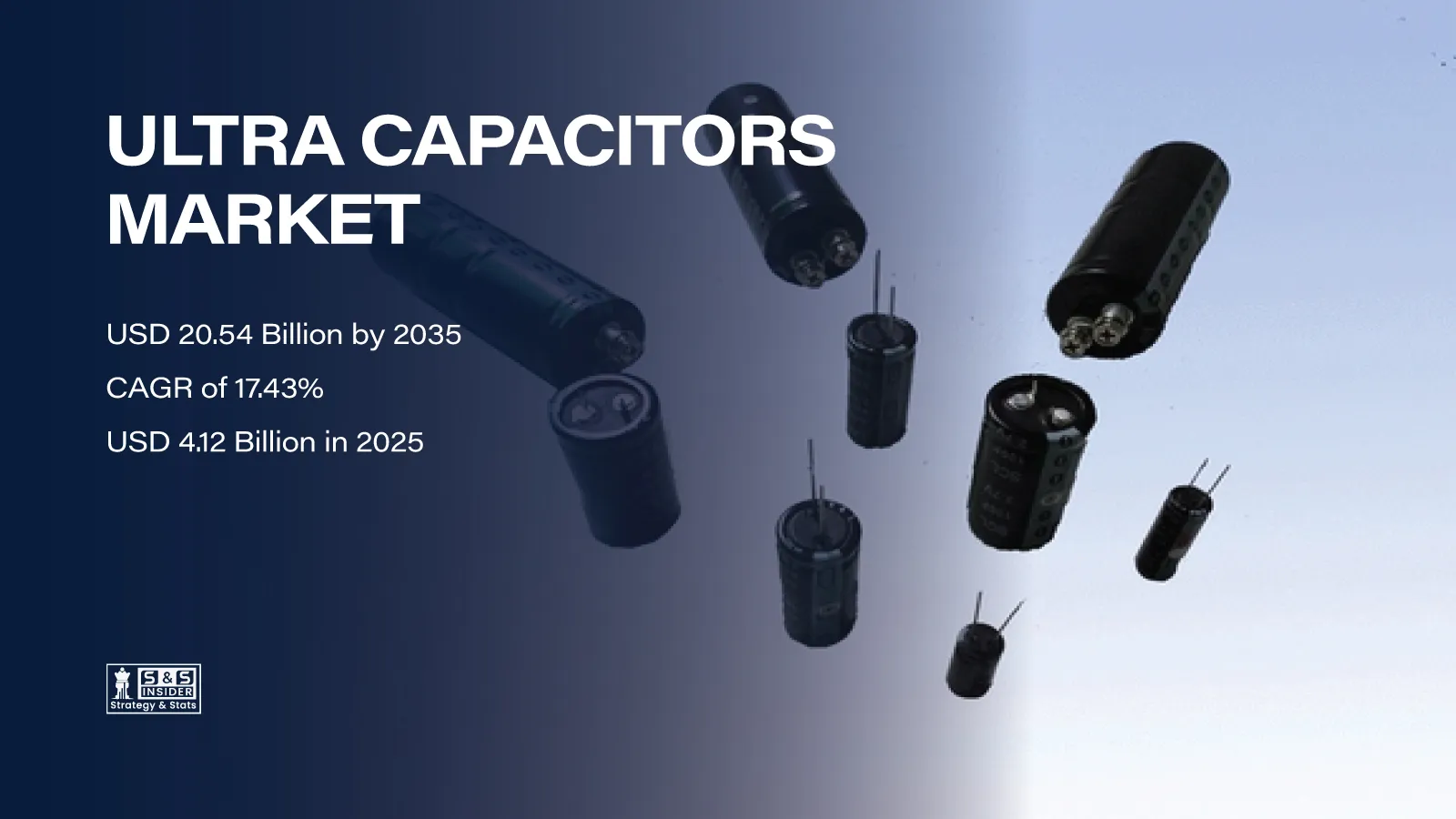
The global ultra capacitors market was valued at USD 4.12 Billion in 2025 and is estimated at USD 4.84 Billion in 2026. It is projected to reach USD 20.54 Billion by 2035, growing at a CAGR of 17.43% during 2026–2035.
Electric buses, trucks, rail systems and heavy machinery use ultra capacitors to capture braking energy and support peak power. As a result, transport remains the largest source of demand.
Data centers and telecom networks are the fastest growing users. Operators need short-term backup that protects servers from power swings. New electrode materials, such as graphene and hybrid cell designs are also improving energy storage per unit.
Asia Pacific is the largest market and is also growing the fastest, supported by strong manufacturing and electric vehicle production in China.
Market Size and Forecast
|
Market Indicator |
Value |
|
Market Size, 2025 |
USD 4.12 Billion |
|
Market Size, 2026 |
USD 4.84 Billion |
|
Market Forecast, 2035 |
USD 20.54 Billion |
|
CAGR, 2026–2035 |
17.43% |
|
Leading Region, 2025 |
Asia Pacific (43.62%) |
|
Fastest-Growing Region |
Asia Pacific (19.17% CAGR) |
Demand Drivers and Constraints
Primary Demand Drivers
-
Electrification of transport and heavy equipment: Electric vehicles, buses, rail systems and machinery use ultra capacitors to recover braking energy and to deliver power during acceleration.
-
Power fluctuation management in data centers: Operators install ultra capacitors to absorb sudden load changes and to bridge short power gaps.
-
Grid stabilization and renewable integration: Utilities use fast-response storage to smooth the variable output of wind and solar plants.
-
Advances in graphene and hybrid electrodes: New materials raise energy density, which makes ultra capacitors useful in more applications.
-
Backup power in electronics and industry: Factories and electronic devices rely on ultra capacitors to keep memory and controls running during brief outages.
Potential Growth Constraints
-
Lower energy density than batteries.
-
High cost per unit of stored energy.
-
Competition from advanced battery technologies.
-
Supply chain and electrolyte limits.
Demand Structure by Type
Electric Double Layer Capacitors (2025 Market Share: 63.42%)
Electric double layer capacitors held 63.42% of the global ultra capacitors market in 2025. These cells store charge on the surface of carbon electrodes, which gives them very long cycle life and fast response. Their design is mature and manufacturers can produce them at scale with steady quality. Vehicle makers, grid operators and industrial users trust them for repeated, high-power duty. As electrification spreads through 2035, demand for these cells is expected to stay strong.
Current trend: Wider use of double layer cells in transport and grid support systems.
Major trends: High-voltage modules, longer cycle life, lower internal resistance and larger production lines.
Hybrid Capacitors (Forecast CAGR: 21.86%)
Hybrid capacitors are projected to grow at a CAGR of 21.86% during 2026–2035, the fastest rate among types. They combine one capacitor-type electrode with one battery-type electrode, so they store more energy while keeping fast charging. This balance suits uses that need both quick power and longer run time, such as data center backup and electric vehicles. As costs fall, more buyers are expected to choose hybrid cells over pure capacitor designs.
Current trend: Rising adoption of hybrid cells where both power and energy matter.
Major trends: Lithium-ion capacitors, higher energy density, compact cell formats and data center backup modules.
Demand Structure by Electrode Material
Activated Carbon (2025 Market Share: 71.35%)
Activated carbon accounted for 71.35% of the market in 2025. The material has a large surface area, is widely available and costs less than newer options. Most commercial cells use it because its performance is well proven over many years. Suppliers have also improved purity and pore structure, which raises capacitance without changing the basic process. Activated carbon is expected to remain the standard electrode material in high-volume production.
Current trend: Steady improvement of carbon quality for higher capacitance.
Major trends: Engineered pore structures, low-impurity carbon, cost reduction and regional material sourcing.
Graphene (Forecast CAGR: 24.31%)
Graphene is forecast to expand at a CAGR of 24.31% through 2035. The material conducts electricity very well and offers a high surface area, which can lift both power and energy density. Developers are using curved and layered graphene to build cells that come closer to battery-level storage. Production costs are still high, but scale-up is reducing them. As these costs fall, graphene is expected to move from premium products into broader use.
Current trend: Growing commercial use of graphene-based electrodes.
Major trends: Curved graphene, composite electrodes, scaled production and high-energy cell designs.
Demand Structure by Application
Automotive and Transportation (2025 Market Share: 36.52%)
Automotive and transportation represented 36.52% of the market in 2025. Electric buses, trucks, trams and trains use ultra capacitors to store braking energy and to release it during acceleration. The cells also support start-stop systems and protect batteries from sharp power peaks, which extends battery life. Heavy equipment such as port cranes and mining vehicles uses them for the same reason. Growing fleets of electric vehicles are expected to keep this application in the lead.
Current trend: Increasing use of ultra capacitors in electric buses, rail and heavy vehicles.
Major trends: Regenerative braking, battery support modules, start-stop systems and high-voltage vehicle packs.
Data Centers and Telecom (Forecast CAGR: 26.74%)
Data centers and telecom are expected to grow at a CAGR of 26.74% during 2026–2035. Computing loads, especially for artificial intelligence workloads, can change sharply within milliseconds. Ultra capacitors absorb these swings and provide short backup until generators or batteries take over. Telecom operators also use them to protect remote sites from brief outages. As data center capacity expands, demand for fast and reliable backup power is expected to rise quickly.
Current trend: Rapid adoption of ultra capacitors for server power stability.
Major trends: Rack-level backup, load smoothing, uninterruptible power supply support and telecom site protection.
Demand Structure by Capacitance
100 F to 1,000 F (2025 Market Share: 41.67%)
The 100 F to 1,000 F range held 41.67% of the market in 2025. Cells in this range balance size, cost and power, so they suit many industrial, automotive and electronics uses. Designers often combine them into modules to reach the voltage a system needs. Their wide use across sectors gives manufacturers steady, high-volume demand. This range is expected to remain the most common choice for general applications.
Current trend: Broad use of mid-range cells in industrial and vehicle systems.
Major trends: Standard cell formats, module integration, compact designs and cost control.
Above 1,000 F (Forecast CAGR: 22.58%)
Cells above 1,000 F are forecast to grow at a CAGR of 22.58% through 2035. Large-capacity cells are needed for grid storage, heavy transport and data center backup, where systems must deliver large amounts of power. Using bigger cells reduces the number of units in each module, which simplifies design and maintenance. As high-power projects grow, demand for these cells is expected to rise sharply.
Current trend: Rising demand for large cells in grid and heavy-duty systems.
Major trends: High-capacity cells, grid storage modules, heavy vehicle packs and simpler system design.
Key Market Participants
The ultra capacitors market includes specialist cell makers, diversified electronics companies and power management suppliers.
Key participants include Skeleton Technologies, Eaton, KYOCERA AVX, Vinatech, Musashi Energy Solutions, CAP-XX and Panasonic Industry.
Competition centers on energy density, cycle life, cost per cell and the ability to supply complete modules. Suppliers that can scale production and serve fast-growing uses, such as data centers and electric transport, are well placed for growth.
Regional Market Dynamics
Asia Pacific (2025 Market Share: 43.62%; Forecast CAGR: 19.17%)
Asia Pacific led the global ultra capacitors market with a 43.62% share in 2025 and is expected to grow fastest at a CAGR of 19.17%. China accounts for 52.04% of regional demand, supported by large electric vehicle production, rail projects and an extensive electronics supply chain. South Korea and Japan add demand through advanced cell makers and automotive suppliers. New data centers and renewable energy projects across the region are also increasing purchases.
Direction: Continued leadership and fastest growth, supported by manufacturing strength and electrification.
North America (2025 Market Share: 23.48%)
North America held 23.48% of the market in 2025. The United States accounts for 81.37% of regional demand, with a market value of USD 787.15 Million in 2025 and a projected CAGR of 16.05%. Growth comes from data center expansion, grid modernization and electric transport programs. New investment in local manufacturing is also expected to strengthen regional supply.
Direction: Steady growth driven by data center power needs and domestic production.
Europe (2025 Market Share: 19.07%)
Europe held 19.07% of the market in 2025. Germany leads the region with 24.18% of regional demand, supported by its automotive and industrial equipment base. Renewable energy targets increase the need for grid support, while electric buses and rail systems add transport demand. European cell makers are also expanding production capacity to serve local buyers.
Direction: Stable expansion supported by renewable integration and electric mobility.
Middle East & Africa (2025 Market Share: 6.62%)
The Middle East and Africa held 6.62% of the market in 2025. Saudi Arabia leads with 31.45% of regional demand, driven by large energy, infrastructure and renewable projects. Utilities in the region are adding solar capacity, which creates a need for fast-response storage. Elsewhere, adoption is slower because of budget limits and smaller industrial bases.
Direction: Emerging opportunities tied to renewable energy and infrastructure investment.
Latin America (2025 Market Share: 7.21%)
Latin America held 7.21% of the market in 2025. Brazil leads with 46.12% of regional demand, supported by public transport, industry and renewable power projects. Mexico benefits from automotive manufacturing linked to North American supply chains. Cost pressures remain, so buyers often choose proven, lower-cost cell designs.
Direction: Gradual growth supported by transport, industry and clean energy projects.
Market Outlook (2026–2035)
The global ultra capacitors market is forecast to reach USD 20.54 Billion by 2035, reflecting strong investment in electrification and power stability.
Transport electrification, data center growth and grid stabilization will remain the main growth drivers. Hybrid capacitors and graphene electrodes will gain ground as they close the energy gap with batteries.
Rising demand from data centers and telecom will broaden the market beyond its traditional base in vehicles and industry.
Growth will vary by region. Asia Pacific is expected to hold both the largest share and the fastest growth, while North America and Europe expand steadily.
Overall, the ultra capacitors market is set for strong expansion through 2035, with success increasingly determined by energy density, production scale, cost control and the ability to serve fast-growing power applications.



