
According to the latest SNS Insider Artificial Intelligence in Genomics Market report, AI is becoming a standard tool for reading and using genomic data. Sequencing now costs far less than it did a decade ago, so labs produce more data than people can review by hand. AI tools help researchers and clinicians find useful results in that data faster.
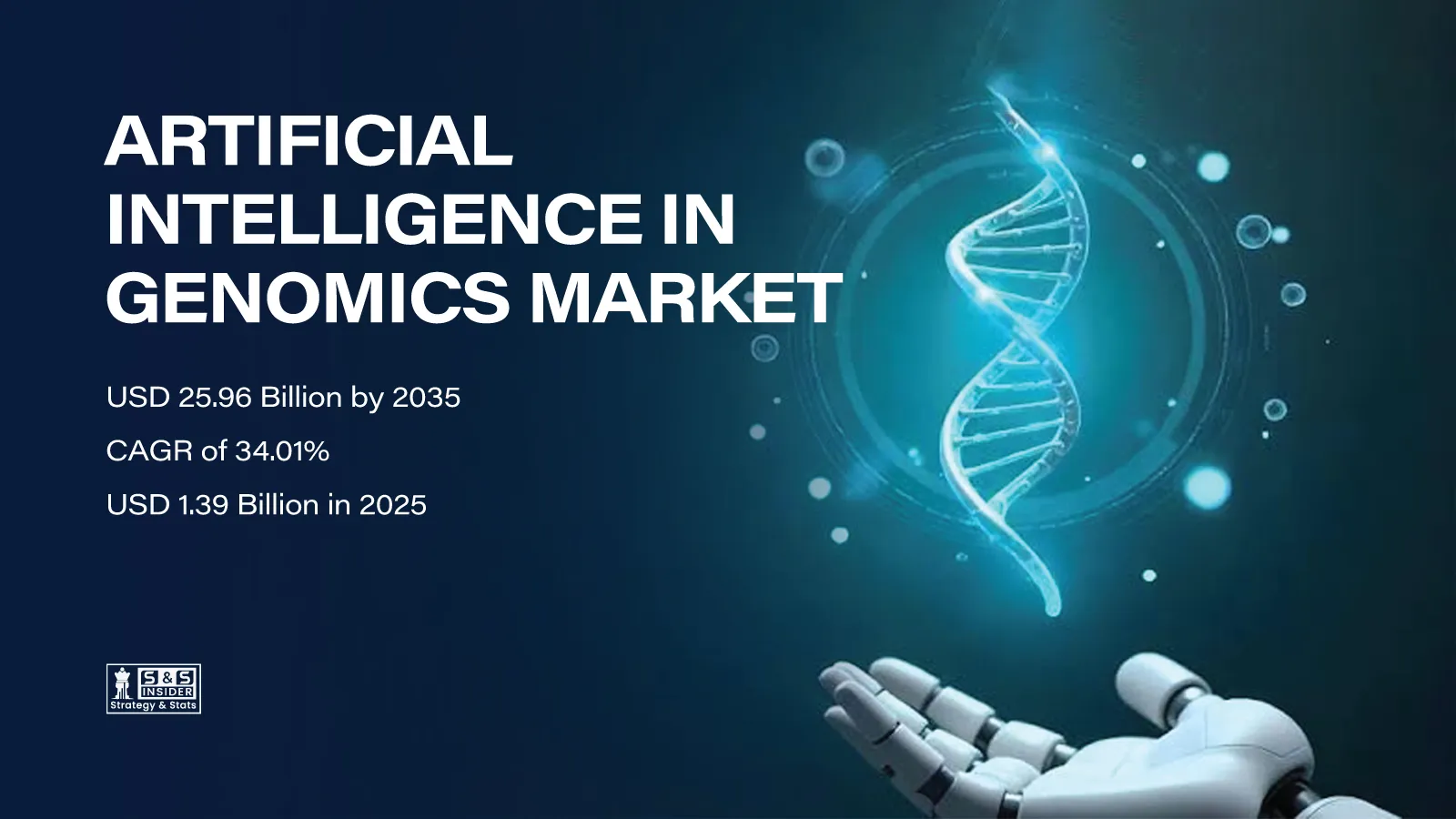
The global artificial intelligence in genomics market was valued at USD 1.39 Billion in 2025. It is estimated at USD 1.86 Billion in 2026 and is projected to reach USD 25.96 Billion by 2035, growing at a CAGR of 34.01% from 2026 to 2035.
Software holds the largest share of spending today, as labs and drug developers license analysis platforms. Services are growing faster, because many organizations lack the staff to build and run AI models on their own.
Drug discovery is the largest application, while precision medicine is growing fastest as genomic testing moves into routine cancer and rare disease care. National genomics programs are also adding large new datasets for AI tools to use.
North America is the largest regional market. Asia Pacific is growing fastest as countries in the region expand sequencing capacity and population genomics projects.
Market Size and Forecast
|
Market Indicator |
Value |
|
Market Size, 2025 |
USD 1.39 Billion |
|
Market Size, 2026 |
USD 1.86 Billion |
|
Market Forecast, 2035 |
USD 25.96 Billion |
|
CAGR, 2026–2035 |
34.01% |
|
Leading Region, 2025 |
North America (39.56%) |
|
Fastest-Growing Region |
Asia Pacific (37.89% CAGR) |
Demand Drivers and Constraints
Primary Demand Drivers
-
Lower sequencing costs: Cheaper sequencing produces more genomic data and AI is needed to analyze it at scale.
-
Population genomics programs: National projects create large, well-organized datasets that support new AI tools.
-
Genomic foundation models: Large models trained on DNA and cell data are moving from research into daily use.
-
Drug discovery partnerships: Drug developers sign AI platform deals to find new drug targets faster.
-
Precision oncology and rare disease testing: Doctors use AI to read complex test results and reach a diagnosis sooner.
Potential Growth Constraints
-
Training data that underrepresents many ancestry groups.
-
Privacy and data sovereignty rules that limit data sharing.
-
Slow clinical validation and uncertain reimbursement.
-
Too few trained clinical bioinformatics staff.
-
Rising computing and data storage costs.
Demand Structure by Component
Software (2025 Market Share: 41.55%)
Software accounted for 41.55% of the market in 2025. Labs, hospitals and drug developers buy platforms that align sequence reads, call variants and rank their clinical meaning. These tools save time, because they replace steps that once needed several specialists. Many platforms now run in the cloud, which lets smaller labs use them without large hardware purchases. Vendors also add new AI models to existing products through regular updates. This keeps software the main area of spending as test volumes grow.
Current trend: Labs are moving variant analysis to cloud-based AI platforms.
Major trends: Variant interpretation software, cloud analysis tools, built-in reporting and regular model updates.
Services (Forecast CAGR: 35.63%)
Services are projected to grow at a CAGR of 35.63% from 2026 to 2035. Many hospitals and smaller biotech firms do not have staff who can build, test and manage AI models. They hire outside partners for data analysis, model setup and validation work. Drug developers also contract service firms to run large genomic studies for them. As more organizations use AI without building in-house teams, demand for these services will keep rising.
Current trend: More organizations are outsourcing genomic data analysis and model validation.
Major trends: Managed analysis services, model validation support, consulting and contract research partnerships.
Demand Structure by Technology
Machine Learning (2025 Market Share: 63.43%)
Machine learning held 63.43% of the market in 2025. It is the main method used to find patterns in genomic data, such as variants linked to disease or drug response. Deep learning models now help predict how genetic changes affect protein function. These methods are well tested and widely understood by researchers. They also fit easily into current lab workflows. This broad use keeps machine learning at the center of AI in genomics.
Current trend: Deep learning models are being used more often to predict the effects of variants.
Major trends: Deep learning, genomic foundation models, variant effect prediction and multi-omics analysis.
Natural Language Processing (Forecast CAGR: 35.94%)
Natural language processing is expected to grow at a CAGR of 35.94% through 2035. Much useful genomic knowledge sits in research papers, clinical notes and test reports written in plain text. NLP tools read this text and link it to genetic findings. This helps clinicians match a patient’s variants with published evidence. Language models are also used to draft test reports. As these tools improve, more labs will use them to speed up interpretation.
Current trend: Labs are using language models to search the literature and draft reports.
Major trends: Literature mining, clinical note analysis, automated report writing and evidence matching.
Demand Structure by Functionality
Genome Sequencing (2025 Market Share: 44.36%)
Genome sequencing represented 44.36% of the market in 2025. AI is used at every step of sequencing, from improving base calling to finding and ranking variants. Lower sequencing costs have raised the number of genomes processed each year. Each new genome adds data that must be checked and interpreted. Large national programs and clinical labs run very high test volumes. This makes sequencing the largest use of AI in genomics.
Current trend: Sequencing providers are building AI directly into their analysis software.
Major trends: AI-based base calling, faster variant calling, whole-genome testing and cloud analysis pipelines.
Gene Editing (Forecast CAGR: 34.31%)
Gene editing is projected to grow at a CAGR of 34.31% from 2026 to 2035. Researchers use AI to design guide sequences and predict where edits may cause unwanted changes. These predictions cut the number of lab experiments needed. Gene therapy developers rely on this work to improve safety before clinical trials. More gene-editing therapies are now in development. As a result, demand for AI design and safety tools will keep growing.
Current trend: Developers are using AI to predict off-target effects before lab testing.
Major trends: Guide design tools, off-target prediction, editing outcome models and therapy design platforms.
Demand Structure by Application
Drug Discovery and Development (2025 Market Share: 33.99%)
Drug discovery and development accounted for 33.99% of the market in 2025. Drug developers use genomic AI to find disease targets and to choose patients who are likely to respond to treatment. This can lower the cost of failed trials, which is one of the largest costs in drug development. Many large drug companies have signed multi-year deals with AI platform providers. They also fund large cell and genome datasets. This steady investment keeps drug discovery the largest application.
Current trend: Drug developers are signing long-term deals for AI target discovery.
Major trends: Target identification, patient selection, companion diagnostics and large cell atlases.
Precision Medicine (Forecast CAGR: 36.45%)
Precision medicine is expected to grow at a CAGR of 36.45% through 2035. Genomic testing is becoming part of routine care for cancer and rare diseases. AI helps doctors read complex test results and choose treatments based on a patient’s genes. Faster results can shorten the time to a diagnosis for patients with rare conditions. Clearer rules on evidence for AI tools are also helping hospitals adopt them. These changes make precision medicine the fastest-growing application.
Current trend: Hospitals are adding AI tools to cancer and rare disease testing.
Major trends: Tumor profiling, rare disease diagnosis, treatment matching and clinical decision support.
Demand Structure by End User
Pharma and Biotech Companies (2025 Market Share: 38.22%)
Pharma and biotech companies accounted for 38.22% of the market in 2025. They are the largest buyers of genomic AI because they use it across research, trials and diagnostics. These companies have the budgets to license platforms and fund large studies. They also partner with AI firms to build companion diagnostics for new drugs. Their work often spans many countries and large datasets. This keeps them the leading end-user group.
Current trend: Drug developers are expanding AI use from research into clinical trials.
Major trends: AI partnerships, trial patient selection, companion diagnostics and shared data platforms.
Clinical Labs and Diagnostic Centers (Forecast CAGR: 35.17%)
Clinical labs and diagnostic centers are projected to grow at a CAGR of 35.17% from 2026 to 2035. Test volumes are rising as more doctors order genomic tests. Labs use AI to interpret variants faster and to handle more cases with the same staff. This matters because skilled genetic analysts are hard to hire. Lab software providers are also merging, which gives labs access to broader tools. These factors make labs the fastest-growing end-user group.
Current trend: Labs are using AI interpretation to manage higher test volumes.
Major trends: Automated variant review, lab network platforms, faster reporting and decision support tools.
Key Market Participants
The AI in genomics market includes sequencing companies, genomic analysis software providers, clinical testing firms and AI drug discovery companies.
Key participants include Tempus AI, QIAGEN, Illumina, SOPHiA GENETICS, GeneDx, SeqOne, Lifebit and BenevolentAI.
Competition centers on data quality, model accuracy and clinical proof. Many companies are growing through acquisitions and drug company partnerships, because buyers want tested tools that fit into their current lab and research work.
Regional Market Dynamics
North America (2025 Market Share: 39.56%)
North America led the market with a 39.56% share in 2025. The United States accounts for most regional demand. It has large sequencing companies, many cancer centers and strong funding for drug research. The U.S. market was valued at USD 485.93 Million in 2025 and is projected to grow at a CAGR of 34.63%. Many leading AI genomics firms are based in the country. Canada adds demand through research hospitals and public genomics projects.
Direction: The region will stay the largest market, supported by research funding and clinical adoption.
Europe
Europe is a major market for AI in genomics. Germany leads the region, supported by strong research institutes and a large diagnostics sector. The United Kingdom, France and the Nordic countries run national genomics programs that produce large datasets. Strict privacy rules shape how data is shared. As a result, many projects use secure platforms that analyze data without moving it across borders.
Direction: Steady growth, led by national programs and secure data analysis platforms.
Asia Pacific (Forecast CAGR: 37.89%)
Asia Pacific is the fastest-growing region, with a CAGR of 37.89% through 2035. China leads the region, supported by large sequencing capacity and national investment in genomics. Japan and South Korea add demand through advanced hospitals and cancer research. India and Australia are expanding population genomics projects. Lower sequencing costs and growing research budgets are bringing AI tools to more labs across the region.
Direction: The region will add the most new demand through 2035.
Middle East & Africa
The Middle East and Africa market is smaller but growing. Saudi Arabia leads the region through national genome programs aimed at inherited diseases. The United Arab Emirates and Qatar also fund population genomics projects. In Africa, research groups are adding sequencing capacity, though funding and skilled staff remain limited. These programs are creating new datasets that can help reduce ancestry gaps in AI models.
Direction: Gradual growth, led by government genome programs.
Latin America
Latin America is an emerging market for AI in genomics. Brazil is the largest country market, supported by research universities and growing private diagnostics companies. Mexico, Argentina and Chile are adding genomic testing in major cities. High costs and limited local sequencing capacity slow adoption. Cloud-based analysis tools give labs a practical way to use AI without large upfront spending.
Direction: Moderate growth, with cloud tools helping labs adopt AI at lower cost.
Market Outlook (2026–2035)
The global artificial intelligence in genomics market is forecast to reach USD 25.96 Billion by 2035, as AI becomes a routine part of genomic research and testing.
Lower sequencing costs, national genomics programs and drug discovery deals will remain the main growth drivers. Services will grow quickly as many organizations look for outside support.
Precision medicine and clinical labs will widen demand beyond research, as genomic testing becomes part of everyday care.
Growth will differ by region. North America will keep its lead, while Asia Pacific will add the most new demand.
Overall, the AI in genomics market will grow quickly through 2035 and suppliers that offer accurate models, proven clinical value and secure data handling will be best placed to win.



