
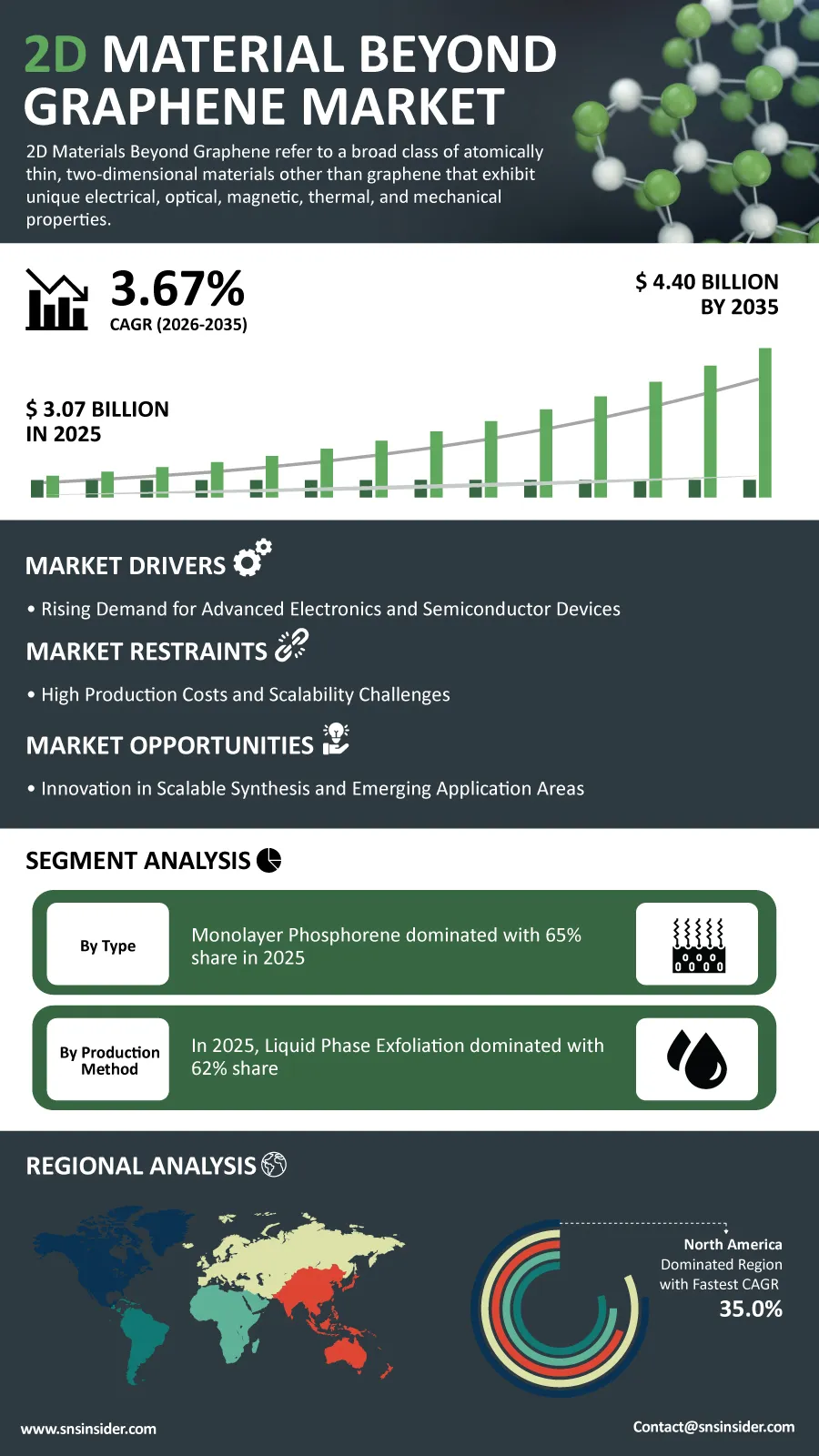
Demand for the advanced material required to enable faster, smaller and energy-efficient electronic devices is growing rapidly. Hence, the global 2D Material Beyond Graphene market is witnessing a rapid rise. “According to a recent study by SNS Insider, the global 2D Material Beyond Graphene Market size valued at USD 3.07 Billion in 2025, is anticipated to grow to USD 4.40 Billion by 2035, registering a CAGR of 3.67% over the 2026–2035 forecast period.”
An increased adoption rate of high-performance semiconductor materials has encouraged manufacturers to look into alternatives to graphene for applications which need improved electrical properties, flexibility, and tunability of electronic properties. Such materials as phosphorene, transition metal dichalcogenides, MXenes, and borophene have started gaining commercial attention in electronics, photonics, sensors, and energy storage.
A continuous development of artificial intelligence hardware, 5G infrastructure, wearable electronics, and advanced computing platforms has created new prospects for ultra-thin materials that will enable innovative device architectures. Furthermore, research organizations and technology companies have begun focusing on developing large-scale manufacturing processes for such materials.
To Get Detailed Insights on the 2D Material Beyond Graphene Market – Request a Sample Report
Semiconductor Innovation and Advanced Electronics Expand Commercial Opportunities
High investments in the production process of semiconductors and electronics are ensuring the establishment of favorable conditions for the widespread use of advanced 2D materials. Manufacturers of devices are demanding materials which would be able to operate at increased switching speeds, less energy usage, and flexibility because existing semiconductor technologies are approaching their physical performance limitations.
Rapid growth of flexible electronics, intelligent sensors, and optoelectronics devices will ensure good future perspectives for such materials. They require light-weight materials having high electrical conductivity and good mechanical characteristics. Advanced 2D materials become good prospects for their future commercial application.
Furthermore, there are new growth opportunities due to rising investments in technologies like batteries and renewable energy storage systems. The research is being conducted on 2D materials to develop future-generation batteries and supercapacitors that can offer faster charging and longer lifecycle.
Key Market Insights Highlight Evolving Technology Adoption
According to type, the revenue contribution of Monolayer Phosphorene was 65% in 2025 due to its high carrier mobility and increasing use in semiconductor electronics and optoelectronics applications. The Few-Layer Phosphorene segment will show the highest growth rate up to 2035 as there will be rising needs for better stability along with good electronic properties of phosphorene.
Considering production method, the revenue share of Liquid Phase Exfoliation was 62% in 2025 due to scalability and lower costs associated with material production in commercial scale. The Chemical Vapor Deposition (CVD) process is expected to demonstrate the highest growth rate because of better film quality and layer control enabling high-end semiconductors production.
As far as application is concerned, the revenue share of Electronics & Semiconductors segment in 2025 was 35%, driven by increasing demand for advanced transistors, flexible displays, and other photonics-based devices. Energy Storage Systems will be the fastest-growing segment because of the development of advanced batteries and supercapacitors.
Advanced Manufacturing Technologies Accelerate Market Transformation
Innovation is still a key driving force in the development of the 2D Material Beyond Graphene industry. There are still innovations in developing more efficient synthesis methods that increase the yield of manufacture, provide better material quality and improved environmental stability of 2D material for practical applications.
In addition, there are innovations in hybrid technologies of manufacture, wafer scale fabrication, and advanced deposition techniques suitable for the mass manufacture of semiconductors. It should decrease the cost of manufacture while increasing applicability in electronics, sensing, biomedical applications, and industry.
Also, the collaboration between universities, government institutions, and private technological firms speeds up commercialization through improving manufacturing technologies and the variety of applications.
North America Led the Market with 35% Revenue Share in 2025, While Asia Pacific to Expand at 6.90% CAGR Through 2035
North America represented around 35% of the total market revenue in 2025 due to its strong ecosystem of semiconductors, robust research infrastructure, and considerable investment in materials science. In addition, North America continues to be benefited from the close collaboration of technology companies, research institutions, and governmental organizations involved in next generation electronics.
Asia-Pacific is expected to lead in terms of growth at a CAGR of 6.90% up to 2035 owing to increasing production of semiconductors, growing production of electronics, and considerable investments in renewable energy materials in countries like China, Japan, South Korea, among others. Initiatives taken by the governments for advanced materials research are adding strength to the commercialization process.
Europe continues to grow steadily as a result of considerable investments in advanced manufacturing, automotive innovations, aerospace technologies, and research programs. On the other hand, Latin America and MEA are increasingly participating through investments in research facilities and modernization of industries and technologies.
Industry Participants Focus on Commercialization and Scalable Manufacturing
Market competition is growing fiercer since major players are making investments in advanced production methods, improvements in materials and their quality, as well as in commercialization initiatives aimed at increasing market penetration. Collaboration with semiconductor manufacturers and technologists plays an important role in broadening applications.
Key companies operating in the global 2D Material Beyond Graphene Market include ACS Material LLC, 2D Semiconductors Inc., American Elements, Nanochemazone, HQ Graphene BV, Manchester Nanomaterials, 6Carbon Technology, Taizhou Sunano Energy, Shandong Ruifeng Chemical, Mophos, Iris Light Technologies Inc., Inorganic Ventures, SAE, Accumet Materials Co., Mil-Spec Industries Corp., Nichia Corporation, STREM Chemicals, Noah Technologies, and Espicorp Inc.
An SNS Insider analyst Himanshu Sharma commented, “Growing investment in advanced semiconductor technologies, flexible electronics, and next-generation energy storage solutions continues to strengthen the commercial outlook for materials beyond graphene. Organizations advancing scalable production techniques, improving material stability, and expanding industrial partnerships are expected to play a leading role in shaping the future of the global 2D materials ecosystem.”
About the Author

Get in touch




