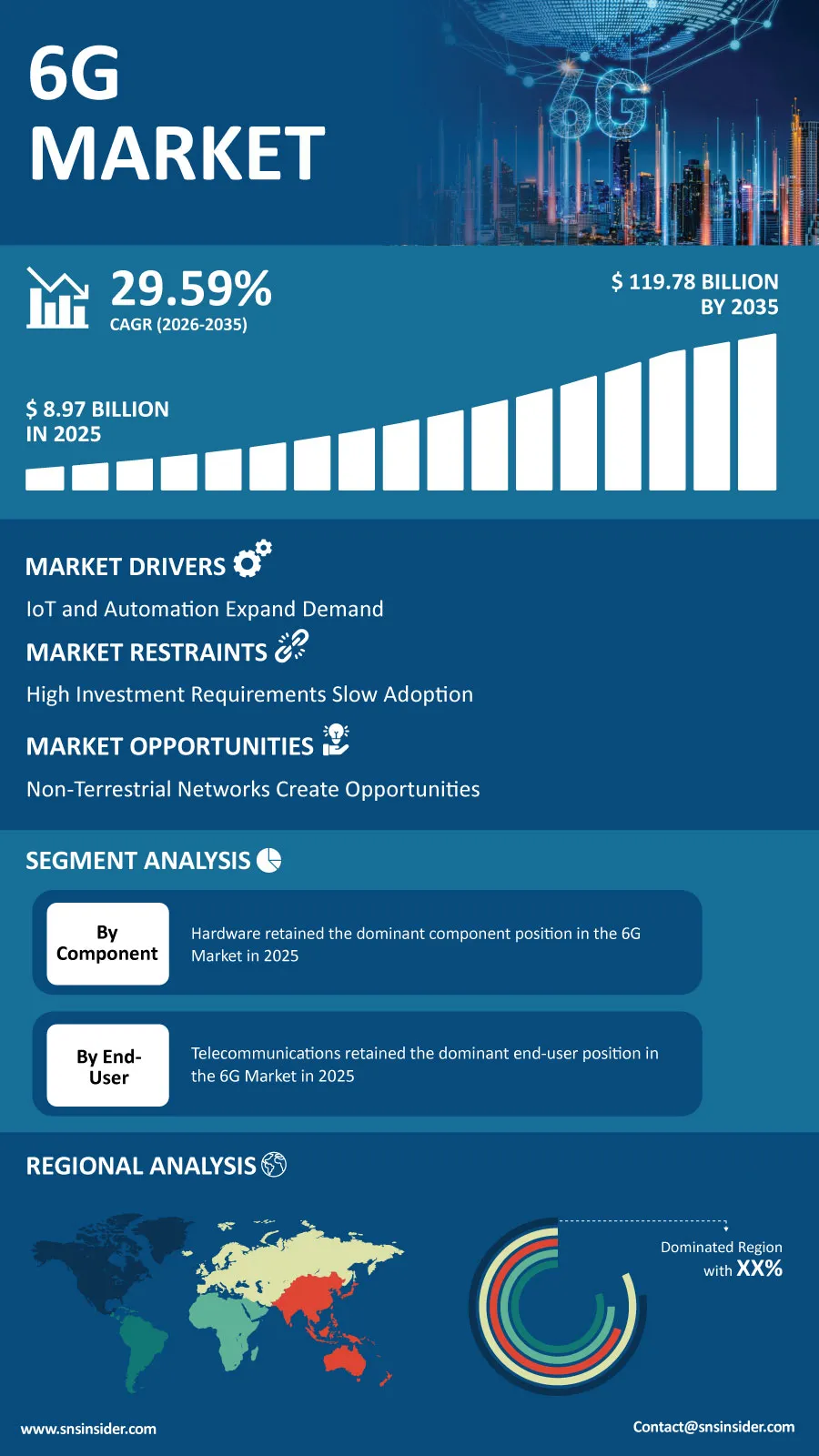
The global 6G Market is entering a transformative phase as governments, telecom operators, and technology companies intensify investments in next-generation wireless communications. According to a recent study by SNS Insider, the global 6G Market size valued at USD 8.97 billion in 2025, is anticipated to grow to USD 119.78 billion by 2035, registering a CAGR of 29.59% over the 2026–2035 forecast period.
The increasing need for faster connectivity, network automation, and smooth connection among countless connected devices has caused the growth of R&D and commercializing activities all over the world. Producers of various products are getting ready for the moment when progressive digital solutions, automated systems, and rich experiences will require communication capabilities.
The growing trend of either public or private investment is mainly due to a necessity to gain a leading position in the future telecommunications market. Research programs in advanced spectrum technologies, AI-native networking, and new semiconductor technologies act as a fundamental basis for commercializing 6G in the coming decade.
To Get Detailed Insights on the 6G Market – Request a Sample Report
AI-Native Networks and Advanced Connectivity Create New Growth Opportunities
The advancements in the digital economy have created a need for communication solutions capable of continuous decision-making, intelligent automatization, and flexible digital ecosystems. With the growing adoption of artificial intelligence, extended reality, and autonomous technologies, the need for sophisticated wireless infrastructure is predicted to rise dramatically.
The ongoing progress of terahertz communications, intelligent edge computing, and integrated satellites connectivity is creating chances for telecoms and equipment producers. These technologies are expected to offer high capacity, low latency level, and wider coverage; they will also enable the deployment of future technologies in the spheres of transport, medicine, industry, and smart city.
The ongoing work in the sphere of spectrum exploration, the development of cooperation on an international level, and expansion of telecommunications innovations are contributing to the long-term realization of projects in the major world economies.
Key Market Insights Highlight Shifting Demand Patterns
By component, hardware is expected to generate the largest share of global market revenue in 2025 as investments continue in advanced semiconductor technologies, antenna systems, prototype infrastructure, and network equipment. Software is projected to register the fastest growth through 2035 as AI-native architectures, virtualization, network orchestration, and intelligent automation become increasingly important across future wireless networks.
Based on communication type, wired communications are anticipated to account for approximately 43.4% of market revenue in 2025, reflecting ongoing investments in fiber infrastructure supporting advanced wireless research and dense network architectures. Wireless communications are forecast to experience the strongest growth during the forecast period as commercial deployment activities accelerate.
By network infrastructure, base stations are expected to maintain market leadership in 2025 due to continued investment in core wireless infrastructure and research platforms. Edge computing is projected to expand at the fastest pace through 2035 as organizations require ultra-low latency processing for autonomous mobility, industrial automation, digital twins, and immersive applications.
By end user, the telecommunications sector is anticipated to dominate market revenue in 2025 as network operators continue investing in next-generation communications infrastructure. Media and entertainment are expected to emerge as the fastest-growing end-user segment, driven by increasing demand for immersive XR experiences, holographic communication, and interactive digital content.
Emerging Digital Applications Continue to Accelerate Market Development
It is anticipated that the generation that follows will be able to implement technologies needing remarkably better network performance than the current one can offer. Applications like autonomous transport, collaborative robotics, digital twins, precision production, remote healthcare, and immersive virtual environments lead to a growing demand for intelligent communication platforms ensuring real-time connectivity.
In addition, technology developers are implementing artificial intelligence in the architecture of the network, which will be responsible for automated traffic management, predictive maintenance, intelligent spectrum management, and improved cybersecurity. These functions will maximize the efficiency of the network and provide support for the growing complexity of different digital ecosystems.
Regional Markets Strengthen Global Innovation Leadership
North America is expected to remain the leading regional market throughout the forecast period, supported by extensive government-backed research initiatives, significant private-sector investments, and the presence of major telecommunications technology companies. Continued investment in wireless innovation, semiconductor manufacturing, and advanced networking research reinforces the region's leadership position.
Asia Pacific continues to emerge as one of the most strategically important regions for 6G development, driven by aggressive national research programs, expanding technology ecosystems, and strong participation from leading telecommunications equipment manufacturers. Countries across the region are accelerating investments in spectrum research, advanced network technologies, and future commercial deployment initiatives.
As international collaboration on standards development continues, global investment in 6G infrastructure is expected to expand steadily over the coming decade.
Industry Participants Focus on Next-Generation Wireless Innovation
Competition within the 6G market is intensifying as technology providers accelerate investments in advanced radio technologies, AI-driven networking platforms, semiconductor innovation, and integrated communications infrastructure. Companies are pursuing strategic partnerships, research collaborations, and technology development initiatives to establish leadership in the future wireless communications ecosystem.
Key companies operating in the global 6G Market include Nokia Corporation, Ericsson AB, Huawei Technologies Co. Ltd., Samsung Electronics Co. Ltd., Qualcomm Technologies Inc., Intel Corporation, AT&T Inc., Verizon Communications Inc., T-Mobile US Inc., Deutsche Telekom AG, SK Telecom Co. Ltd., NTT Corporation, ZTE Corporation, KDDI Corporation, Orange S.A., Vodafone Group plc, Apple Inc., Microsoft Corporation, NVIDIA Corporation, and InterDigital Inc.
An SNS Insider analyst Sushant Kadam commented, “The transition toward AI-native wireless infrastructure, combined with expanding investments in advanced spectrum technologies and intelligent connectivity, is creating a strong foundation for long-term market growth. Organizations driving innovation in network intelligence, semiconductor technologies, and integrated communication platforms will be well positioned to capitalize on the next generation of global connectivity.”
About the Author

Get in touch