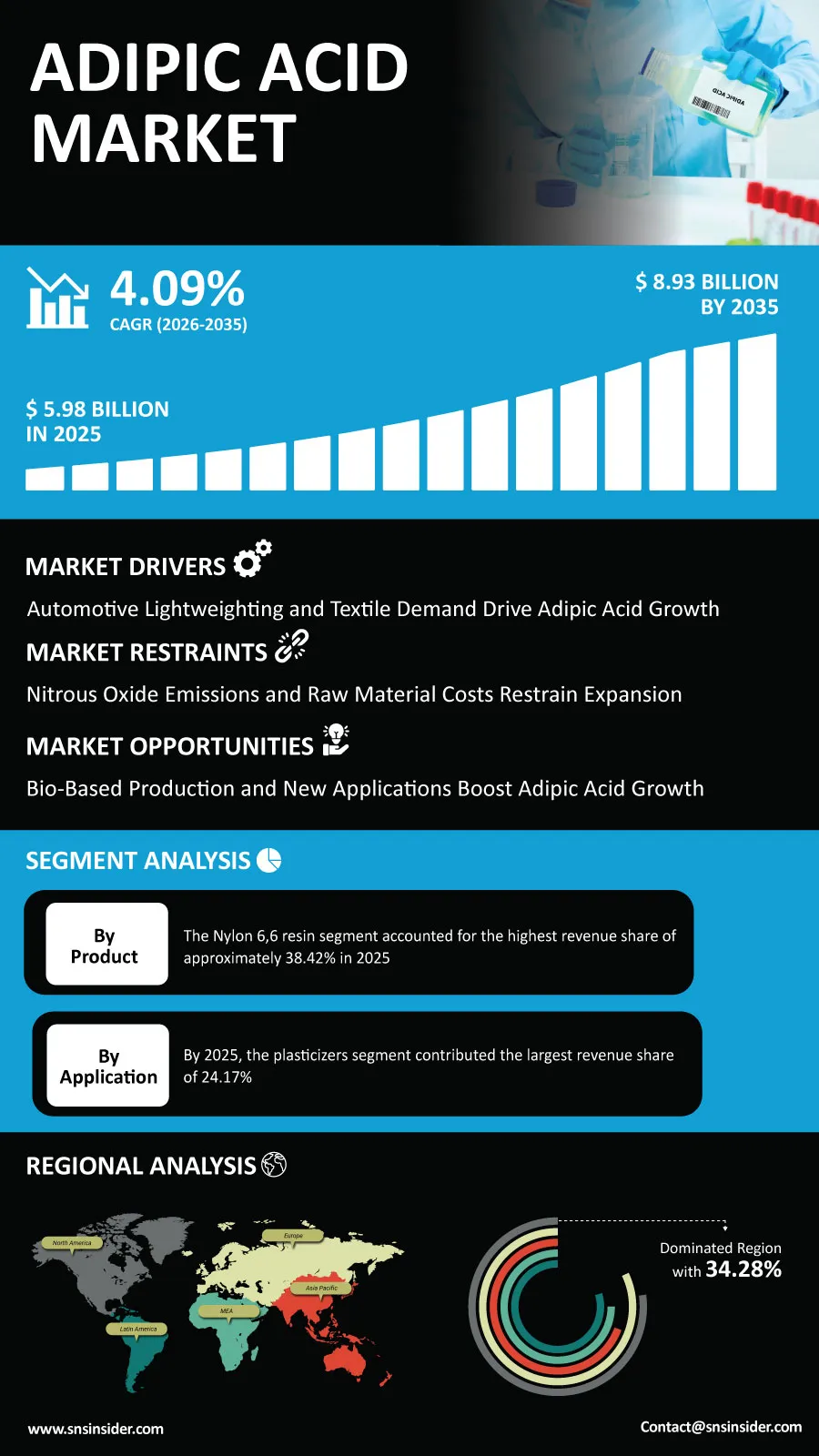
The global Adipic Acid Market is expected to witness steady growth as companies make increasing investments in high performance engineering plastics, sustainable chemical manufacturing, and high-performance polymers. “According to a recent study by SNS Insider, the global Adipic Acid Market size valued at USD 5.98 Billion in 2025, is anticipated to grow to USD 8.93 Billion by 2035, registering a CAGR of 4.09% over the 2026–2035 forecast period.”
Increasing demands for light weight auto parts, high-performance textiles, and polyurethanes further brighten the market prospects. The use of adipic acid is inevitable in the production of Nylon 6,6 and therefore allows manufactures to produce strong, heat-resistant, and light-weighted components that can be used in transport vehicles, industrial machinery, consumer goods, and electrical applications. Growing preference for sustainable chemicals and less emission technologies is further motivating producers to upgrade their plants and broaden their sources of feedstocks.
To Get Detailed Insights on the Adipic Acid Market – Request a Sample Report
Sustainable Chemical Innovation Creates Long-Term Growth Opportunities
With regard to the shift towards green manufacturing practices, there are more prospects for adipic acid suppliers. In order to comply with environmental legislation and increase efficiency of production processes, chemical firms are making increased efforts to introduce sustainable raw materials, biological production, and waste management systems.
The rise in application of polyurethane foam in construction, furniture, refrigeration, and consumer goods contributes to even greater expansion of business opportunities. There is growing demand for high-quality polyester polyols, special-purpose elastomers, and coatings that would provide strength, elasticity, and environmental characteristics, which will result in further growth of this industry over the coming ten years.
Key Market Insights Highlight Evolving End-Use Demand
Based on the product type, Nylon 6,6 Resin contributed about 38.42% towards global market revenue in 2025 as a result of extensive applications in engineering plastics, automotive parts, and various industrial applications. The polyurethane segment will witness the fastest growth till 2035 driven by rising demands for flexible foam products, insulators, and advanced elastomers.
On the basis of application, plasticizers contributed nearly 24.17% towards global market revenue in 2025 as a result of rising adoption of adipate ester-based formulas in flexible plastics, wires & cable insulation, films and packaging films, and pharmaceuticals. Food Additives Segment is expected to grow at the highest CAGR owing to increased manufacture of food-grade ingredients in processed foods and beverages.
Based on End User Industry, automotive end user industry is estimated to account for about 27.63% share towards global market revenue in 2025 as a result of rising adoption of lightweight Nylon 6,6 based materials in vehicles. Packaging industry is estimated to register the fastest growth rate till 2035 as a result of rising demands for high performance adhesives and sustainable packaging materials.
Advanced Production Technologies Transform the Industry
Innovation continues to be a key concern for adipic acid companies trying to enhance their productivity and environmental compliance. The organizations are employing state-of-the-art catalytic processes, process automation, and digital manufacturing techniques to maximize their production while cutting down on pollution and operating expenses.
The development of bio-based adipic acid routes by using sustainable feedstocks is another area that is attracting attention from chemical firms worldwide. Such developments ensure that there are fewer greenhouse gas emissions while at the same time meeting the strict environmental regulations. The constant development of specialty adipates is allowing suppliers to meet the needs of the customers.
North America Led the Nylon 6,6 Market with Over 34.28% Revenue Share in 2025, While Asia Pacific Emerges as the Fastest-Growing Region Through 2035
The North American region has contributed more than 34.28% to the total market revenue in 2025 owing to the presence of well-developed capacity for the production of Nylon 6,6, the developed chemical production industry, and the robust automotive industry. Investments in sustainable chemical production processes would likely help in strengthening the market leadership of the region.
The Asia Pacific region is estimated to have the fastest regional growth during the forecast period. Increasing textile production, growing automobile production, rising consumption of engineering plastics, and the support extended by the governments of China, India, South Korea, and other fast-growing nations towards the development of their chemical industries is driving the demand. Europe is another important market with chemical manufacturers focusing on sustainable production practices.
Industry Participants Accelerate Sustainable Manufacturing Strategies
The competitive environment keeps changing as major companies increase their production capacities, improve their global supply chains, and develop eco-friendly manufacturing processes. As a result of these activities, along with investments into bio-feedstock, emission control, specialty polymer intermediates, and research collaborations, manufacturers are able to increase quality of their products while reaching sustainability goals.
Key companies operating in the global Adipic Acid Market include BASF SE, Invista S.à r.l., Lanxess AG, Ascend Performance Materials, Radici Group, Solvay S.A., Asahi Kasei Corporation, Evonik Industries AG, Toray Industries, Inc., China Shenma Group Co., Ltd., Huafon Group Co., Ltd., Lihua Chemical, Haili Chemical Industry Co., Ltd., Shandong Hongye Chemical Co., Ltd., Verdezyne, Inc., Rennovia Inc., BioAmber Inc., Covestro AG, Grupo Alpek S.A.B. de C.V., and Hanwha Solutions Corporation.
An SNS Insider analyst Himanshu Sharma commented, "Growing adoption of high-performance polymers, expanding polyurethane applications, and accelerating investment in sustainable chemical technologies are reshaping the global adipic acid industry. Companies focusing on bio-based production pathways, emission reduction, and advanced polymer innovation will be well positioned to capitalize on future market opportunities as demand continues to diversify across automotive, packaging, consumer goods, and industrial manufacturing."
About the Author

Get in touch