
Advanced Node Foundry Market Report Scope and Overview:
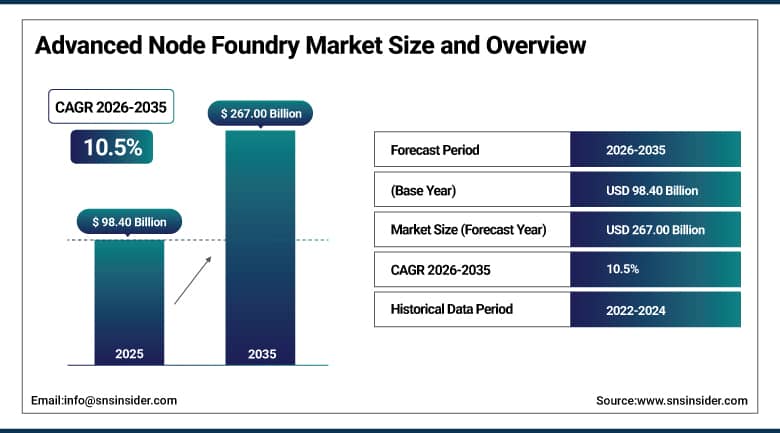
The Advanced Node Foundry Market size was valued at USD 98.40 Billion in 2025 and is projected to reach USD 267.00 Billion by 2035, registering a CAGR of 10.5% from 2026 to 2035.
The Advanced Node Foundry Market is enabling the next wave of computing performance through the fabrication of next-generation semiconductor wafers using 5-nanometer, 3-nanometer, and 2-nanometer process nodes for fabless chip companies and integrated device manufacturers. This market is distinguished by rising demand for AI accelerators, high-performance computing chips, and premium smartphone SoCs, increased adoption of gate-all-around transistors, and increased investments made by governments into local advanced logic wafer fabrication capabilities. Growth is occurring in AI data center processors, advanced driver-assistance system chips for vehicles, and cloud server processors since hyperscalers, car makers, and governments are investing in obtaining resilient access to next-generation semiconductor foundries.
TSMC continued ramping volume production of its N2 (2-nanometer) process node across its Hsinchu and Kaohsiung fabs throughout 2025, targeting smartphone and high-performance computing customers ahead of broader commercial availability.
To Get More Information On Advanced Node Foundry Market - Request Free Sample Report
Advanced Node Foundry Market Trends
-
Rapid volume ramp of 2-nanometer gate-all-around process technology continues expanding leading-edge capacity for AI and high-performance computing customers.
-
Growing government-backed investment in domestic advanced logic fabs continues reshaping the geography of leading-edge semiconductor manufacturing capacity.
-
Rising demand for AI accelerator and cloud server silicon continues driving sustained capital expenditure toward sub-5-nanometer wafer capacity.
-
Increasing adoption of chiplet architectures and advanced packaging continues complementing leading-edge node manufacturing across high-performance computing platforms.
-
Expanding automotive and industrial demand for advanced driver assistance chipsets continues broadening advanced node adoption beyond smartphones and computing.
U.S. Advanced Node Foundry Market Size Outlook
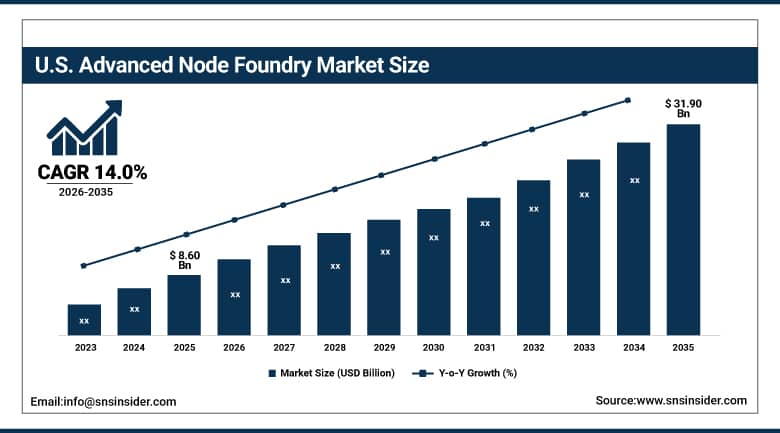
The U.S. Advanced Node Foundry Market was valued at approximately USD 8.60 Billion in 2025 and is projected to reach approximately USD 31.90 Billion by 2035, registering a CAGR of approximately 14.0% from 2026 to 2035.
Demand across the United States continued to be shaped by CHIPS and Science Act incentives supporting domestic advanced logic fab construction, sustained hyperscaler investment in AI accelerator supply security, and growing federal emphasis on supply chain resilience for leading-edge semiconductor manufacturing. Rising deployment of new advanced node fabrication capacity by both domestic and foreign-headquartered foundry operators continued reinforcing the country's position as an increasingly important, fast-growing hub for leading-edge chip manufacturing. Growing automotive, defense, and cloud computing demand for domestically fabricated advanced logic added further layers of sustained momentum behind the country's advanced node capacity build-out.
Intel Foundry advanced qualification of its 18A process node throughout 2025, securing external customer commitments including Microsoft and additional hyperscale computing partners for advanced logic manufacturing at its Arizona and Ohio fabrication facilities.
Advanced Node Foundry Market Segment Analysis
-
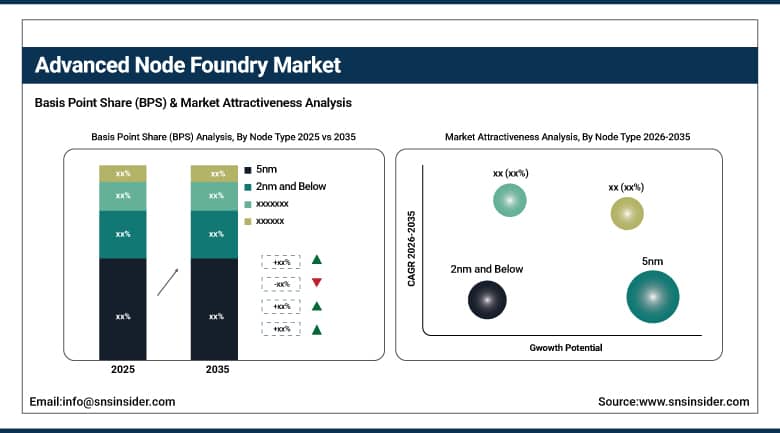
By Node Type, 5nm segment dominated the Advanced Node Foundry Market in 2025 with 38% share; 2nm and Below segment is the fastest growing segment.
-
By Foundry Type, Pure-Play Foundry segment dominated the market in 2025 with 79% share; Integrated Device Manufacturer (IDM) Foundry segment is the fastest growing segment.
-
By Application, Consumer Electronics segment dominated the market in 2025 with 34% share; Data Center segment is the fastest growing segment.
-
By End-User, Fabless Companies segment dominated the market in 2025 with 61% share; Integrated Device Manufacturers segment is the fastest growing segment.
By Node Type, 5nm Leads While 2nm and Below Grows Fastest
The 5nm segment dominated the Advanced Node Foundry Market in 2025 owing to its established volume production maturity and broad adoption across flagship smartphone, high-performance computing, and AI accelerator designs. Fabless customers continue relying on 5nm capacity for cost-optimized, high-yield production while newer nodes ramp toward volume readiness. Continued yield improvement and expanding fab capacity at this maturity level have kept the 5nm node the largest single revenue contributor within the leading-edge node landscape tracked in this report.
The 2nm and Below segment is the fastest growing in the Advanced Node Foundry Market owing to accelerating gate-all-around transistor adoption and surging demand from AI accelerator and premium smartphone customers seeking maximum transistor density and power efficiency. Foundries are racing to bring 2nm capacity online to capture early, premium-priced customer commitments. Growing hyperscaler and automotive interest in next-generation compute efficiency continues accelerating the ramp of sub-2nm node capacity across leading foundry operators.
By Foundry Type, Pure-Play Dominates While IDM Foundry Records Fastest Growth
The Pure-Play Foundry segment dominated the Advanced Node Foundry Market in 2025 due to the fabless business model’s continued dominance across smartphone, computing, and AI chip design, which relies entirely on third-party wafer manufacturing capacity. Pure-play foundries have built the deepest leading-edge process expertise and the largest customer bases among fabless chip designers globally. Sustained fabless industry growth has kept pure-play operators the largest overall contributor to advanced node foundry revenue.
The Integrated Device Manufacturer (IDM) Foundry segment is the fastest growing in the Advanced Node Foundry Market owing to expanding third-party foundry service offerings from IDMs seeking to monetize excess advanced node capacity and diversify revenue streams. Growing government incentives supporting domestic IDM-operated advanced fabs continue accelerating this segment’s expansion. Rising customer interest in geographically diversified, non-Asia-Pacific foundry options continues driving accelerated growth in IDM-operated foundry services.
By Application, Consumer Electronics Leads While Data Center Grows Fastest
The Consumer Electronics segment dominated the Advanced Node Foundry Market in 2025 due to sustained global demand for premium smartphones and wearable devices requiring the highest available transistor density and power efficiency. Smartphone original equipment manufacturers continue prioritizing leading-edge nodes for flagship system-on-chip designs given their scale and recurring upgrade cycles. Sustained global premium smartphone shipment volumes have kept this application the largest overall revenue contributor across the market.
The Data Center segment is the fastest growing in the Advanced Node Foundry Market owing to surging demand for AI accelerator, GPU, and cloud server processors requiring maximum computational density and energy efficiency. Hyperscale cloud operators increasingly demand leading-edge node capacity to support generative AI training and inference workloads. Accelerating global AI infrastructure investment continues driving sustained growth in data center-oriented advanced node demand.
Regional Analysis
|
Region |
Major Country |
Share within Region, 2025 (%) |
|---|---|---|
|
North America |
United States |
92.00% |
|
Europe |
Germany |
21.50% |
|
Asia Pacific |
Taiwan |
58.00% |
|
Middle East and Africa |
Israel |
34.50% |
|
Latin America |
Mexico |
29.00% |
Asia Pacific Advanced Node Foundry Market Insights
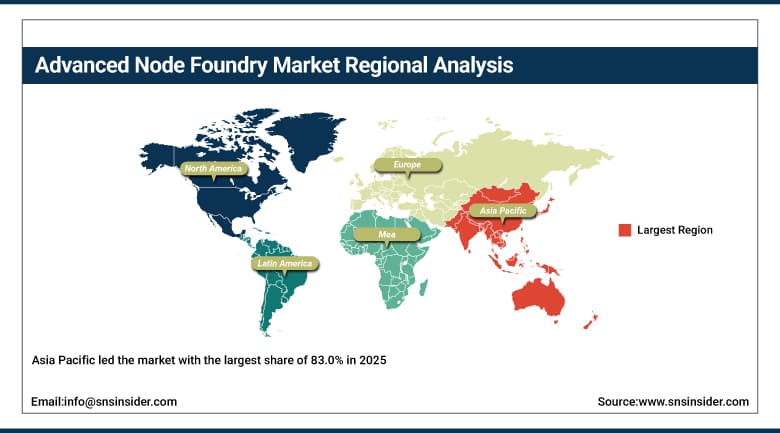
Asia Pacific led the market with the largest share of 83.0% in 2025, registering a CAGR of 9.0% from 2026 to 2035, driven by concentrated leading-edge fabrication capacity, deep semiconductor manufacturing expertise, and sustained government-backed investment in domestic advanced logic capability across the region’s largest economies. That combination of manufacturing scale and deeply entrenched process technology leadership kept the region’s revenue base well ahead of every other region tracked in this report, even as North America’s comparatively faster growth rate begins gradually narrowing the gap.
Taiwan led the pack, supported by its unmatched leading-edge fabrication capacity and deep process technology leadership among global foundry operators. South Korea contributed substantial additional demand through its own advanced logic and memory foundry capability, with China’s expanding domestic foundry ecosystem and Japan’s renewed advanced node ambitions both reinforcing the region’s position as the largest advanced node foundry market tracked in this report.
Get Customized Report as Per Your Business Requirement - Enquiry Now
North America Advanced Node Foundry Market Insights
North America is registering the fastest CAGR among all regions, at approximately 14.5% from 2026 to 2035. CHIPS and Science Act incentives supporting domestic advanced logic fab construction, sustained hyperscaler investment in AI accelerator supply security, and growing federal emphasis on supply chain resilience continued driving rapid regional capacity expansion. Rising deployment of new advanced node fabrication capacity by both domestic and foreign-headquartered foundry operators further strengthened North America’s standing as the fastest-growing, most policy-supported market tracked in this report, with continued federal incentive disbursement expected to sustain the region’s capacity build-out through the forecast period.
The United States accounted for roughly 92.00% of regional revenue, anchored by sustained CHIPS Act-backed fab construction and substantial hyperscaler and defense demand for domestically fabricated advanced logic. Canada and Mexico contributed limited additional regional demand, and that combined North American capacity build-out kept the continent the fastest-growing addressable market for advanced node foundry vendors through the forecast period, with continued federal incentive programs expected to sustain regional investment.
Europe Advanced Node Foundry Market Insights
Europe held a modest but strategically important share of global revenue, supported by growing European Chips Act investment and continued expansion of domestic semiconductor manufacturing capability across the region’s major economies. Regulatory momentum around supply chain sovereignty continued shaping regional investment priorities without meaningfully altering the region’s relatively limited leading-edge production footprint, while sustained automotive and industrial semiconductor demand kept the region a genuinely relevant, if smaller, advanced node foundry market tracked in this report.
Germany led demand at roughly 21.50% of European revenue, supported by planned leading-edge fab investment and its substantial automotive and industrial semiconductor demand base. France and other European economies contributed additional demand, and continued European Chips Act-backed investment should keep regional demand for advanced node foundry capacity climbing steadily through the forecast period.
MEA and Latin America Advanced Node Foundry Market Insights
The Middle East and Africa and Latin America both remained comparatively nascent markets, constrained by limited existing leading-edge fabrication infrastructure and continued reliance on imported advanced logic chips. As government sovereign wealth funds and multinational operators explore modest local semiconductor manufacturing investment, advanced node foundry capacity proved a genuinely aspirational rather than immediate opportunity in most of these markets during the period tracked in this report.
Israel led Middle East and Africa demand, supported by the country’s established semiconductor manufacturing presence and ongoing fab investment by global operators. In Latin America, Mexico accounted for the largest share of regional revenue, with growing semiconductor assembly and test investment continuing to anchor limited regional demand for advanced node foundry-adjacent capability.
Market Dynamics
Growth Drivers: Surging AI Accelerator Demand and Government-Backed Capacity Investment
The industry is driven by surging demand for artificial intelligence accelerators, high-performance computing processors, and premium smartphone system-on-chips, growing adoption of gate-all-around transistor architectures, and expanding government-backed investment in domestic advanced logic manufacturing capacity. As hyperscalers, automakers, and governments increasingly prioritize resilient, geographically diversified access to leading-edge semiconductor manufacturing, the need for expanded advanced node capacity continues driving sustained capital investment across the industry.
Rising AI data center buildout continues reinforcing this driver, as generative AI training and inference workloads require maximum transistor density and energy efficiency achievable only at the most advanced process nodes. Growing automotive demand for advanced driver assistance chipsets continues defining a further layer of sustained demand, and that combination of AI infrastructure investment and automotive semiconductor content growth is exactly what keeps overall demand climbing at such a steady, sustained pace.
Restraints: Extreme Capital Intensity and Concentrated Manufacturing Risk
The extraordinary capital investment required to construct and equip a leading-edge advanced node fab, often exceeding tens of billions of dollars per facility, continues posing a genuine restraint on faster market-wide expansion, particularly for new entrants without the balance sheet strength that established foundry operators can commit. That cost profile has kept leading-edge capacity concentrated among a very small number of globally significant operators.
Ongoing geographic concentration of leading-edge manufacturing capacity in a small number of facilities continues posing a further restraint, as customers and governments alike remain concerned about single-region supply chain vulnerability to geopolitical disruption or natural disaster. Regulatory export control complexity in certain jurisdictions keeps some leading-edge equipment and technology transfer scenarios more administratively complicated than mature node manufacturing ever required.
Opportunities: Domestic Capacity Expansion and Chiplet-Enabled Design Innovation
Rising government investment in domestic advanced logic manufacturing represents a genuinely significant opportunity, as nations increasingly prioritize supply chain sovereignty and reduced dependence on concentrated overseas production. Vendors positioned early in geographically diversified, policy-supported fab construction stand to capture meaningful share as customers continue diversifying advanced node sourcing away from historically concentrated manufacturing hubs.
Expanding chiplet architecture and advanced packaging adoption offers a second substantial opportunity, as customers increasingly combine leading-edge logic dies with mature node components to optimize cost and performance simultaneously. Vendors with proven, advanced node process technology stand to capture meaningful share as AI accelerator and high-performance computing customers continue scaling chiplet-based system designs across established and emerging computing markets alike.
Recent Developments:
-
2025: TSMC continued ramping volume production of its N2 (2-nanometer) gate-all-around process node across its Hsinchu and Kaohsiung fabs, targeting smartphone and high-performance computing customers ahead of broader commercial availability.
-
2025: Intel Foundry advanced qualification of its 18A process node, securing external customer commitments including Microsoft and additional hyperscale computing partners for advanced logic manufacturing at its U.S. fabs.
-
2024: Samsung Foundry expanded construction at its Taylor, Texas facility, targeting 2-nanometer gate-all-around production capacity to serve U.S.-based fabless and automotive customers.
Advanced Node Foundry Companies are:
-
Samsung Electronics Co., Ltd. (Samsung Foundry)
-
Intel Corporation (Intel Foundry)
-
GlobalFoundries Inc.
-
Semiconductor Manufacturing International Corporation (SMIC)
-
United Microelectronics Corporation (UMC)
-
Vanguard International Semiconductor Corporation (VIS)
-
Tower Semiconductor Ltd.
-
Hua Hong Semiconductor Limited
-
Rapidus Corporation
-
DB HiTek Co., Ltd.
-
Nexchip Semiconductor Corporation
-
Shanghai Huali Microelectronics Corporation
-
X-FAB Silicon Foundries SE
-
SkyWater Technology, Inc.
-
SK Keyfoundry Inc.
-
Sony Semiconductor Manufacturing Corporation
-
Infineon Technologies AG
-
STMicroelectronics N.V.
Advanced Node Foundry Market Report Scope:
| Report Attributes | Details |
|---|---|
| Market Size in 2025 | USD 98.40 Billion |
| Market Size by 2035 | USD 267.00 Billion |
| CAGR | CAGR of 10.5% From 2026 to 2035 |
| Base Year | 2025 |
| Forecast Period | 2026-2035 |
| Historical Data | 2022-2024 |
| Report Scope & Coverage | Market Size, Segments Analysis, Competitive Landscape, Regional Analysis, DROC & SWOT Analysis, Forecast Outlook |
| Key Segments | • By Node Type (5nm, 3nm, 2nm and Below) • By Foundry Type (Pure-Play Foundry, Integrated Device Manufacturer (IDM) Foundry) • By Application (Consumer Electronics, Automotive, Industrial, Data Center, Telecommunications, Others) • By End-User (Fabless Companies, Integrated Device Manufacturers, Foundry Service Providers, Others) |
| Regional Analysis/Coverage | North America (US, Canada), Europe (Germany, UK, France, Italy, Spain, Russia, Poland, Rest of Europe), Asia Pacific (China, India, Japan, South Korea, Australia, ASEAN Countries, Rest of Asia Pacific), Middle East & Africa (UAE, Saudi Arabia, Qatar, South Africa, Rest of Middle East & Africa), Latin America (Brazil, Argentina, Mexico, Colombia, Rest of Latin America). |
| Company Profiles | Taiwan Semiconductor Manufacturing Company Limited (TSMC), Samsung Electronics Co., Ltd. (Samsung Foundry), Intel Corporation (Intel Foundry), GlobalFoundries Inc., Semiconductor Manufacturing International Corporation (SMIC), United Microelectronics Corporation (UMC), Powerchip Semiconductor Manufacturing Corporation (PSMC), Vanguard International Semiconductor Corporation (VIS), Tower Semiconductor Ltd., Hua Hong Semiconductor Limited, Rapidus Corporation, DB HiTek Co., Ltd., Nexchip Semiconductor Corporation, Shanghai Huali Microelectronics Corporation, X-FAB Silicon Foundries SE, SkyWater Technology, Inc., SK Keyfoundry Inc., Sony Semiconductor Manufacturing Corporation, Infineon Technologies AG, STMicroelectronics N.V. |

Frequently Asked Questions
The Advanced Node Foundry Market is expected to grow at a CAGR of approximately 10.5% from 2026 to 2035, based on triangulated secondary research estimates.
The Advanced Node Foundry Market was valued at approximately USD 98.40 Billion in 2025, based on triangulation across multiple independent research sources.
The major growth factor is surging demand for AI accelerators, high-performance computing processors, and government-backed investment in domestic advanced logic manufacturing capacity.
The 5nm segment dominated the Advanced Node Foundry Market by node type, representing the largest share of revenue in 2025.
Asia Pacific dominated the Advanced Node Foundry Market in 2025, holding an estimated 83.0% share of total global market revenue.
