
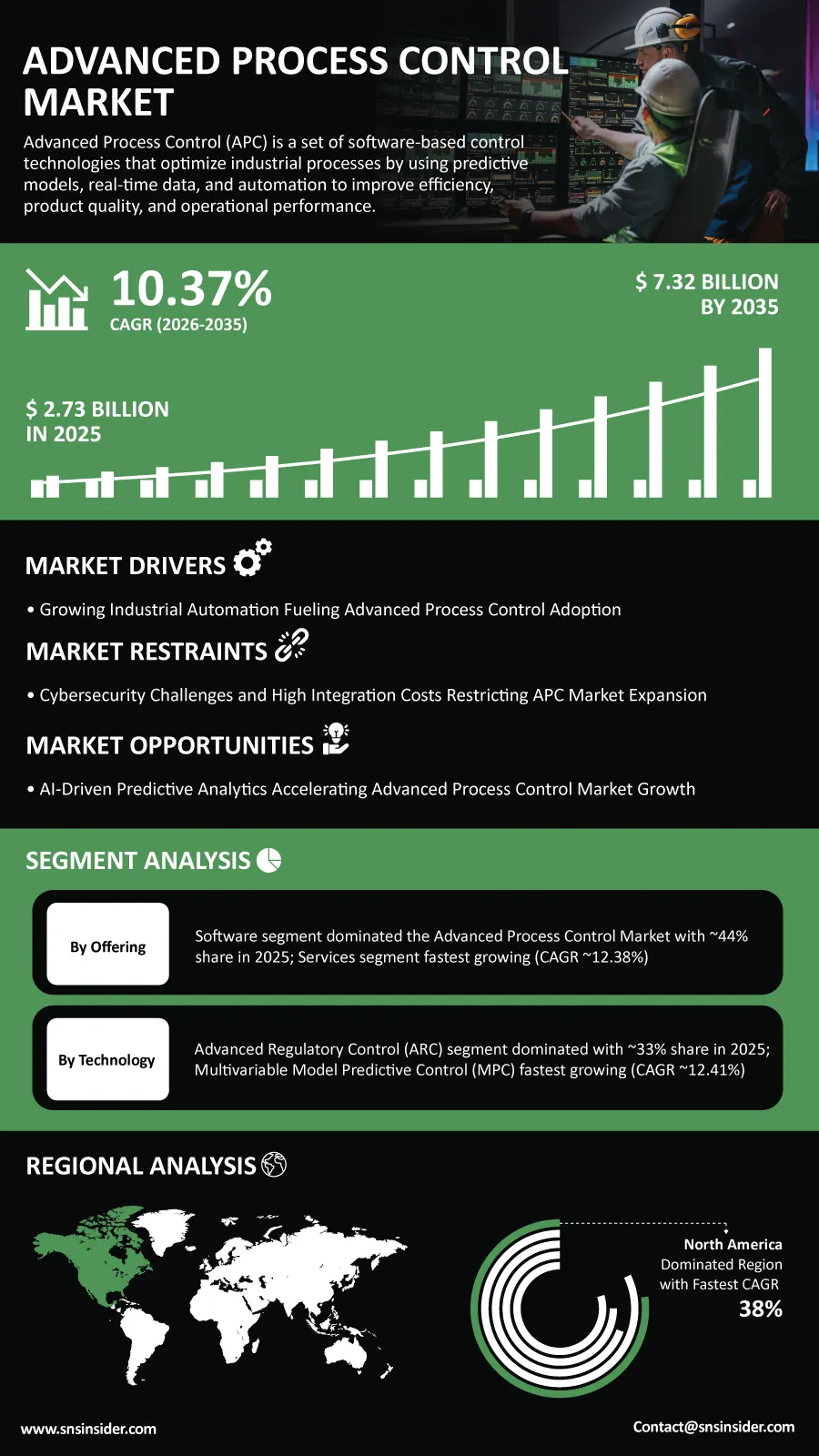
The global Advanced Process Control Market is entering a period of strong expansion as process industries accelerate digital transformation, automation, and energy-efficiency initiatives. According to a recent study by SNS Insider, the global Advanced Process Control Market size valued at USD 2.73 billion in 2025, is anticipated to grow to USD 7.32 billion by 2035, registering a CAGR of 10.37% over the 2026–2035 forecast period.
Manufacturing companies involved in refineries, chemical, pharmaceutical, food processing, and similar industries using continuous manufacturing processes are now moving toward advanced automation solutions that would help them increase throughput, provide product quality consistency, and save on resource consumption. Moreover, the increased availability of data from industrial operations helps decision makers act quickly and optimize their production environment.
The move towards smart factory environments is adding impetus to the development of control solutions that would be able to operate together with artificial intelligence, IoT in industry, digital twins, and advanced analytical solutions. With the rise of sustainability goals being linked to operations, process optimization becomes an important instrument in managing energy consumption and emissions.
To Get Detailed Insights on the Advanced Process Control Market – Request a Sample Report
Industrial Digitalization Continues to Create New Growth Opportunities
Improvements in industrial infrastructure are creating new opportunities for APC technology companies. Cloud computing solutions are making the use of APC easier by lowering the need for a computing infrastructure while subscription business models are enabling small-scale manufacturers to circumvent the need for huge investments.
The combination of APC with digital twin solutions is becoming increasingly popular in the industry as a way for industrial teams to test out new control processes without having to make changes to real industrial systems. Additionally, artificial intelligence diagnostics can detect any abnormalities in system operation as well as performing regular optimization tasks.
The rising use of standardized industrial communication protocols will help make the connection of APC to existing distributed control systems easier, thereby reducing the time taken to implement the project and enhancing its scalability.
Key Market Insights Highlight Shifting Demand Patterns
By offering, software occupied approximately 44% of total market revenue in 2025 owing to the importance of optimization platform in modern APC solutions. Services are projected to witness the highest growth at a CAGR of approximately 12.38% till 2035 as the installed systems need tuning of models, performance evaluation, upgrading, and technical assistance.
Based on technology, Advanced Regulatory Control was projected to account for nearly 33% of the total market revenue in 2025. Multivariable Model Predictive Control will register the highest growth at approximately 12.41% CAGR due to increasing demand for optimizing several process variables and constraints simultaneously.
By organization size, large enterprises accounted for the largest share of nearly 69% of the market revenue in 2025. On the other hand, small and medium enterprises will witness the highest growth at approximately 11.95% CAGR as a result of easy accessibility of APC solutions using the cloud and subscription.
In terms of end user, oil and gas emerged as the leading application with approximately 27% of market revenue in 2025 owing to extensive deployment of APC in refinery and hydrocarbon processing operations. On the other hand, pharmaceuticals are projected to witness the highest growth at approximately 14.04% CAGR in order to ensure continuous production and consistent quality.
Energy Optimization and AI Integration Remain Key Priorities
Industries are now considering the use of APC technology within wider plans aimed at managing energy expenses and improving sustainability performance. Advanced optimization could help the production units operate at their optimum level without disruptions and wastage of resources.
Artificial intelligence integration into APC systems is extending the applicability of such systems. For instance, fault detection, self-monitoring of models and predictive analysis powered by AI are allowing operators to detect deviations in processes before any effect is seen on production. Such aspects are bound to become more relevant in the future.
North America Holds 38% Advanced Process Control Market Share in 2025 as Asia Pacific Grows at a 12.20% CAGR Through 2035
It is anticipated that North America will hold around 38% of the total market share in 2025 owing to the development of the country's refining, chemicals, and pharmaceuticals industry along with a considerable number of industrial automation technology players. Modernization of existing process plants is also aiding the growth of optimization solutions.
Asia Pacific region is expected to witness highest growth among all regions with around 12.20% CAGR during the forecast period from 2026 to 2035. Growth of the industrial capacity in China, India, South Korea, and Southeast Asia along with digitalization of factories is creating immense opportunities for APC solutions.
The region's expanding petrochemical, pharmaceutical, and manufacturing sectors are increasingly adopting advanced automation solutions to improve productivity and meet evolving quality and environmental requirements.
Industry Participants Focus on AI-Enabled Process Optimization
The competitive landscape remains dynamic as technology providers invest in cloud-native architectures, artificial intelligence, cybersecurity, and advanced model predictive control capabilities. Companies are also focusing on integration with existing industrial control environments to reduce implementation complexity and deliver measurable operational improvements.
Key companies operating in the global Advanced Process Control Market include Aspen Technology, Inc. (AspenTech), Honeywell International Inc., Emerson Electric Co., Siemens AG, ABB Ltd., Yokogawa Electric Corporation, Schneider Electric SE, Rockwell Automation, Inc., General Electric Company (GE Vernova), AVEVA Group plc (Schneider Electric), Pavilion Technologies (Rockwell), KBC Advanced Technologies (Yokogawa), Spartan Controls Ltd., Apex Optimization Inc., DMC3 (Kelley-Mahon), ProcessECC Inc., Tecnimont ICB Pvt. Ltd., Control Station, Inc., Quanta Associates, and Perceptive Engineering Ltd.
An SNS Insider analyst Sushant Kadam commented, “The convergence of industrial automation, real-time analytics, and AI is creating a broader role for advanced process control across energy-intensive industries. As manufacturers pursue lower operating costs and stronger sustainability performance, providers capable of delivering secure, scalable, and continuously optimized control platforms will be well positioned to capture emerging opportunities.”
About the Author

Get in touch




