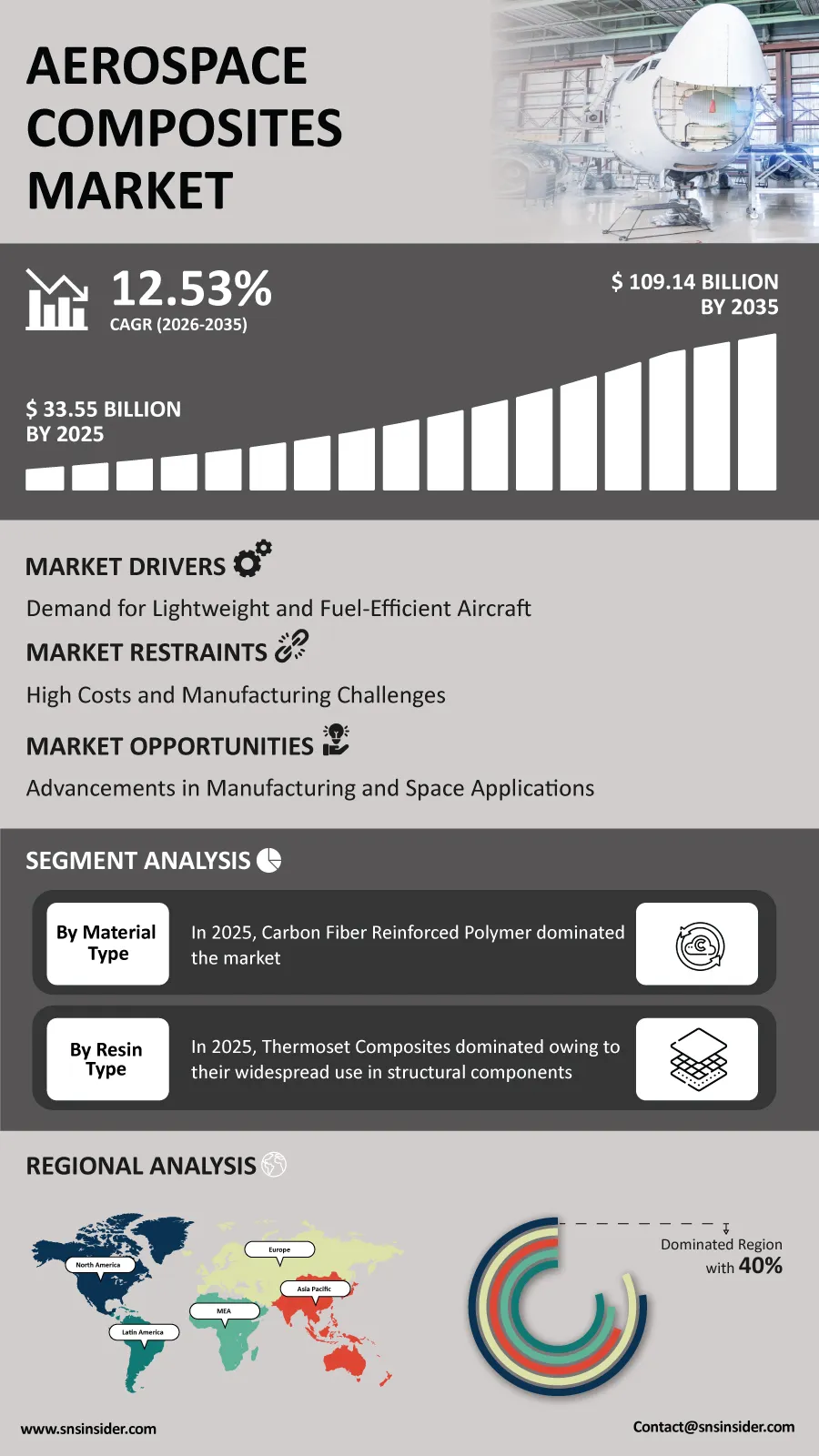
The global Aerospace Composites Market is expected to witness robust growth over the next decade as aircraft manufacturers increasingly prioritize lightweight materials to improve fuel efficiency, operational performance, and environmental sustainability. “According to a recent study by SNS Insider, the global Aerospace Composites Market size valued at USD 33.55 billion in 2025, is anticipated to grow to USD 109.14 billion by 2035, registering a CAGR of 12.53% over the 2026–2035 forecast period.”
The increased funding for the commercial aviation sector, defense modernization, and future space projects is increasing the use of composite materials in the aerospace industry. Aircraft and airlines are in need of new materials that will be lightweight but still have excellent mechanical strength and resistance to corrosion and wear.
The ongoing move towards sustainability within the industry has made the need for high-performance composite materials even greater. Manufacturers are using advanced manufacturing techniques to ensure efficient manufacturing while meeting ever more demanding standards.
To Get Detailed Insights on the Aerospace Composites Market – Request a Sample Report
Advanced Aircraft Manufacturing Creates New Opportunities for Composite Materials
Significant advancements have been observed in advanced manufacturing techniques that increase manufacturing accuracy, minimize waste, and enhance assembly operations for OEMs and aerospace parts suppliers in this industry. The advancements in technology will increase the economic efficiency of composites in the aerospace sector.
While aircraft fleets expand on a global level and the number of passengers grows, airlines make considerable efforts to acquire fuel-efficient aircraft that help save on operating expenses and carbon footprint. Aircraft with increased usage of composites are becoming a key focus of many aviation companies trying to meet their sustainability goals.
Increasing spending on defense aviation, UAVs, satellites, and commercial space exploration will also widen market opportunities. There is an increasing demand for lightweight materials able to provide high structural stability under difficult working conditions.
Continuous progress in such technological advancements as automated fiber placement, additive manufacturing, thermoplastics, and new resins will help achieve scalability and more complex aircraft design.
Key Market Insights Reflect Strong Demand Across Aerospace Applications
Based on material type, Carbon Fiber Reinforced Polymer (CFRP) accounted for the largest share of global market revenue in 2025, supported by its exceptional strength-to-weight ratio and widespread use in aircraft fuselage, wings, and structural assemblies.
Ceramic Matrix Composites (CMCs) are expected to register the fastest growth through 2035 as demand rises for heat-resistant materials capable of improving engine efficiency and supporting next-generation propulsion technologies.
Among resin types, thermoset composites remained the dominant category in 2025 due to their long-standing use in certified aerospace structures. Meanwhile, thermoplastic composites are projected to witness the highest growth as manufacturers increasingly seek recyclable materials with shorter production cycles and greater manufacturing flexibility.
Commercial aircraft represented the leading aircraft segment in 2025, driven by strong production volumes and ongoing fleet expansion worldwide. Spacecraft applications are anticipated to expand at the fastest pace as governments and private organizations continue increasing investments in satellite deployment and space exploration missions.
By application, primary aircraft structures generated the highest market demand because of extensive composite utilization in wings, fuselage sections, and tail assemblies. Engine components are forecast to experience rapid growth owing to rising adoption of advanced materials capable of withstanding extreme operating temperatures.
Lightweight Engineering and Sustainability Remain Industry Priorities
Materials that will contribute to improved aircraft performance through reduced life cycle costs continue to be favored in the aerospace industry. The use of composites is becoming increasingly significant in realizing fuel efficiencies, increased cargo capabilities, and longevity of aircraft.
At the same time, manufacturers are concentrating on automated manufacturing processes, composite recyclability technologies, and digitized manufacturing processes. All these developments are anticipated to increase the adoption of composites in various aerospace ventures.
As governments strengthen emissions reduction policies and aviation companies pursue carbon-neutral operations, lightweight structural materials are expected to remain central to future aircraft development strategies.
North America Accounted for 40% Market Share in 2025; Asia Pacific Forecast to Expand at a 16.04% CAGR by 2035
The North American region held around 40% share of the global Aerospace Composites Market in 2025 due to the presence of leading aircraft makers, state-of-the-art aerospace supply chain systems, significant defense expenditure, and constant research and development activities in the region.
The Asia Pacific region is expected to witness the highest CAGR of 16.04% during the forecast period till 2035, owing to rapid expansion of the commercial aviation industry, increased budget on defense, strong governmental backing for local manufacturing in aerospace industry, and increase in aircraft manufacturing capacity in the region.
Europe also continues to maintain a strong market position through its established aerospace manufacturing ecosystem, while Latin America and the Middle East & Africa are gradually increasing composite adoption as regional aviation industries continue to expand.
Industry Leaders Accelerate Innovation and Manufacturing Expansion
The Competitive Dynamics within the Aerospace Composites Industry have become increasingly intense with the increasing capacities of manufacturing companies, introduction of innovative composite materials and collaboration with aircraft OEMs. There has been extensive investment in the development of advanced composites solutions offering structural advantages, manufacturing efficiencies and eco-friendliness.
Key companies operating in the global Aerospace Composites Market include Toray Industries Inc., Hexcel Corporation, Solvay SA, Mitsubishi Chemical Group Corporation, SGL Carbon SE, Teijin Limited, Owens Corning, Materion Corporation, Gurit Holding AG, TenCate Advanced Composites BV, Park Aerospace Corp., Huntsman Corporation, Evonik Industries AG, Kineco Kaman Composites India Pvt. Ltd., Spirit AeroSystems Inc., Lee Aerospace Inc., General Electric Company, Safran SA, Lockheed Martin Corporation, and Airbus SE.
An SNS Insider analyst Santosh Bhul commented, "The growing emphasis on lightweight aircraft, sustainable aviation technologies, and next-generation aerospace platforms is creating strong momentum for advanced composite materials. Companies that continue investing in manufacturing innovation, material performance, and scalable production capabilities are expected to strengthen their competitive advantage as global aerospace demand accelerates throughout the coming decade."
About the Author

Get in touch