According to the latest SNS Insider Data Monetization in Healthcare Market report, the global market is experiencing rapid expansion as healthcare organizations increasingly convert clinical records, insurance claims, genomic information, and patient-generated data into commercially valuable intelligence. Pharmaceutical research, artificial intelligence adoption, and growing demand for real-world evidence are accelerating investment in secure healthcare data platforms.
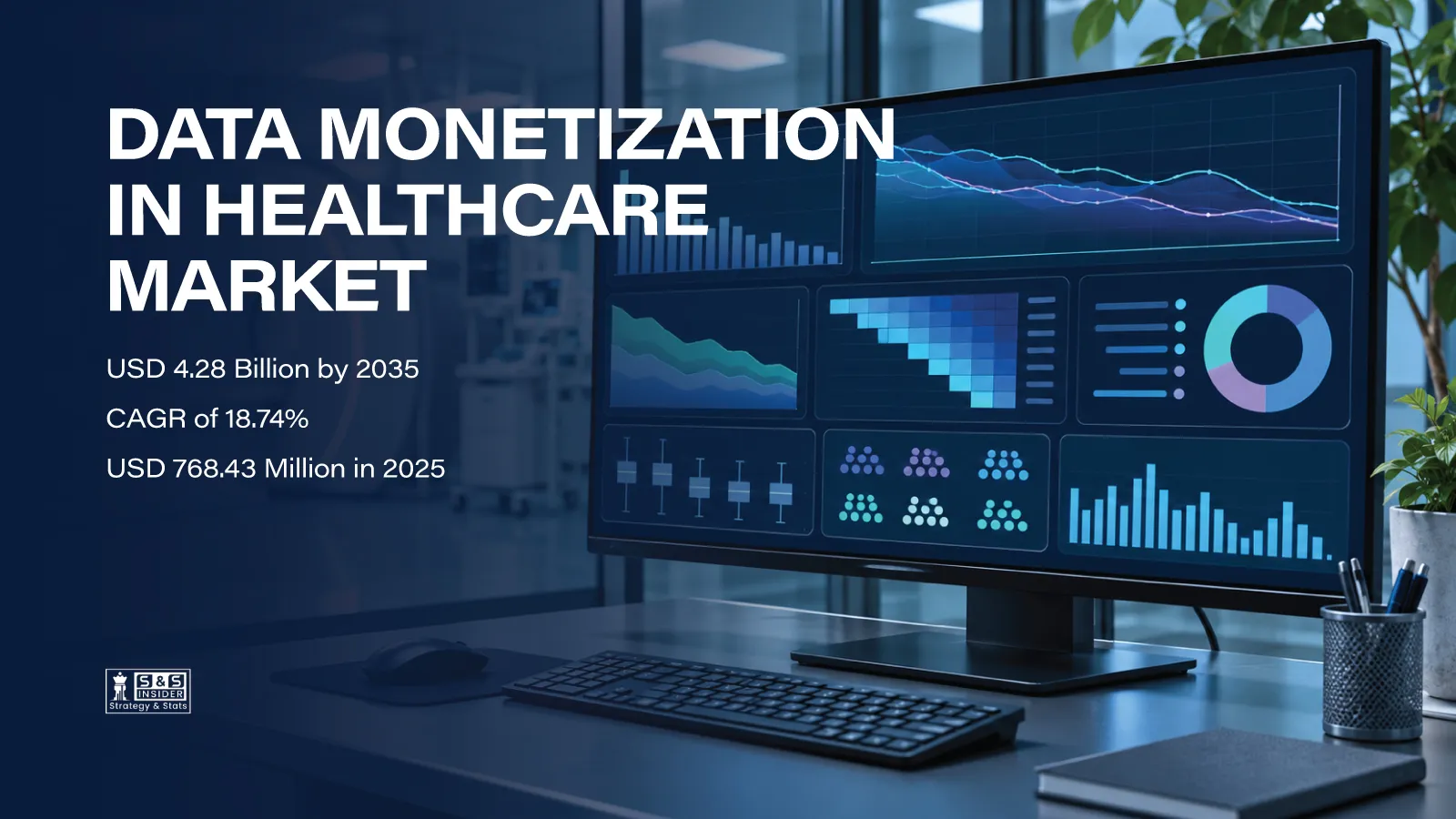
The global data monetization in healthcare market was valued at USD 768.43 Million in 2025, is estimated to reach USD 912.43 Million in 2026, and is projected to reach USD 4.28 Billion by 2035, expanding at a CAGR of 18.74% during 2026–2035.
Licensed datasets and analytics are being used by healthcare providers, drug companies, insurers, and medical device makers to refine their efforts in research, therapy assessment, operations, and business strategy. While privacy protection is being enabled through technologies and cloud computing, revenues are also being generated.
To Get Detailed Insights on the Data Monetization in Healthcare Market – Request a Sample Report
North America dominated the market with a 37.86% share in 2025, while Asia-Pacific is expected to register the fastest growth through 2035.
Market Size and Forecast
|
Market Indicator |
Value |
|---|---|
|
Market Size, 2025 |
USD 768.43 Million |
|
Market Size, 2026 |
USD 912.43 Million |
|
Market Forecast, 2035 |
USD 4.28 Billion |
|
CAGR, 2026–2035 |
18.74% |
|
Largest Regional Market |
North America (37.86%) |
|
Fastest-Growing Region |
Asia-Pacific (20.36% CAGR) |
|
Leading Solution |
Analytics-enabled Platform as a Service |
Demand Drivers and Constraints
Primary Demand Drivers
-
Expanding electronic health record adoption: Healthcare digitization generates increasing volumes of structured clinical information suitable for research, analytics, and commercial licensing.
-
Growing demand for real-world evidence: Pharmaceutical and biotechnology companies require longitudinal patient information for clinical trial planning, treatment evaluation, and post-marketing research.
-
Artificial intelligence integration: Advanced analytics, machine learning, and automated data processing increase the commercial usefulness of healthcare datasets.
-
Value-based healthcare expansion: Providers and insurers increasingly require outcomes information to evaluate treatment performance, manage costs, and improve care delivery.
-
Development of healthcare data marketplaces: Subscription-based platforms and secure data-sharing networks simplify access to research-ready information.
Potential Growth Constraints
-
Stringent privacy regulations and healthcare data protection requirements.
-
High costs associated with data standardization, integration, and cybersecurity.
-
Fragmented electronic health record systems and inconsistent data formats.
-
Patient consent restrictions and concerns regarding secondary data usage.
-
Complexity of international data-sharing and compliance frameworks.
Demand Structure by Solution Type
Analytics-enabled Platform as a Service (2025 Market Share: 40.37%)
Analytics-enabled Platform as a Service accounted for 40.37% of global market revenue in 2025, making it the leading solution segment. There is a growing trend towards adopting an integrated approach where data preparation, storage, analysis, and access of data can all take place from one location. The developers of pharmaceuticals use this technology to determine which patients are suitable for their treatment and study other effects related to their treatment without dealing with the actual records. Cloud deployment and interoperable analytical tools support broader adoption among healthcare networks, insurers, and life sciences companies.
Current trend: Growing demand for integrated healthcare intelligence platforms with privacy-preserving analytical capabilities.
Major trends: Cloud-based analytics, secure data linkage, automated de-identification, longitudinal patient records, and subscription-based intelligence services.
Embedded Analytics (Forecast CAGR: 22.84%)
Embedded analytics is projected to be the fastest-growing solution segment, expanding at a CAGR of 22.84% during 2026–2035. Developers of healthcare software are designing analytical functions as integral parts of EHRs, insurance software, clinical research platforms, and operational management solutions. Such an integration allows companies to gain insight based on their current processes without having to rely on separate BI software. The increasing need for decision-making support and performance monitoring is supposed to fuel the adoption rate.
Current trend: Increasing integration of analytical intelligence into healthcare software applications.
Major trends: AI-powered dashboards, predictive analytics, automated reporting, clinical workflow intelligence, and real-time data visualization.
Demand Structure by End User
Pharmaceutical and Biotechnology Companies (2025 Market Share: 38.27%)
Pharmaceutical and biotechnology companies represented the largest end-user category, holding 38.27% of market revenue in 2025. These companies purchase data sets related to the healthcare sector to aid in the process of drug discovery, recruiting people for clinical trials, safety monitoring, and designing commercial approaches. The availability of diverse patient population data and long-term clinical history helps researchers analyze the patterns of treatment and evaluate the efficacy of treatments. Increasing interest in precision medicine and cancer studies will drive the demand for health information licensing.
Current trend: Increasing pharmaceutical investment in commercially accessible real-world healthcare datasets.
Major trends: Clinical trial optimization, patient cohort identification, treatment effectiveness studies, and evidence-based drug development.
MedTech Companies (Forecast CAGR: 21.37%)
Medical technology companies are expected to register the fastest end-user growth, with a CAGR of 21.37% through 2035. Device companies involved in manufacturing of connected medical devices, diagnostic instruments, and remote monitoring tools have increasingly been demanding performance data to showcase the effectiveness of their products for evaluation purposes. Through the combination of data from these devices and patient outcomes, these organizations are able to strengthen product development as well as the commercial positioning of these products.
Current trend: Growing commercialization of device-generated information and real-world performance analytics.
Major trends: Connected medical devices, remote patient monitoring, post-market evidence generation, and AI-enabled diagnostic insights.
Demand Structure by Data Type
Clinical Data (2025 Market Share: 36.12%)
Clinical data dominated the market with a 36.12% revenue share in 2025. Electronic health records, diagnosis reports, lab results, and therapy histories provide the necessary information required for conducting research in the clinical setting. More pharmaceutical organizations and research institutes are getting standardized clinical data sets in order to conduct research into how diseases progress, how they respond to treatments, and patterns of healthcare usage. The advancement of interoperability and data governance is improving access to these data resources.
Current trend: Rising demand for structured, research-ready clinical datasets.
Major trends: Electronic health record integration, clinical data licensing, longitudinal patient analytics, and privacy-preserving data exchange.
Patient-Generated Data (Forecast CAGR: 24.19%)
Patient-generated data is projected to be the fastest-growing data category, advancing at a CAGR of 24.19% during 2026–2035. Wearable devices, mobile health apps, and connected monitoring systems generate information about physical activities, symptoms, adherence to medications, and health status of patients. This data gives additional information about patients' experience outside the confines of conventional clinical practice. It is expected that increasing usage of telemedicine and decentralized clinical trials will contribute to commercial demand for regulated patient data.
Current trend: Rapid growth in connected health information generated outside hospitals.
Major trends: Wearable sensors, digital biomarkers, mobile health platforms, remote monitoring, and patient-reported outcomes.
Demand Structure by Monetization Model
Direct Monetization (2025 Market Share: 51.38%)
Direct monetization accounted for 51.38% of the market’s revenue in 2025, supported by the proven business models of data licensing, subscription, and research contracts. The healthcare organizations earn money through provision of licensed datasets or analysis services to the designated customers. Structured deals are more preferred by pharmaceutical sponsors and insurance companies because of defined use cases, data quality, and refreshing period. There will be an increasing number of specific healthcare data markets.
Current trend: Increasing adoption of governed healthcare data licensing and subscription agreements.
Major trends: Data marketplaces, recurring subscriptions, commercial research partnerships, and secure analytical access.
Indirect Monetization (Forecast CAGR: 20.63%)
The indirect monetization approach is expected to have a CAGR of 20.63% up until 2035. Instead of directly monetizing data, the health care institutions create economic value from the increased efficiency of operations, conducting research, avoiding unnecessary spending, and increasing efficacy of treatment. Hospitals and insurance companies are increasingly making use of the analytics to streamline the processes and identify areas where savings can be made.
Current trend: Increasing use of healthcare information to generate measurable operational and strategic value.
Major trends: Cost optimization, research partnerships, population health analytics, fraud detection, and performance-based healthcare management.
Regional Market Dynamics
North America (2025 Market Share: 37.86%)
North America captured a revenue share of 37.86% in 2025, due to established electronic health record system, pharmaceutical research spending, and healthcare data solutions. The U.S. generated a revenue of USD 260.79 million in 2025 and represented 89.64% of North American revenue. Pharmaceutical companies, health systems, insurance companies, and research institutions are making significant investments in integrated patient databases and analytics. Canada presents other avenues to explore as well, in the context of healthcare research initiatives within the country.
Direction: Market leadership supported by pharmaceutical research, mature data infrastructure, and commercial analytics adoption.
Europe — Second-Largest Regional Market
Europe takes second place when it comes to market shares, which can be explained by national healthcare data systems, drug research organizations, and increased funding of the security system of data exchange. Germany made up 24.73% of the regional revenue in 2025. The United Kingdom and France provide contributions to the market via their clinical research practices and initiatives within digital healthcare. The European Health Data Space framework is expected to support more standardized secondary use of healthcare information as its provisions are phased in.
Direction: Continued expansion supported by regulated healthcare data access and interoperable research infrastructure.
Asia-Pacific (Forecast CAGR: 20.36%)
The Asia-Pacific region is forecasted to show the fastest regional growth, with an estimated CAGR of 20.36% expected between 2026 and 2035. For 2025, China's share of regional revenue was 28.46%, and countries like India, Japan, South Korea, and Australia are building their digital health facilities and research capabilities. The increasing use of electronic health records, mobility in health care delivery services, and increased funding in pharmaceuticals are creating more opportunities for analytic companies.
Direction: Fastest-growing region, driven by healthcare digitization, expanding research demand, and analytics investment.
Latin America — Expanding Healthcare Data Commercialization
Healthcare analytics is gaining popularity in Latin America due to the modernization of information systems in hospital groups, insurers, and pharmaceutical companies in the region. The country that made the largest contribution to the revenue in 2025 was Brazil, which accounted for 46.87%. This is due to the developed healthcare system and research of the pharmaceutical industry. Mexico, Argentina, and Colombia are developing in digital healthcare sector.
Direction: Gradual expansion supported by healthcare digitalization and growing pharmaceutical research activity.
Middle East & Africa — Emerging Digital Health Opportunities
The Middle East & Africa market is developing as healthcare organizations invest in electronic medical records, national health platforms, and connected clinical infrastructure. Saudi Arabia represented 33.41% of regional revenue in 2025. The United Arab Emirates is also advancing healthcare digitization and research initiatives, while South Africa contributes established clinical research capabilities. Secure information-sharing frameworks and international technology partnerships could expand commercial opportunities.
Direction: Emerging growth supported by healthcare modernization, national data initiatives, and research partnerships.
Competitive Landscape
The market includes specialized healthcare data providers, technology platforms, and real-world evidence companies. Key participants identified in the SNS Insider report include Datavant, Truveta, Komodo Health, HealthVerity, Innovaccer, Flatiron Health, Tempus, Particle Health, Arcadia, IQVIA, and Verana Health.
Competition centers on dataset coverage, information quality, privacy protection, analytical capabilities, and access to longitudinal patient records. Companies are expanding cloud-based intelligence platforms, secure data linkage technologies, and partnerships with healthcare institutions.
Market Outlook (2026–2035)
The global data monetization in healthcare market is expected to reach USD 4.28 Billion by 2035, supported by artificial intelligence adoption, increasing demand for real-world evidence, and expanding healthcare digitization.
Healthcare intelligence platforms using subscription-based service, analytics, and patient-generated data will be able to provide additional commercial opportunities. The pharmaceutical industry and med-tech companies will remain major customers for their use in developing evidence-based products.
Commercial success will depend significantly on privacy compliance, data interoperability, and trust among patients. Healthcare providers who will be able to offer high-quality, safe, and up-to-date data will probably have an edge over others.
Overall, healthcare data monetization is evolving from isolated information licensing toward integrated, analytics-driven business models that support clinical research, operational improvement, and evidence-based decision-making.
About the Author

Get in touch