
According to the latest SNS Insider Home Healthcare Devices Market report, the global market is witnessing consistent growth due to the change in the delivery of healthcare services from institutions to residences. The prevalence of chronic diseases, longevity, and need for self-sufficiency are contributing factors to the increasing use of medical devices at homes.
This market is comprised of medical instruments for diagnosis and treatment, and mobility aids that are used by patients and caregivers away from healthcare institutions. Devices, such as connected glucose monitors, blood pressure monitors, respiratory devices, and patient supports are vital in treating chronic illnesses.
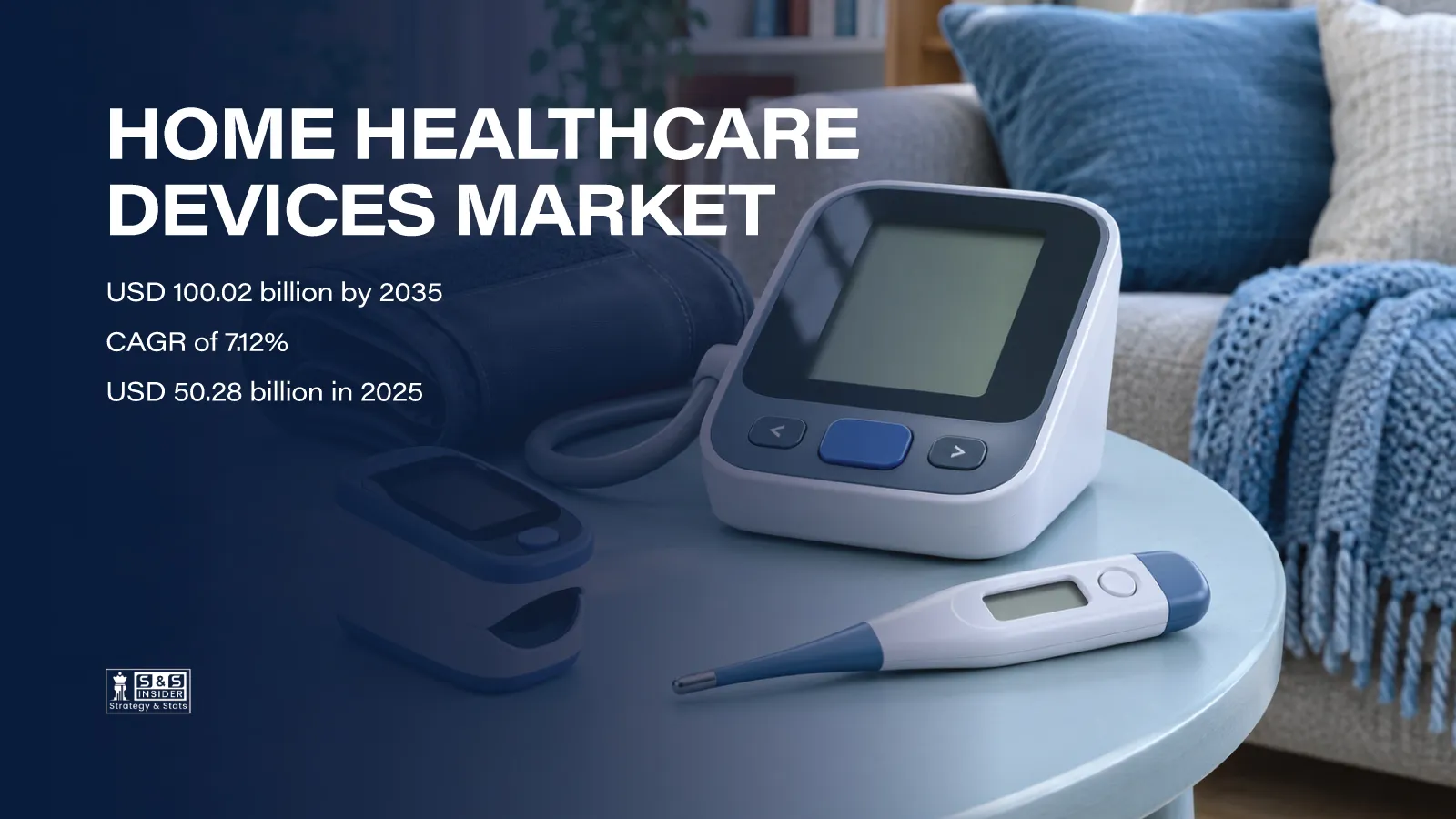
The global home healthcare devices market was valued at USD 50.28 billion in 2025, is estimated to reach USD 53.86 billion in 2026, and is projected to attain USD 100.02 billion by 2035, registering a CAGR of 7.12% during 2026–2035.
Advancements in technology are changing home medical devices into a connected medical care system that includes wireless sensors, applications in smartphones, and remote monitoring systems, which give doctors access to information on patients without the need for hospital trips.
To Get Detailed Insights on the Home Healthcare Devices Market – Request a Sample Report
North America will remain the largest market owing to its proven reimbursement system as well as the use of devices in the area. Asia-Pacific will experience the fastest growth due to increased access to healthcare and high demand for economical monitoring devices. Through 2035, manufacturers offering reliable, accessible, and easy-to-operate devices will be positioned to capture opportunities across aging populations and chronic disease management.
Market Size and Forecast
|
Market Indicator |
Value |
|---|---|
|
Global Market Size, 2025 |
USD 50.28 Billion |
|
Global Market Size, 2026 |
USD 53.86 Billion |
|
Market Forecast, 2035 |
USD 100.02 Billion |
|
CAGR, 2026–2035 |
7.12% |
|
Leading Region, 2025 |
North America (38.96%) |
|
Fastest-Growing Region |
Asia-Pacific (9.84% CAGR) |
|
Largest Product Segment |
Monitoring and Diagnostic Devices |
|
Fastest-Growing Sales Channel |
Online Retailers |
Demand Drivers and Constraints
Primary Demand Drivers
-
Aging populations: Increasing numbers of older adults are creating sustained demand for mobility aids, respiratory equipment, and routine health monitoring devices.
-
Growing chronic disease burden: Diabetes, cardiovascular disorders, and respiratory conditions require regular monitoring and long-term treatment support.
-
Expansion of hospital-at-home programs: Healthcare providers are increasingly using residential care models to reduce hospitalization expenses and improve patient convenience.
-
Connected healthcare technologies: Wireless sensors, wearable monitoring systems, and smartphone integration are improving access to real-time health information.
-
Increasing consumer accessibility: Online retailers and medical stores are expanding access to monitoring equipment, replacement accessories, and home therapeutic devices.
-
Product innovation: Compact designs, improved battery performance, and simplified interfaces are encouraging adoption among patients and caregivers.
Potential Growth Constraints
-
High equipment costs and limited reimbursement in price-sensitive markets.
-
Inconsistent digital connectivity and technology access among older patients.
-
Regulatory requirements affecting medical device approvals and product claims.
-
Data privacy and cybersecurity concerns associated with connected devices.
-
Price competition and reimbursement pressure affecting manufacturer profitability.
Demand Structure by Product Type
Monitoring and Diagnostic Devices (2025 Market Share: 44.37%)
Monitoring and diagnostics devices were the leading product segment and accounted for 44.37% share of the global revenues in 2025. The drivers behind the market include patients’ need for regular measurements of glucose levels, blood pressure, oxygen saturation, and other physiological parameters. Systems for continuous glucose monitoring and wireless diagnostics devices are reducing dependence on hospital-level tests. Additionally, manufacturers are developing user-friendly interfaces and automation of data transfer functions. Adoption through 2035 will be supported by disease management programs, increased awareness regarding prevention of diseases, and continuous demand for sensors and disposables.
Current trend: Strong demand for connected home diagnostic and monitoring equipment.
Major trends: Continuous glucose monitoring, wireless blood pressure devices, wearable sensors, and automated health data transmission.
Mobility Assist and Patient Support Devices (Forecast CAGR: 9.12%)
Mobility assist and patient support devices are projected to expand at a CAGR of 9.12% from 2026 to 2035, making them the fastest-growing product category. Independent living is one of the rising demands of the senior citizen population, and this is leading to the purchase of motorized wheelchairs, walking aids, bed lifts, and patient lifters. There are other areas where the industry could find growth due to rehabilitation and modification of homes. Light-weight designs, better safety mechanisms, and the use of batteries are contributing to easy usage by patients and attendants.
Current trend: Increasing preference for mobility solutions that support independent home living.
Major trends: Powered wheelchairs, adjustable patient beds, lightweight mobility aids, and automated lifting systems.
Demand Structure by Application
Diabetes Care (2025 Market Share: 35.18%)
Diabetes care dominated the application segment with a 35.18% revenue share in 2025. Patients managing diabetes frequently require glucose monitoring systems, insulin delivery equipment, and related consumables. Increased usage of continuous glucose monitors ensures increased availability of information regarding glucose levels while reducing the need for conventional blood glucose testing methods using the finger-prick method. Increased adoption of mobile technology and health applications will allow constant monitoring of this condition. The future demand up to 2035 will be driven by higher diabetes prevalence and greater patient awareness.
Current trend: Expanding use of continuous glucose monitoring and connected diabetes equipment.
Major trends: Wearable glucose sensors, smartphone-linked monitoring, automated insulin delivery, and simplified testing systems.
Neuro-Rehabilitation (Forecast CAGR: 9.47%)
Neuro-rehabilitation is expected to grow at a CAGR of 9.47% during 2026–2035, representing the fastest-growing application category. Individuals suffering from strokes, neurological trauma, and other movement disabilities require lengthy rehabilitation after hospitalization. Advances in stimulation equipment, sensor-based physical exercise tools, and rehabilitation technologies will allow such therapies to be conducted at home. The rise in popularity of customized rehabilitation treatment plans will lead to the development of equipment for individuals with different mobility issues.
Current trend: Growing adoption of home-based neurological rehabilitation equipment.
Major trends: Wearable rehabilitation sensors, electrical stimulation devices, portable therapy systems, and remote rehabilitation monitoring.
Demand Structure by Sales Channel
Retail Medical Stores (2025 Market Share: 39.12%)
Retail medical stores accounted for 39.12% of global sales in 2025, maintaining their leading position through product accessibility and personalized purchasing assistance. Professional help is usually needed when picking up blood pressure machines, breathing apparatuses, mobility devices, and other types of special equipment. Traditional stores let the customers look at the equipment, compare their operating features, and get demo samples before purchasing them. Pharmacy chains and recommendations of medical professionals support this distribution channel. Retail stores should continue playing an important role for the equipment that needs fitting/installation/technical support.
Current trend: Continued consumer reliance on specialist medical retailers.
Major trends: In-store demonstrations, professional purchasing assistance, insurance-linked distribution, and expanded medical equipment availability.
Online Retailers (Forecast CAGR: 11.86%)
Online retailers are forecast to record the fastest sales-channel growth, at a CAGR of 11.86% through 2035. The availability of online markets makes it easier for one to find glucose testers, blood pressure monitors, mobility aids, and even replacement components. The product comparison, customer reviews, and delivery services make the buying process more convenient, especially for those who have mobility challenges. There are also manufacturers building platforms for direct consumer sales in order to build customer relationships.
Current trend: Accelerating adoption of digital purchasing for home medical equipment.
Major trends: Direct-to-consumer websites, online pharmacies, subscription-based consumables, and doorstep equipment delivery.
Demand Structure by End User
Elderly and Assisted-Living Users (2025 Market Share: 34.04%)
Elderly and assisted-living users represented the largest end-user category, accounting for 34.04% of market revenue in 2025. Older adults frequently require multiple devices to facilitate movement, breathing, and regular health checks. Dependability is a factor highly valued by the family members of the elderly, as well as caregivers at assisted living facilities, as this ensures less physical exertion and greater independence on a daily basis. Increased demand for age-friendly living space is also leading to the purchase of beds, mobility devices, safety and monitoring devices.
Current trend: Rising investment in age-friendly home medical equipment.
Major trends: Assisted-living monitoring, mobility support equipment, fall-prevention solutions, and caregiver-friendly device designs.
Chronic-Disease Home Care (Forecast CAGR: 8.73%)
Chronic-disease home care is projected to grow at a CAGR of 8.73% between 2026 and 2035. Patients suffering from cardiac diseases, diabetes, breathing problems, and other chronic ailments need to be monitored repeatedly and treated accordingly. More and more healthcare professionals are using connected medical devices to monitor patients outside their office visits. The remote monitoring program might assist in detecting any alarming change that could occur in the health of the patients.
Current trend: Increasing use of connected devices for long-term disease management.
Major trends: Remote patient monitoring, connected therapeutic equipment, clinician dashboards, and continuous health tracking.
Regional Market Dynamics
North America (2025 Market Share: 38.96%)
North America led the global market with a 38.96% share in 2025. The United States accounted for 84.37% of regional revenue, supported by established healthcare reimbursement systems, advanced distribution networks, and strong adoption of home monitoring technologies. The U.S. market reached USD 16.53 billion in 2025 and is expected to grow at a CAGR of 6.58% through 2035. Canada contributes through community healthcare and home care initiatives. Increasing demand for respiratory support, diabetes management, and connected monitoring equipment continues to reinforce regional growth.
Direction: Sustained market leadership supported by established healthcare infrastructure and connected device adoption.
Europe — Second-Largest Regional Market
Europe is the second-largest regional player due to aging demographics and government-funded healthcare system. In 2025, the share of Germany’s contribution to revenue of Europe was 27.31%. The other countries that include France, the United Kingdom, Italy, and Spain also form significant markets for home diagnostics, respiratory care, and mobility solutions. The governments are increasingly considering the option of community-based care to cope with the pressure on hospitals and expenses for long-term care facilities.
Direction: Steady expansion through population aging, home care investment, and medical device innovation.
Asia-Pacific (Forecast CAGR: 9.84%)
Asia Pacific is projected to witness the highest regional growth rate of 9.84%, during 2026–2035. In 2025, China accounted for 38.94% of the regional revenue. Both Japan and South Korea have a large base of elderly people, whereas India has opportunities in terms of increased access to healthcare facilities along with a demand for cost-effective medical devices. Increased e-commerce adoption and manufacturing capabilities have helped improve the availability of products. Awareness about diabetes and hypertension further aids the market growth.
Direction: Fastest regional expansion supported by demographic changes, affordable manufacturing, and improving healthcare accessibility.
Latin America — Growing Home Monitoring Adoption
Demand for home care medical devices is rising in Latin America, especially in Brazil that holds a 45.28% share in the region’s revenues in 2025. Mexico, Argentina, and Colombia also hold potential as knowledge about managing chronic diseases rises. Availability of home care medical devices via pharmacy growth and e-commerce is also becoming easier; however, high import costs and lack of insurance coverage play a role.
Direction: Gradual market expansion supported by chronic disease management and improved medical device distribution.
Middle East & Africa — Emerging Home Care Opportunities
Middle East & Africa presents developing opportunities for home healthcare equipment manufacturers. Saudi Arabia accounted for 31.76% of regional revenue in 2025, supported by healthcare modernization and rising demand for diabetes monitoring. The UAE is investing in digital healthcare and home-based services, while South Africa represents an important private healthcare market. Limited reimbursement and distribution challenges remain obstacles in several African economies.
Direction: Emerging growth supported by healthcare investment, preventive care initiatives, and wider device accessibility.
Key Market Participants
The global competitive landscape includes Koninklijke Philips, Abbott Laboratories, Medtronic, OMRON Healthcare, ResMed, Dexcom, Baxter International, Becton Dickinson, GE HealthCare, Medline Industries, Fresenius Medical Care, A&D Company, Inogen, Insulet, F. Hoffmann-La Roche, and Drive DeVilbiss Healthcare.
Competition is increasingly determined by product reliability, patient convenience, reimbursement eligibility, connected monitoring features, and distribution capabilities.
Market Outlook (2026–2035)
The global home healthcare devices market is forecast to reach USD 100.02 billion by 2035, supported by population aging, chronic disease management, and continued adoption of connected medical equipment.
Product manufacturers should emphasize on making accessible devices, accurate sensors, remote monitoring features, and digital delivery methods. Demand for mobility aids and neuro-rehabilitation products would add further opportunities for growth, while the online sales channel would increase consumers' reach.
Reimbursement limitations, equipment costs, and security considerations would continue to be key business barriers. Overall, the market would see continued growth until 2035 as doctors and patients embrace medical devices to make home-based treatment safer and more efficient.
About the Author

Get in touch




