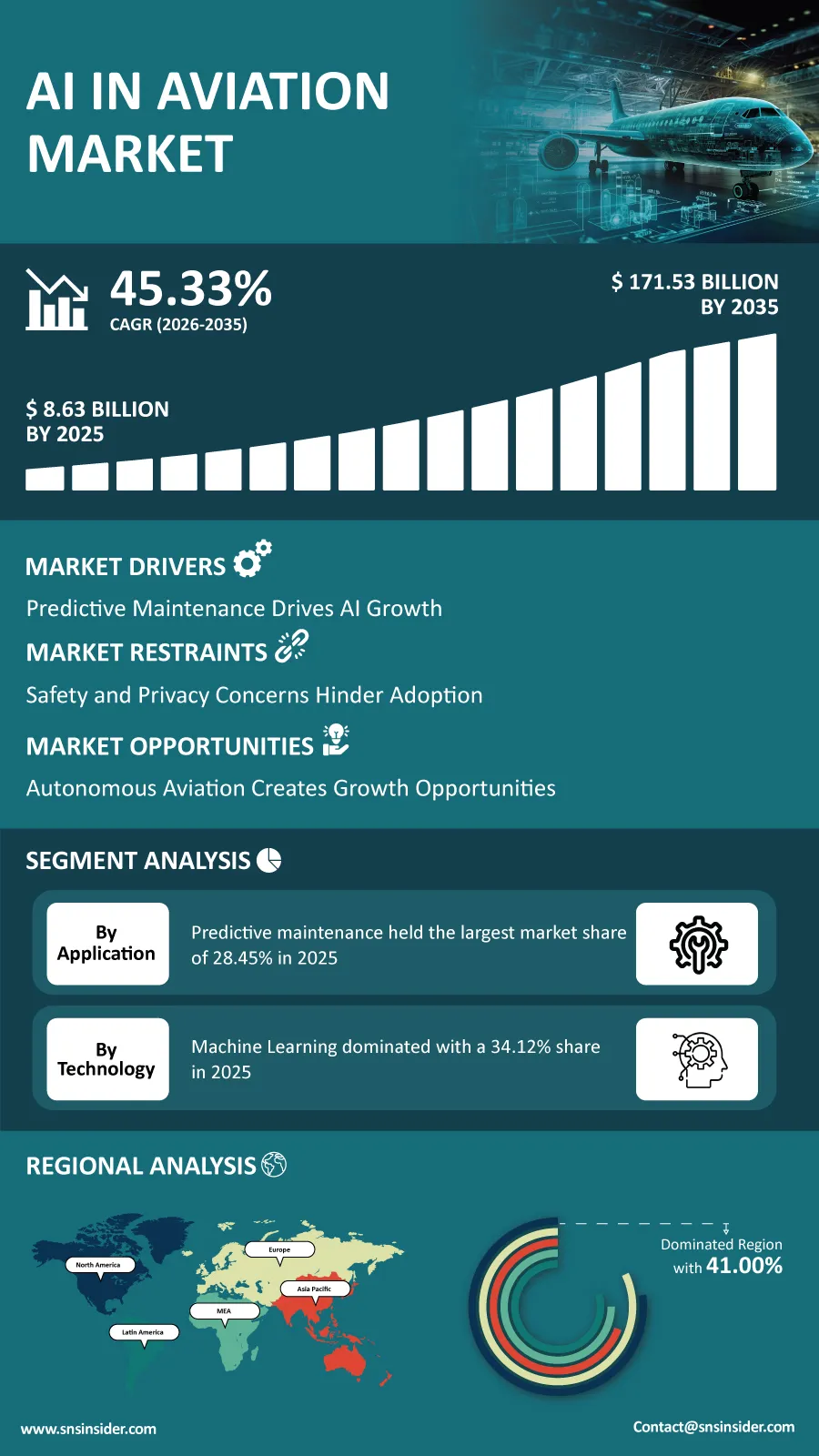
The global AI in Aviation Market is expected to witness unprecedented expansion over the coming decade as airlines, airports, and aerospace organizations accelerate investments in artificial intelligence to enhance operational intelligence, improve safety, and optimize passenger services. “According to a recent study by SNS Insider, the global AI in Aviation Market size valued at USD 8.63 billion in 2025, is anticipated to grow to USD 171.53 billion by 2035, registering a CAGR of 45.33% over the 2026–2035 forecast period.”
Commercial aviation is becoming more reliant on AI technologies for processing large amounts of information, making complicated decisions, and optimizing the use of assets. From maintenance scheduling to actual flights and customer interaction, artificial intelligence has been growing in significance in commercial aviation.
As airlines continue navigating rising operating costs, workforce shortages, and sustainability objectives, AI-powered platforms are helping organizations improve efficiency while delivering safer and more resilient aviation ecosystems.
To Get Detailed Insights on the AI in Aviation Market – Request a Sample Report
Digital Aviation Transformation Creates Long-Term Growth Opportunities
AI is influencing almost all aspects of aviation operation. Airlines are using AI algorithms to increase aircraft availability, schedule flights, predict passenger loads, and manage their crews.
Also, airport managers are introducing AI-based solutions to handle passenger baggage, organize passenger flow, enhance security measures at airports, and conduct airside operations. Introduction of smart infrastructure, digital twin solutions, and aviation platforms that are operated via cloud computing creates new business opportunities for companies operating in the aerospace segment.
Finally, large investments into autonomous aviation systems, air traffic management, and cockpit technologies powered by AI create prerequisites for further digitalization of the industry.
Given that governments around the world invest into aviation infrastructure modernization and digitalization, it can be predicted that AI will remain one of the leading technological areas for investment within the industry.
Key Market Insights Highlight Rapid Technology Adoption
By application, predictive maintenance accounted for 28.45% of global market revenue in 2025, supported by increasing adoption among airlines seeking to reduce unplanned aircraft downtime and maintenance costs.
Meanwhile, passenger experience enhancement is anticipated to emerge as the fastest-growing application through 2035, registering a 52.14% CAGR as carriers invest in AI-powered personalization, virtual assistants, and intelligent customer engagement platforms.
Based on technology, machine learning generated 34.12% of total market revenue during 2025 owing to its widespread deployment across operational analytics, maintenance forecasting, and revenue optimization systems. Computer vision is forecast to record the fastest expansion with a 54.06% CAGR, driven by growing implementation in aircraft inspection, airport security, and automated passenger processing.
Within the component segment, software represented 41.25% of market revenue in 2025, while services are projected to experience the strongest long-term growth as aviation companies increasingly seek AI integration, consulting, and managed solutions.
Among end users, airlines maintained the leading position with 38.91% market share in 2025, whereas airports are expected to register the fastest CAGR of 53.45% as smart airport initiatives continue expanding globally.
Operational Intelligence and Sustainability Become Strategic Priorities
The aviation industry is becoming more focused on intelligent decision-making amid an increasing level of operational complexity. AI solutions which can analyze real-time operational information help airlines maximize their fleet utilization, minimize delays, enhance fuel efficiency, and improve disruption management capabilities.
There is also an acceleration of sustainability efforts, which in turn contributes to the adoption of AI technologies within the industry. Airlines utilize artificial intelligence to optimize flights and achieve higher levels of fuel efficiency and reduced carbon emissions without impacting performance.
In addition, regulatory authorities work alongside tech companies to create frameworks that would promote responsible adoption of AI technologies amid the existing high level of safety standards in the industry.
The development of explainable AI, high-performance computing, and machine learning solutions specific to aviation will continue to drive commercial implementation of AI technologies in the forecast period.
North America Accounted for 41.00% Market Share in 2025; Asia Pacific Forecast to Expand at a 45.98% CAGR by 2035
North America contributed to around 41.00% of the global AI in Aviation Market share in 2025 owing to the availability of significant players related to aircraft manufacturing, technological innovation, airlines operations, and high-quality aviation infrastructure. Investment in the development of advanced air traffic management systems and digital aviation systems keeps the region ahead of its competitors.
The Asia-Pacific region is predicted to be the fastest growing market till 2035, growing at a CAGR of 45.98%. Fast-paced expansion of airline fleets, aviation infrastructure development, implementation of smart aviation programs backed by governments of China, India, Japan, Singapore, and Australia, among others, drives market growth.
Europe also remains an important innovation hub as aerospace manufacturers, airlines, and aviation authorities continue advancing AI-enabled maintenance, flight operations, and regulatory modernization programs.
Industry Participants Accelerate AI Innovation Across Aviation
The competitive landscape in the global market of AI in Aviation is becoming increasingly fierce, as leading aerospace and technology companies increase their capacities in artificial intelligence through alliances, product development, and implementation. Manufacturers and software vendors are progressively designing more efficient AI solutions for improving performance, predictive analysis, autonomous decision-making, and the experience of customers.
Key companies operating in the global AI in Aviation Market include Airbus SE, Boeing Company, IBM Corporation, Microsoft Corporation, Google LLC (Alphabet Inc.), Honeywell International Inc., GE Aerospace, Thales Group, Palantir Technologies Inc., Northrop Grumman Corporation, RTX Corporation, Lockheed Martin Corporation, SparkCognition Inc., C3.ai Inc., NVIDIA Corporation, Rolls-Royce Holdings PLC, Safran SA, CAE Inc., SITA, and Lufthansa Systems GmbH & Co. KG.
An SNS Insider analyst Santosh Bhul commented, "Artificial intelligence is becoming a foundational technology for the future of aviation. As airlines pursue greater operational resilience, airports embrace digital transformation, and regulators advance AI governance frameworks, organizations investing in intelligent automation, predictive analytics, and scalable AI platforms will be well positioned to capture long-term growth opportunities across the global aviation ecosystem."
About the Author

Get in touch