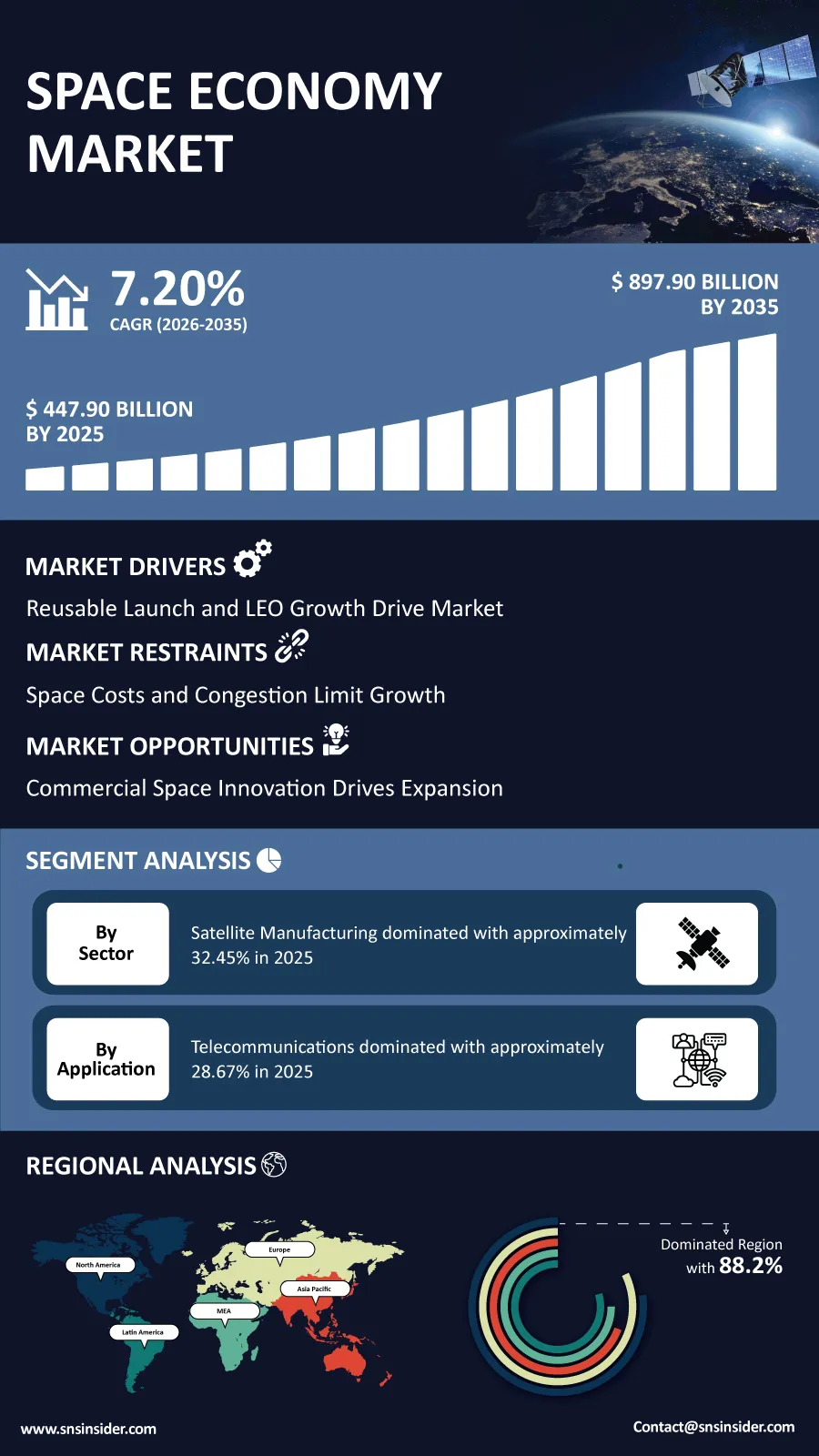
The global Space Economy Market is entering a transformative growth phase as governments, commercial enterprises, and technology innovators accelerate investments in satellite infrastructure, launch services, Earth observation, and next-generation space applications. “According to a recent study by SNS Insider, the global Space Economy Market size valued at USD 447.90 billion in 2025, is anticipated to grow to USD 897.90 billion by 2035, registering a CAGR of 7.20% over the 2026–2035 forecast period.”
Commercialization of space technology has been progressing at a rapid pace, moving away from the conventional approach of launching programs run by governments. The involvement of private firms, launch of more satellites, and rising need for communication and navigation solutions from space have made the environment more conducive to supporting several industries.
As launch costs keep dropping and technology hurdles are overcome, there will be more possibilities of using information from space to improve efficiency and connectivity. The consequence is a growing market that will be vital to the global digital economy.
To Get Detailed Insights on the Space Economy Market – Request a Sample Report
Commercial Space Investments Open New Growth Opportunities
Investments in private commercial space ventures around the world have changed the competitive structure of the industry. Private money is being invested in spacecraft manufacturing, launchers, space infrastructure, and innovative solutions that can be used during future missions to the Moon and outer space.
An increase in the number of LEO satellite clusters has greatly enhanced connectivity worldwide, while making fast communication channels accessible to previously underserved and remote territories. In addition to that, reusable rockets have made space cheaper and promoted more frequent launches.
In addition to satellite services, there are many potential applications for businesses that include orbital manufacturing, research platforms, and advanced Earth intelligence through artificial intelligence. All of these advancements have increased the economic benefits of space assets that go well beyond aerospace.
Key Market Insights Highlight Expanding Commercial Applications
On the basis of the sector, Satellite Manufacturing occupied 32.45% of the worldwide market revenue share in 2025 owing to the rising requirement for satellites catering to communication, navigation, military uses, science studies, and earth observation operations.
On the other hand, Space Tourism is projected to exhibit the highest growth during 2026-2035 registering a 9.80% CAGR due to the rise in expansion of human spaceflight operations by private companies along with reusable space launches that can make it economical.
Based on the applications, Telecommunications captured 28.67% of the total market revenue in 2025 owing to the extensive use of satellite communications by the consumer, enterprise, and governmental networks.
The fastest growing application will be Earth Observation due to the rising requirement for high-resolution earth intelligence for the use in agriculture, climate studies, insurance, infrastructure planning, environmental control, and military purposes.
Government and defense organizations continue to represent the largest end-user category, while commercial enterprises are anticipated to deliver the strongest future growth as businesses increasingly integrate satellite-based services into everyday operations.
Innovation and Digital Transformation Continue Driving Industry Expansion
Space technologies are now critical parts of digital infrastructure. Enterprises belonging to different industrial sectors rely on satellite-based positioning, secured communications, environment monitoring, and real-time data analytics to make more informed decisions.
Further improvements are being made in terms of artificial intelligence which allows automated image analysis, predictions based on the analyzed data, and fast processing of large Earth observation datasets. This results in the emergence of new business opportunities for firms that provide advanced geospatial intelligence services.
Industry participants are also investing heavily in autonomous spacecraft technologies, digital mission management platforms, and next-generation satellite architectures designed to improve operational efficiency while reducing deployment costs.
With increasing commercial demand, cooperation between governments, research organizations, and private companies is expected to increase innovations in the field of space industry.
North America Held the Leading Market Share in 2025; Asia Pacific Projected to Register the Fastest Growth Throughout the Forecast Period
North America retains the leading position in 2025 due to its advanced aerospace industry, substantial government spending, improved launch technologies, and the presence of a commercially driven space segment. The U.S. is one of the countries that continue making advancements in terms of innovative projects due to many government programs and a flourishing network of space organizations.
The Asia Pacific region is predicted to experience the largest growth during the forecast period as the nations of this region increase spending on the development of satellite manufacturing, launch services, communications networks, and space programs. Participation of companies in this field and involvement of governments are boosting the competitive edge of the region.
Europe is another leading country due to the development of satellites, launchers, space research, and cooperation. Finally, some emerging regions such as the Middle East, Africa, and Latin America gradually expand their space abilities.
Industry Participants Focus on Next-Generation Space Technologies
Competition across the global Space Economy Market continues to intensify as established aerospace companies and emerging commercial innovators invest in reusable launch systems, advanced satellite platforms, orbital services, and data-driven space applications. Strategic partnerships, technology development, and infrastructure expansion remain central priorities as organizations seek to capture growing commercial opportunities across the evolving space ecosystem.
Key companies operating in the global Space Economy Market include SpaceX, Boeing Defense, Space & Security, Lockheed Martin Corporation, Northrop Grumman Corporation, RTX, Airbus Defence & Space, Thales Alenia Space, Maxar Technologies, Planet Labs PBC, Amazon (Kuiper Systems), Blue Origin, Virgin Galactic Holdings, SES S.A., Intelsat S.A., Eutelsat Communications, OneWeb (Eutelsat), Axiom Space Inc., Rocket Lab USA Inc., United Launch Alliance (ULA), and Arianespace.
An SNS Insider analyst Santosh Bhul commented, "Commercial investment, reusable launch technologies, expanding satellite services, and increasing reliance on space-enabled digital infrastructure are reshaping the global space economy. Organizations that continue investing in innovation, operational efficiency, and scalable space technologies will be well positioned to capitalize on long-term industry growth."
About the Author

Get in touch