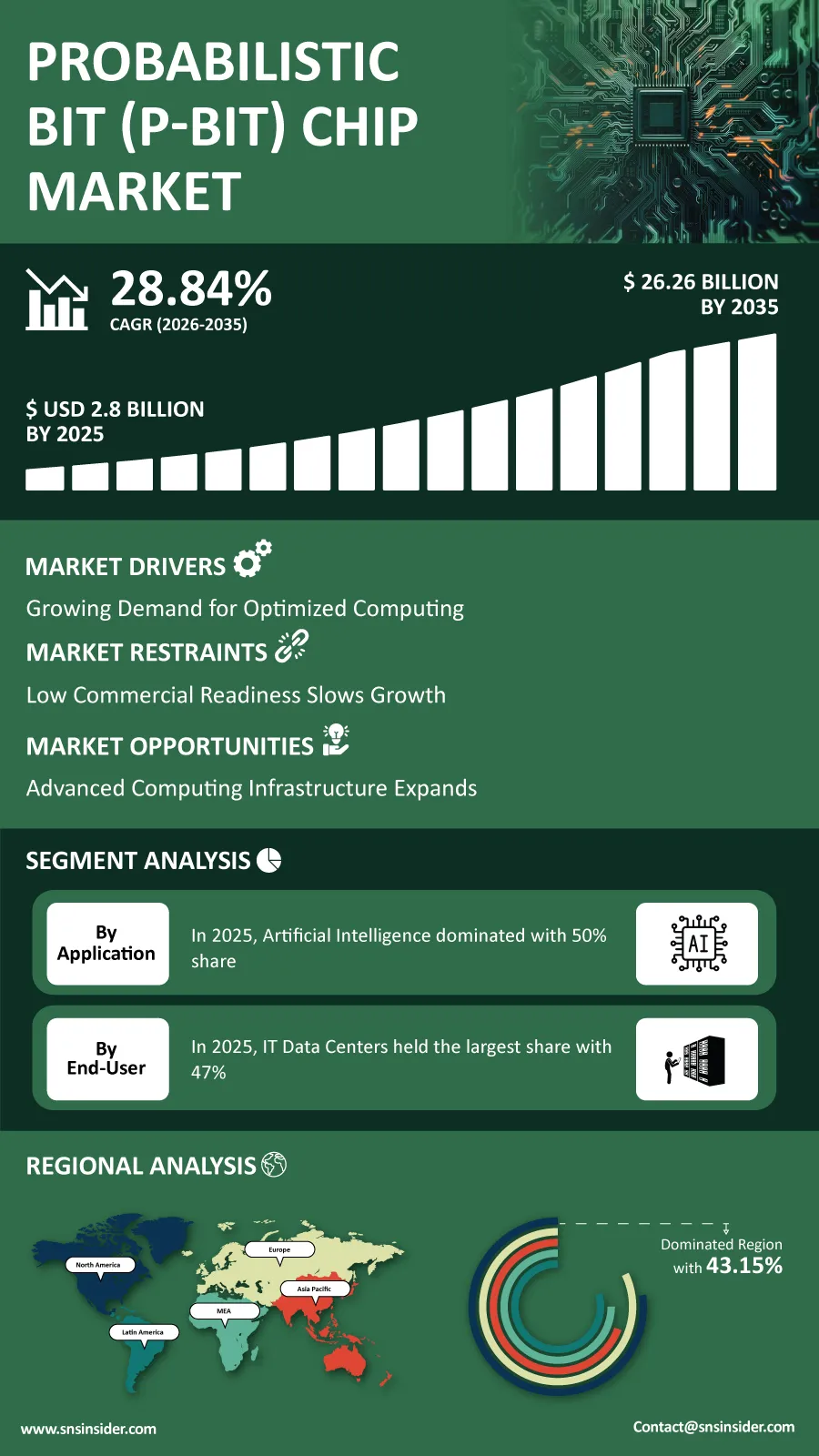
The global Probabilistic Bit (p-bit) Chip Market is poised for remarkable expansion over the coming decade due to the increasing investment by the sectors in advanced computing technologies that can handle more complex optimization and AI operations. According to a recent study by SNS Insider, the global Probabilistic Bit Chip Market size valued at USD 2.8 billion in 2025, is anticipated to grow to USD 26.26 billion by 2035, registering a CAGR of 28.84% over the 2026–2035 forecast period.
Due to the fast development of AI, machine learning, and super-computing systems, there is a need for new hardware architecture, which would offer better computation efficiency as well as reduction in energy usage. In search of an alternative to traditional deterministic processors, probabilistic computing becomes a perspective way of dealing with large scale optimization and inference problems with high energy efficiency.
Technological advances in semiconductors, probabilistic architectures, and spintronics will increase the prospects of p-bit chip applications in the market. Increasing attention towards sustainable computing infrastructure and data centers powered by artificial intelligence will motivate hardware manufacturers to produce efficient equipment for future computations.
To Get Detailed Insights on the Probabilistic Bit Chip Market – Request a Sample Report
Next-Generation Computing Investments Drive Market Expansion
The increased implementation of AI systems in various industries is putting immense stress on current computer infrastructures. Companies and research institutes are currently investigating new processor technologies that will be able to support complicated probabilistic computations without increasing power requirements.
The development of hyperscale data centers, government-supported semiconductor programs, and research initiatives is offering many chances to companies involved in making p-bit chips. Collaborations between private and public sectors that aim at advanced computation, quantum computing, and semiconductor innovations are fueling commercial activities across global regions.
Sustainability in the field of computing is also driving interest in energy-efficient processing technologies that would help in future AI computations along with helping companies meet their carbon reduction goals.
Key Market Insights Highlight Shifting Demand Patterns
By component type, p-bit processing units are set to constitute 48% of total global market revenue in 2025, owing to their importance in supporting probabilistic computing, AI inference, and optimization applications. The random number generator module is set to register the fastest growth rate until 2035 due to rising need for stochastic computing with very high accuracy.
Based on technology, the CMOS-based p-bit technology segment is estimated to contribute 52% of global market revenue in 2025, since it is compatible with the present semiconductor manufacturing process and faster commercialization prospects. The spintronic MTJ-based technology segment is set to witness the highest growth rate until 2035 as the technology advances towards scalability, efficiency, and ultra-low power consumption.
By application, artificial intelligence is expected to make up 50% of total global market revenue in 2025, backed by increasing adoption of probabilistic processors in applications of machine learning, inference, and analytics. The optimization computing application segment is set to be the fastest growing one as more industries turn to probabilistic hardware for solving scheduling, routing, simulation, and decision-making problems.
In terms of end users, IT data centers are expected to contribute 47% of global market revenue in 2025 due to the growing demand for energy efficient AI infrastructure and high-performance computing systems. The defense research institutions are set to experience the fastest growth rate until 2035 owing to increasing investments by governments into advanced computing technologies for simulation, cryptography, and other applications.
Energy-Efficient AI Hardware Gains Industry Momentum
Technology companies are now more inclined to use processor architecture that not only meets their computing requirements but also fits into sustainability objectives. It has been proven that probabilistic computing provides a solution to the increasing challenges of handling computing power in training and inference for AI algorithms and processing large datasets.
There is also a trend towards using hybrid computing systems that include p-bit accelerators along with the classical CPU and GPU. With such a solution, it is possible to boost computing power of particular tasks while utilizing existing computing facilities.
As semiconductor innovation continues to advance, improvements in device reliability, fabrication processes, and software ecosystems are expected to accelerate adoption across commercial, industrial, and research applications.
North America Held 43.15% Market Share in 2025, While Asia Pacific to Grow at 31.84% CAGR
North America held around 43.15% share in the global market revenue by 2025, on account of extensive investment in semiconductor research, increasing usage of AI technologies, and presence of top tech companies that are working on future computing technology architecture.
The Asia Pacific region is expected to have the fastest growing regional market, at a CAGR of 31.84%, over the forecast period from 2026 to 2035. The growing semiconductor manufacturing industry, increasing investments in AI technology, and rising implementation of high-performance computing systems are the major factors driving the market growth in the region.
As nations continue strengthening digital infrastructure and semiconductor capabilities, adoption of probabilistic computing technologies is expected to accelerate significantly throughout the forecast period.
Industry Participants Focus on Advanced Computing Innovation
The competitive landscape remains highly dynamic as semiconductor companies continue investing in probabilistic computing, AI accelerators, neuromorphic architectures, and next-generation semiconductor technologies. Strategic partnerships with research institutions, cloud providers, and government agencies are expected to accelerate product development and commercialization.
Key companies operating in the global Probabilistic Bit Chip Market include:
-
IBM Corporation
-
Intel Corporation
-
Google LLC (Alphabet)
-
Microsoft Corporation
-
NVIDIA Corporation
-
Advanced Micro Devices, Inc. (AMD)
-
Qualcomm Technologies Inc
-
Samsung Electronics Co. Ltd
-
Rain Neuromorphics
-
BrainChip Holdings Ltd
-
Graphcore Ltd
-
Tenstorrent
-
Groq Inc
-
Cerebras Systems Inc
-
D-Wave Systems Inc
-
Rigetti Computing Inc
-
Extropic Inc
-
Flo Labs
-
Analog Devices Inc
-
SynSense Group AG
An SNS Insider analyst Sushant Kadam commented, “Growing demand for energy-efficient artificial intelligence infrastructure and advanced optimization computing is accelerating interest in probabilistic chip architectures. Organizations that successfully combine scalable semiconductor design, low-power performance, and seamless integration with existing computing platforms will be well positioned to capitalize on this rapidly evolving market.”
About the Author

Get in touch