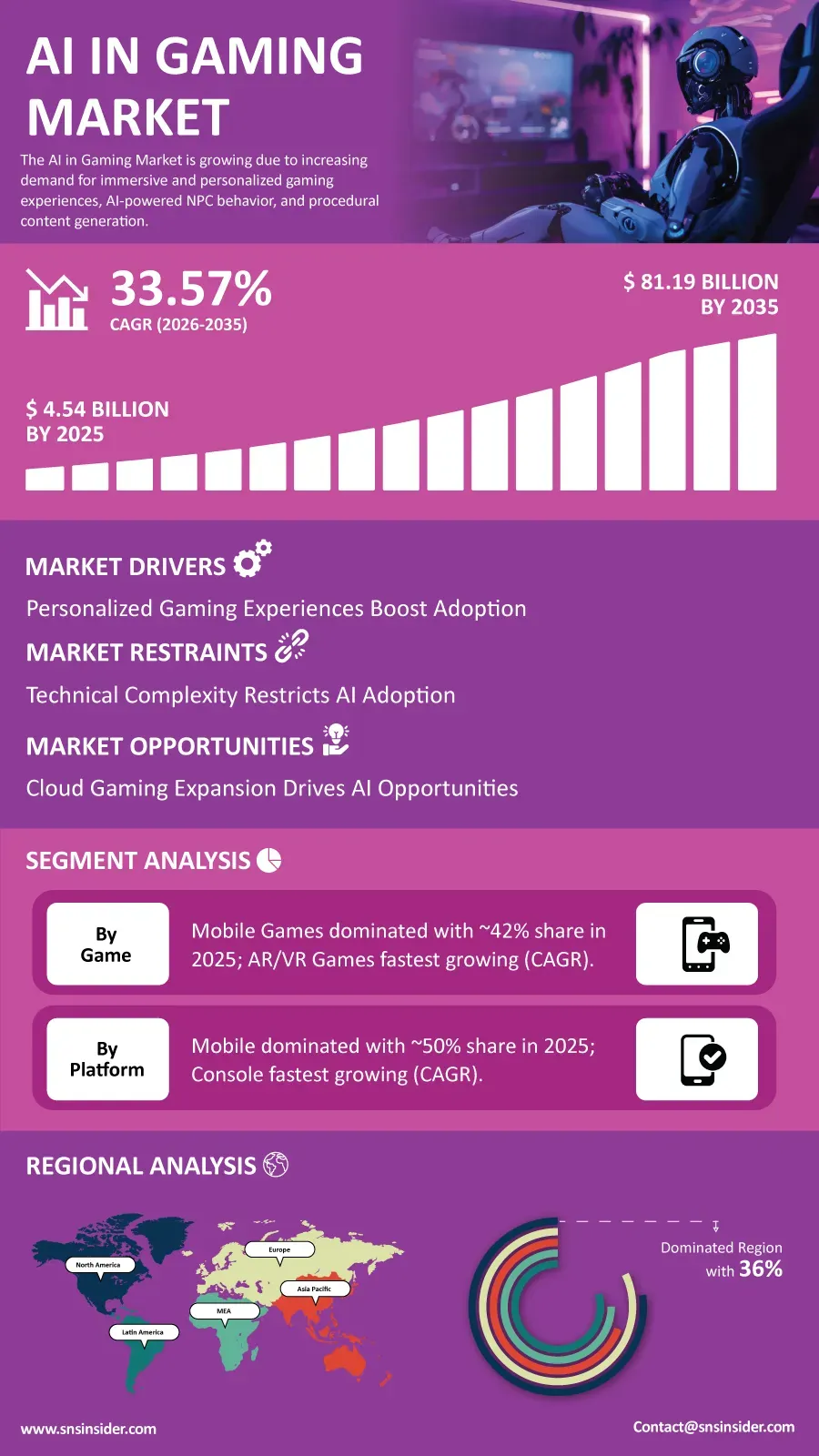
The global AI in Gaming Market is expected to witness remarkable expansion as game developers increasingly integrate artificial intelligence into game design, player engagement, and content creation. “According to a recent study by SNS Insider, the global AI in Gaming Market size valued at USD 4.54 billion in 2025, is anticipated to grow to USD 81.19 billion by 2035, registering a CAGR of 33.57% over the 2026–2035 forecast period.”
AI technologies have been evolving into an essential part of the gaming industry through their ability to make gameplay more realistic, enable smart NPCs, and adapt according to user behavior. Developers implement machine learning, computer vision, and natural language processing to make gaming more interactive for players while providing highly immersive entertainment at the same time.
The rising demand for cloud gaming services, eSports competitions, augmented and virtual reality, and many other trends in the industry is making more companies invest in intelligent game engines, automation of development processes, and predictive analytics to reduce development time and improve monetization and engagement rates.
To Get Detailed Insights on the AI in Gaming Market – Request a Sample Report
Intelligent Gaming Technologies Create Long-Term Growth Opportunities
The gaming companies have been making substantial investments in AI technologies that aid in each step of the game development process, ranging from asset creation to testing and optimization. The use of procedural content generation helps create huge virtual worlds while delivering unique experiences to users during every game session.
The gaming platforms based on cloud computing are opening up new ways of using AI, such as graphics optimization, matchmaking, streaming, and recommendation systems. These technologies will help deliver top-notch gaming experience without the need for powerful local hardware.
Additionally, the use of generative AI is transforming the way the creative process works by helping the developers code, animate, generate dialogues, and even create characters. With further advancements in AI technology, gaming companies will be able to implement more advanced game mechanics while cutting down costs and speeding up innovation.
Key Market Insights Highlight Shifting Demand Patterns
Based on game type, mobile games are estimated to account for approximately 42% of global market revenue in 2025 owing to widespread smartphone adoption, extensive global player communities, and increasing integration of AI-driven personalization features. The AR/VR games segment is expected to register the fastest growth through 2035 as immersive gaming technologies gain broader consumer acceptance.
By platform, the mobile segment is projected to generate nearly 50% of total market revenue in 2025 due to its accessibility, continuous player engagement, and seamless implementation of AI-powered gameplay enhancements. The console segment is anticipated to witness the highest growth over the forecast period as next-generation gaming hardware supports increasingly sophisticated AI capabilities and realistic gaming environments.
In terms of application, NPC behavior modeling held approximately 21% market share in 2025 because developers continue prioritizing intelligent non-player characters capable of responding dynamically to player actions. Procedural content generation is forecast to experience the fastest expansion through 2035 as studios increasingly utilize AI to automatically generate levels, environments, characters, and game assets that improve replayability and reduce development time.
Advanced Artificial Intelligence Accelerates Gaming Innovation
AI technology is revolutionizing game development today because it allows for intelligent behavior and decision-making, adaptive game mechanics, and realism in virtual worlds. With the help of AI models, developers are able to create more intelligent interaction between non-player characters, dynamic game balancing, automatic QA processes, and adaptive game experience based on user preference.
Game developers are also using AI to generate games in order to facilitate coding processes, animations, voices, and world building. This allows developers to speed up the process of development and dedicate their time to other tasks, such as story and gameplay creation.
North America Held Approximately 36% of the AI in Gaming Market Share in 2025; Asia Pacific Projected to Register the Fastest CAGR Through 2035
North America is likely to contribute 36% to the global market revenue in 2025 due to its highly advanced gaming environment, popular cloud gaming platform, robust technology infrastructure, and presence of game developers and AI technology vendors. The ongoing investments in the field of eSports, game streaming, and immersive entertainment will continue driving market leadership in the region.
Asia Pacific is expected to witness highest CAGR over the forecast period (2035) due to the fast adoption of smartphones, digital infrastructure development, increase in the number of gamers and AI technology investments. Countries like China, Japan, South Korea, and India are making significant progress in mobile gaming and consumer demands for immersive entertainment.
Europe is also an important contributing region to the market growth due to its highly advanced game development industry, increasing investments in AI technologies, and adoption of cloud gaming technologies. Latin America and the Middle East & Africa regions are also gaining traction due to improvements in digital connectivity and gaming adoption.
Industry Participants Focus on Innovation and AI-Driven Gaming Experiences
The competitive landscape remains highly dynamic as leading gaming companies, cloud providers, and AI technology firms continue investing in intelligent game development platforms, generative AI capabilities, cloud infrastructure, and advanced analytics solutions. Strategic collaborations, technology partnerships, and continuous research initiatives are enabling companies to develop highly immersive gaming environments while improving operational efficiency and player engagement across global gaming platforms.
Key companies operating in the global AI in Gaming Market include Microsoft Corporation, Electronic Arts Inc., NVIDIA Corporation, Unity Technologies, Epic Games Inc., IBM Corporation, Google LLC, Ubisoft Entertainment SA, Sony Interactive Entertainment, Tencent Holdings Ltd., Activision Blizzard Inc., Amazon Web Services (AWS), Valve Corporation, Take-Two Interactive Software Inc., Bandai Namco Entertainment Inc., Square Enix Holdings Co., Ltd., Konami Holdings Corporation, NetEase Games, Riot Games, and Roblox Corporation.
An SNS Insider analyst Sakshi Kale commented, “Artificial intelligence is fundamentally reshaping the future of interactive entertainment by enabling intelligent gameplay, personalized player experiences, and more efficient game development. Companies investing in generative AI, cloud gaming infrastructure, and advanced machine learning technologies will be well positioned to capitalize on the rapidly expanding global AI in Gaming Market.”
About the Author

Get in touch