
The worldwide AI in VFX Market is anticipated to notice a spectacular expansion as amusement organizations are progressively the use of fake knowledge tactical edge in visual outcomes creation, nicely-shielding creativity, workflow optimization and relations and clever manufacturing. “According to a recent study by SNS Insider, the global AI in VFX Market size valued at USD 4.87 billion in 2025, is anticipated to grow to USD 28.66 billion by 2035, registering a CAGR of 19.46% over the 2026–2035 forecast period.”
Rising consumer appetite for visually immersive cinema, streaming content, video gaming and digital advertising has incentivised production studios to leverage smart automation at every phase of the VFX pipeline. With the introduction of artificial intelligence, artists are able to finish more complex compositing, animation, rendering and scene generation tasks in a fraction of a time without an obvious visual quality drop.
Emerging graphics technologies in fields such as cloud-based rendering platforms, generative AI technologies and virtual production environments are changing the game. Machine learning methods can help artists with object tracking, facial animation, motion prediction and asset generation freeing creative teams of repetitive tasks that tend to be tedious.
To Get Detailed Insights on the AI in VFX Market – Request a Sample Report
Intelligent Production Technologies Create New Growth Opportunities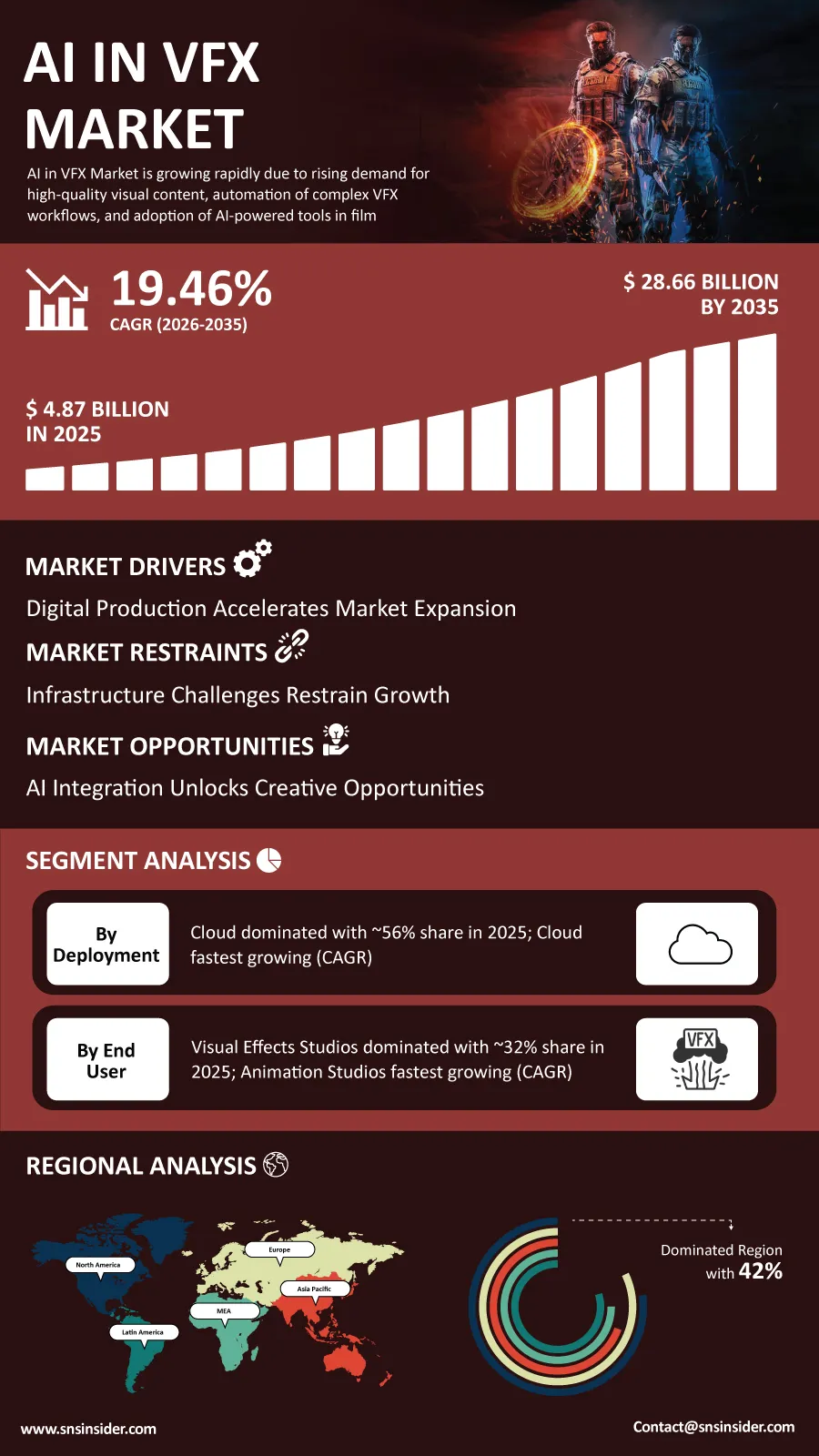
There is an ever-growing demand for high-quality digital content and so, film studios, gaming companies, advertising firms and streaming platforms are pouring billions into AI-enabled production technologies. This is the interplay of artificial intelligence with virtual production, real-time rendering, and cloud computing to facilitate highly scalable visual productions for larger and complex projects.
The additional prospects for AI-enabled visual effects solutions are being created by the way that repeated reality, computer generated reality, and metaverse experiences are rising. In-game animations, procedural environment generation and adaptive scene creation AWS allow developers to provide more interactive and immersive digital experiences on a wide range of media.
At the same time, deep learning, computer vision and generative artificial intelligence continues to evolve, allowing for greater realism in simulations, higher rendering speeds and even more creative scope. These innovations allow studios to shorten production cycles while providing audiences worldwide with ever more sophisticated visual experiences.
Key Market Insights Highlight Shifting Demand Patterns
By deployment, cloud is expected to contribute around 56% global market revenue share in 2025 as a result of its scalability, flexible computing resources and capability to provide collaborative production workflows amongst geographically distributed creative teams. You are trained with data until 2035 and more studios move toward on-demand rendering and cloud-native production environments.
Under end user, visual effects studios are expected to remain the largest revenue contributor during 2025 owing to their high adoption of artificial intelligence for compositing, rendering simulation and post-production automation in large-scale entertainment projects. Over the forecast period, animated films, streaming content and digital advertising are expected to drive growth at animation studios rapidly relative to other types of film production.
In 2025, deep learning continued to dominate the market due to its capability of automating image recognition, facial animation, scene reconstruction and most importantly predictive rendering with unparalleled accuracy. We expect motion capture to post the fastest growth through 2035 as AI-enabled tracking capabilities allow for improvements in the realism of characters & in-turn maintain production speed across media (film + game applications) in real-time. Based on the application, in 2025, film and television held a large market share whereas video games is expected to grow at the highest growth due to growing demand for immersive gameplay, procedural environments and real-time visual effects.
Advanced Artificial Intelligence Technologies Accelerate Industry Transformation
The definitive impact of Artificial Intelligence in visual effects production is shaping up and causing disruption with fast rendering, automated animation, intelligent compositing, data-driven creative workflows. Today, artists are able to create high quality visuals, [integrate] realistic digital faces, and even automate the most tedious of production tasks or improve efficiency all without relinquishing creative control with new AI platforms.
However, studios are increasingly building AI into game engines, throwing cloud rendering infrastructure and virtual production technologies around the tools with the goal of supporting collaborative workflows between globally distributed creative teams. With continuing advances in generative AI capabilities, intelligent production systems will likely be a key building block of next-gen content across entertainment, advertising, education and immersive digital experiences.
North America Held Approximately 42% of the AI in VFX Market Share in 2025; Asia Pacific Projected to Register the Fastest CAGR Through 2035
Due to the presence of major film production studios, an established digital effects market, and a higher degree of cloud infrastructure adoption as well as early AI technology adoption, North America is expected to hold about 42% share in global revenues by 2025. Regional market dominance has remained supported by robust investment from streaming platforms, gaming companies and digital media producers.
By 2035, Asia Pacific is expected to be the fastest-growing regional market driven by expanding film industries in China and India, increasing animation production in Japan and Korea, rising gaming investments across Southeast Asia and increasingly widespread adoption of cloud-based production technologies. Regional growth is also being bolstered by government promotion of digital media and creative industries.
Europe remains a key player in the wider AI in VFX landscape as a direct result of its strong creative industries, robust tech capabilities and growing use of intelligent production software. At the same time, Latin America and Middle East & Africa are gradually building a digital production base giving rise to new opportunities for AI-enabled visual effects solutions across new entertainment markets.
Industry Participants Focus on Innovation and Intelligent Content Creation
The competitive landscape features rapid developments as top software developers, graphics technology firms and visual effects service providers invest in generative AI, intelligent rendering platforms, cloud-based production tools, and real-time animation technologies. Strategic alliances, ongoing software advancements, and greater AI capabilities are allowing companies to deliver better production efficiency while also enabling much more complex creative workflows.
Key companies operating in the global AI in VFX Market include Adobe Inc., Autodesk Inc., Epic Games Inc., NVIDIA Corporation, Foundry Visionmongers Ltd., Weta Digital Ltd., Framestore Ltd., Industrial Light & Magic, Pixomondo, Digital Domain Holdings Ltd., Rodeo FX Inc., BOT VFX, Blur Studio, Animal Logic Pty Ltd., Metaphysic, Rebellion, Technicolor SA, Tippett Studio Inc., Deep Voodoo, and Wonder Dynamics.
An SNS Insider analyst Sakshi Kale commented, "Artificial intelligence is redefining the future of visual effects by enabling faster production cycles, higher creative efficiency, and unprecedented levels of realism across digital content. Companies investing in intelligent rendering technologies, generative AI platforms, and cloud-based production ecosystems will be well positioned to capitalize on the growing demand for next-generation visual storytelling."
About the Author

Get in touch




