
AI Clinical Documentation Market Report Scope & Overview:
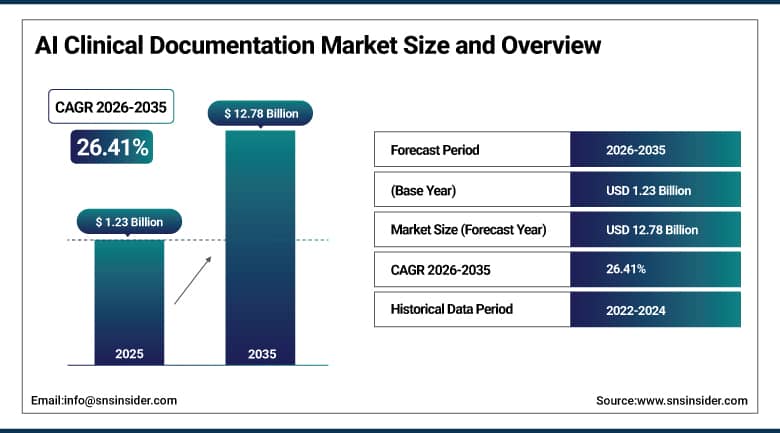
The AI Clinical Documentation Market was valued at USD 1.23 Billion in 2025 and is expected to reach USD 12.78 Billion by 2035, growing at a CAGR of 26.41% from 2026 to 2035.
The market is growing because of the increasing administrative burden placed on healthcare professionals, the rise in physician burnout linked to manual documentation, and the increased adoption of AI-driven workflow automation in healthcare systems. Health care providers are turning more and more to generative AI, ambient listening technologies and natural language processing platforms to automate the creation of clinical notes and make documentation more accurate. Moreover, growing investments for digital health transformation, increasing adoption of electronic health records, and growing demand for operational efficiency are further supporting the growth of the market. The growth prospects of healthcare ecosystems are also being strengthened in the long run by the rise of speech recognition technology and AI-powered clinical workflows.
In March 2025, Microsoft-owned Nuance Communications enhanced its generative AI-powered documentation capabilities for healthcare providers, further expanding its ambient clinical intelligence capabilities. In January 2026, Oracle Health extended its EHR ecosystem with AI-enabled clinical documentation capabilities to automate physician note capture and improve administrative efficiency.
To Get More Information On AI Clinical Documentation Market - Request Free Sample Report
Market Trends:
-
Increasing adoption of ambient AI and generative AI technologies is transforming physician documentation workflows globally.
-
Healthcare providers are increasingly investing in AI-assisted clinical note generation and speech recognition solutions to reduce administrative burden.
-
Growing integration of AI clinical documentation platforms with electronic health record systems is improving workflow efficiency and data accuracy.
-
Rising focus on physician productivity and burnout reduction is accelerating deployment of automated clinical documentation technologies.
-
Expanding investments in digital healthcare infrastructure are supporting the adoption of intelligent clinical workflow automation platforms worldwide.
U.S. AI Clinical Documentation Market Outlook:
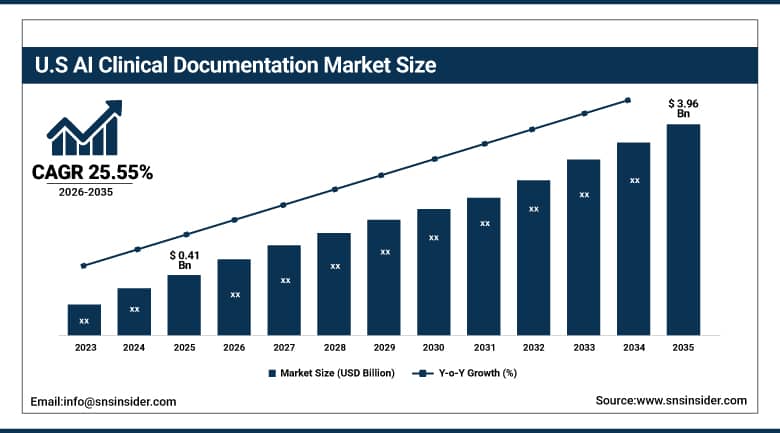
The U.S. AI Clinical Documentation Market was valued at USD 0.41 Billion in 2025 and is expected to reach USD 3.96 Billion by 2035, growing at a CAGR of 25.55% from 2026 to 2035.
Increasing workloads on physicians documentation, increasing adoption of artificial intelligence in healthcare administration, and increasing demand for workflow automation technologies are driving the growth of the market. Healthcare organisations are increasingly implementing ambient listening systems, natural language processing platforms and generative AI tools to enhance documentation accuracy and reduce clinician burnout. Growing initiatives for healthcare digitalisation and increasing investments for electronic health record optimisation are further supporting growth in the market. Nationwide, the focus on physician productivity and operational efficiency keeps growing, which is driving the adoption of intelligent clinical documentation technologies.
Nuance Communications announced in March 2025 enhanced generative AI features for its Dragon Ambient eXperience platform to automate physician documentation workflows. In January 2026, Oracle Health expanded its AI-powered clinical documentation features to allow instantaneous note creation and administrative workflow enhancements.
AI Clinical Documentation Market Segment Analysis:
-
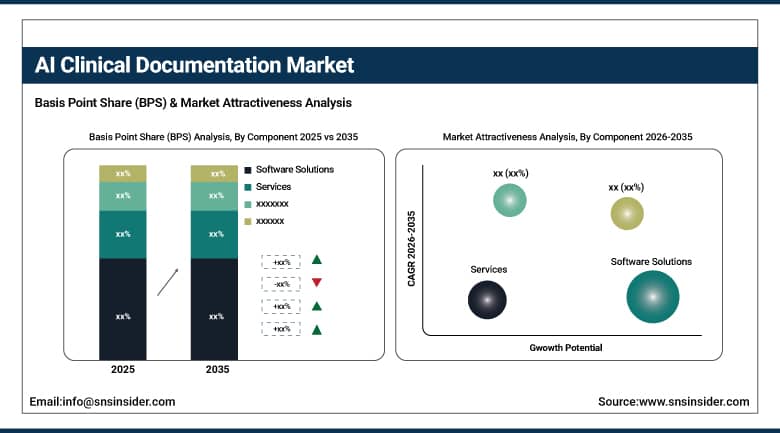
By Component, Software Solutions dominated the AI Clinical Documentation Market with approximately 57.00% share in 2025, while Services are the fastest-growing component segment from 2026 to 2035.
-
By Deployment Mode, Cloud-based Deployment dominated the market with approximately 68.00% share in 2025, while Hybrid Deployment is the fastest-growing deployment segment from 2026 to 2035.
-
By Application, EHR Documentation Automation dominated the market with approximately 35.00% share in 2025, while Clinical Documentation Improvement is the fastest-growing application segment from 2026 to 2035.
-
By End User, Hospitals & Health Systems dominated the market with approximately 52.00% share in 2025, while Ambulatory Care Centers are the fastest-growing end-user segment from 2026 to 2035.
By Component, Software Solutions dominate, Services grow fastest
Software Solutions dominated the AI Clinical Documentation Market in 2025 and held approximately 57% revenue share. AI-driven Documentation Platforms have been developed in healthcare organisations to automate clinical documentation generation, decrease administrative burden, and improve documentation quality. Another factor that further consolidated segmental leadership is the integration of AI technologies with EHRs.
The Services segment is expected to witness the fastest CAGR during the forecast period, attributed to the increasing demand for implementation, integration, customization, and services. There is an increasing need for expertise in implementing AI-driven documentation tools.
By Deployment Mode, Cloud-based Deployment dominates, Hybrid Deployment grows fastest
Cloud-based Deployment dominated the market in 2025 and accounted for approximately 68% revenue share. The segment benefited from lower infrastructure requirements, scalability and integration capabilities across healthcare organisations. In addition, increasing inclination towards subscription-based healthcare software models further propelled adoption.
The Hybrid Deployment is projected to witness the highest CAGR during the forecast period owing to the rising demand for flexible data management approaches that combine cloud scalability with improved data governance and security requirements.
By Application, EHR Documentation Automation dominates, Clinical Documentation Improvement grows fastest
Metal forming dominated the AI Clinical Documentation Market in 2025 and held approximately 38% revenue share. Health care organizations started using AI-enabled automation solutions that facilitated writing of notes, made record keeping more accurate and simplified documentation process for medical practitioners.
Clinical Documentation Improvement is expected to register the fastest CAGR, driven by growing demands for accurate clinical records, better reimbursement and better quality reporting.
By End User, Hospitals & Health Systems dominate, Ambulatory Care Centers grow fastest
Hospitals & Health Systems dominated the market in 2025 and accounted for approximately 52% revenue share. Large healthcare providers are increasingly leaning towards adopting AI-based documentation systems in order to enhance productivity of doctors as well as improve their workflows and cope with increased demand for patient documentation.
The segment of Ambulatory Care Centers is expected to witness the highest CAGR during the forecast period due to increasing digitization initiatives along with increasing demand for efficient documentation processes.
Regional Analysis:
|
Region |
Major Country |
Share within Region, 2025 (%) |
|---|---|---|
|
North America |
United States |
82.72% |
|
Europe |
Germany |
22.80% |
|
Asia Pacific |
China |
39.50% |
|
Middle East |
UAE |
28.60% |
|
Latin America |
Brazil |
43.90% |
North America AI Clinical Documentation Market Insights
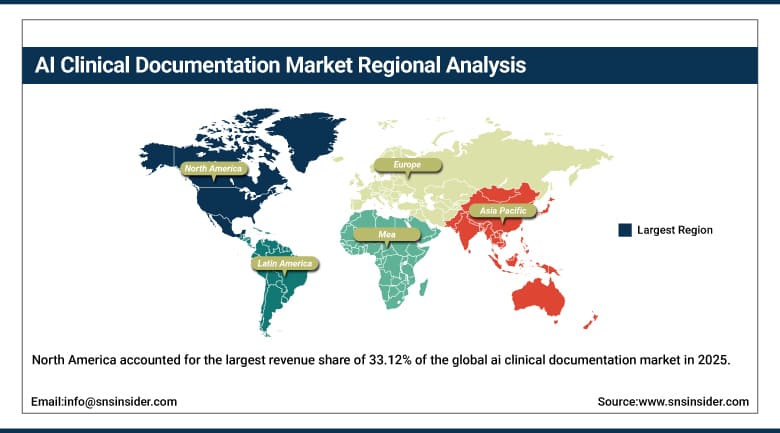
North America accounted for the largest revenue share of 33.12% of the global ai clinical documentation market in 2025. The region’s leadership was supported by widespread adoption of electronic health records, an existing healthcare IT infrastructure and greater use of AI-based clinical documentation tools. Healthcare facilities are using ambient listening, generative AI applications and workflow automation to improve the efficiency of doctors and reduce the administrative burden of clinical documentation.
North America held 82.72% share of the total revenue i.e. US$ 1.7 billion, due to huge investments in AI in healthcare and adoption of intelligent clinical documentation solutions in USA. AI-assisted documentation solutions are being incorporated by many healthcare institutions into electronic health record systems to increase efficiency. Canada is also supporting the growth of the regional market by investing in the digital health transformation and AI-based clinical workflows.
Get Customized Report as Per Your Business Requirement - Enquiry Now
Europe AI Clinical Documentation Market Insights
The Europe region held around 31.57% of the global ai clinical documentation market revenue share in 2025. The fast adoption of artificial intelligence-enabled documentation tools in the region can be attributed to the increasing efforts towards healthcare digitalisation and a heightened focus on administrative efficiency. Hospitals and health systems are increasingly adopting natural language processing tools, speech recognition tools and documentation software that use artificial intelligence.
The Germany market held the largest revenue share of more than 22.80% of the European market, due to the strong IT infrastructure of the healthcare system in the country, and increasing adoption of digital healthcare technologies. The UK and France are increasingly using AI assisted documentation tools to ease administrative burden and improve efficiency of healthcare processes.
Asia Pacific AI Clinical Documentation Market Insights
Asia Pacific held around 28.41% share of the global revenues in 2025 and is projected to grow at the fastest pace during the forecast period. Region is boosting due to increasing healthcare modernisation initiatives, increasing healthcare IT expenditure and increasing implementation of artificial intelligence technologies in hospitals and healthcare systems. Healthcare providers are increasingly focusing on smart workflow automation and AI-enabled documentation platforms to improve operational efficiency and clinical record management.
Rapid digitalisation of healthcare and huge investments in AI-powered healthcare technologies, in turn, made China account for some 39.50% of regional revenues. India and Japan are increasingly turning to AI-enabled clinical documentation systems, which boost the productivity of healthcare and help support digital health initiatives. Asia Pacific remains the fastest growing regional market with increasing investments in cloud infrastructure and healthcare automation technologies.
Middle East & Africa & Latin America AI Clinical Documentation Market Insights
The Middle East and Latin America combined contributed some 6.90% to the world’s revenues in 2025. The growing healthcare digitalisation initiatives, increasing healthcare infrastructure and rising adoption of cloud-based healthcare technologies support the market growth in these regions. Clinical efficiency and patient management are being improved by healthcare organisations through the adoption of electronic medical records, workflow automation technologies and AI-assisted documentation platforms.
Brazil dominated the Latin American market, with greater investment in healthcare IT and hospital infrastructure upgrades. UAE invested more in digital healthcare infrastructure and AI technologies to enhance healthcare delivery and administrative efficiency. Increasing adoption of digital health platforms and growing government support for transformation of healthcare are creating favourable conditions for the growth of the regional market.
Market Dynamics:
Growth Drivers: Rising physician burnout and increasing administrative workload
Increasing documentation needs and growing administrative tasks have led to a surge in global demand for AI-based clinical documentation solutions. Healthcare organisations are increasingly automating the note-taking process to reduce clinicians’ documentation efforts using ambient AI technology, speech recognition and natural language processing.
The health sector is only likely to place greater emphasis on investment in intelligent documentation solutions due to the prevalence of EHRs and the desire for more efficiency. Hospitals and physician groups are now using AI-powered documentation solutions to improve the accuracy of records and streamline workflows to avoid physician burnout.
Restraints: Data privacy concerns and integration complexities
Using the highly sensitive patient data through an AI-based documentation solution poses several risks related to data privacy, cybersecurity, and compliance requirements. There is still room for improvement in the creation of safe data environments along with the compliance with the rules that regulate the use of patient healthcare data. Problems associated with security and access to the data pose essential obstacles on the way of implementing such technologies.
Another challenge in using AI documentation systems is the difficulty of integration with existing EHR solutions of most healthcare facilities. The limited interoperability, high cost of the process, and the complex implementation process create obstacles for small-scale healthcare organizations in their efforts to use the technology.
Opportunities: Expansion of generative AI and ambient clinical intelligence
The AI Clinical Documentation Market is growing rapidly due to fast progress in generative artificial intelligence and ambient clinical intelligence technologies. Increasingly, healthcare providers are adopting AI systems that can automatically generate clinical notes, summarise patient encounters and support documentation processes in real time. These technologies improve documentation efficiency, decrease physician workload and enhance overall clinical workflow performance in healthcare organisations.
Increasing investments in healthcare digital transformation and intelligent workflow automation are creating new opportunities for next-generation documentation platforms. Healthcare organisations are increasingly adopting AI-powered clinical workflow solutions that integrate with electronic health records and offer real-time decision support capabilities. The proliferation of digital healthcare ecosystems and the wider adoption of ambient AI technologies are anticipated to drive sustained long-term growth and innovation across healthcare systems worldwide.
Recent Developments:
-
March 2025: Microsoft-owned Nuance Communications expanded generative AI capabilities within Dragon Ambient eXperience to improve automated clinical documentation workflows.
-
February 2025: Oracle Health introduced enhanced AI-assisted documentation capabilities designed to automate physician note creation and improve EHR workflow efficiency.
-
January 2026: Abridge expanded its ambient AI platform by introducing advanced real-time clinical note generation functionalities for healthcare providers.
-
December 2025: Suki AI launched new generative AI features supporting automated clinical documentation and improved physician workflow efficiency.
Key Players:
-
Nuance Communications, Inc.
-
Oracle Health
-
Abridge AI, Inc.
-
Suki AI, Inc.
-
Augmedix, Inc.
-
DeepScribe Inc.
-
Microsoft Corporation
-
3M Health Information Systems
-
Dolbey Systems, Inc.
-
M*Modal
-
Commure, Inc.
-
athenahealth, Inc.
-
Epic Systems Corporation
-
eClinicalWorks LLC
-
NextGen Healthcare, Inc.
-
Cerner Enviza
-
Veradigm LLC
-
AvoMD, Inc.
-
Nabla Technologies
-
Saykara Inc.
AI Clinical Documentation Market Report Scope:
| Report Attributes | Details |
|---|---|
| Market Size in 2025 | USD 1.23 Billion |
| Market Size by 2035 | USD 12.78 Billion |
| CAGR | CAGR of 26.41% From 2026 to 2035 |
| Base Year | 2025 |
| Forecast Period | 2026-2035 |
| Historical Data | 2022-2024 |
| Report Scope & Coverage | Market Size, Segments Analysis, Competitive Landscape, Regional Analysis, DROC & SWOT Analysis, Forecast Outlook |
| Key Segments | • By Component (Software Solutions, Services, and Platforms) • By Deployment Mode (Cloud-based, On-premise, and Hybrid Deployment) • By End User (Hospitals & Health Systems, Physician Practices, Ambulatory Care Centers, and Specialty Clinics) • By Application (Clinical Documentation Improvement, Medical Transcription & Speech Recognition, EHR Documentation Automation, and Coding & Revenue Cycle Management) |
| Regional Analysis/Coverage | North America (US, Canada, Mexico), Europe (Eastern Europe [Poland, Romania, Hungary, Turkey, Rest of Eastern Europe] Western Europe] Germany, France, UK, Italy, Spain, Netherlands, Switzerland, Austria, Rest of Western Europe]), Asia Pacific (China, India, Japan, South Korea, Vietnam, Singapore, Australia, Rest of Asia Pacific), Middle East & Africa (Middle East [UAE, Egypt, Saudi Arabia, Qatar, Rest of Middle East], Africa [Nigeria, South Africa, Rest of Africa], Latin America (Brazil, Argentina, Colombia, Rest of Latin America) |
| Company Profiles | Nuance Communications, Inc., Oracle Health, Abridge AI, Inc., Suki AI, Inc., Augmedix, Inc., DeepScribe Inc., Microsoft Corporation, 3M Health Information Systems, Dolbey Systems, Inc., M*Modal, Commure, Inc., athenahealth, Inc., Epic Systems Corporation, eClinicalWorks LLC, NextGen Healthcare, Inc., Cerner Enviza, Veradigm LLC, AvoMD, Inc., Nabla Technologies, Saykara Inc. |
Frequently Asked Questions
The AI Clinical Documentation Market is expected to grow at a CAGR of approximately 26.41% during the forecast period.
The AI Clinical Documentation Market was valued at approximately USD 1.23 Billion in 2025.
Rising physician documentation burden, increasing adoption of ambient AI technologies, and growing healthcare digital transformation initiatives are major factors driving market growth globally.
Software Solutions dominated the market in 2025 due to increasing adoption of AI-powered documentation platforms and workflow automation technologies across healthcare organizations.
North America dominated the AI Clinical Documentation Market in 2025 due to extensive healthcare digitalization, strong EHR adoption, and increasing deployment of AI-driven clinical documentation solutions across the United States and Canada.
