
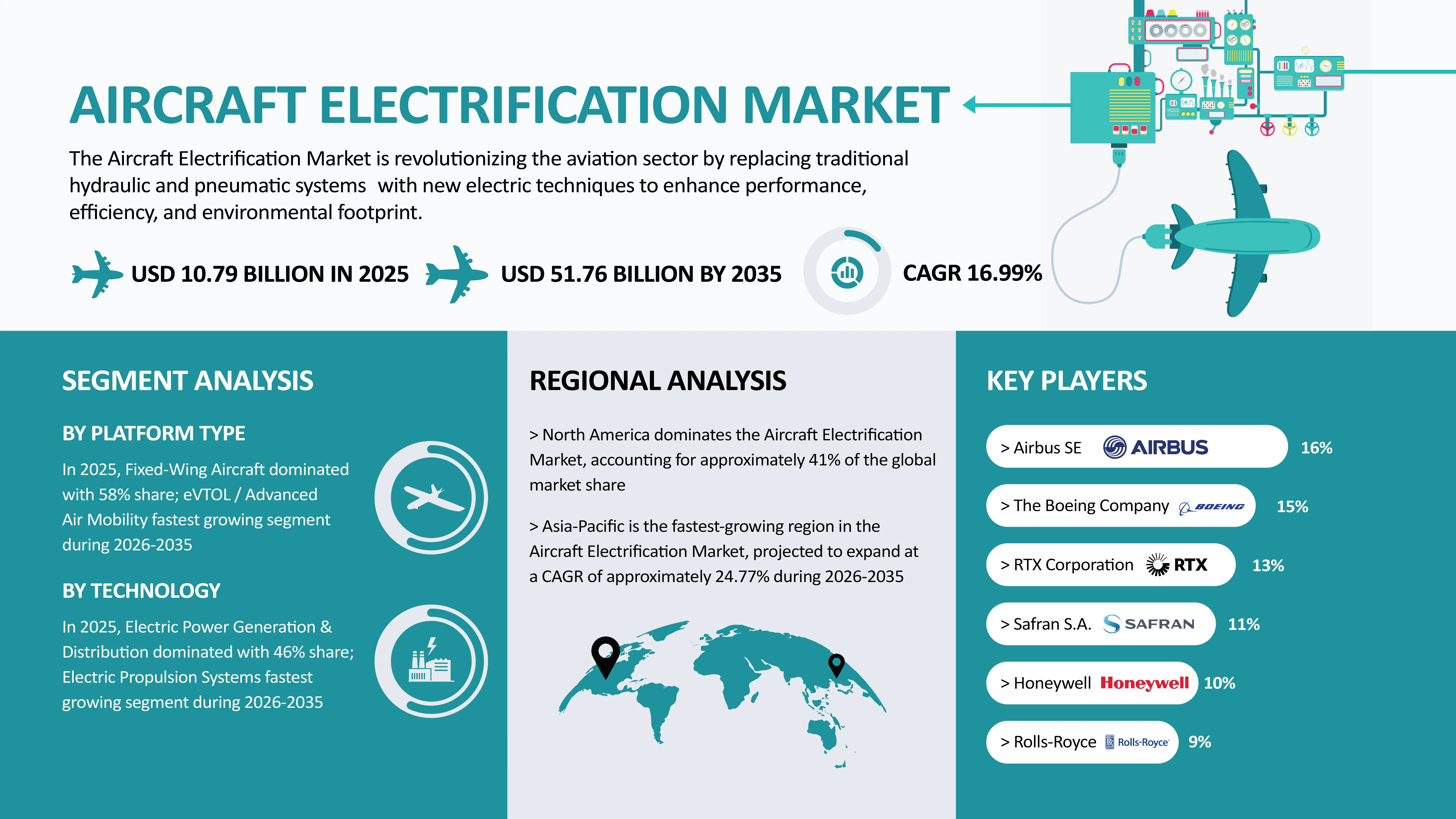
As per the SNS Insider Report titled, Aircraft Electrification Market by Platform Type, by Technology, by Application, by Energy Storage, and Region | Global Forecast 2026-2035, “The global Aircraft Electrification Market size valued at USD 10.79 billion in 2025, is anticipated to grow to USD 51.76 billion by 2035, registering a CAGR of 16.99% over the 2026–2035 forecast period.”
Key Takeaways
-
Fixed-Wing Aircraft held about 58% of the market share in 2025, attributable to rising usage of electrified components in commercial as well as military aircraft.
-
The eVTOL / Advanced Air Mobility segment is likely to grow at the fastest rate during 2026-2035, mainly due to rising spending on urban air mobility and future electric aircraft.
-
The Electric Power Generation & Distribution segment dominated the technology segment with almost 46% share of total revenue in 2025, attributed to the rising need for advanced onboard power management solutions.
-
The Electric Propulsion Systems segment is poised to grow at the fastest rate through 2035, backed by efforts from aerospace manufacturers towards hybrid and electric aircraft development.
-
The Flight Control Systems segment held nearly 39% of the market share in 2025, boosted by rising electrification of aircraft flight control systems.
-
The Environmental Control Systems segment is likely to emerge as the fastest growing application segment during the forecast period owing to rising emphasis on energy efficiency and passenger comfort.
-
Lithium-Ion Batteries captured nearly 67% of market revenue in 2025, due to their proven performance and energy efficiency and widespread use in aviation electrification initiatives.
-
North America led the regional segments in terms of revenue generation, capturing almost 41% of total global revenue in 2025, attributed to superior aerospace manufacturing capability.
 Why Aircraft Electrification Market is Growing?
The market for Aircraft Electrification is witnessing considerable growth, owing to efforts made by the aviation industry to provide sustainable alternatives to existing aircraft systems. Due to rising concerns to lower greenhouse emissions and improve fuel efficiency, as well as meet the goals of decarbonization, the aerospace industry is embracing electric technologies in various aspects of aircraft functioning.
Electrification allows achieving great savings in terms of fuel economy, maintenance expenses, and overall weight of aircraft. Aerospace firms are progressively replacing hydraulic, pneumatic, and mechanical aircraft components with electric ones to achieve greater sustainability.
In addition to support from the government to promote sustainable aviation and progress in electric battery technologies, as well as electric propulsion research, the development of advanced air mobility and eVTOL technologies opens up ample avenues for expansion of the industry.
Aircraft Electrification Market Statistics
-
The international community involved in aviation is spending large amounts of money on innovations that would minimize emissions of aircraft and increase their energy efficiency.
-
There is still plenty of investment in projects involving electric and hybrid-electric aircraft from both aerospace industry players and government agencies and venture capital funds.
-
Battery innovations are making these sources of power more efficient, safer, and better performing.
-
Projects connected with urban air mobility create additional demand for lightweight electric propulsion systems and energy storage innovations.
-
There are increased efforts made by airplane manufacturers to substitute traditional hydraulic and pneumatic systems with electric systems.
-
There is an increase in research and development related to hydrogen fuel cell and batteries innovations in the aerospace industry.
Emerging Trends
In the Aircraft Electrification Market, there is considerable innovation taking place regarding electric propulsion, energy storage, and power management systems. Aerospace companies are coming up with hybrid-electric propulsion architecture that will incorporate conventional propulsion and electric power systems.
A technology that holds a lot of promise in the coming years is solid-state batteries, which have an edge over traditional lithium-ion batteries in terms of increased efficiency and long-life span, as well as added security. Another area worth noting here is hydrogen fuel cells, which can enable zero emission longer range flight operation in the coming years.
An important area is the rapid progress being made in relation to eVTOL (electric vertical take-off and landing) aircraft, which are part of an advanced air mobility ecosystem. This is another area where there will be considerable use of electrical technology.
Top 10 Companies
-
The Boeing Company
-
Airbus SE
-
RTX Corporation
-
Safran S.A.
-
Honeywell International Inc.
-
Rolls-Royce Holdings plc
-
GE Aerospace
-
BAE Systems plc
-
Thales Group
-
MagniX
About the Author

Get in touch




