
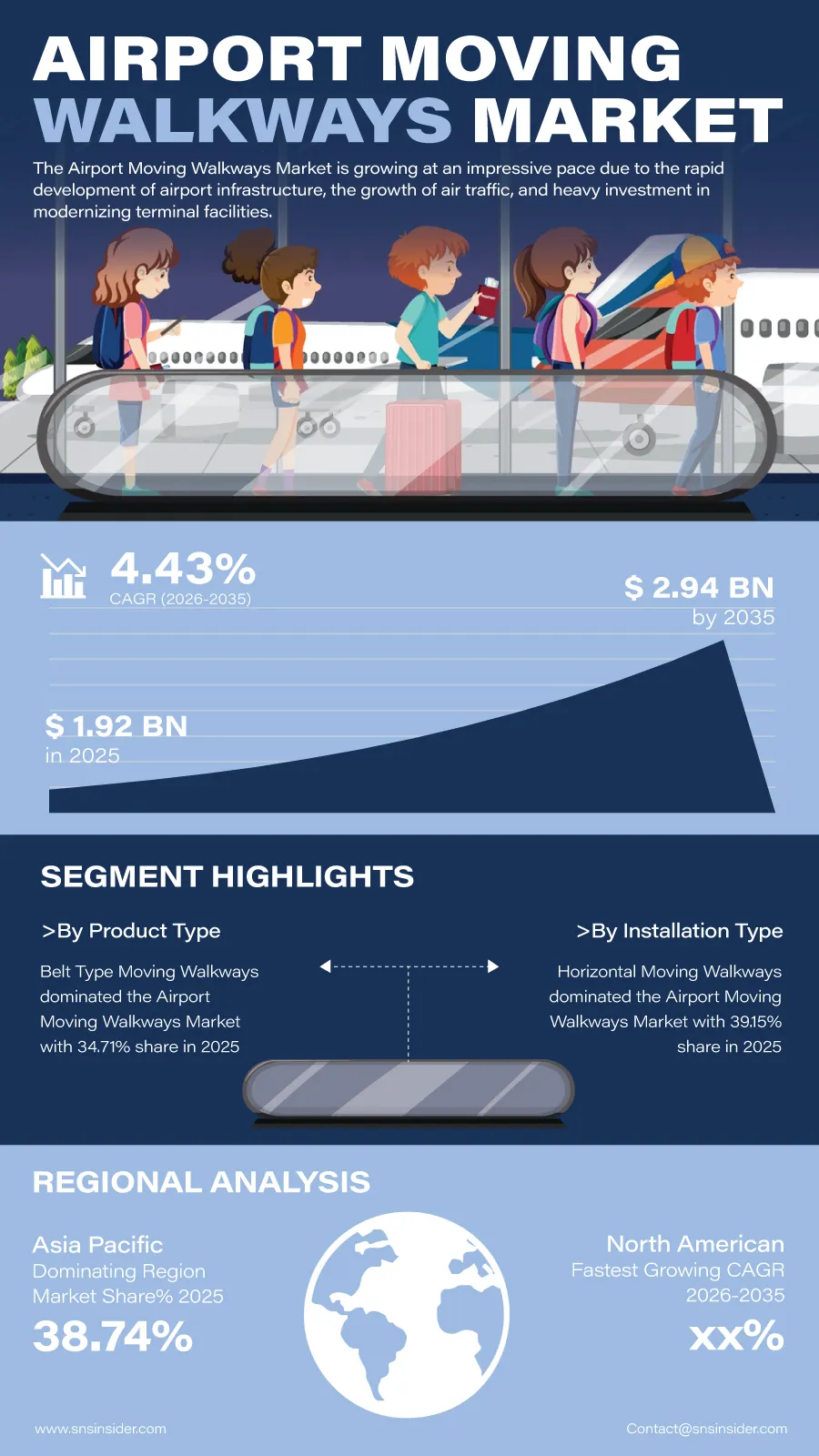
The global Airport Moving Walkways Market is expected to exhibit stable growth in the coming decade owing to growing infrastructure development by airport bodies in terms of intelligence-driven mobility systems at airports. “According to a recent study by SNS Insider, the global Airport Moving Walkways Market size valued at USD 1.92 billion in 2025, is anticipated to grow to USD 2.94 billion by 2035, registering a CAGR of 4.43% over the 2026–2035 forecast period.”
With the consistent recovery of global aviation services along with the introduction of airport modernization plans, it is becoming increasingly important for operators to invest in technology that enables them to facilitate movement and also make their terminal management more efficient. Moving walkways have become an integral part of contemporary airports and assist in decreasing transit time in large terminals.
To Get Detailed Insights on the Airport Moving Walkways Market – Request a Free Sample Report
The incorporation of automated transportation systems within new terminals is being included in the planning process as well by the infrastructure planners. As the passengers' needs change, airports are now considering mobility options that can ensure reliability and sustainability along with being technologically sound.
Smart Airport Investments Continue to Transform Passenger Mobility
The global aviation infrastructure is now undergoing the next wave of modernization as there are substantial investments made towards the construction of next-generation airports and advanced transportation systems. Larger airports are now increasingly turning to connected mobility systems that can handle greater numbers of passengers efficiently.
Digital transformation is becoming increasingly important as a part of this process. The airport managers are now integrating predictive maintenance solutions, intelligent monitoring systems, and automated control systems to increase efficiency and reduce downtime in equipment. This is helping in increasing investment prospects for mobility infrastructure providers.
On the other hand, sustainability activities continue to be one of the major priorities in airport development. Modern energy-efficient drive systems, regenerative mechanisms, and environmental infrastructures are already regarded as a standard component in terminal expansion due to the high targets that have been set by aviation authorities to reduce the level of carbon emissions.
Key Market Insights Highlight Evolving Infrastructure Priorities
Moving Walkways Belt Type occupied a share of 34.71% of the global market revenue in 2025 due to its extensive usage in airport terminals along passenger travel routes.
Modular Pallet Walkway category is anticipated to witness the highest growth rate till 2035 on account of growing demand for flexible mobility systems that can cope up with increasing size of the airport facilities.
By installing type, the horizontal moving walkways captured 39.15% of market revenues in 2025 owing to their widespread usage in busy passenger passages. On the other hand, multi-level connectivity walkways are estimated to register the highest growth rates as airports develop intricate multi-terminal transportation systems.
International airports formed 44.37% of the overall market revenue for 2025 due to constant efforts to develop terminals and increased global passenger traffic. The greenfield airport development is expected to record the highest growth rate during the forecast period.
In terms of technology, the smart sensor-based walkways accounted for 31.28% market share in 2025, whereas the AI-enabled passenger flow monitoring system is expected to record the highest growth rate in technology segments.
An Infographic Representation of the Global Airport Moving Walkways Market
Passenger Experience and Operational Efficiency Remain Central to Future Development
The airport authorities continue striving to strike the balance between the increasing numbers of passengers and the need for speedier, safer, and better services at the airports. The automatic transport system is now seen as an important component of the airport's infrastructure, making the terminals more connected, and providing accessible transport options for elderly people, families, and passengers with limited mobility.
In response, manufacturers are designing systems with improved safety features, reduced noise level, decreased maintenance requirements, and increased energy efficiency. Real-time monitoring of the equipment condition, provided by integration with the airport management software, makes the maintenance planning more efficient.
Such innovations are likely to boost long-term demand as airports require infrastructure that will enable them to handle increasing traffic levels without affecting passenger comfort or reliability.
Regional Markets Continue Expanding Through Infrastructure Modernization
The Asia-Pacific region held 38.74% of the revenue share in the global Airport Moving Walkways Market in 2025, and is expected to lead as the fastest-growing regional market over 2025-2035, driven by growing airport construction, rising air traffic both domestically and internationally, and investments in aviation infrastructure in countries like China, India, Japan, South Korea, and Southeast Asian nations.
The North America region too holds good potential for growth, backed by consistent renovation of terminals, smart airports, and extensive investments made in various international airports. Modernization drives are making it more and more favorable to install intelligent transportation systems at airports.
The Europe region is constantly progressing with sustainable airport mobility projects that help achieve operational efficiency and low environmental impact. In developing markets of Latin America and the Middle East, there is opportunity created by developments in airports and growth in tourism.
Industry Leaders Strengthen Focus on Intelligent Mobility Solutions
The competition within the Airport Moving Walkways Market is focused on the technological innovations and energy efficiency and performance throughout the life cycle of products. The main market participants are enhancing their smart mobility solutions through investments in such components as diagnostics, predictive maintenance, regenerative drive technology, and passenger safety systems.
Key companies operating in the global Airport Moving Walkways Market include KONE Corporation, TK Elevator, Otis Worldwide Corporation, Schindler Group, Mitsubishi Electric Corporation, Fujitec Co. Ltd., Hitachi Ltd., Toshiba Elevator and Building Systems Corporation, Hyundai Elevator Co. Ltd., Stannah Lifts Holdings Ltd., Sigma Elevator Company, Kleemann Hellas SA, Gulf Elevator & Escalator Co. Ltd., Analogue Holdings Limited, SJEC Corporation, Sicher Elevator Co. Ltd., Canny Elevator Co. Ltd., Orona Group, Savaria Corporation, and Stein Ltd.
An SNS Insider analyst Santosh Bhul commented, "Airport mobility infrastructure is becoming increasingly intelligent as operators invest in automation, digital monitoring, and sustainable transportation technologies. Organizations that deliver reliable, energy-efficient, and connected walkway systems will be well positioned to benefit from long-term airport expansion and modernization initiatives worldwide."
About the Author

Get in touch




