
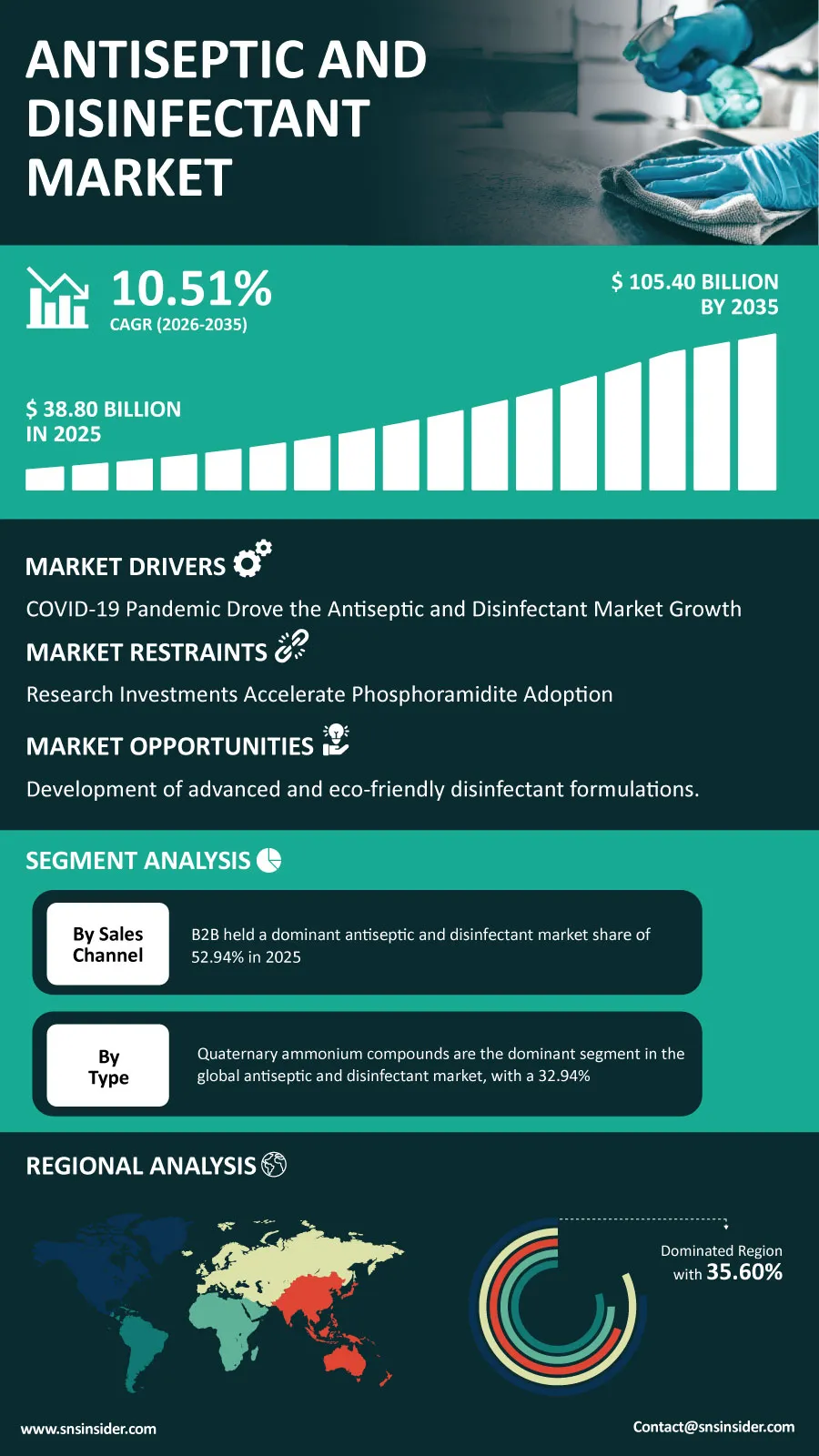
The global Antiseptic and Disinfectant Market is witnessing robust momentum as governments, healthcare providers, businesses, and consumers continue to prioritize infection prevention and hygiene standards across everyday environments. “According to a recent study by SNS Insider, the global Antiseptic and Disinfectant Market size valued at USD 38.80 billion in 2025, is anticipated to grow to USD 105.40 billion by 2035, registering a CAGR of 10.51% over the 2026–2035 forecast period.” Growing investments in healthcare infrastructure, increased demand for environmentally responsible hygiene products, and continuous product innovation are expected to sustain long-term market expansion.
The scope of demand has increased significantly from hospitals to include other sectors such as education facilities, hotels, food processing plants, transport systems, and even homes. This has been met with a shift by producers to come up with products that offer high efficiency as well as being environmentally friendly.
To Get Detailed Insights on the Antiseptic and Disinfectant Market – Request a Sample Report
Sustainable Hygiene Solutions Drive the Next Phase of Growth
The industry is shifting toward more sustainable technology as customers look for products that strike a balance between efficacy and sustainability. Formulations that are biodegradable, active ingredients from plants, recycling of packing materials, and minimal use of chemicals are now a competitive edge in the market.
Hygiene management is another area that technology has improved upon. Intelligent dispensers, automatic sterilizers, UV-C disinfection units, predictive cleaning technologies, and antimicrobial portables are some of the advancements that have been contributing to improved infection control as well as efficiency in operations.
Key Market Findings Highlight High-Growth Segments
By sales channel, B2B maintained market leadership with a 52.94% revenue share in 2025, supported by consistent procurement from hospitals, healthcare facilities, food processing companies, and industrial users. Meanwhile, the FMCG segment is projected to register the fastest growth, expanding at a 10.77% CAGR through 2035 as demand for household disinfectants, hand sanitizers, wipes, and sprays continues to rise.
By type, quaternary ammonium compounds accounted for 32.94% of global revenue in 2025 due to their broad-spectrum antimicrobial effectiveness and versatility across multiple applications. Enzyme-based disinfectant solutions are expected to emerge as the fastest-growing category with an estimated 11.32% CAGR, reflecting growing interest in biodegradable and environmentally friendly cleaning technologies.
Among product categories, medical device disinfectants represented the largest segment, contributing 45.94% of market revenue in 2025 as healthcare providers strengthened sterilization protocols. Enzymatic cleaners are anticipated to record the fastest growth during the forecast period, supported by increasing demand for residue-free and non-corrosive cleaning solutions.
By end user, hospitals remained the largest consumers of antiseptic and disinfectant products worldwide, while the other end-user segment, including households, veterinary care, food processing, and public facilities, is forecast to experience the strongest growth through 2035.
Innovation and Digital Technologies Strengthen Infection Prevention
Increasingly, research efforts are directed toward increasing antimicrobial efficacy while enhancing safety and efficiency of the processes involved. Continued investments are made in developing formulations that will offer increased effectiveness, improved material compatibility, and easier application.
Another area of difference is digitalization. Through connected dispensers, automated monitoring tools, and predictive maintenance, companies can streamline their hygiene procedures while minimizing product wastage and expenses on manpower. Moreover, online selling is increasingly becoming available for residential buyers of high-quality hygiene products.
Regional Markets Continue Expanding Worldwide
North America dominated the regional market share accounting for 35.60% of total revenue in 2025 owing to good healthcare infrastructure, strict infection prevention standards, high awareness level among consumers, and innovative product development. Among all countries, the market value in the United States was estimated at USD 10.28 billion in 2025 and expected to hit USD 22.53 billion in 2035, growing at a CAGR of 10.34%.
The market in Europe remained in the second position, which could be attributed to stringent regulations, advanced healthcare system, and growing adoption of environmentally friendly disinfectants.
Asia Pacific is anticipated to exhibit the highest regional growth rate at an outstanding 11.21% CAGR during 2025-2035 owing to rapid urbanization, healthcare infrastructure development, rising disposable income levels, and various sanitation campaigns undertaken by the governments in China, India, Japan, and others.
Latin America and the Middle East & Africa are also experiencing gradual market development as healthcare investment, urbanization, and public hygiene initiatives continue improving product accessibility across both healthcare and non-healthcare environments.
Leading Companies Strengthen Competitive Position Through Innovation
Market participants continue expanding product portfolios while investing in sustainable technologies, regulatory compliance, and advanced infection prevention solutions. Leading companies operating in the global antiseptic and disinfectant market include 3M, Ecolab, GOJO, Schülke & Mayr, Metrex, Johnson & Johnson, Unilever, B. Braun, Clorox, Reckitt Benckiser, Procter & Gamble, Kimberly-Clark, SteriPro Inc., Becton, Dickinson and Company, Medline Industries, Cardinal Health, PAUL HARTMANN AG, Diversey Holdings, Groupe Lépine, and Laboratoires Anios.
Recent industry developments continue to reinforce innovation momentum. In April 2024, Ecolab introduced EcoSure Surface Defense, a biodegradable hospital-grade disinfectant designed for healthcare and food industry applications. In January 2025, 3M enhanced its Surface Shield technology with advanced antiviral protection designed to provide continuous surface defense for up to 90 days.
An SNS Insider analyst Parry Kardani commented, "The antiseptic and disinfectant industry is evolving beyond conventional infection control toward smarter, safer, and more sustainable hygiene solutions. Companies that successfully combine scientific innovation, environmental responsibility, and digital technologies will be well positioned to capture the next wave of global market growth."
About the Author

Get in touch




