
Hand Sanitizer Market Report Scope & Overview:
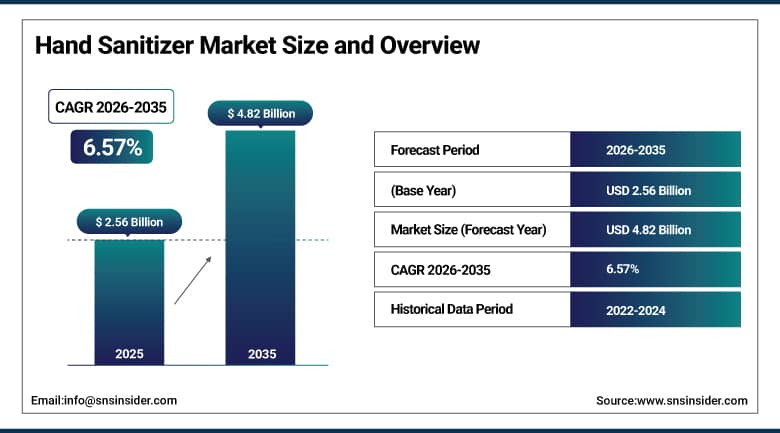
The Hand Sanitizer Market was valued at USD 2.56 billion in 2025 and is expected to reach USD 4.82 billion by 2035, growing at a CAGR of 6.57% from 2026–2035.
The hand sanitizer market is growing at a fast pace in the global market due to rising hygiene awareness and increasing health consciousness among consumers. Increased demand for personal hygiene products in public spaces, healthcare facilities, and workplaces is driving market expansion. The post-pandemic shift toward preventive healthcare practices has significantly strengthened product adoption. The growing preference for alcohol-based sanitizers, herbal formulations, and skin-friendly products is contributing to strong market growth. Expansion of retail distribution channels, including e-commerce platforms and pharmacies, is further accelerating product availability. Rising urbanization and changing lifestyles are increasing daily usage of sanitization products across all age groups.
Innovations such as new skin-compatible formulas, different fragrances, and convenient packaging increase market adoption rates by 15% to 25%. Hospitals and institutions together make up 25% to 30% of the market, whereas in the Asia Pacific region, the growth rate of the market stands at 7% to 8%, owing to increased hygiene consciousness. Growth through e-commerce is responsible for over 30% sales growth.
To Get More Information On Hand Sanitizer Market - Request Free Sample Report
Hand Sanitizer Market Trends
-
Increasing shift toward alcohol-based formulations is driving demand due to higher effectiveness against germs and viruses. This is strengthening usage across healthcare and public hygiene settings.
-
Growing preference for skin-friendly and moisturizing sanitizers is increasing adoption in daily personal care usage. This trend is improving consumer retention and product differentiation.
-
Rising demand for portable and travel-size packaging is boosting convenience-based consumption among urban users. This is expanding on-the-go hygiene adoption globally.
-
Expansion of e-commerce and quick-commerce platforms is increasing product accessibility and driving online sales growth. This is supporting faster market penetration.
-
Increasing institutional demand from hospitals and healthcare centers is strengthening bulk procurement patterns. This is ensuring consistent and large-scale consumption.
-
Growing focus on sustainable and natural ingredient-based sanitizers is driving eco-friendly product innovation. This is aligning with rising environmental awareness among consumers.
U.S. Hand Sanitizer Market Size Outlook.
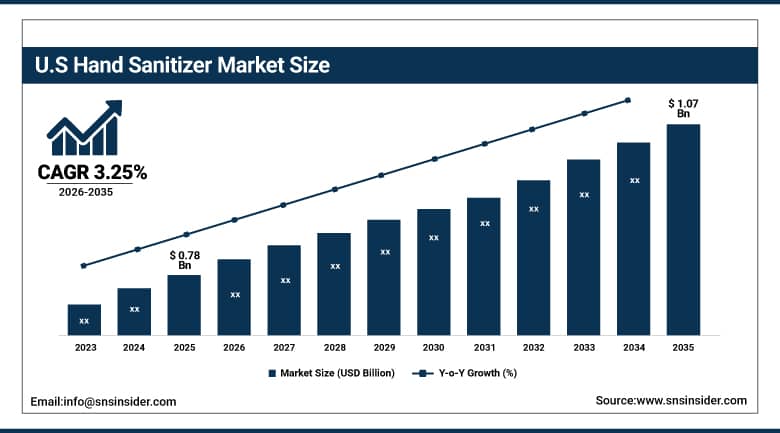
The U.S. Hand Sanitizer Market was valued at USD 0.78 billion in 2025 and is expected to reach around USD 1.07 billion by 2035, growing at a CAGR of 3.25% from 2026–2035.
The U.S. hand sanitizer market is growing steadily due to high hygiene awareness and strong adoption of personal care and hygiene maintenance products across daily life. Demand is strongly supported by widespread usage in households, healthcare institutions, corporate offices, educational centers, and public infrastructure. Increasing awareness regarding infection prevention, disease control, and workplace safety standards is further strengthening consistent product consumption. The presence of well-established healthcare systems and strict hygiene compliance regulations in medical facilities is also boosting long-term product demand across the country.
The U.S. hand sanitizer market is expanding owing to its popularity in AB types, which account for around 75%–80% of the total market share, owing to their effectiveness at eliminating bacteria and germs. The skin-safe variants are becoming popular among individuals for personal grooming. RPCs and supermarkets together account for ~55%–65% of the market, owing to their reliability. The ORC market occupies ~25%–28% of the market share.
Hand Sanitizer Market Segment Analysis
-
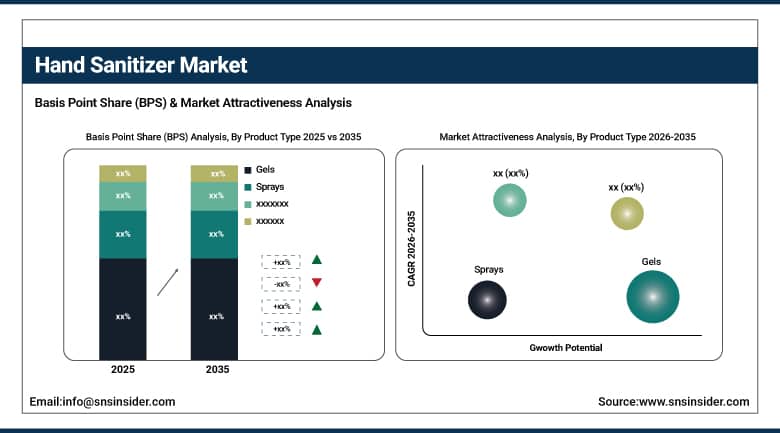
By Product Type, gels dominated the hand sanitizer market with 61.20% share in 2025; while sprays is the fastest growing segment with CAGR of 9.94% during 2026 to 2035.
-
By End-User, households dominated the hand sanitizer market with 63.25% share in 2025; while hospitals & healthcare centers is the fastest growing segment with CAGR of 8.10% during 2026 to 2035.
-
By Composition, alcohol based dominated the hand sanitizer market with 78.60% share in 2025; while alcohol-free is the fastest growing segment with CAGR of 10.05% during 2026 to 2035.
-
By Distribution Channel, supermarket/hypermarkets dominated the hand sanitizer market with 38.55% share in 2025; while online retail channels is the fastest growing segment with CAGR of 11.84% during 2026 to 2035.
-
2026: GOJO Industries expanded PURELL hand hygiene solutions across healthcare and commercial sectors, strengthening infection prevention programs and improving institutional sanitizer adoption through advanced dispensing systems and skin friendly formulations.
-
By Product Type, gels dominated the hand sanitizer market, while sprays is the fastest growing segment.
Gels segment holds the dominated market share as far as revenue generation is concerned in the hand sanitizer market in 2025. This high growth rate can be accredited to rising preference because of easy application, quick absorption, and effective germ protection. Gels have the advantage of being easily dispensable along with causing lesser wastage; therefore, it is a suitable product for household and commercial purposes like hospitals and other public areas. Easy availability and brand reliability further contribute to the supremacy of the gels segment in the market.
Sprays segment is expected to exhibit the fastest CAGR during the forecast period owing to increasing consumption of spray sanitizer due to its convenience. The spray sanitizer is easier to apply, provides quicker coverage, and is more user-friendly. Further growth will be driven by higher usage in commercial places and transport stations. Technological innovations in the field have enhanced user convenience.
By End-User, households dominated the hand sanitizer market, while hospitals & healthcare centers is the fastest growing segment.
Households Segment emerged as the dominated player in the Hand Sanitizer Market, accounting for the leading market share in 2025. The growth of this segment can be attributed to increased awareness regarding hygiene, regular usage of products, and increased use of personal care products in routine activities. Rising consciousness among people regarding protection against infections in the house environment, along with the availability of these products, both retail as well as online, propels the market.
The Hospitals & Healthcare Centers segment is anticipated to exhibit the fastest CAGR from 2026 to 2035. Such rapid growth is attributed to stringent infection control policies, rising patient admissions, and demand for hygiene products in hospitals. Increased usage of these sanitizers in operations, wards, and other emergency units of healthcare centers adds momentum to the growth rate.
By Composition, alcohol based dominated the hand sanitizer market, while alcohol-free is the fastest growing segment.
Alcohol Based segment led the hand sanitizer market in 2025 owing to its highly efficient antimicrobial properties. The product is often suggested by health bodies for fast killing of bacteria and viruses. High application in hospital and hygiene settings, along with public places, adds to the popularity of the segment. Due to its efficiency, quickness, cost-effectiveness, and easy availability, it is widely chosen for use around the world.
Alcohol Free segment is likely to have a faster CAGR during the forecast period from 2026 to 2035 due to the increasing cases of skin irritation. Demand for a gentler formulation is rising among consumers. Increasing usage among kids, elderly customers, and individuals with sensitive skin is adding impetus to the growth of this segment. Natural skincare solutions drive growth as well.
By Distribution Channel, supermarket/hypermarkets dominated the hand sanitizer market, while online retail channels is the fastest growing segment.
Supermarket/Hypermarkets segment held the dominant position in the hand sanitizer market on account of high levels of trust, wide availability, and convenient purchases. The high level of penetration in retail along with consistent customer traffic in these stores makes them highly dominant in the offline market for hand sanitizers. In addition to that, these stores provide products by multiple brands, offer price comparisons, and even have promotional discounts.
Online Retail Channels segment is anticipated to witness the fastest CAGR during the forecast period owing to growing trends in digitalization and the convenience of online shopping. Penetration of smartphones, e-commerce platforms, and quick commerce services has increased the availability of the product. People prefer buying these products through deliveries, subscriptions, and greater product variety online. Discounts, faster deliveries, and digital infrastructure have been contributing to this trend.
Regional Analysis:
|
Region |
Major Country |
Share within Region, 2025(%) |
|---|---|---|
|
North America |
United States |
82.45% |
|
Europe |
Germany |
23.65% |
|
Asia Pacific |
China |
34.20% |
|
Middle East & Africa |
UAE |
8.15% |
North America Hand Sanitizer Market Insights.
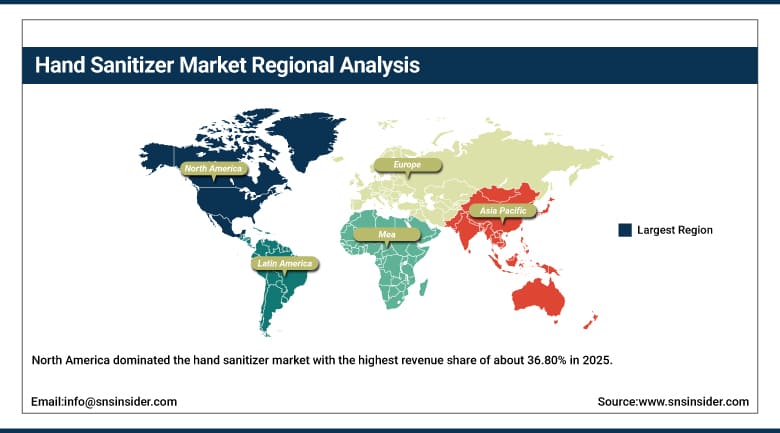
North America dominated the hand sanitizer market with the highest revenue share of about 36.80% in 2025 due to strong hygiene awareness and high consumption of personal care products. The region benefits from well developed healthcare infrastructure, strong retail penetration, and high demand across households, hospitals, and workplaces. Widespread availability of alcohol based sanitizers and strong brand presence further supports steady market expansion across the United States and Canada. Rising focus on infection prevention and public hygiene standards is accelerating product adoption across multiple end use sectors.
Based on the reports from the industrial sector, alcohol-based sanitizers account for almost 75%-80% of total sales as they have very strong bacteria killing properties. The increase in usage within hospitals and corporate environments is responsible for the growing demand for sanitizer products. E-commerce is contributing to almost 25%-30% of total sales because of factors such as ease of use, subscriptions, and quick deliveries.
Get Customized Report as Per Your Business Requirement - Enquiry Now
Europe Hand Sanitizer Market Insights.
Europe region happens to be one of the prominent players in the hand sanitizer market in the year 2025 due to strong regulations as well as stringent hygienic measures practiced in diverse fields. The countries that fall under the ambit include Germany, France, as well as UK. All the aforementioned nations have witnessed an increasing trend towards use of hand sanitizers for healthcare purpose, as well as household and commercial purposes. Safety regulations along with increased awareness about prevention from infections continue to fuel the growing demands. Increased network of retail pharmacies, hospital hygiene programs, as well as corporate hygiene initiatives have led to sustained demands across Europe region.
According to European health data, more than 60.35% of consumers regularly use hand sanitizers in daily hygiene practices. Demand is strongly supported by hospitals clinics and public facilities maintaining strict sanitation protocols. Growth in alcohol free and skin friendly formulations is also increasing product diversification. Rising e commerce adoption contributing nearly 24.80% of sales and sustainability focused packaging innovations are further contributing to steady market expansion across Europe.
Asia Pacific Hand Sanitizer Market Insights.
Asia Pacific holds a market share of about 10.47% in 2025 and is expected to grow at the fastest CAGR due to rising population and increasing hygiene awareness. Rapid urbanization expanding healthcare infrastructure and strong retail growth in China India Japan and Southeast Asia are driving product demand. Increasing government initiatives promoting public health and sanitation are further supporting adoption. Strong presence of local manufacturers is improving affordability and accessibility across the region.
According to reports, nearly 60.45% of consumers in Asia Pacific are adopting hygiene products regularly including hand sanitizers. Rising usage in hospitals schools and public transport systems is strengthening demand. Growth of e commerce platforms contributing around 31.20% of sales and quick commerce delivery services is improving product availability. Increasing penetration of alcohol based formulations and affordable packaging formats is further boosting consumption across developing economies in the region.
Middle East & Africa and Latin America Hand Sanitizer Market Insights.
Middle East & Africa and Latin America regions is expected to account for an increasing market share in 2025 due to urbanization and increased hygiene consciousness in these regions. Nations such as UAE, Saudi Arabia, South Africa, Brazil, and Mexico have shown significant increases in demand from the fields of healthcare, commercial establishments, retail sales, and institutions. The efforts being made by governments regarding their initiatives to improve hygiene through government programs for infection control, and better sanitation facilities are also contributing to market growth to some extent in these regions. Growth in the presence of global hygiene products producers and distribution channels will also contribute towards market growth.
As per the industry reports and hygiene norms, adoption of hand sanitizer products is increasing at a constant rate in cities, as per the consumer estimation exceeding 60% who use them in healthcare-related settings. Increase in HCFs, retail shops, and hygiene programs in workplaces has increased the constant demand for these products. Market penetration is also increasing due to the presence of international brand expansion and efficient distribution channels. Increased infection prevention awareness is aiding in its growth. EC contributes almost 25%–30% of total sales.
Market Dynamics:
Growth Drivers: Rising hygiene awareness and infection prevention practices driving strong global demand across consumer and institutional segments.
Growing awareness regarding hand hygiene at home, hospitals, and office environments is greatly driving product uptake. Changes in behavior due to the pandemic have led to regular use of sanitizers in everyday lives. Hospitals and public places are implementing stringent hygiene policies. This is causing increased demands for alcohol-based sanitizers. Growth in retail footprint along with rise in ecommerce activity is making the product more accessible. Persistent campaigns launched by governments and health agencies have contributed to sustained consumption growth.
Increasing hand hygiene consciousness at home, hospitals, HCFs, and workplaces is fuelling the rise in the sanitizer market. After pandemic practices, over 70% urban users have become frequent users of sanitizers. Strict hygiene rules in hospitals and other public places are adding fuel to the fire, increasing the sale of alcohol-based sanitizers (AB). Expansion of retail and e-commerce (EC) is ensuring ease of availability.
Restraints: Environmental concerns and product safety issues restricting long term sustainable market expansion.
Overuse of chemical sanitizers has raised some concerns owing to skin irritation and other health problems for consumers having sensitivities. Plastic sanitizers are causing waste problems for sustainability. Action by regulatory authorities against particular substances used in products and labeling techniques has increased significantly. Naturally alcohol-free alternatives have gained some popularity among consumers. Awareness regarding such sanitizers in rural areas is not much, causing improper utilization.
Opportunities: Growth in product innovation and formulation advancements creating new opportunities for market expansion globally.
The development of products that are safe for use on the skin as alcohol-based and alcohol-free formulations is gaining acceptance among more consumers. Products in the form of herbal organic or fragranced versions have been introduced. The growing trend towards travel-friendly packaging has resulted in more product consumption due to ease of usage. The increased R&D expenditure will improve both product safety and efficacy. Increasing consumer preferences will aid in the use of premium products.
The creation of alcohol-based and alcohol-free products is fueling the use of hand sanitizers. The herbal and organic segments have a share of around 20%-25% in premium usage. Research and Development spending in personal care is on the rise, with an annual growth rate of more than 5%. This would contribute to improving the effectiveness of the product. Convenience-driven sales of travel-friendly packs are helping, along with a growing trend toward premium usage among consumers.
Recent Developments
-
2026: Reckitt enhanced Dettol hygiene portfolio with stronger focus on sustainability and infection prevention solutions, improving global accessibility of hand sanitizers across emerging and developed markets.
-
2025: Procter & Gamble strengthened hygiene focused product innovation under personal care brands, supporting increased consumer awareness and adoption of sanitization practices across households and public environments.
-
2025: Unilever expanded Lifebuoy hygiene campaigns with greater emphasis on public health awareness and improved access to affordable sanitation solutions in developing regions.
-
2024: 3M advanced infection prevention and disinfection technologies, strengthening healthcare hygiene systems and improving antimicrobial effectiveness across global hospital environments.
Hand Sanitizer Market Key Players are:
-
GOJO Industries
-
Reckitt
-
Procter & Gamble
-
Unilever
-
Johnson & Johnson
-
3M
-
Ecolab
-
STERIS
-
Vi-Jon
-
Bath & Body Works
-
Medline Industries
-
Hartmann Group
-
Schülke & Mayr
-
Kutol Products Company
-
Saraya Co., Ltd.
-
GOJO Canada Inc.
-
Nice-Pak Products
-
Chattem Inc.
-
SC Johnson Professional
-
Deb Group
Hand Sanitizer Market Report Scope:
| Report Attributes | Details |
|---|---|
| Market Size in 2025 | USD 2.56 Billion |
| Market Size by 2035 | USD 4.82 Billion |
| CAGR | CAGR of 6.57% From 2026 to 2035 |
| Base Year | 2025 |
| Forecast Period | 2026-2035 |
| Historical Data | 2022-2024 |
| Report Scope & Coverage | Market Size, Segments Analysis, Competitive Landscape, Regional Analysis, DROC & SWOT Analysis, Forecast Outlook |
| Key Segments | • By Product Type (Gels, Liquids, Sprays) • By End-User (Households, Commercials/Institutions, Hospitals & Healthcare Centers) • By Composition (Alcohol Based, Alcohol-Free) • By Distribution Channel (Pharmacy Stores, Supermarket/Hypermarkets, Online Retail Channels, Others (Departmental Stores, Grocery Stores)) |
| Regional Analysis/Coverage | North America (US, Canada), Europe (Germany, UK, France, Italy, Spain, Russia, Poland, Rest of Europe), Asia Pacific (China, India, Japan, South Korea, Australia, ASEAN Countries, Rest of Asia Pacific), Middle East & Africa (UAE, Saudi Arabia, Qatar, South Africa, Rest of Middle East & Africa), Latin America (Brazil, Argentina, Mexico, Colombia, Rest of Latin America). |
| Company Profiles | GOJO Industries, Reckitt, Procter & Gamble, Unilever, Johnson & Johnson, 3M, Ecolab, STERIS, Vi-Jon, Bath & Body Works, Medline Industries, Hartmann Group, Schülke & Mayr, Kutol Products Company, Saraya Co., Ltd., GOJO Canada Inc., Nice-Pak Products, Chattem Inc., SC Johnson Professional, Deb Group |
Frequently Asked Questions
The hand sanitizer market is expected to grow at a CAGR of 6.57% from 2026 to 2035.
The hand sanitizer market was valued at USD 2.56 billion in 2025.
Rising hygiene awareness, increasing health consciousness, and growing demand for personal hygiene products in healthcare facilities, workplaces, and public spaces are driving market growth.
The Gels segment dominated the market in 2025 due to easy application, quick absorption, effective germ protection, and strong availability across retail and institutional channels.
North America dominated the market in 2025 due to strong hygiene awareness, high product consumption, advanced healthcare infrastructure, and strong retail penetration.
