
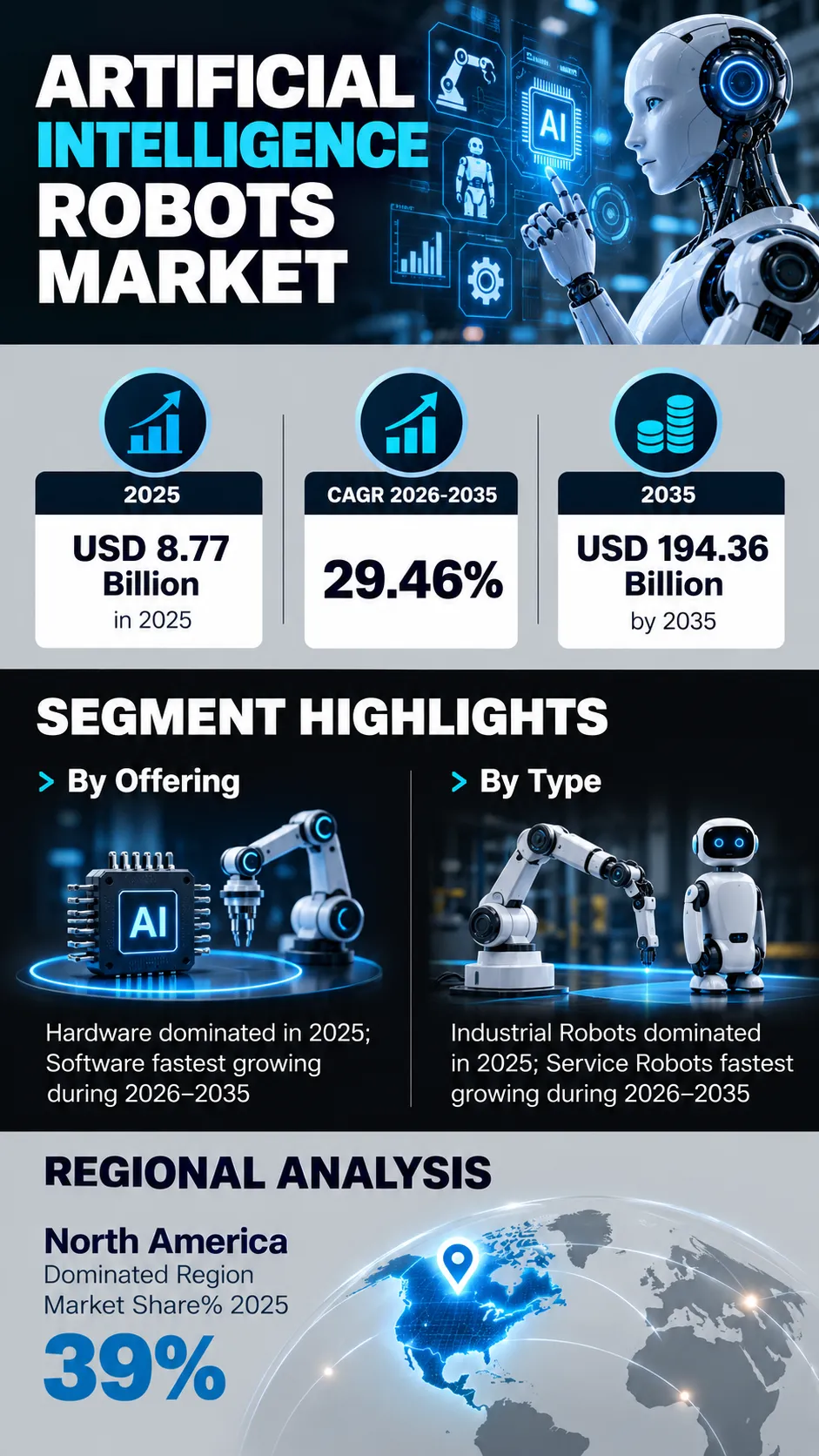
The global Artificial Intelligence Robots Market is entering a period of exceptional expansion as businesses increasingly turn to intelligent machines to address productivity pressures, workforce constraints, and the need for autonomous operations. According to a recent study by SNS Insider, the global Artificial Intelligence Robots Market size valued at USD 8.77 billion in 2025, is anticipated to grow to USD 194.36 billion by 2035, registering a CAGR of 29.46% over the 2026–2035 forecast period.
Fast development in machine learning, computer vision, edge computing, and intelligent control systems allows robots to carry out more sophisticated functions without significant human involvement. Companies, hospitals, logistics companies, retailers, and the military industry are intensifying their automation initiatives as they try to ensure accuracy, reliability, and robustness of their operations.
The transition to smart factories and smart workplaces is contributing positively to the emergence of AI robotics. Robots have graduated from monotonous manufacturing processes to places where perception, decision-making, navigation, and human interaction are needed.
To Get Detailed Insights on the Artificial Intelligence Robots Market – Request a Sample Report
Intelligent Automation Creates New Growth Opportunities
Investment in the development of Industry 4.0 infrastructure has turned out to be an important driver of the market. Companies are linking their robotic systems with digital manufacturing systems, sensors, analytics software, and cloud infrastructure in order to achieve more flexible business environments.
The use of service robots is another promising area of growth. Hospitals, warehouses, hotels, retail businesses, and homes are considering robotic solutions for the purposes of delivery, surveillance, assistance, cleaning, and other activities that could benefit from automation.
In addition to that, edge AI technology and cloud robotics enable companies to implement advanced robots and improve their data management capabilities. Increasing research in the area of collaborative and humanoid robots is forecasted to drive the market even further.
Key Market Insights Highlight Shifting Demand Patterns
By offering, hardware segment held the largest share of the market in 2025 due to the continued need for sensors, actuators, controllers, and computational modules in intelligent robots. The software segment is estimated to experience the fastest growth rate from 2026 to 2035 owing to advancements in AI algorithms and real-time decision-making capabilities.
Based on robot type, Industrial robots dominated the market in 2025 due to their dominance in automotive, electronic, and general manufacturing sectors. Service robots are expected to post the highest CAGR owing to automation in various sectors such as healthcare, hospitality, retail, logistics, and household applications.
By technology, machine learning was projected to hold the leading position in 2025 due to the significant role it plays in the ability of robots to learn from operational data. Computer vision will grow at the highest rate as a result of its wide range of applications including navigation, object identification, inspection, surveillance, and quality control.
In terms of application, military and defense was anticipated to account for the largest share in 2025, supported by investment in autonomous systems, surveillance platforms, and unmanned vehicles. Personal assistance and care is expected to experience the fastest growth as aging populations, healthcare automation, rehabilitation requirements, and home-based assistance increase demand for intelligent robotic solutions.
AI-Powered Robotics Expands Across Non-Industrial Environments
The scope of intelligent robots is widening as perception and navigation technology enable robots to work in more unstructured environments. Intelligent robots are being developed by healthcare providers for assisting and rehabilitating patients, and logistics companies for transporting materials and fulfilling orders.
Robots are also being evaluated by retailers and hospitality establishments for providing customer assistance services and handling other repetitive tasks. Agriculture and defense sectors are taking advantage of robots that can work in environments where constant human intervention might not always be feasible.
North America Captures 39% Market Revenue as Asia Pacific Accelerates at 31.8% CAGR
It is predicted that North America will continue to dominate as the largest regional market segment, contributing about 39% of the total global market share by 2025. The presence of heavy investment in artificial intelligence, well-established robotics expertise, highly advanced manufacturing facilities, and automation will fuel the regional dominance.
Asia Pacific is set to grow at the fastest pace among all regional markets, with a CAGR of 31.8% until 2035. Industrialization along with widespread deployment of robotics technology in countries like China, Japan, South Korea, and others will generate high demand for intelligent automation.
The European region is also experiencing steady growth as manufacturers prefer Industry 4.0 along with advanced production technology and sustainable automation. Latin America and Middle East & Africa are steadily growing with robotics, smart infrastructure, digitalization, and automated manufacturing systems.
Industry Participants Accelerate Robotics Innovation
The competitive landscape is evolving rapidly as technology companies and robotics specialists invest in AI platforms, autonomous machines, collaborative robots, and intelligent industrial systems. Strategic development is increasingly focused on combining advanced computing with perception, simulation, navigation, and machine learning capabilities.
Key companies operating in the global Artificial Intelligence Robots Market include NVIDIA Corporation, ABB Ltd, Intel Corporation, 1X, Google, IBM Corporation, Hanson Robotics, Boston Dynamics, Xilinx Inc., Fanuc Corporation, KUKA AG, Blue Frog Robotics, Promobot, Vicarious FPC, Inc., Neurala Inc., Veo Robotics Inc., and Miso Robotics Inc.
An SNS Insider analyst Sushant Kadam commented, “The convergence of artificial intelligence, advanced computing, and robotics is creating a fundamental shift from programmed automation toward adaptive machines capable of responding to changing environments. As labor constraints and productivity requirements intensify, companies that combine intelligent software with scalable robotic platforms will be positioned to capture substantial long-term opportunities.”About the Author

Get in touch




