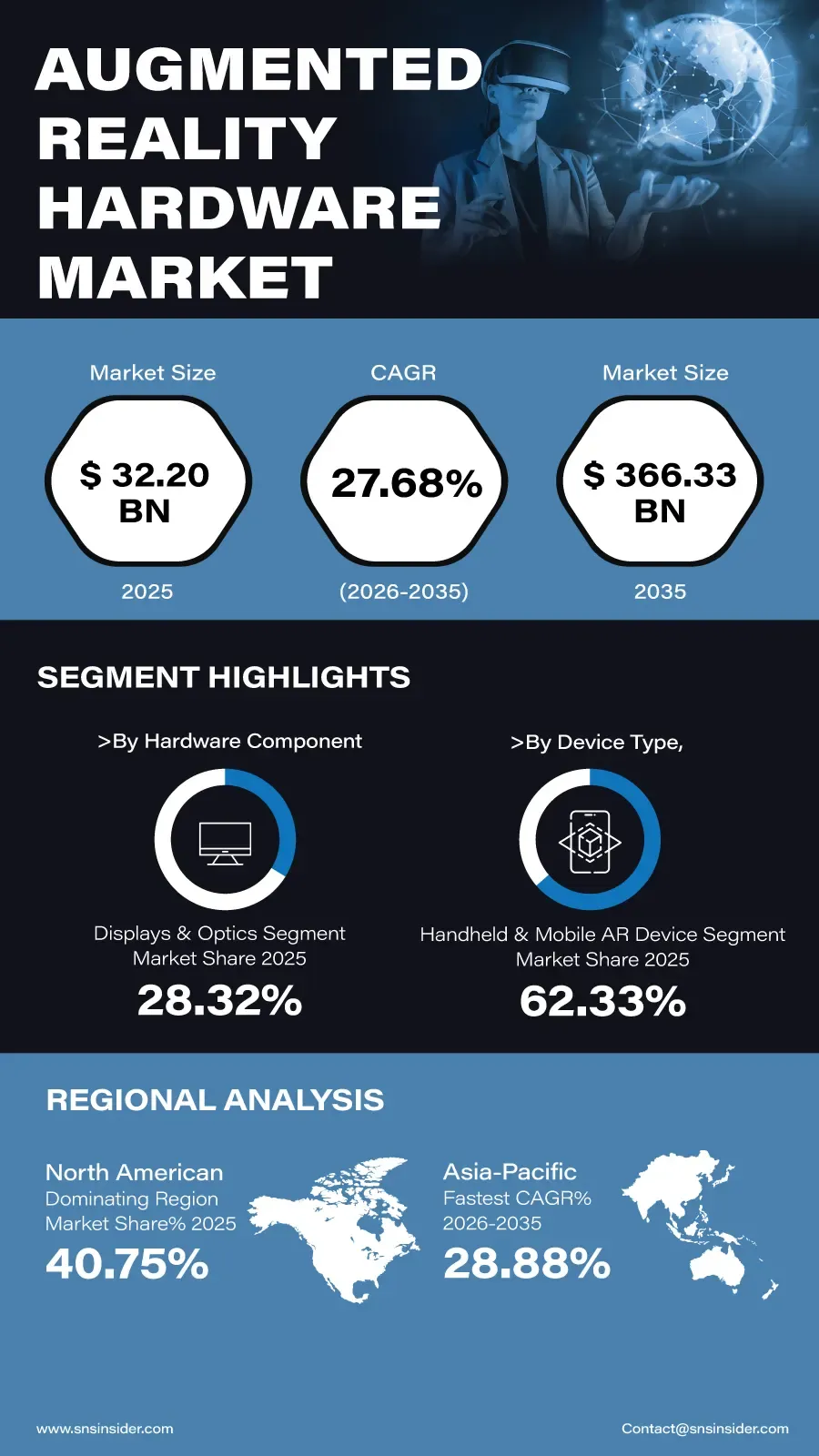
The global Augmented Reality Hardware Market is set to experience an incredible growth during the next decade as companies and individuals turn more towards immersive technologies to revolutionize digital engagement in different sectors. According to a recent study by SNS Insider, the global AR Hardware Market size valued at USD 32.20 billion in 2025, is anticipated to grow to USD 366.33 billion by 2035, registering a CAGR of 27.68% over the 2026–2035 forecast period.
With the rising investments in spatial computing, smart display technology, and optical technologies, there is an increased commercialization of next generation hardware for AR applications. Augmented Reality hardware is being integrated by companies in various industries ranging from manufacturing and healthcare to entertainment, automotive, and education for better productivity and enhanced visualization experience.
To Get Detailed Insights on the AR Hardware Market – Request a Free Sample Report
Additionally, the market is experiencing fast growth due to innovation in wearable electronic devices, smaller components, and AI-powered processors. With improved weight, better processing capabilities, and lower costs, the AR market is slowly making a move from enterprise-level implementations to consumer-level implementations.
Enterprise Digital Transformation Creates Significant Growth Opportunities
Many companies from different sectors use AR hardware to optimize processes, conduct better staff training, and collaborate remotely. Industrial companies are using AR-supported hardware to maintain equipment, assemble products, and perform quality control. At the same time, companies in the healthcare sector are increasingly using immersive technology to plan surgeries, educate students, and provide services to patients.
Integration of artificial intelligence, IoT networks, 5G networks, and edge computing is contributing to the advanced capabilities of devices with features such as real-time data processing, accurate spatial mapping, and smart object recognition. Such developments will help enterprises find more opportunities in the business world.
In addition, declining hardware costs and continuous improvements in battery efficiency, optics, and ergonomic design are expanding accessibility, encouraging wider adoption among businesses and consumers alike.
Key Market Insights Highlight Shifting Demand Patterns
Display and Optics segments will command 28.32% share of total market revenue in 2025 due to its importance for creating high immersive visuals in AR devices. Segments of sensors and cameras are expected to see the fastest growth during the forecast period on account of growing demand for motion-tracking capability, environmental mapping, and computer vision powered by AI.
Among various AR devices type, Handheld and Mobile AR devices will generate 62.33% of revenue in 2025 due to presence of AR enabled smartphones and tablets. Growth of smart glasses/AR glasses is expected to be fast due to adoption of hands-free wearables in industrial applications such as manufacturing, logistics, healthcare, and field services.
Sensors & Tracking Systems will account for 24.65% share of market revenue in 2025 as it helps in spatial awareness and interaction in augmented environment. Cameras and Vision Systems segments will show highest CAGR during forecast period due to development in image recognition, vision processing and environmental sensing.
Industrial and Manufacturing will have 31.58% market revenue share in 2025 as organizations use AR hardware technology for enhancing efficiency and productivity in operations and maintenance activities. Healthcare and Medical will emerge as the fastest growing end-use segment during the forecast period on account of adoption of AR assisted surgeries, diagnostics and patient engagement solutions.
An Infographic Representation of the Global AR Hardware Market
Intelligent Wearables Continue Transforming Immersive Computing
Today, manufacturers are trying to create compact, light, and smart AR devices that can provide users with the smooth experience in enterprise and consumer settings. The development of such technologies as micro OLED screens, holographic waveguides, gesture recognition by means of artificial intelligence, and spatial computing is making AR devices smarter and providing better comfort and energy efficiency.
Furthermore, the integration of wearable computing with cloud platforms, analytics, and collaborative services allows companies to implement AR solutions into increasingly complex business processes. As the technology of immersive computing becomes more accessible and scalable, the demand for hardware platforms will rise around the world.
Regional Markets Demonstrate Strong Growth Potential
The North American region is set to contribute 40.75% of the worldwide market revenues in 2025, owing to the presence of robust technology infrastructure, higher enterprise adoption rates, and sustained investments from top-notch hardware manufacturers. Adoption within healthcare, manufacturing, defense, and entertainment sectors has strengthened its market leadership position.
The Asia-Pacific region is forecasted to become the fastest growing regional market, growing at a CAGR of 28.88% up to 2035. Industrialization, production of consumer electronics, digitalization strategies, and investments in future technologies will propel market growth in China, Japan, South Korea, and India.
As governments and enterprises continue prioritizing digital innovation, augmented reality hardware adoption is expected to accelerate across both mature and emerging economies.
Industry Participants Focus on Product Innovation
The competitive landscape remains highly dynamic as technology companies continue investing in advanced optics, wearable computing platforms, AI-powered processing, and next-generation smart glasses. Product innovation, strategic partnerships, and ecosystem development remain central to strengthening long-term market competitiveness.
Key companies operating in the global AR Hardware Market include Meta, Apple, Microsoft, Google, Sony, Samsung Electronics, Qualcomm, Nvidia, Magic Leap, Lenovo, HTC, Huawei, LG Electronics, Panasonic, Epson, Vuzix, PTC, Niantic, Snap Inc., and Toshiba.
An SNS Insider analyst Sushant Kadam commented, “Rapid advances in spatial computing, AI integration, and wearable display technologies are reshaping how enterprises and consumers interact with digital content. Companies that prioritize lightweight designs, intelligent functionality, and seamless connectivity will be well positioned to capitalize on the expanding global demand for augmented reality hardware.”
About the Author

Get in touch