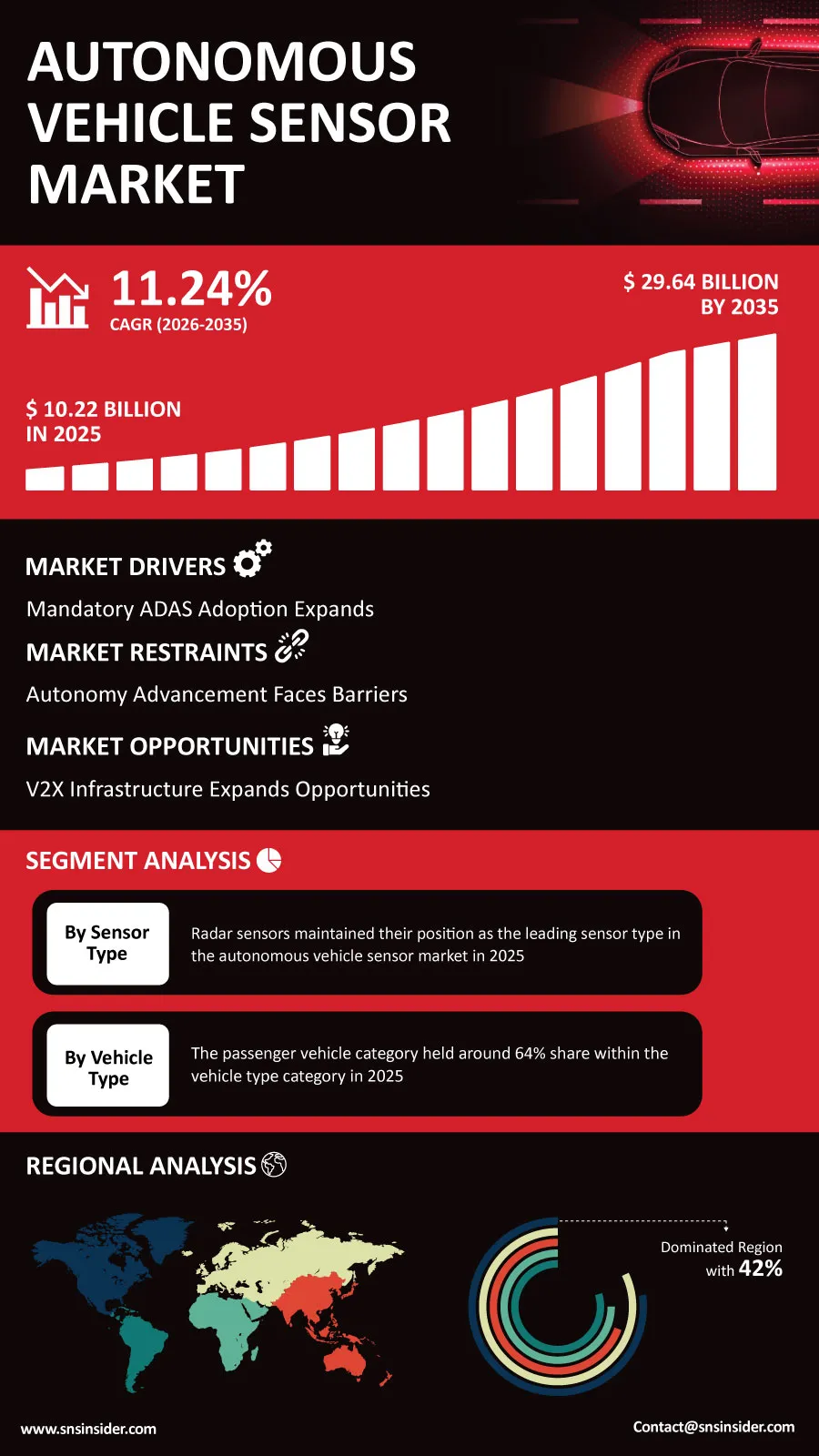
The global Autonomous Vehicle Sensor Market is experiencing robust growth as automakers accelerate the deployment of intelligent sensing technologies to enhance vehicle safety and support higher levels of driving automation. According to a recent study by SNS Insider, the global Autonomous Vehicle Sensor Market size valued at USD 10.22 billion in 2025, is anticipated to grow to USD 29.64 billion by 2035, registering a CAGR of 11.24% over the 2026–2035 forecast period.
Automotive manufacturers are largely investing into advanced perception systems that allow vehicles to identify, classify and react to the world around them. Increasing use of advanced driver-assistance systems in conjunction with regulatory demands for vehicle safety results in continuous need for sophisticated sensor technologies in both cars and commercial vehicles.
Fast developments in AI technology, semiconductor performance and software for sensors fusion also contribute to boosting reliability of autonomous driving systems. As these technologies advance, car manufacturers also roll out the integration of more sensors into the majority of their car models.
To Get Detailed Insights on the Autonomous Vehicle Sensor Market – Request a Sample Report
Advancements in Intelligent Mobility Create New Growth Opportunities
The evolution of the automotive sector towards connected, software-defined vehicles underscore the necessity for effective sensing systems that provide real-time information about the environment. Therefore, sensing technologies play a crucial role in enabling collision avoidance, adaptive driving functions, automated parking, and future driverless transportation services.
The increasing commercialization of robotaxi services, autonomous freight transport, and smart mobility projects creates further chances for sensor manufacturers. Ongoing development in solid-state LiDAR, advanced radar, AI cameras, and centralized computing systems allows for decreasing the complexity of systems and enhancing operational efficiency.
Government investments in intelligent transportation infrastructure and evolving regulatory frameworks supporting autonomous vehicle deployment are expected to further strengthen long-term market prospects.
Key Market Insights Highlight Shifting Demand Patterns
By sensor type, radar is expected to account for approximately 30% of global market revenue in 2025 due to its dependable performance across varying weather and lighting conditions. LiDAR is projected to be the fastest-growing sensor category through 2035 as declining hardware costs, compact solid-state designs, and improved detection capabilities encourage wider automotive adoption.
Based on vehicle type, passenger vehicles are anticipated to contribute 64% of market revenue in 2025, supported by growing integration of ADAS features across mass-market vehicle segments. Commercial vehicles are forecast to record the fastest growth during the assessment period as logistics providers and fleet operators invest in autonomous transportation technologies.
By level of autonomy, Level 1 systems are expected to represent 39% of market revenue in 2025, reflecting widespread deployment of entry-level driver assistance features. Level 4 and Level 5 autonomous systems are projected to witness the strongest growth through 2035 as commercial autonomous mobility programs expand globally.
Sensor Innovation Continues to Enhance Road Safety
Automotive technology companies are looking for ways to improve accuracy of sensors, processing speed and perception of the environment to handle more complex driving environments. The combination of high-resolution cameras, 4D imaging radar, LiDAR, ultrasonic sensors and AI-enabled sensor fusion will allow vehicles to make more informed driving decisions in varied operating conditions.
Automotive makers are also building edge-processing capabilities, which cut response times and reduce the computational load on the central vehicle systems. The innovations are expected to improve the safety performance and commercial viability of autonomous driving technologies.
North America Holds 42% Market Share in 2025 as Asia Pacific Emerges as the Fastest-Growing Region
North America is projected to account for nearly 42% share of global revenue in 2025, driven by strong activity in autonomous vehicle research, positive regulatory developments and significant investments from automotive manufacturers and technology companies. The U.S. remains the region’s leader in innovation, with extensive testing of autonomous vehicles and high-level ADAS deployment.
Asia Pacific is expected to be the fastest growing regional market owing to increasing investments in intelligent mobility, electric vehicles, and autonomous driving technologies by governments and automotive manufacturers. The region is becoming more competitive due to rising production capacity, positive policy initiatives and growing consumer demand for connected vehicles.
As countries continue advancing smart transportation ecosystems, demand for next-generation automotive sensing technologies is expected to rise steadily throughout the forecast period.
Industry Participants Accelerate Sensor Technology Innovation
Competition within the autonomous vehicle sensor market continues to intensify as companies invest in advanced perception technologies, AI-enabled processing platforms, and scalable automotive sensor architectures. Manufacturers are emphasizing higher reliability, enhanced object recognition, and cost-effective production to support the transition toward increasingly autonomous vehicle platforms.
Key companies operating in the global Autonomous Vehicle Sensor Market include Robert Bosch GmbH, Continental AG, Denso Corporation, Valeo SA, Aptiv PLC, ZF Friedrichshafen AG, Mobileye Global Inc., Velodyne Lidar Inc., Luminar Technologies Inc., Innoviz Technologies Ltd., NXP Semiconductors N.V., Texas Instruments Incorporated, STMicroelectronics N.V., Infineon Technologies AG, Hella GmbH & Co. KGaA (FORVIA HELLA), Hesai Technology Co. Ltd., Ouster Inc., Quanergy Systems Inc., Cepton Technologies Inc., and Veoneer Inc.
An SNS Insider analyst Sushant Kadam commented, “Advancements in sensor fusion, artificial intelligence, and automotive safety technologies are accelerating the evolution of autonomous mobility. Companies that continue improving perception accuracy, reliability, and scalable sensor integration will be well positioned to capitalize on the expanding global demand for intelligent transportation solutions.”
About the Author

Get in touch