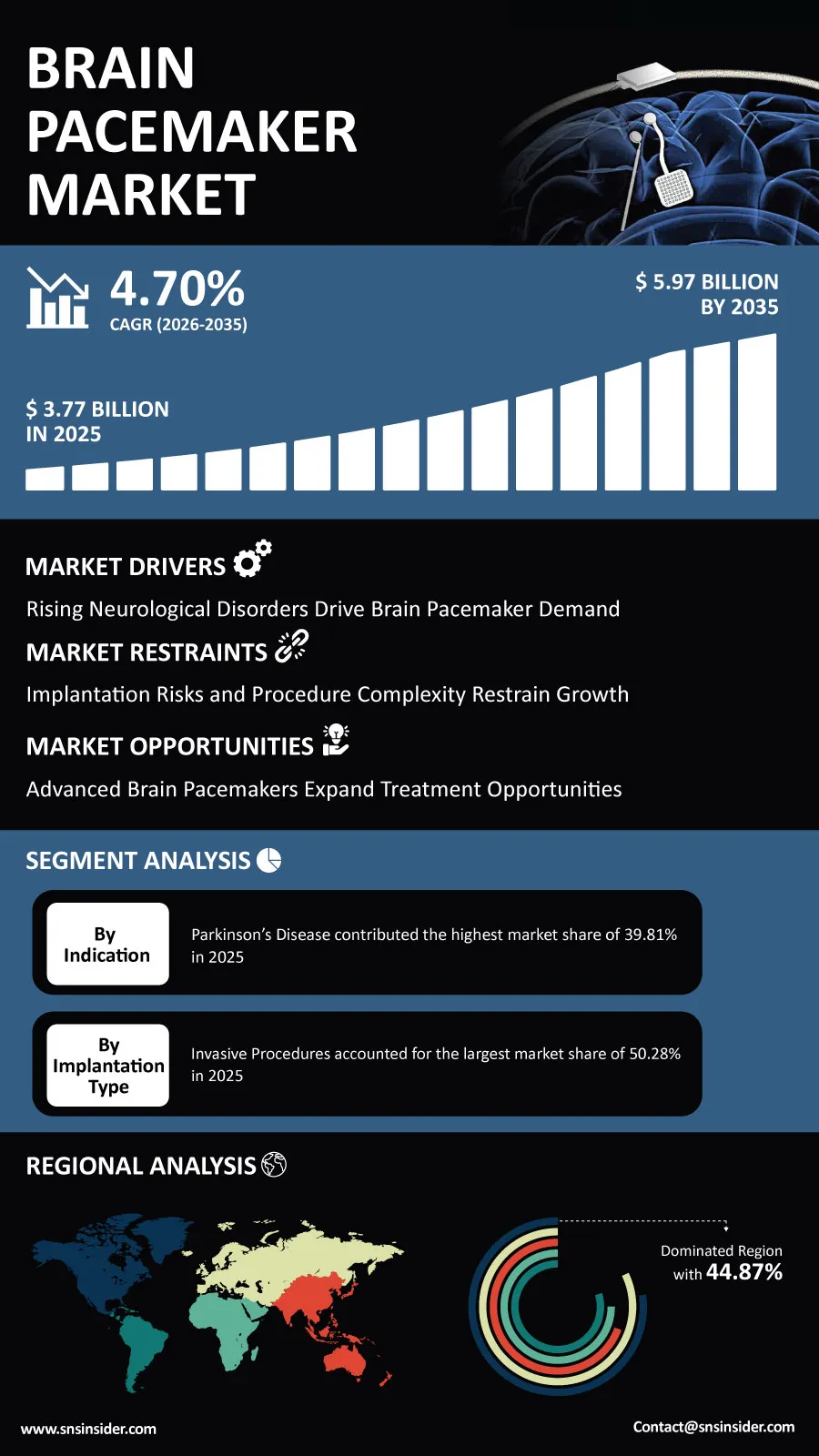
The global Brain Pacemaker Market is witnessing steady growth as healthcare systems increasingly adopt advanced neurostimulation technologies for managing complex neurological disorders. "According to a recent study by SNS Insider, the global Brain Pacemaker Market size valued at USD 3.77 Billion in 2025, is anticipated to grow to USD 5.97 Billion by 2035, registering a CAGR of 4.70% over the 2026–2035 forecast period." The market continues to benefit from expanding clinical acceptance of implantable neuromodulation therapies, improved surgical techniques, and growing investments in neuroscience research aimed at enhancing patient outcomes.
The demand for neurostimulators that work on the brain continues to grow due to the efforts of doctors in finding a cure for neurological disorders including Parkinson's disease, epilepsy, essential tremor, depression and other conditions. Technological advancements continue to make these treatments more efficient while promoting adoption in hospitals and outpatient centers.
To Get Detailed Insights on the Brain Pacemaker Market – Request a Sample Report
Advancements in Neurostimulation Expand Treatment Possibilities
Constant innovations in the realm of medical implants have been revolutionizing the way neurological diseases are being treated across the globe. Medical professionals are now becoming more inclined towards using highly advanced stimulation devices that offer customized treatment options for their patients according to their specific needs.
The increasing awareness levels about deep brain stimulation are also aiding in accelerating the growth of the industry. In the coming years, rising healthcare spending and neurology service availability will likely drive the demand.
Key Market Findings Highlight Technology Evolution
By power source, Rechargeable Systems dominated the market with a 59.26% revenue share in 2025, reflecting growing preference for long-lasting implant solutions. Wireless Power Transfer Systems are projected to record the fastest expansion, registering a 6.12% CAGR through 2035.
By device type, Dual-Channel Brain Pacemakers accounted for the largest market share of 34.72% in 2025, while Multi-Channel Brain Pacemakers are expected to expand at the highest 6.47% CAGR, supported by advances in precision neuromodulation.
Based on implantation type, Invasive Procedures represented 50.28% of market revenue during 2025. Meanwhile, Minimally Invasive Procedures are forecast to grow at a 5.53% CAGR as healthcare providers increasingly prioritize reduced surgical trauma and faster patient recovery.
By indication, Parkinson's Disease remained the leading application with 39.81% of total revenue in 2025, whereas Epilepsy is projected to be the fastest-growing indication at a 5.04% CAGR through the forecast period.
Among end users, Hospitals held the dominant market position with 44.63% revenue share during 2025, while Specialty Neurology Clinics are anticipated to register the fastest growth at a 5.79% CAGR.
Innovation Continues to Improve Clinical Outcomes
Manufacturers are emphasizing the creation of advanced neurostimulation devices that feature high flexibility in programming, improved battery capabilities, and customized treatment. The use of dual and multi-channel stimulators by doctors is helping to create effective treatment approaches for people suffering from movement disorders and neurological ailments.
Advances in technology are also contributing towards increased popularity of rechargeable implant devices that cut down the need for replacement surgeries and enhance the convenience of the patients. These factors, along with ongoing clinical trials and approvals, are building up trust in the implants among physicians.
Regional Markets Demonstrate Strong Growth Momentum
The North American region retained its dominant position as the major regional market, commanding 44.87% of the total revenue globally in 2025. Over 42,300 surgeries for brain pacemaker were performed in the region driven by the high standardization of neurology facilities and increased utilization of advanced neurostimulation devices. The US market witnessed a revenue of USD 1.38 Billion in 2025 and estimated to register USD 2.13 Billion by 2035, growing at a rate of 4.42% CAGR, with more than 33,000 surgeries done in 2025.
The Asia-Pacific region is estimated to lead as the fastest-growing regional market and is expected to expand at a CAGR of 6.14% up to 2035. In 2025, more than 12,800 brain pacemaker implants were performed in the region. The Japanese market contributed to the performance of more than 5,200 procedures in the same period.
The European region also experienced sustained growth by registering more than 17,100 brain pacemaker implants across Germany, France, and UK in 2025. The Germany market led in the region with approximately 6,300 implants. In addition, the Latin American market registered more than 4,350 implants, while the Middle East & Africa performed more than 2,750 procedures.
Leading Companies Accelerate Product Innovation
Competition remains focused on advancing precision neurostimulation technologies, expanding clinical indications, and strengthening global distribution networks. Major companies operating in the global Brain Pacemaker Market include Medtronic, Boston Scientific Corporation, Abbott Laboratories, Aleva Neurotherapeutics, NeuroPace, Inc., Renishaw plc, Beijing PINS Medical Co., Ltd., SceneRay Co., Ltd., LivaNova PLC, BrainsWay Ltd., Functional Neuromodulation Ltd., NeuroSigma, Synapse Biomedical Inc., Synteract, Alpha Omega Engineering Ltd., Newronika S.p.A., Soterix Medical, AlphaDBS Solutions (Deep Brain Innovations), Neuronetics, Inc., and Fisher Wallace Laboratories, Inc.
An SNS Insider analyst Parry Kardani commented, "Advancements in neurostimulation technology, combined with increasing clinical acceptance of personalized brain stimulation therapies, are creating sustained opportunities for innovation. Companies delivering safer implantation procedures, intelligent programming capabilities, and durable device performance are expected to remain at the forefront of the global brain pacemaker market."
About the Author

Get in touch