
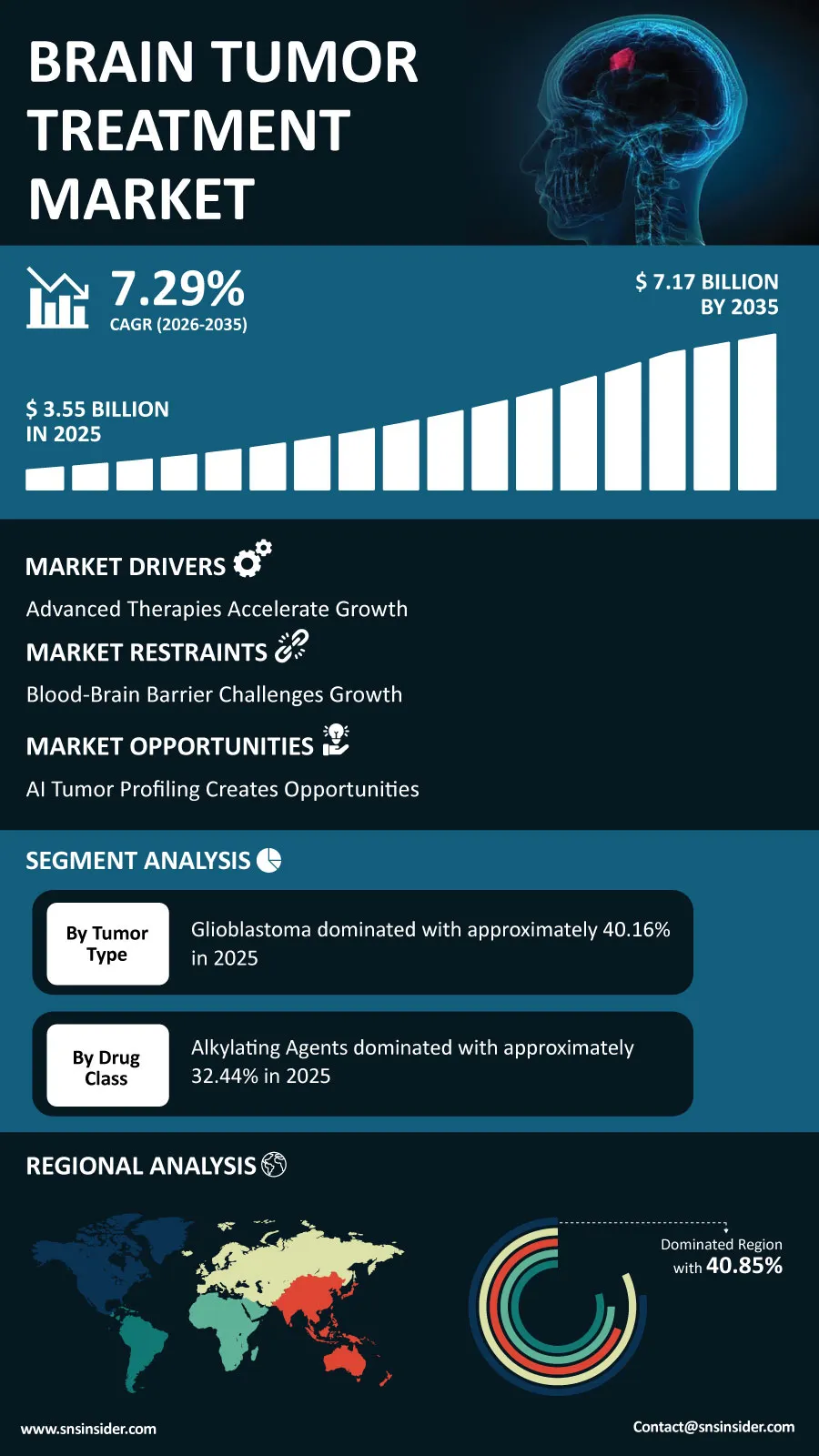
The global Brain Tumor Treatment Market is witnessing sustained growth as healthcare systems invest in advanced neuro-oncology therapies, precision diagnostics, and innovative treatment approaches for complex brain cancers. “According to a recent study by SNS Insider, the global Brain Tumor Treatment Market size valued at USD 3.55 billion in 2025, is anticipated to grow to USD 7.17 billion by 2035, registering a CAGR of 7.29% over the 2026–2035 forecast period.”
The growing incidence of primary and secondary brain cancers has been stimulating healthcare professionals, drug developers, and researchers to develop innovative approaches and methods to target these diseases through personalized treatment regimens. Ongoing innovations in imaging technology, molecular diagnosis, minimally invasive surgery, and patient-centered care have not only enhanced clinical outcomes but have also contributed to sustained market growth.
To Get Detailed Insights on the Brain Tumor Treatment Market – Request a Sample Report
Precision Oncology Reshapes Brain Tumor Care
The evolution of medicine in genomics is transforming the way that physicians diagnose and treat brain tumors. Treatment options today depend upon the use of molecular biomarkers to enable clinicians to determine which treatment options are most suitable for a particular patient. This is leading to better treatment selection, improved prognosis, and new avenues for targeted drug discovery.
In addition to this, innovations from the pharmaceutical sector are leading to the development of drugs intended for genetically specified tumors. Cooperation among biotech firms, academic institutions, and medical practitioners is helping in speeding up the process of clinical development.
Key Market Findings Highlight High-Growth Segments
Surgery remained the leading treatment category, accounting for approximately 35.42% of market revenue in 2025 due to its continued role as the primary intervention for many brain tumors. Immunotherapy is projected to record the fastest expansion, advancing at a CAGR of 9.54% through 2035 as immune-based treatment strategies gain clinical acceptance.
Among tumor types, glioblastoma represented the largest share at approximately 40.16% in 2025, reflecting its high treatment complexity and extensive care requirements. Pituitary tumors are expected to emerge as the fastest-growing segment with a CAGR of 8.24% during the forecast period.
Within drug classes, alkylating agents accounted for approximately 32.44% of total market revenue in 2025, while targeted therapy drugs are anticipated to experience the strongest growth, expanding at a CAGR of 9.11% as precision medicine adoption continues to rise.
Hospitals maintained leadership among end users with approximately 50.38% market share in 2025, supported by comprehensive neuro-oncology services. Specialty clinics are expected to register the fastest growth at a CAGR of 8.01%. Hospital pharmacies generated approximately 44.82% of distribution channel revenue, whereas online pharmacies are forecast to expand at a CAGR of 9.32% through 2035.
Innovation in Drug Delivery and Digital Technologies Accelerates Growth
Researchers are concentrating on addressing existing therapeutic problems related to treatment of brain tumors. New drug delivery systems that aim at enhancing therapeutic effect, along with advanced radiotherapy planning and artificial intelligence-supported imaging analysis, offer prospects for enhanced and efficient patient management.
Artificial intelligence is contributing to diagnosis through tumor segmentation and treatment planning. With increasing use of digital technology in neuro-oncology, one should expect improved operational performance from healthcare professionals combined with provision of more personalized services to patients.
Regional Markets Continue to Expand
The North American market made up for approximately 40.85% of the total market revenue in 2025, backed by robust clinical research facilities, excellent healthcare infrastructural developments, and extensive neuro-oncology centers. The United States made up for about 85.6% of the North American market revenues in 2025 and earned almost USD 1.45 billion. It is expected that by 2035, the revenue will be around USD 2.93 billion growing at a CAGR of 7.29%.
The Asia Pacific region is expected to be the fastest growing region, with CAGR of 8.72% until 2035, on account of rising investment in healthcare infrastructure, rising incidence of diagnosis and availability of advanced cancer treatment in the region. The contribution of China to the Asia Pacific revenue was around 41.4% in 2025.
Amongst European countries, Germany contributed to 26.8% of the regional revenue owing to the presence of advanced oncology centers and research activities in the region. In the Middle East & Africa region, the share of Saudi Arabia was around 28.7%.
Leading Companies Drive Innovation and Competition
The competitive landscape continues to evolve as pharmaceutical manufacturers, biotechnology companies, and medical technology developers expand research programs focused on targeted therapies, immunotherapy, precision diagnostics, and advanced treatment platforms. Strategic collaborations, regulatory approvals, and continued clinical investments are expected to strengthen innovation across the industry.
Major companies operating in the global Brain Tumor Treatment Market include Novartis AG, Roche Holding AG (Genentech), Pfizer Inc., Bristol Myers Squibb Company, AstraZeneca plc, Merck & Co. Inc. (MSD), Servier Pharmaceuticals, Novocure Ltd., Karyopharm Therapeutics Inc., Celldex Therapeutics Inc., Northwest Biotherapeutics Inc., DelMar Pharmaceuticals, Aivita Biomedical Inc., Cellenkos Inc., Imvax Inc., Istari Oncology Inc., Insightec Ltd., Carthera SAS, Champions Oncology Inc., and Tyme Technologies Inc.
An SNS Insider analyst Parry Kardani commented, "The future of brain tumor treatment will be defined by precision medicine, novel immunotherapy platforms, advanced drug delivery technologies, and AI-enabled clinical decision support. Organizations capable of combining scientific innovation with personalized care strategies will be well positioned to address the growing global demand for effective neuro-oncology therapies.
About the Author

Get in touch




