
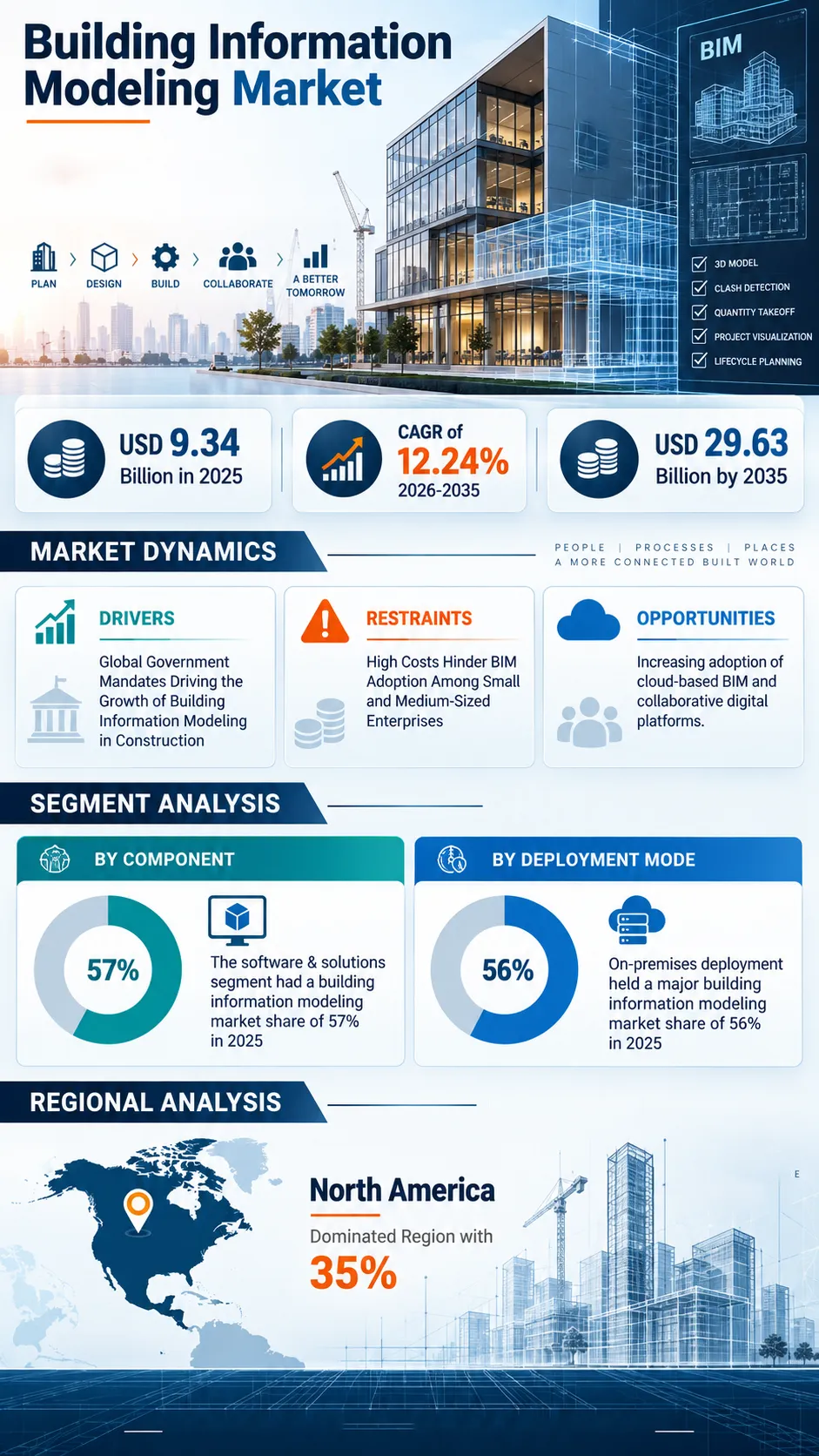
The global Building Information Modeling (BIM) Market is about to witness a phase of growth in the coming years owing to the rising inclination of construction participants toward digitalization for improved project management and planning. “According to a recent study by SNS Insider, the global Building Information Modeling (BIM) Market size valued at USD 9.34 billion in 2025, is anticipated to grow to USD 29.63 billion by 2035, registering a CAGR of 12.24% over the 2026–2035 forecast period.”
The adoption of BIM technology by architecture, engineering, and construction companies will enable the creation of better teamwork on projects in addition to gaining higher visibility into designs, scheduling, cost estimations, and construction. The transition to data-driven construction will further drive businesses to combine BIM technology with other digital technologies, including cloud computing, artificial intelligence, and IoT, among others.
Governments' construction projects will provide yet another impetus for market growth. The government's demand for BIM will prompt firms in the field to streamline digital processes, while standards, such as ISO 19650 will enable better information management in construction projects.
To Get Detailed Insights on the Building Information Modeling Market – Request a Sample Report
Digital Construction Adoption Creates New Growth Opportunities
The increase in the complexity of the infrastructures and buildings projects is generating demand for systems that can handle the coordination of large amounts of design and construction information. The use of BIM technology ensures that all parties can operate using a digital model that helps them identify any conflict early enough.
The shift to the use of cloud-based systems is another factor that is influencing the use of BIM systems. Cloud-based systems make it possible for parties working in different locations to access project information and ensure that there is only one source of data at different phases of the project.
BIM adoption is also expanding beyond design and construction into facility operations and asset management, creating opportunities for providers to deliver solutions covering a building's broader lifecycle.
Key Market Insights Highlight Shifting Demand Patterns
By component, the software and solutions category was forecasted to generate 57% of BIM market revenues globally in 2025 due to the increased adoption of digital tools used for modeling, visualization, coordination, and project management. Services segment is expected to be the fastest-growing segment during the forecast period due to the increasing demand from the construction industry for consultation on using BIM.
Based on deployment mode, on-premises solutions are projected to account for 56% of market revenues in 2025 due to the high demand for such solutions among companies that require full control over project data and IT infrastructures. Cloud deployment is projected to grow at the highest rate due to its scalability, and accessibility of information.
By project lifecycle, preconstruction segment was accounted for 43% of the market revenue in 2025 due to the importance of BIM during the visualizing, coordinating, scheduling, and cost estimation stages. Construction will be fast-growing through 2035 due to the use of digital models for coordination and real-time management of projects.
BIM Integration Strengthens Construction Workflow Efficiency
More construction firms are integrating BIM platforms with project management, scheduling, cost estimating, and field management systems. With such an approach, project information can be better used by teams from conception to construction and further operation of the facility.
The current trend of sustainable construction has increased the importance of BIM as well. With BIM digital models, energy performance analyses can be conducted and materials selected for the project. It helps project managers to consider sustainability at early stages of construction.
North America Leads BIM Market with 35% Share as Asia Pacific Grows at a 12.79% CAGR Through 2035
The North American region will hold the dominant position with 35% share of worldwide BIM market revenue in 2025. Construction activity, digital infrastructure development, government mandates, and investment in the development of smart cities and infrastructure projects have contributed to the growing adoption of BIM technology in the United States and Canada.
In terms of growth rate, the Asia Pacific region will emerge as the fastest growing region with a CAGR of 12.79%. Urbanization, infrastructure development, and digital construction initiatives by governments in countries, such as China, India, Japan, and others have boosted the adoption of BIM solutions.
The U.S. BIM market is anticipated to grow from around USD 3.90 billion in 2025 to USD 12.22 billion by 2035 at a CAGR of 12.1% during the forecast period. Growth has been fueled by infrastructure development, smart city initiatives, cloud-based construction technology, and AI/IoT-enabled systems.
Industry Participants Focus on Platform Expansion and Collaboration
The competitive landscape still continues as vendors improve their skills in modeling, cloud collaboration, interoperability, automation, and lifecycle management. The organizations are also starting to position the BIM solutions as part of larger digital construction ecosystem rather than as standalone design software.
Key companies operating in the global Building Information Modeling Market include Autodesk, Bentley Systems, Trimble, Nemetschek Group, Dassault Systèmes, Siemens, Hexagon AB, Graphisoft, AVEVA Group, ArchiCAD, RIB Software, Asite, Procore Technologies, Trimble Solutions Corporation, Acca Software, MagiCAD Group, Innovaya, Bluebeam, Inc., Vectorworks, Inc., and Synchro Software.
An SNS Insider analyst Sushant Kadam commented, “The shift toward connected and data-driven construction workflows is creating sustained demand for BIM platforms and associated services. As infrastructure programs become more complex and project stakeholders place greater emphasis on cost control, collaboration, sustainability, and lifecycle management, BIM adoption is expected to broaden across construction markets worldwide.”
About the Author

Get in touch




